The Impossibility of Interpersonal Utility Comparisons
By Vasco Grilo🔸 @ 2026-08-19T15:22 (+11)
This is a linkpost to https://www.jstor.org/stable/2254638
This is a linkpost for The Impossibility of Interpersonal Utility Comparisons by Daniel M. Hausman, which was originally published in Mind in 1995. It is freely available on Sci-Hub. Below is a summary from Claude Opus 4.8 High. Daniel said "I think the summary is accurate". I also believe the summary is accurate based on my read of the article. I used the following prompt. "Hi. Make an in-depth summary of the article "The Impossibility of Interpersonal Utility Comparisons", which I send attached".
The central thesis and argument structure
Hausman targets the preference-satisfaction theory of well-being — the view that a person's welfare consists in the extent to which their preferences are satisfied (where a preference is satisfied when the world is as the person prefers, independently of any accompanying feeling of satisfaction). His conclusion is that this theory must be rejected, because it cannot underwrite the interpersonal comparisons that moral theory requires.
The argument is a modus-tollens-style reductio [ad absurdum] in three premises [context]:
- If welfare is the satisfaction of (actual or rational) preferences, then interpersonal utility comparisons cannot be made in a morally acceptable way.
- If such comparisons cannot be made acceptably, then utilitarianism and virtually all other moral views are untenable.
- Therefore, either those moral views are untenable, or well-being is not the satisfaction of preferences.
The essay concentrates almost entirely on defending premise 1. Premise 2 rests on the thought that most moralities require comparing the good of different people for purposes of benevolence or justice. Throughout, Hausman insists on taking the slogan "utility just represents preference" literally: utility is nothing more than an index of location in an unchanging preference ranking, not a separate good that people possess in varying intensities. He assumes preferences are consistent (an ordering) and unchanging, since relaxing either only makes comparisons harder.
A key framing distinction: an interpersonal comparison here is a comparison of how well satisfied Ira's and Jill's preferences are, not of how well off Ira and Jill are as persons — not a comparison of their mental or physical states, but of the extent to which the world matches what each prefers.
Section 1 — Ordinal utility
On the standard ordinal conception, only the ordering of utility numbers carries information; differences and ratios are arbitrary. Hausman grants immediately that ordinal unit (difference) comparisons are impossible — but notes this has nothing to do with interpersonality, since utility differences are meaningless even intrapersonally. This already dissolves Nozick's "utility monster" and Ira's claim to greater "sensitivity": with only ordinal information, a global claim to always gain more utility is simply incoherent.
The harder case is ordinal level comparisons. Superficially, Jill is better off than Ira if her preferences are satisfied to a greater extent — i.e., if she sits higher in her ranking than he sits in his. But Hausman attacks the notion of comparable "location" in an ordinal ranking. There are no units of "distance" within an ordinal ordering. Attempts to give location content — e.g., counting alternatives above and below an option — fail: the individuation and counting of alternatives is arbitrary, and once lotteries are admitted there are infinitely many alternatives above and below any intermediate option. So there is no non-arbitrary fact about whether a position in one ranking is "higher" than a position in another.
He then adds a second, independent objection: even if such counting could be made to work, it would be morally irrelevant, because the count depends on incidental facts like what each person happens to be able to imagine. Either way, ordinal level comparisons of the intermediate positions are unavailable.
Section 2 — Extended sympathy fails to rescue
The main proposed rescue is Arrow's "judgments of extended sympathy": an extended utility function V over person-state pairs, so that Ira-with-x beats Jill-with-y iff [if and only if] V(Ira,x) > V(Jill,y). Hausman asks what fills the blank in "___ prefers Ira-with-x to Jill-with-y." No one's actual preferences will do: whether Ira is better off than Jill shouldn't depend on what bystanders happen to prefer; people may prefer to be Jill for reasons (nobility, etc.) unrelated to who is better off; and people who prefer Ira's state because they judge him better off cannot ground that judgment in the preference — the belief explains the preference, not vice versa.
On the standard reading, extended-sympathy judgments express "impersonal" preferences realized by imaginatively taking on Ira's, then Jill's, preferences and asking how well one's imagined preferences would be satisfied. This is supposed to be underwritten by psychological laws (V summarizing what causal factors produce which preferences, with Uⱼ(y) = V(rⱼ,y)). Hausman's objection: what one needs is not laws relating how preferences are acquired to causal factors — those we roughly have — but laws relating preference structures and world-states to some impersonal measure. There is no evidential basis for the latter. It can't come from a theory of mental states (welfare is supposed to be preference satisfaction, not feeling), nor from any substantive theory of the good (those have been set aside by assumption), nor from comparisons of well-being (which is exactly what's in question and would make the account circular), nor from actually expressed preferences (already ruled out). So extended sympathy provides no way to determine whose preferences are better satisfied.
Section 3 — Conclusion on ordinal levels
Within a purely ordinal index there are at most three comparable locations: bottom, top, and undifferentiated "intermediate." No evaluative commitment to fairness or equality can generate comparisons among intermediate locations. Robbins was therefore right to deny ordinal level comparability — but for the wrong reasons (not because of introspection problems or because such comparisons are value judgments; value judgments can be inconsistent and are of no help). Hausman notes that people do make interpersonal welfare comparisons in ordinary life, but takes this as no embarrassment: there's little reason to think those everyday comparisons are comparisons of preference satisfaction, and the very fact that eminent theorists can't hold consistently to the preference view is itself evidence for that.
Section 4 — Cardinal utility and the zero-one rule (the positive core)
The striking move: adding cardinal structure changes nothing unless the cardinal index is bounded. If unbounded, the "distance" above and below any option is infinite for both people, and comparison remains impossible. But if preferences can be represented by a bounded cardinal utility function, unique up to positive affine transformation [context], then Hausman contends there is exactly one right way to compare — the zero-one rule: normalize each person's scale so that the top of their preference ranking = 1 and the bottom = 0, then compare the resulting ratios
His central and most provocative claim is that taking the preference view literally commits you to the zero-one rule — and crucially, this argument does not rest on any fairness premise (unlike the rule's usual defenders). The reasoning: to say Jill's bottom might be "lower" than Ira's bottom is implicitly to smuggle in some notion of utility beyond "extent to which preferences are satisfied." If both are at the very bottom, neither's preferences are satisfied at all — there is simply nothing there to be more or less of. He reinforces this with a change argument: if Jill's preferences shifted to become identical to Ira's while leaving her non-comparative welfare untouched, a definition of comparative well-being denying top/bottom equality would have to say her welfare both did and didn't change — a contradiction. Hence people at the top (or bottom) of their rankings must be equally well off.
He carefully distinguishes his rule from two lookalikes: it is not assigning 0 and 1 to the best/worst feasible options in a decision problem, and it is not Gauthier-style "relative concessions" in bargaining. The relevant scale is the person's full ranking over everything they've conceived. He concedes an awkward consequence — those good at imagining bliss come out worse off, those good at imagining misery better off — but argues this is an objection to preference-satisfaction views (or to using actual preferences), not to his account of how to compare given that view.
Section 5 — Why the solution has been missed
His eleven-word diagnosis: because theorists haven't taken literally the view that utility represents preference. The zero-one rule is old (Isbell 1959), but it has always been presented and attacked as a fairness device. Hausman reviews four critics — Hammond, Sen, Rawls, Griffin — and turns each objection against the preference view rather than against his rule:
- Hammond objects that normalizing an "undemanding" person's scale to match a "greedy" person's over-rewards the greedy under a 90%-of-max distribution. Hausman agrees it's unfair — but says this shows one should abandon the preference view, not the rule.
- Sen attacks both the fairness and the plausibility of the rule (noting rival normalizations, e.g., setting the sum of utilities to 1, and the wish to accommodate people with lower "capacity for satisfaction"). Hausman replies that the sum-based alternative doesn't track extent of preference satisfaction at all, and that Sen's plausibility worry presupposes utility is more than a preference index.
- Rawls (expanding Sen) says the rule implies all individuals have "similar capacities for satisfaction" and that great social utility comes from teaching people simple, easily satisfied desires. Hausman charges this conflates preference-satisfaction with mental-state views — the giveaway phrase being "easily satisfied." That someone with modest desires ends up "better off" is an objection to the preference view itself.
- Griffin says the rule is "just false" — we don't all reach the same peaks and valleys. Hausman: to say your top preference leaves you "higher up" than my top preference is to invoke elevation, i.e., some notion beyond preference satisfaction. If utility is only a preference index and both are perfectly satisfied, they must be equally well off.
Section 6 — Implications
The argument can be read two ways: as a new technology for making comparisons, or as a reductio of the preference-satisfaction conception. For actual-preference views, one must read it as a reductio: comparison requires a bounded cardinal representation (which few people's preferences even approximate — many can't be represented ordinally), and even where it works, the Hammond/Sen/Rawls/Griffin intuitions show that people at the same ranking-location are not intuitively equally well off. Hausman argues the same conclusion follows, if less obviously, for informed/rational-preference views: because extravagant or extremely modest preferences may fail to be "rational," the rule won't automatically recommend cultivating modest wants, so the objections are partly answered — but the rule remains ethically implausible and ordinal comparisons remain impossible. He also rebuts the economist's fallback that preference satisfaction is merely an empirical proxy for welfare: preference satisfaction is too hard to measure to be a good proxy, and if welfare is something else, economists owe an account of what that something is.
Section 7 — Objections and replies
Five objections, each turned aside:
- Thermometer analogy (Sensat): chemists with uncalibrated thermometers normalizing freeze/boil points to 0–1 could say ethanol is "higher up its scale" than water, which sounds like an error since ethanol isn't hotter. Hausman: given their concept of "hotness" (relative location between freeze and boil), ethanol is hotter; the analogy shows one should develop a better concept, not that the zero-one rule misapplies the concept one has.
- Can indices be added/subtracted? (Elster): yes, sometimes sensibly — e.g., ranking environments by percent of genetically maximal height or lifespan achieved, then summing or averaging across populations to compare countries. So difference-comparison worries don't defeat the rule.
- Cross-category intensities (Broome): why say the most intense blue equals the most intense anger? Hausman: if "intensity" just means location in a cardinal ranking, the zero-one rule is right, and the two maxima are equally intense. What's odd is wanting to compare them at all — but he only claims to show how to compare if one wants to, not that one ought to.
- Utility reflects rather than determines welfare (Railton): the judgment that Jill is higher in her ranking follows from her being better off, not the reverse. Hausman agrees about the direction of determination for a single person's own case, but points out that when comparing Jill-with-y and Ira-with-x, the rankings are already given; the interpersonal comparison doesn't constitute them, so we still lack a basis for the cross-person judgment.
- Straw man — real comparisons use empathy, not preference-extent. Hausman: correct as description, but this supports his thesis, since it shows practitioners don't actually hold consistently to the preference notion they claim to endorse.
Section 8 — Conclusion
Two disturbing results: interpersonal comparisons of ordinal utilities are largely impossible, and for bounded cardinal utilities the zero-one rule is the uniquely correct method — yet it conflicts with our intuitive comparisons. Since interpersonal comparison is ineliminable in human life, and since the serious problems with "equally well off iff equally satisfied" give strong reason not to identify welfare with preference satisfaction, anyone assessing preference utilitarianism, refining benevolence, or understanding prudence must first be clear about what taking well-being to be preference satisfaction actually involves.
David Mathers🔸 @ 2026-08-20T09:36 (+4)
I like the zero-one rule idea, but the last time I pushed it on here someone pointed out it might run into trouble with two people who have different trade offs between their worst possible and best possible experiences. I.e. if you would take a 51/49 chance of best v worst possible experience, but someone else will only take the deal when the ratio is 80/20, applying the normalization idea possibly breaks. I don't have the mathematical sophistication to work out if this is right, but I suspect you do.
Vasco Grilo🔸 @ 2026-08-20T17:55 (+2)
Hi David. I do not understand in which sense that would break the zero-one rule. The denominator of the normalised degree of preference satisfaction would be smaller for the person who is closer to indifferent between the best and worst possible experiences. However, for the purpose of comparing the degree of preference satisfaction across people, one person going from the worst to the best possible experience for them would be as good as the other person going from the worst to the best possible experience for them.
I do not like the zero-one rule. I understand it implies one bacterium going from their worst to best state would be as good as one human going from their worst to best state. I find this very counterintuitive.
David Mathers🔸 @ 2026-08-21T12:28 (+4)
On the first point, maybe I'm wrong then.
On the second, only if bacteria have preferences in a morally relevant sense. But yes, it probably does imply that animals and humans get the same moral weight if combined with strict preference utilitarianism. But it's hard to see how else interpersonal utility comparison could be made-in my view, this is true of hedonistic utility comparisons too actually, although that's more controversial-so maybe the problem here is utilitarianism, not the rule.
Vasco Grilo🔸 @ 2026-08-21T13:18 (+2)
I think any sharp falsifiable operationalisation of "morally relevant" will be arbitrary. So I would assume all organisms have morally relevant preferences of varying strengths.
David Mathers🔸 @ 2026-08-21T13:22 (+4)
It doesn't usually follow from a lack of sharp cut-off that something applies to everything. "Tall" lacks a sharp cut-off, but a 5 ft 1 inch tall man is not a little bit tall, he's just not tall. I also doubt you can get rid of arbitrariness here, because if you zoom in far enough the line between organism and not will probably itself get blurry, at least for some possible organism-ish things that could exist or around the moment of death etc.
Vasco Grilo🔸 @ 2026-08-21T13:38 (+2)
The way I see it, the probability of someone being considered tall increases with height, and it is never exactly 0 or 1. In that sense, it applies to everyone to some extent. Likewise, I think "morally relevant" applies to all systems, organisms or not, if it means having a moral value above exactly 0.
David Mathers🔸 @ 2026-08-21T14:09 (+4)
Why think this though? What's wrong with the view that it's just false that a 5ft 1 man is tall?
Vasco Grilo🔸 @ 2026-08-21T14:58 (+2)
I was not clear. I think that view is right for the vast majority of current definitions of being tall.
The point I wanted to make is that, given 2 systems which only differ infinitesimally, it should not be the case that one has a moral value of exactly 0, and another has a moral value above exactly 0. Granting this, all systems have a moral value above exactly 0 if one can go from any system to another via a series of infinitesimal changes.
David Mathers🔸 @ 2026-08-21T15:16 (+4)
What does the phrase "current definitions of being tall" pick out exactly?
"The point I wanted to make is that, given 2 systems which only differ infinitesimally, it should not be the case that one has a moral value of exactly 0, and another has a moral value above exactly 0."
This is the famous claim that vague predicates shouldn't have sharp cut-offs. It's been analyzed to death in philosophy, because it generates paradox, but I don't know of any way of rejecting it that implies that when you have a continuous underlying thing, and a concept that is vague, the concept must apply at least a little bit to every thing on the continuum. And indeed, as I said, I think moving from "this way of distinguishing things from moral status from things without them would lead to an arbitrary cut where things go from zero to one" to "we should reject it", will swiftly get you the view that everything or nothing has moral status if your not careful, because whatever apparently binary on/off thing, like being an organism that gets you onto the continuum that "moral status" is meant to apply to, will turn out itself to look more like something that comes in degrees when you zoom in.
Vasco Grilo🔸 @ 2026-08-21T16:52 (+2)
What's wrong with the view that it's just false that a 5ft 1 man is tall?
Only mathematical propositions can be true or false? I do not think a statement like "Vasco is tall" is true or false, although one can still analyse it. For example, for some available answers (like "agree", "disagree", and "I do not know"), one can investigate which fraction of people in a given population pick each answer.
given 2 systems which only differ infinitesimally, it should not be the case that one has a moral value of exactly 0, and another has a moral value above exactly 0
You disagree?
I think moving from "this way of distinguishing things from moral status from things without them would lead to an arbitrary cut where things go from zero to one" to "we should reject it", will swiftly get you the view that everything or nothing has moral status if your not careful, because whatever apparently binary on/off thing, like being an organism that gets you onto the continuum that "moral status" is meant to apply to, will turn out itself to look more like something that comes in degrees when you zoom in.
I would say everything has moral value above exactly 0. Do you see any problems with this? It could still be the case than many organisms have a moral value of practically 0 (in the sense that rounding their moral value down to 0 would practically not change any decisions).
David Mathers🔸 @ 2026-08-21T17:35 (+4)
"I do not think a statement like "Vasco is tall" is true or false"
Why not?
"given 2 systems which only differ infinitesimally, it should not be the case that one has a moral value of exactly 0, and another has a moral value above exactly 0
You disagree?"
I think it's unclear exactly what the right thing to say here is, because the sorites paradox is hard to resolve, but yes, probably I disagree. This is the specific to "has moral value" version of the second premise in the standard way of running the sorites paradox. The standard way of running the sorites, with the toy example of "heap" is:
A. 1 grain of sand is not a heap of sand.
B: For any number n, if n grains don't make a heap, then n+1 grains don't make a heap.
Conclusion, 1 million grains of sand don't make a heap.
It's unclear exactly what the "moral value" version is, unless we pin down what having moral value varies with, but if we say it varies with whether something is a living organism, we can run a version that goes something like:
D) At time t, where t is a time where it's dead, Bob the horse does not have moral value.
E) If Bob lacks more value at time t, he also lacks moral value at time t minus 1 planck time.
Conclusion: Bob the horse never had moral value.
In the case of the original argument with grains of and, A is absolutely definitely correct, and we definitely want to reject the conclusion, so we have to reject either B or the validity of the argument from A and B to the conclusion. But going from A and B to the conclusion is just modus ponens, and also looks like mathematical proof by induction. So it seems like we have to reject B. Famously rejecting B at least seems to commit you to there being "sharp cut-offs", for example, an exact number of grains that make a heap, an exact answer about where the boundaries of Mount Everest are etc. This is very counter-intuitive, but since B is false, either the "no sharp cut-offs" intuition must just be wrong, or there must be a way of making it compatible with rejecting generalisations like B after all.
"given 2 systems which only differ infinitesimally, it should not be the case that one has a moral value of exactly 0, and another has a moral value above exactly 0" looks like exactly the sort of no sharp cut-offs-adjacent generalisation that thinking about the sorites shows must be wrong somehow.
Vasco Grilo🔸 @ 2026-08-22T10:12 (+2)
I do not think a statement like "Vasco is tall" is true or false
I meant logically/mathematically true or false, which is a property of logical/mathematical statements, not sentences in natural language.
The standard way of running the sorites, with the toy example of "heap" is:
A. 1 grain of sand is not a heap of sand.
B: For any number n, if n grains don't make a heap, then n+1 grains don't make a heap.
Conclusion, 1 million grains of sand don't make a heap.
Here is how I would think about this. The statement "N grains of sand make up a heap of sand" is not logically true or false (regardless of the value of N). However, N grains of sand are more likely to be described by people as a heap of sand as N increases if N is positive, and not super large (for a sufficiently large N, the grains would collapse into a solid body which is not well described as a heap of sand). It is super unlikely for people to describe 1 grain of sand as one heap of sand. It is much more likely people would do so for 1 M grains of sand.
I would prefer people to investigate the falsifiable/physical properties of N grains of sand (like mass) instead of whether they are fundamentally a heap of sand or not. I think there is a fact of the matter about the former, but not the latter. Likewise, I would prefer people to investigate the falsifiable/physical properties of systems which may be relevant to assess their moral value (including all the behavioural, physiological, neural, pharmacological, cognitive, evolutionary, and ecological evidence) instead of whether they are fundamentally morally relevant or not.
David Mathers🔸 @ 2026-08-23T11:58 (+4)
Let me put my argument another way, without mention of truth, since I think getting into theories of truth is kind of overcomplicating things.
You want to use some kind of no sharp cut-offs claim to do work for you, in ruling out certain moral theories. But very normal reasoning from no sharp cut-off claims like your "give 2 systems" etc, plus claims we definitely want to accept like "0 grains is not a heap" or "a non-conscious non-living, mindless object isn't a moral patient" leads to conclusions we definitely don't want to accept. This is fairly strong evidence we shouldn't use no sharp cut-off claims to draw substantive conclusions (or at least not unless we can distinguish the way were using them from the bad way of using them that leads to drawing absurd conclusions.)
Which part(s) of this do you think are wrong?
Vasco Grilo🔸 @ 2026-08-23T12:22 (+2)
claims we definitely want to accept like "0 grains is not a heap" or "a non-conscious non-living, mindless object isn't a moral patient"
I think 0 grains of sand could be a heap of sand under some definitions of being a heap of sand, and I also believe non-conscious non-living mindless objects could have moral value (and therefore be moral patients) under some definitions of consciousness, life, mind, and objects. For example, I think standard laptops could reasonably be described as non-conscious non-living mindless objects, but I would not assign them a moral value of exactly 0.
David Mathers🔸 @ 2026-08-23T14:52 (+4)
If I try to do the sorites reasoning from say, a 5 ft man isn't tall and "if a n foot man isn't tall, the neither is an n ft + 0.0000000000000000001 man" to a 7 ft man is not tall" where does this go wrong in your view"?
Vasco Grilo🔸 @ 2026-08-23T15:17 (+2)
I would think about it as I do about grains of sand. The statement "a N ft man is tall" is not logically true or false (regardless of the value of N). However, a taller man is more likely to be described as tall. It is very unlikely a man A is described as tall if they have an height of 5 ft (1.5 m). A man B who is 10^-10 ft taller will be a super tiny bit more likely to be described as tall than man A. However, in practice, one can assume A and B to be as tall. I am not seeing which decisions would be influenced by rounding a height difference of 10^-10 ft to exactly 0.
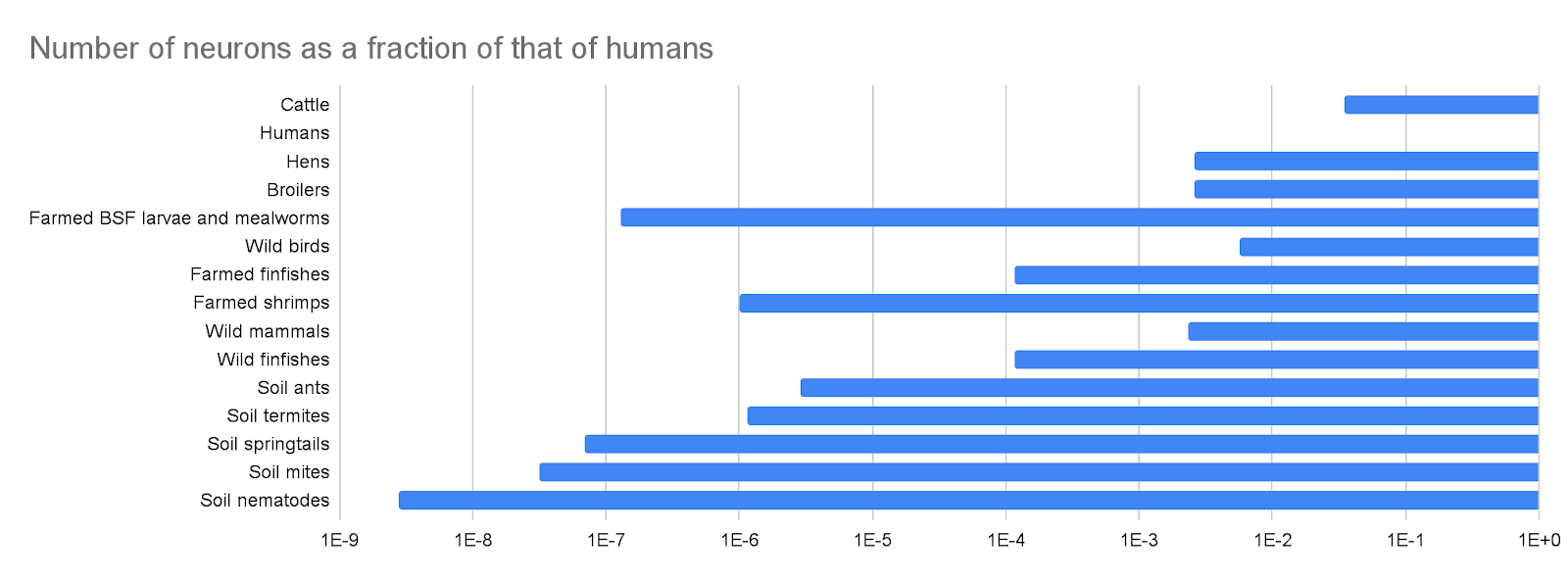
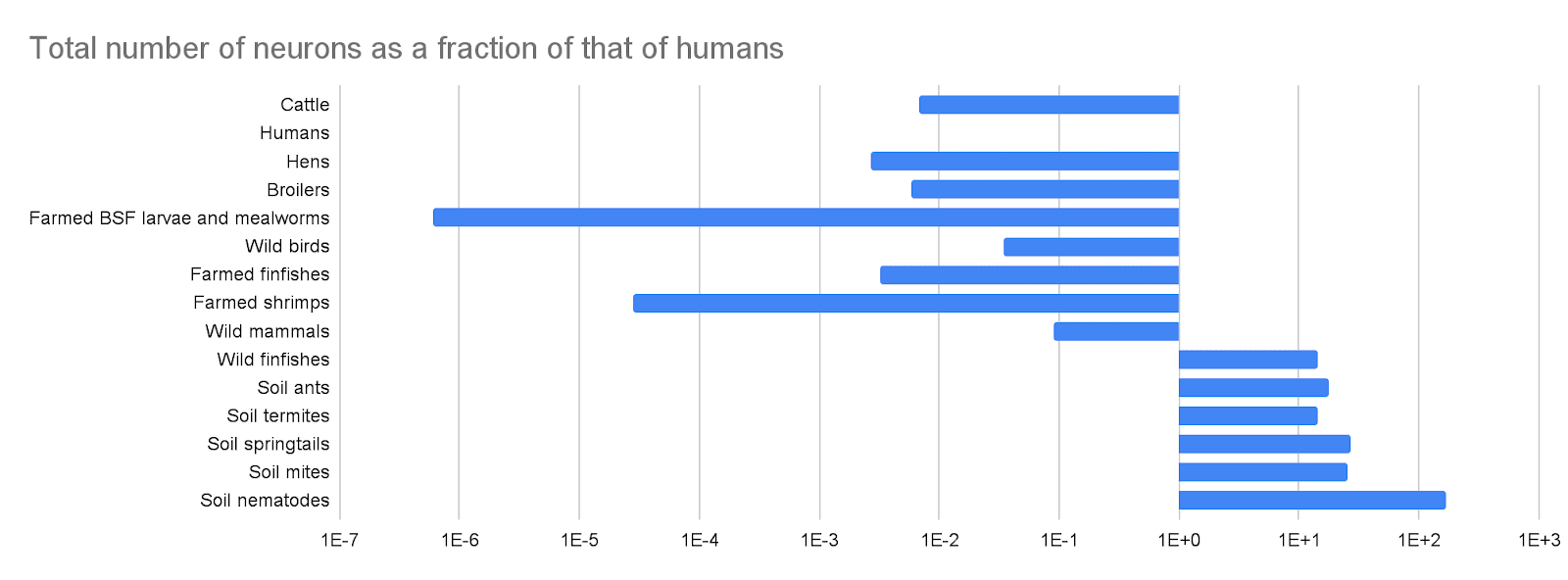
In contrast, rounding to exactly 0 a super small moral weight could have significant implications. Moral weight might be roughly proportional to the individual number of neurons (or, more plausibly, proportional to "individual number of neurons"^"exponent"), and soil invertebrates have way fewer neurons per individual than humans, but more neurons in total.
David Mathers🔸 @ 2026-08-21T15:18 (+2)
https://plato.stanford.edu/entries/sorites-paradox/ This is worth reading on what philosophers have said about "no sharp cut-off" principles like "given 2 systems which only differ infinitesimally, it should not be the case that one has a moral value of exactly 0, and another has a moral value above exactly 0"
David Mathers🔸 @ 2026-08-21T14:10 (+2)
Also death is a process, with a blurry line, that I will eventually undergo, but I'm not a little tiny bit dead if I have an incurable cancer but am currently fit and active.