Digging In Your Heels
By Vasco Grilo🔸 @ 2026-03-08T10:31 (+19)
This is a linkpost to https://homosabiens.substack.com/p/digging-in-your-heels
This is a crosspost for Digging In Your Heels by Duncan Sabien, which was originally published on Homo Sabiens on 27 March 2024.

I think the phenomenon of people “digging in their heels” is poorly understood, and I think there’s an extremely easy fix that would save a lot of people a lot of headache.
The situation:
Person A needs to do X, for some reason or another. X is unpleasant, or aversive. Perhaps Person A has wronged someone, and needs to apologize (or perhaps a calculated apology would smooth things over in a tricky personal or political situation). Perhaps they’ve procrastinated, and they need to buckle down. Perhaps they’re trying to achieve some larger goal, and there’s a difficult or distasteful step they need to take, along the way.
X is usually pretty obvious. It’s often quite clear what needs to be done—which actions will improve the situation.
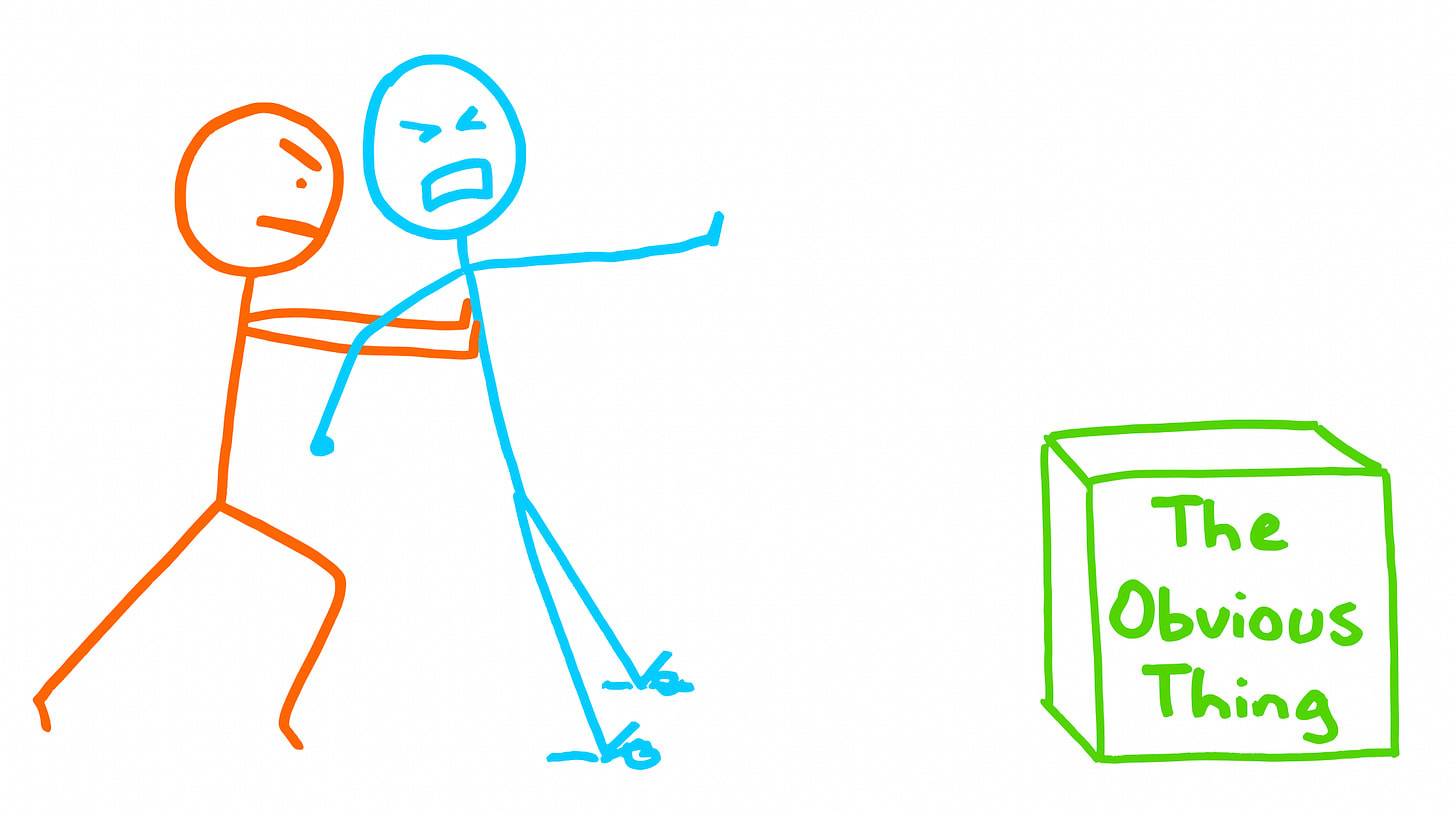
However, for whatever reason, Person A hesitated a bit. They didn’t immediately do X. And now Person B, looking in from the outside, begins adding pressure in the direction of X. As a result, Person A digs in their heels.
A few examples from my own experience:
- I write an essay prominently featuring the children’s game “punch bug,” as a metaphor. Someone shows up in the comments extremely stridently objecting to the idea of being punched, and insisting that I immediately and publicly commit to never punching them. I, having never had any intention of punching this person, am curiously reluctant to type the words “of course.”
- A member of my extended community does some rather awful stuff with some of his romantic partners, and is essentially exiled. A few months later, another community member is aghast at how many people have not blocked the exile, on Facebook. They make an argument that seems to me to boil down to “if you do not block this person, you are Bad.” I’m already not really interacting with the exile very often anymore, but I very much do not want to block the exile now.
- I use the term “transgenderism” in an essay on LessWrong. A not-established user replies with “Some copy-editing notes:” and says that the word is incorrect and instructs me to replace it. I notice reluctance, and anger.
Other instances that people have told me about:
- “I knew I’d screwed up and should apologize, but as soon as they started insisting that I apologize, my brain switched to ‘well, fuck you, then’ mode.”
- “He said it felt to him like I was ‘defecting,’ and clearly expected me to respond to that feeling by, like, saying sorry and doing something different, and nope, nuh-uh, you don’t get to win an argument by feeling like I’ve done something wrong, if I haven’t.”
- “I get that the poll said ‘choose the least wrong option’ but you don’t understand, ALL the options were wrong, they were wrong in a bad and confusion-inducing way, it doesn’t matter that one of them was least bad, I’m not going to endorse and validate a broken poll based on a broken worldview by participating in it.”
The disconnect, as I see it, is usually that the person putting on the pressure is focused on ends, and the person resisting the pressure is focused on means.
The pressure-er’s experience is something like this:
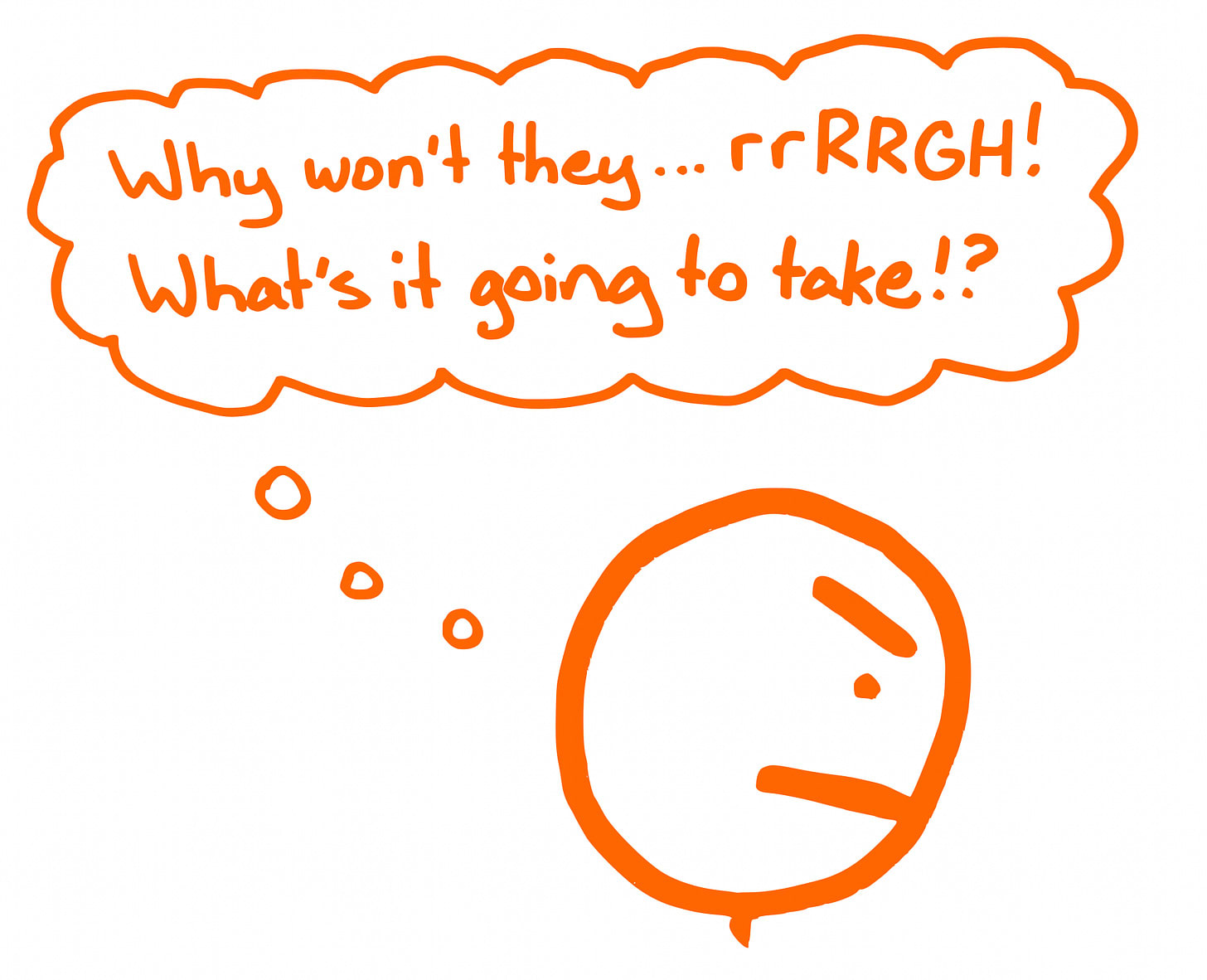
There’s a sense of why won’t they just, followed by a sort of casting-about for ways to make them do the obvious thing, are you kidding me, this is so stupid, all of this would go away if you would just fuCKING—
And in that sort of goal-oriented, do-whatever-it-takes-to-make-them-say-the-words mode, it’s pretty easy for the pressure-er to start deploying all sorts of tools/weapons, such as:
- Peer pressure
- Arguments from authority
- Threats of punishment
- Bribes
- Shouts
- Insults
- Attempts to guilt or shame or embarrass
…the more the person won’t budge, the more it feels appropriate to make them move in the right direction, escalating upwards until people are doing very silly things like grounding their child for two months or threatening to break up the marriage. It’s easy to get caught up in the process, to get tunnel-visioned on the goal, and to lose track of the side effects that are piling up.
Meanwhile, the resister’s experience is more like:
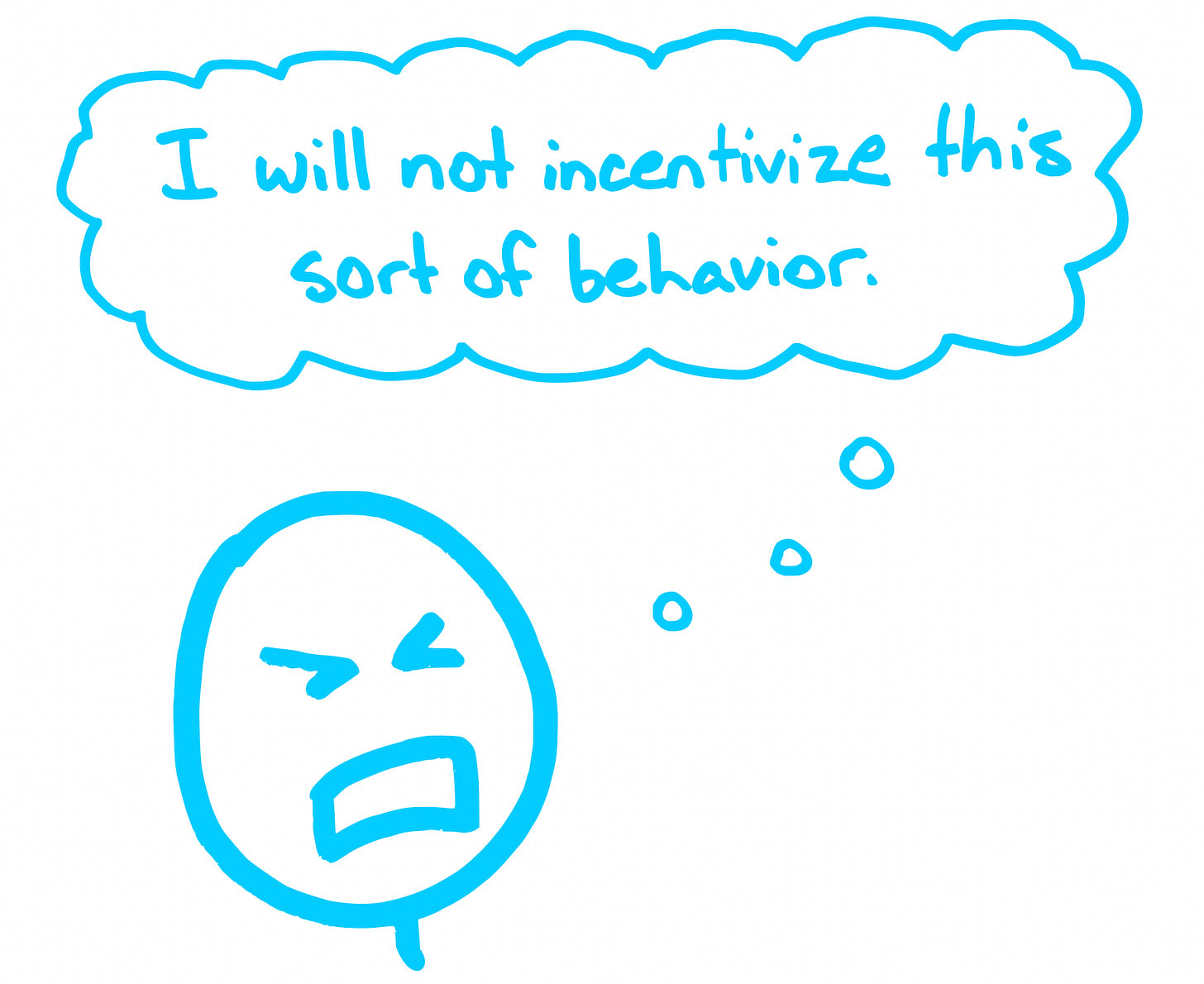
Usually, the resister has stopped paying attention to the object-level considerations entirely, and is instead focused on something like what sorts of policies should I have, in the face of various pressure campaigns?
Should I give in to peer pressure?
Should I negotiate with terrorists?
Should I let people badger me into doing what they want, regardless of whether it’s a good idea in its own right?
This person is trying to order me around, as if they are in a position of authority over me; if I acquiesce, am I not implicitly accepting and acknowledging that authority, thereby making it real? Especially if other people are watching…
Blue: hmmmm, maybe I should clean my room.
Orange: “Yo, clean your room.”
Blue: well now I am not doing it.
It’s the difference between whether your attention is local, and focused on the matter at hand (such as how all of these problems will go away if you just apologize)…
…or whether your attention is global, and focused on something like what sorts of messages are we sending, about what kinds of pressure are okay?
It’s not always easy, upon noticing the problem, to solve it. It’s not always possible to do [the obvious pragmatically correct next action] without incidentally sending the message that [the pressures being brought to bear were appropriate and acceptable]. Sometimes, you end up having to pick which thing you’re going to sacrifice: do you do the worse local move, to defend important norms? Or do you do the right thing locally even though it means some amount of rewarding bad behavior?
But you can sometimes take a third path. Noticing that your resistance is actually not about [the obvious pragmatically correct next action] can sometimes allow you to split the two things apart, and say something like:
So, here’s the thing. I’ve been thinking about why I was so reluctant to just … agree that I’m not going to randomly punch him (because I’m not, and never was, and would not be giving up anything at all by committing to never doing it). And what I’ve realized is that I think there were multiple kind of head-fucky things going on, and I was reacting to those things.
One of them is that my words were being ridiculously twisted around, such that a metaphor about a child’s game was being treated as if it was evidence of a credible physical threat, and that seems super disingenuous and not the sort of thing we should play into or tolerate or reward.
Another is that something like social submission was being demanded, purely on the basis of someone’s strength of feeling, and that kind of incentivizes performative histrionics and making ourselves crazy anxious because if we can make ourselves crazy anxious enough, this justifies insisting that other people warp their behavior to accommodate us, and that, too, seems pretty dangerous.
Which is a rather long-winded way of saying that I do want to give him precisely the reassurance that he’s seeking—I just don’t want to make it seem like I’m doing it because of his demand. I don’t want it to seem like I agree that he actually had valid reason to worry, or that he had a legitimate justification for dragging the entire conversation to a halt and setting the next agenda item himself. It’s kind of like randomly showing up on someone’s doorstep and insisting that they sign a public pledge not to be a terrorist—the problem isn’t that they want to be a terrorist, it’s that they shouldn’t be singled out and put under social duress to specifically agree not to do a thing that there was no reason to suspect them of in the first place.
The problem arises when [the obvious pragmatically correct next action] and [giving in to the messed-up social dynamic] are bundled together as a package deal, and you have to say “yes” or “no” to both of them, simultaneously:
- If I block the exile, it will seem like I did it because I was threatened.
- If I change the word in my essay, it will seem like I agree that this random user has authority on questions like this, and can give me orders.
- If I apologize now, it’ll both cheapen the apology (because it’ll look like I only did it because he told me to) and make it more likely that people will try to boss me around in the future (because it’ll look like I caved).
- If I back down now, that’s basically tantamount to agreeing that I defected, when I didn’t.
Even just noticing that [the object-level question] and [the social dynamic] are two different things at all is progress, and can reduce one’s reluctance substantially. And if you can manage to split them apart, such that you can say “yes” to one and “no” to the other, often this solves the problem completely.
Trigger: notice yourself feeling reluctant and defensive.
Action: try asking yourself something like “hey, am I reluctant because I actually don’t want to do the thing itself? Or is it because I think doing the thing will imply something else that I don’t agree with?”
Trigger: notice someone else digging in their heels.
Action: try asking them (possibly in private/in a sidebar!) something like “hey, just wondering, are you really adamantly opposed to X because you think X itself is somehow bad or the wrong move? Or is it more like, doing X under these circumstances sends the wrong message or leads to something bad?”
It’s a disentangling move, a space-creating move. Which is usually precisely what people need, especially if they were already feeling nervous or hesitant about X (i.e. wanting more time to think it through) and the people around them responded by shoving them toward X harder and more urgently.