Caroline Ellison has joined Manifund
By Austin, Carol N @ 2026-09-11T17:48 (–93)
This is a linkpost to https://manifund.substack.com/p/caroline-ellison-has-joined-manifund
Austin: I’m happy to announce that Caroline Ellison has accepted a role at Manifund, to develop our funding platform and research how to effectively direct philanthropic dollars.
In fact, she started a work trial on July 13, which converted to a fulltime role on Aug 10. Over the past two months, she’s been publishing her work and supporting Manifund users under the pseudonym “Carol”.
How did I come to consider this at all?
- I specifically enjoyed Caroline’s tumblr and other writings, which I found thoughtful and relatable. I invited her to Manifest 2026, just because I wanted to meet her. During the festival, she came to my night market booth, and asked about joining our team, which I was interested to explore.
- I felt a keen debt to the FTX Future Fund. They provided seed funding for Manifold. They funded the retreat which drew me into the EA community, and the conference where I met my wife. Much of Manifund’s work today is directly inspired by the Future Fund’s approach.
- On FTX itself, I remain conflicted. It was their money and spirit that enabled the Future Fund, and I still admire many aspects of FTX and the individuals who worked there. But also: FTX did wrong. Its collapse harmed users (myself included), and damaged the movement which I deeply care about. I may write more about this in the future, but in any case:
- I believe in redemption. Caroline has admitted her faults, worked to make creditors whole, and served her time in prison. I’d like to give her the opportunity to contribute back to the world; I hope that the world will concur.
Why did I hire Caroline for Manifund?
- Manifund needs talent. Leading AI labs warn about recursive self improvement; poverty and disease remain unsolved; billions of animals suffer hell on earth. I, my team, and many EAs I know, are often burning the midnight candle to address these wrongs. I don’t wish to sideline a pair of capable hands. (We’re hiring!)
- Caroline brings specific, useful expertise around finance and systems management to Manifund. I know this might seem like a joke — why would you trust someone who blew up an exchange? — but in fact she’s already been invaluable, for example building a reconciliation tool which identified several misregistered transactions in our database, in the 5-6 figures. (Obviously, she and I will be extremely motivated not to repeat FTX’s mistakes).
- Through working together, I’ve had the privilege to know Caroline as more than just an icon of FTX. I find her to be kind, humble, down to earth, hardworking, smart and witty. She cares deeply about doing right, for our users, our donors, and the world. She shares many of my sensibilities around extant problems of philanthropy; see, for example, our essay in support of for-profits. She adores Ada, my 2yo daughter (and, the feeling is clearly mutual).
Manifund strives to be unusually transparent. And so, I apologize for our minor deception, in using a pseudonym over the last couple months. I still endorse having done this — I think it’s relatively common to work with people pseudonymously, when their real identity is famous. But I want to call out that we compromised on transparency here, which I do not take lightly.
I understand that some of our users, donors, and partners may now be skittish about working with Manifund, given this announcement. I appreciate any trust you are willing to extend, and ask that you judge us by our historical and future outputs. You (or your LLM) can take a look at Manifund’s source code, underlying data, finances and research; if you wish, you can see Caroline’s specific code commits and comments on Manifund.
I’m happy to take questions, over public comments or emailed to austin@manifund.org. (I can’t promise I’ll be able to reply to every one.) In the meantime, I’d like to ask Caroline to say a few words.
Caroline: I’ve said a lot about what I did wrong at Alameda/FTX—you can read what I said at my plea, during trial, and remarks at sentencing. I’m deeply sorry for what I did, and I completely understand why people may not want to work with me. But I’m very grateful to Austin for giving me a second chance, and judging me on my current work performance rather than my past. I feel very lucky not only to have a job, but to be working somewhere that I think is doing great work and has a mission I believe in.
When I started my work trial, unsure if I’d get a full-time offer at the end, I didn’t want to go through a public announcement just to potentially be let go a month later. But now that I’ve accepted a full-time offer at Manifund, I want to be upfront about it.
I’m excited to continue improving our technical infrastructure, working on operations and customer support, and posting updates on our newsletter.
I probably won’t reply to comments on this post—sorry.
Flo 🔸 @ 2026-09-11T20:31 (+188)
While I am thankful for the transparency and understand that you don't want to take part in discussing this in public forum threads, I, and maybe others, want to.
I have to say, I think this is harming what remains of the Effective Altruism name/brand and is making me reconsider openly associating with it.
If we ever hope to rebuild the trust that was lost and construct a better public image of EA, we need to have strong community norms that people who commit wire fraud, securities fraud and money laundering have no place in any type of financial role in organisations that make up this community.
I get that you have personal ties, and I can understand wanting to act from a position of forgiveness towards a friend and uphold norms of redemption. From an outside perspective, though, these same personal ties can be perceived as more of the same mixing of professional and personal lives that infamously happened at FTX.
I, too, believe people can redeem themselves and, after completing their sentence, should be able to rejoin society. And I also think that the EA community can only ever gain a positive public image if they beat the accusations of fraud and favouritism through an abundance of care about these things and strict professional norms. Background checks for financial roles that exclude people with felony convictions for financial crimes are, in my opinion, justified.
Flo 🔸 @ 2026-09-11T22:17 (+139)
After researching this a little more, I'm quite taken aback that apparently you still didn't return the 500.000$ FTX investment, and instead let it go to litigation. So the Trust that is making the victims whole is currently suing you (Manifold for Charity) for that Money, while you hire one of the perpetrators.
Surely, even though you may not consider these facts related, you must understand how this looks from the outside. Let me spell it out: It looks like Caroline is continuing to benefit from the fraud by being paid by an organisation that kept the money she helped steal.
Austin @ 2026-09-11T23:08 (+12)
(Unfortunately, it's tricky for me to comment on active legal proceedings, but I intend to check to see what our lawyer thinks is reasonable for me to say here. Please follow up if I haven't said anything in 2 weeks.)
Ryan-Baylon @ 2026-09-13T12:09 (+14)
I care for non-optics reasons, and would appreciate a follow up when you find the time.
Flo 🔸 @ 2026-09-11T23:25 (+7)
I don't expect you to; this is mostly about the optics, no internal details needed.
Austin @ 2026-09-15T22:02 (+11)
I think I can share that the $500k was a grant (not investment) from the Future Fund, to fund a program where successful Manifold traders could choose which charities would receive donations: https://forum.effectivealtruism.org/posts/mbBfFHKEDBTwTSSJX/predicting-for-good-charity-prediction-markets
Manifund ran this program for ~2 years and distributed most of this funding to charities & charitable projects, with the top 3 being Givewell (~$61k), LTFF (~$38k), Rethink Priorities (~$27k). We offered to return remaining funds to the estate; we are still in litigation. This case has been going on for years, and may continue for months at least; litigation takes a while. I do hope to write a retro on this overall program someday.
For reference, Lightcone received ~$4.2m from FTX Future Fund and eventually returned ~$1.7m (and then paid some more in legal fees, maybe ~$0.6m): https://www.lesswrong.com/posts/5n2ZQcbc7r4R8mvqc/the-lightcone-is-nothing-without-its-people
jai @ 2026-09-19T16:59 (+8)
Dealing with retroactively-tainted funds is complicated - you can't undo the past. But you do have a great deal of control over the future. Lightcone didn't go on to create a massive conflict of interest by providing career opportunities to co-conspirators convicted of stealing money that went on to benefit Lightcone. Because that would be insane and appear to if not outright be a quid pro quo for criminal activity.
MHR🔸 @ 2026-09-11T21:19 (+58)
I think I concur. It seems like a bad call to put someone who committed massive financial crimes into a grantmaking platform development/research role, especially one in the EA/AI safety community. I don't disagree that redemption is possible and that people can change, but I think the conditions for hiring someone in these kinds of cases (e.g. time since the crime occurred and weight of evidence that the person has changed) need to be a function of the sensitivity of the role and the magnitude of the crime. And I don't think that bar is anywhere close to having been met here.
Aaron Gertler 🔸 @ 2026-09-13T01:30 (+36)
If every decision made by any organization under the EA umbrella can make you reconsider associating with the brand, are there any other brands you associate with that manage to maintain the standards you look for?
Every discussion I've seen makes me think that people within EA overwhelmingly think this is a bad idea, and many of them plan to interact differently with Manifund going forward; for a community without formal standards for who "belongs", that seems like as much as you could reasonably ask for (aside from even more overwhelming condemnation, I suppose).
Caveat: Our differing instincts might be informed by a different understanding of where Manifund sits within EA (I think of them as a fairly minor organization, but EA is a loose and chaotic group of orgs, and I only see certain parts of the elephant).
Flo 🔸 @ 2026-09-13T06:21 (+36)
I'm happy that people overwhelmingly think that this is a bad idea. When I posted the comment, this wasn't clear to me. I posted this because all I had seen at that point was a stream of positive comments on substack which all celebrated that Caroline was given a second chance in this way. I wanted there to at least be one comment expressing why this is bad.
I may have overestimated Manifunds importance since it was regularly recommended to me as where I should apply to fund a side project of mine, and I seriously considered it.
So no, I don't reconsider my involvement after every bad action by any org, only when something seems to me like one of the worst moves, while seeing people I respect celebrating it, with little to no pushback (which now is clearly happening).
jai @ 2026-09-13T01:51 (+5)
Many orgs are affiliated with Manifund one way or another by virtue of fundraising.
Austin @ 2026-09-13T02:52 (+15)
I wish this weren't the case, for what it's worth. I have some aspiration of Manifund being a neutral utility or infrastructure, similar to Twitter or Substack or Stripe, where it's understood that people and orgs of very different backgrounds will still use it for funding.
There's some evidence of this. I believe Manifund is the only platform that has hosted projects receiving donations from people as disparate as Marc Andreessen and Beth Barnes.
Austin @ 2026-09-11T23:05 (+7)
Hey! Thanks for your comments. As mentioned, Caroline doesn't plan on replying, but I am happy to jot some quick thoughts in response:
- "The EA name & brand" is kind of a tricky thing to reason about. Obviously, I feel bad about people who weren't involved in this decision, suffering any kind of backlash as a result. I wish that the public would see "EA" as something like, idk, "Catholic", where one bad or disagreeable act doesn't make a particular statement about others.
- FWIW I did send the CEA community health team a draft of this announcement. (It was with not that much advance notice, and I don't blame them for not having a statement etc ready)
- I expect some funders and orgs to "vote with their feet" and stop working with Manifund, at least for a period of time. I think this is understandable, and I hope to prove through our actions that we're still worthy of trust
- To be clear, Caroline and I hadn't been friends before she came to Manifest 3 months ago. (I did previously count others who had worked at FTX or FTX Future Fund, among my friends.)
- Manifund was already extremely transparent, but I hope one effect of Caroline joining and the public scrutiny on us is that we'll be pushed to be even more transparent, moving forward
Julia_Wise🔸 @ 2026-09-13T15:01 (+170)
>FWIW I did send the CEA community health team a draft of this announcement.
Since you mention my team and you emailed me an FYI about 16 hours before this announcement went up, here's my opinion: don't hire someone with a fraud conviction for a finance or philanthropy role.
Austin @ 2026-09-13T15:36 (+2)
Thank you for weighing in. And I appreciate that this announcement, as timed and as stated, probably makes your job (and the job of others at CEA, not to mention the rest of EA) somewhat harder. Please let me know if there are things you believe I should do moving forward to mitigate this impact (including, renouncing EA. I've written elsewhere, but I'm considering holding a plebiscite on whether we should be cast out).
I am sorry for not having provided more advance notice; for what it's worth, we decided and pulled together this announcement on a very short timeline overall. I think we decided to announce on Tuesday (pacific time), finished the writeup Wednesday, and started forwarding to people on Wed and Thursday. (I believe we emailed you more like 24h before the announcement, but I agree that this is still very low, and nitpick-y.)
Two reasons we decided to announce on Friday were that 1) Caroline was visiting in-person through the week and 2) my son is due to be born later this week, and I wanted this announced before paternity leave.
Julia_Wise🔸 @ 2026-09-13T16:22 (+28)
I think the heads up was optional; thanks for doing it at all. But it felt weird that you included it in your comment, because a heads up to me doesn't really make a difference on the overall situation.
Flo 🔸 @ 2026-09-11T23:20 (+69)
It took the Catholics 2000 years to get to the point where they could systematically protect and enable paedophiles and still survive the blowback. It should be quite obvious why EA's reputation is far more brittle, especially when it comes to funding organisations.
I think you have every right to hire any cofounder you like if you run a startup, whatever their history, but then it shouldn't be a 501c associated in such a big way with Effective Altruism.
From the perspective of someone who spent years in tedious discussions about being extremely careful with public outreach to not damage the perception of EA as a brand when we were building EA Germany, this feels like a slap in the face.
Larks @ 2026-09-12T17:32 (+10)
It took the Catholics 2000 years to get to the point where they could systematically protect and enable paedophiles and still survive the blowback.
This seems both irrelevant and false to me.
Flo 🔸 @ 2026-09-12T20:05 (+8)
Look, Austin made the comparison
I wish that the public would see "EA" as something like, idk, "Catholic", where one bad or disagreeable act doesn't make a particular statement about others.
I may have been more short tempered and aggressive than necessary, and arguing the specifics of what harm the Catholic Church has done is indeed beside the point. What I was gesturing at was: Wishing that EA were the same as a 2000 year old world-spanning religion in terms of public perception when scandals happen has some obvious problems.
Austin @ 2026-09-12T20:35 (+4)
I made this comparison because I am personally Catholic, fwiw, and that feels similarly important to me as my EA-ness. You might make make a comparison for your own community, or religion, or city or country, whatever feels appropriate.
AllFather @ 2026-09-12T00:38 (+1)
I don’t think for-profit and 501c are so different here. Different non-profits have different mission statements and beliefs about what is best for EA.
Sometimes people will do things that harm a brand you share with them, and while they gonna do what they gonna do, it’s natural to be angry or disappointed. I’ve been going through this a lot lately, still figuring out what to do about it.
Roman Ross @ 2026-09-12T00:58 (+16)
"'The EA name & brand' is kind of a tricky thing to reason about."
I don't think it's unreasonable to say that we should be willing to pay a lot to preserve EA's image, and it seems likely that hiring Ellison will cause significant negative backlash. It could be valuable to look at the EA community's historical willingness to pay to improve its image, so here are some proxies:
- CEA reported that about 4% of its 2025 spending ($21.8M) was on marketing and communications, which comes out to roughly $870k. I'm not sure how much of this work is directly about improving EA's name and brand, but I suspect that's maybe half the theory of change for all of CEA's media outreach?
- For reference, Fable says this money was spent on improving social media accounts, redesigning effectivealtruism.org, running an "EA Stories" video campaign, and working with journalists to improve how accurately EA is described in the media.
- Spending on the team is projected to be well above $1M this year, and most of the work (or at least the work related to The Altruists) is reactive media handling and corrections.
- I'm not confident in this, but I suspect that the primary theory of change for giving grants to Andy Masley is that he's a good writer who says reasonable things well and shows off some of the strongest parts of EA.
I lack the information to determine if this hiring decision is net negative or net positive, but I don't think it's impossible to make a reasonable guess for how much we should be willing to pay to avoid bad PR. I hope Manifund receives a lot of surplus benefits from hiring her.
NickLaing @ 2026-09-12T09:20 (+14)
I don't think "The EA name and brand" is that tricky to reason about really. Also what we "wish" the public could do is unfortunately not reality. I think there are a number of reasonable takes and good arguments for and against focusing on brand, which have been discussed much on the forum. These 2 might be the most obvious
1) "Don't worry about PR it hurts epistemics and decision making. We should openly discuss any topic even if the public find it revolting or outside the overton window. This will help us truly do what has the highest EV, and achieve the most good - public perception be darned"
2) " EA being in good standing towards most people helps EA's do more good. PR is important for attracting people to the movement and makes community building easier. It helps It also helps donors outside EA feel more warm towards EA ideas and spend their money more cost-effectively. If we are not pariahs, or even better seen as good by most people, that will help us redirect more thought, talent and resouces towards the movement.
And everything in between, and probably some orthoganal takes too. There are arguments for and against these. But I don't think its tricky to reason about as you state here.
From my perspective when we call ourselves EAs, or EA adjacents or even just vaguely part of the community, then we do have responsibility to others and the movement for the consequences of actions like hiring someone like Caroline Ellison. You've taken some of that responsibility which is great by posting here and having a discussion.
That said my take (FWIW) I understand your reasons for hiring here, but its probably not wise. I do have a STRONG bent towards second chances though, but I feel it might have been wiser for PR reasons at least to put her in a position which had nothing at all to do with finance. Also you are opening yourself up to a lot of risk if anything bad happens with Manifund finances, even if she had nothing to do it.
Achim @ 2026-09-14T12:49 (+3)
The situation is quite different when it comes to the term "Catholic," as the Catholic Church is effectively an organization with clearly defined decision-making rules; it is clear who is authorized to speak for the Church and who decides on—and is responsible for—imposing sanctions when church officials or sub-organizations behave inappropriately. Perhaps the term "Christian" serves as a better point of comparison. However, when considering the impact on reputation, one should focus on a specific religion and put oneself in the shoes of people who know very little about that religion and are now receiving a few additional pieces of information about it.
Zachary Robinson🔸 @ 2026-09-17T17:50 (+170)
For me, this comes down to trust.
FTX collapsed because of fraud. Customers lost money they had trusted the exchange to hold, and the people responsible, including Caroline, were rightly held accountable.
I also believe in second chances and the possibility of redemption. I briefly managed cG's criminal justice reform program, and I deeply believe it's a moral good to give people a path back to participating in society after they've done wrong.
But I also believe that trust – especially trust from a community someone harmed – has to be earned, not simply extended. Going from prison for financial crimes and causing harm with philanthropy to a role with real influence over finances and philanthropy on an extremely short timeline is a leap I do not believe has been earned.
Organizations that ask donors to trust them with money should hold themselves to a higher standard. A recent financial fraud conviction would disqualify someone from a finance role at CEA, regardless of any reputational considerations. I am disappointed with the decision itself, not just its effect on our work.
I saw some of the harm Caroline and her colleagues caused up close. When I took over as CEO of Effective Ventures US to lead EV through the FTX crisis, I worked with core EA institutions who incurred significant damage from the trust they had placed in Caroline and her colleagues when they had claimed to be doing good. Tens of millions of dollars and years of people’s work were lost, as was a level of public and community trust that has taken years to even partially rebuild. One of the lessons I took from that period is that we, as a community, extended trust too easily and too fast. I worry Manifund's decision repeats that mistake.
Caroline hasn't done the work to earn that trust back. Moreover, her willingness to take on a role she should have known would cause harm to others makes me concerned that she is not on track to earn that trust back anytime soon. And Manifund hasn't earned the trust that it will be a responsible steward of the community's trust on her behalf. This was a unilateral call by Austin and Caroline, and I think it traded down our collective trust.
I’m writing this message in my capacity as CEO of CEA. It’s important to remember that nobody runs EA, including CEA, and Manifund has the ability to make hiring decisions on its own. But I think it's fair for people and institutions in the community to speak up when they believe an organization’s actions are out of step with the norms and values that hold this ecosystem together. For our part, CEA will be refraining from giving Manifund a platform through our programs for the foreseeable future, such as recruiting booths at our events.
To be clear, this isn't about writing Caroline off as a person. I believe people can change. I also hope Caroline finds good ways to use her skills. But I think it is wrong for Austin and Caroline to make a decision that affects so many of us given I don’t believe that change has been demonstrated, and I don’t believe diving into finance or philanthropy is the right way to attempt to earn the necessary trust.
Aidan Alexander @ 2026-09-21T08:03 (+46)
Ambitious Impact will also not be participating in or collaborating with Manifund projects for the foreseeable future.
Austin @ 2026-09-21T14:41 (+11)
Thank you for the work you do at AIM; it's long been one of my favorite charities. At our wedding, my wife and I each picked a charity for attendees to donate to in lieu of a wedding gift; my wife picked The Humane League, and I picked the then-Charity Entrepreneurship, now AIM. AIM has also been one of the inspirations for the incubator I now organize, Surplus. Best wishes going forward.
GraceAdams🔸 @ 2026-09-21T05:12 (+37)
Thanks Zach for writing on behalf of CEA.
EA Australia is also not going to be platforming Manifund for the foreseeable future.
Austin @ 2026-09-21T14:36 (+4)
Grace, thank you for the work that you do at EA Australia, and at GWWC previously. I still have fond memories of the EAG talk you gave about the importance of marketing for EA, a subject that I think many people still underrate. And while I haven't been to Australia myself, again and again I'm impressed by the quality of the impactful work and people, from the land down under; keep it up.
Nina Friedrich🔸 @ 2026-09-22T13:45 (+28)
Thank you for writing this, Zach.
High Impact Professionals also won’t collaborate with Manifund for the foreseeable future.
Patrick Gruban 🔸 @ 2026-09-21T01:56 (+28)
But I think it's fair for people and institutions in the community to speak up when they believe an organization’s actions are out of step with the norms and values that hold this ecosystem together.
Thank you for speaking out. I agree with this statement.
I think Manifund’s decision to hire Caroline Ellison reflects a gross failure of judgment. As a result, Successif, the organization I lead, won’t collaborate with Manifund until our trust in its leadership is restored.
JSWinchell @ 2026-09-24T13:56 (+23)
Good Impressions will also not be participating in or collaborating with Manifund projects for the foreseeable future
Manuel Del Río Rodríguez 🔹 @ 2026-09-18T15:31 (+13)
Caroline hasn't done the work to earn that trust back. Moreover, her willingness to take on a role she should have known would cause harm to others makes me concerned that she is not on track to earn that trust back anytime soon. And Manifund hasn't earned the trust that it will be a responsible steward of the community's trust on her behalf. This was a unilateral call by Austin and Caroline, and I think it traded down our collective trust.
All my sympathy for the FTX harm you had to live and suffer up close. I don't doubt how harrowing, stressful and painful it must have been for all who suffered it, for all the careers that were affected and for the overall damage that was done to the EA brand and its capacity to 'do good better'. All my sympathy as well for the challenges of avoiding bad publicity being piled upon EA, all the more so at a time when the US administration seems rather keen on maligning the movement. I would say, though, that you do seem to be presenting a bit of a catch-22 scenario here. How is Caroline supposed to 'earn that trust back'? As far as I've known (which is to say, what is accessible through the public record) she has been engaging since the time of the trial and before and after prison in many iniciatives and work of the kind that is restorative and good for self and others, even if not very impactful: volunteering, soup kitchens, teaching adult-literacy classes, volunteering as a tax preparer for low-income people, helping to send books to prisoners... and she's had great difficulties in finding ordinary paid work (even been asked to leave in some of the work just mentioned when her employers discovered who she was). It's been four years since the FTX debacle. What metric for 'earning back trust' would you consider reasonable? A decade or more doing work like this, out of the public eye, and completely dissociated from EA activities? Would it be okay if she were working in a private charity that is disconnected from EA? Is she supposed not to work in anything related to her skills and talents, even when it doesn't involve investing of safeguarding investments?. As Lorenzo Buonnano says, "improving technical infrastructure, operations and customer support, and posting newsletter updates in a low-paid role at a small charity" feels like a decent fit for a person with her skills and talents, and a desire to do good and show her worth.
jai @ 2026-09-19T18:29 (+4)
As Lorenzo Buonnano says, "improving technical infrastructure, operations and customer support, and posting newsletter updates in a low-paid role at a small charity" feels like a decent fit for a person with her skills and talents.
I think that job description would be an excellent fit, but it does not describe what we're talking about here. The very first sentence of the post we're commenting on says that she will "research how to effectively direct philanthropic dollars". This is not a minor role - Caroline is Manifund's 2nd full-time employee. This is a job which involves making impactful decisions about how not-insignificant quantities of money are directed, at an org funded in part by previous criminal activity.
I do want Caroline to have a chance to rebuild trust, and if she's been working on that out of the spotlight, that's great. I even think there are many paid roles in the EA ecosystem she could reasonably and effectively fill. But "make decisions about directing significant philanthropic funds at an org funded by previous criminal activity she participated in four years ago" is not one of those roles.
Manuel Del Río Rodríguez 🔹 @ 2026-09-20T13:32 (+8)
I think you are making two assumptions here. Please correct me if I'm wrong or misinterpreting you.
1) That Caroline's role at Manifund involves making decisions about how significant philanthropic funds are allocated.
I agree that the job description quoted from Caroline's text ("continue improving our technical infrastructure, working on operations and customer support, and posting updates on our newsletter") may not cover all her responsibilities at Manifund. As you point out, Austin starts his post by saying that Caroline has accepted a role at Manifund "to develop our funding platform and research how to effectively direct philanthropic dollars".
I don't dispute that this is a potentially important role, particularly given that she's apparently Manifund's second full-time employee. And I agree that her research and recommendations could influence funding decisions, perhaps substantially. But I think you're going beyond what the announcement actually establishes when you describe her job as one involving "making impactful decisions about how not-insignificant quantities of money are directed". Researching how to direct philanthropic funds is not the same as exercising decision-making authority over their allocation.
Do we have any evidence that Caroline will actually be making those decisions, approving grants, or exercising control over donor funds? Has anyone asked Austin about this, if it is their main bone of contention? I think not. I also think those are important distinctions, particularly when discussing the responsibilities it would be appropriate to entrust to someone with Caroline's history.
2) That there are other paid roles in the EA ecosystem that Caroline could reasonably and effectively fill.
I agree that there are probably many roles for which Caroline has the necessary skills and qualifications, vut how many EA organizations would actually be willing to offer her one? Do you know of any organization in the EA ecosystem that would be, or would have been, willing to give Caroline a chance, besides Manifund? Myself, I think the number is likely to be very small, and I would be happy to stand corrected.
The distinction matters because there is a considerable difference between saying that someone is qualified for a position and saying that the position is actually available to them. If we're going to argue that Caroline should be rebuilding her professional life elsewhere, I think it's reasonable to ask whether those alternative opportunities genuinely exist.
Finally, I think I agree that it would have been preferable, all else being equal, if the organization she had joined had no unresolved legal or financial issues connected with FTX. However, I don't think the mere existence of litigation or negotiations with the FTX estate establishes wrongdoing or bad faith on Manifund's part.
David Seiler @ 2026-09-21T10:45 (+6)
2) That there are other paid roles in the EA ecosystem that Caroline could reasonably and effectively fill.
Most EAs do not work for EA orgs; they earn money at a normal job and then donate some of it. That's the path I'd recommend for someone with a fraud conviction, even if they weren't as notorious as Caroline.
Manuel Del Río Rodríguez 🔹 @ 2026-09-21T11:55 (+7)
Fair I guess. Still, I feel you are undervaluing how difficult it likely is for Caroline to find, right now, any job that matches her skills and talents and/or could be impactful and aligned with her values.
Matrice Jacobine🔸🏳️⚧️ @ 2026-09-22T16:00 (+3)
As far as I've known (which is to say, what is accessible through the public record) she has been engaging since the time of the trial and before and after prison in many iniciatives and work of the kind that is restorative and good for self and others, even if not very impactful: volunteering, soup kitchens, teaching adult-literacy classes, volunteering as a tax preparer for low-income people, helping to send books to prisoners... and she's had great difficulties in finding ordinary paid work (even been asked to leave in some of the work just mentioned when her employers discovered who she was).
What is your source for all this?
Manuel Del Río Rodríguez 🔹 @ 2026-09-22T16:16 (+10)
The main source is Caroline Ellison's September 2024 sentencing memorandum and the supporting letters submitted to the federal court by her lawyers. There's also contemporary reporting by The New York Times (which touches on her rejection from a tax-preparation position), The Wall Street Journal and other newspapers that likely draw on those documents and other sources .
Matrice Jacobine🔸🏳️⚧️ @ 2026-09-23T13:50 (+2)
So none of this is "after prison"?
Manuel Del Río Rodríguez 🔹 @ 2026-09-23T15:05 (+6)
Not in the public record, and I have no privileged information, so the "after prison" is indeed unattested. I would say, though, purely as a personal belief, that it feels very likely that she would have continued to do so afterwards and before she started with Manifund.
Matrice Jacobine🔸🏳️⚧️ @ 2026-09-24T12:17 (+4)
But this could just well have been strategic to get a lower sentence?
Manuel Del Río Rodríguez 🔹 @ 2026-09-24T13:00 (+7)
We're entering the realm of pure speculation here, and I think we're starting with wildly different priors and have insufficient evidence atm to update them. I feel your suspicions are overtly cynical and are inconsistent with what I feel is the best model of Caroline's personality from what can be reconstructed from all the info in the public domain. Then again, you could retort that she has been involved in a billion-dollar fraud and that it's prudential to be suspicious. So we're stuck in a rut, for now.
Just anecdotally, I'd like to mention some words of Judge Kaplan about her during the trial and sentencing: “I've seen a lot of cooperators in 30 years here. I've never seen one quite like Ms. Ellison”. He was particularly impressed by the accuracy and consistency of her testimony and by her exemplary collaboration, and truthfulness, even against her own interests: “I don't remember a single time when she was caught in the slightest error of fact, the slightest inconsistency”. He definitely considered her remorse genuine, and I can easily imagine that a judge of his experience is a better judge of character than me.
David Thorstad @ 2026-09-22T13:44 (+7)
Thanks for your leadership.
Yarrow Bouchard 🔸 @ 2026-09-17T20:59 (+4)
Thank you, Zachary. I admire the integrity of this eloquent and incisive comment, and I admire even more that it comes with a concrete action attached. Hallelujah.
There is an additional consideration beyond what you mentioned: Austin Chen received $1.5 million in stolen cash from Caroline Ellison, Sam Bankman-Fried, and others at FTX. Austin gave Caroline Ellison a job at Manifund as a reward, a repayment for this stolen cash — a repayment for the debt he feels he owes to her, as he put it. I'm not speculating on his motive; this is what Austin said, openly.
Austin is currently being sued by the FTX Recovery Trust (which represents FTX's creditors) because they want that $1.5 million back. Unlike others in Austin's position, he decided he wanted to keep that stolen cash. And he decided he wanted to reward and thank one of the people who stole it for stealing it for him. His words:
I felt a keen debt to the FTX Future Fund. They provided seed funding for Manifold.
This is just straight-up corruption.
Austin has repeatedly defended FTX executives generally and Sam Bankman-Fried in particular over the last 4 years. As recently as April 2025, Austin said:
...I think we should free SBF and put him to work.
What a brazen embrace of criminality. And he put his money where his mouth is when he hired Caroline.
It's a fantastic first step to ban Manifund booths from events run by the Centre for Effective Altruism. Thank you for that. Can I suggest two further steps?
One, ban Austin and Caroline from attending these events (even if they're not setting up a booth). Two, ban Austin and Caroline from the EA Forum. (Yes, she has an account.)
No single entity controls the entire EA ecosystem, and there's only so much even the CEO of the Centre for Effective Altruism can do. But presumably you can do this.
I don't know what else you might be doing behind the scenes, but if you haven't considered it already, you could consider talking to leaders of other organizations to encourage them to take more steps to dissociate effective altruism from Manifund, Manifold, Austin, and Caroline. This moment is a time to show whether the EA community meant any of the things it said in the wake of FTX's collapse, or if it was all talk.
Manuel Allgaier @ 2026-09-30T04:53 (+3)
@Austin I appreciate your transparency and willignness to respond on all this!
If you can share, I'd be curious to hear if the responses here in this thread changed how you feel about hiring Caroline, and if there's any amount of "(EA) charities / donors stop using Manifund" that would make you think it might have been the wrong call in hindsight.
I was quite a fan of Manifund, for making small-scale crowdfunding easier, and I'm sad to see that it's now practically unusuable for many (EA) charities and donors.
Lorenzo Buonanno🔸 @ 2026-10-01T12:18 (+3)
I'm sad to see that it's now practically unusuable for many (EA) charities and donors.
I don't think this is true for that many. As far as I can see most EA charities and donors privately declined to participate in this pressure campaign against Manifund (and because of that you don't see them posting here), and the ~6 that did participate as far as I know are not funding constrained (edit: and/or have easier ways of receiving donations without the 5% fee), so wouldn't have had much use for Manifund in the first place.
Conor Barnes 🔶 @ 2026-10-09T10:33 (+6)
As a data point: In my capacity as the job board lead at 80,000 Hours, on reading the news I decided to take down Manifund's opportunities, but did not announce it.
Your comment makes it sound like there might be a silent majority of EAs who still consider Manifund usable. I suspect this is false, and that instead most EA orgs are in the same situation as the job board: Opposed to future collaboration, but not announcing it.
Austin @ 2026-09-17T19:12 (+2)
Thank you, Zach. I appreciate you speaking up in public on behalf of CEA; CEA and your leadership is particularly important at times of high stress and uncertainty. I think the actions CEA are taking are entirely reasonable.
I also want to note for the general public, that Manifund has been but a minor player within the larger EA ecosystem, on many dimensions. (Quick estimates: Manifund moved ~$10m in a year when EA moved $1-10B; has 2 FTE in a year when EA has 1000-10,000 FTE. I think we were more impressive as a share of seed-stage AI safety projects funded, but, still not even the biggest funder in that space.) We did not expect this hiring decision to represent all of EA, and I appreciate anyone who pushes back on that narrative.
I hope that someday, I, Caroline, and/or Manifund will be able to regain CEA's trust through our actions. Until then, I wish you the best with your work, and apologize for making your lives harder.
nananana.nananana.heyhey.anon @ 2026-09-12T01:12 (+158)
I don’t think you should make decisions like this based on “what’s good for EA reputation.” I am not swayed by those arguments here.
I do think — unless you think Caroline was wrongfully convicted or convicted under a bogus law and you can say that — this seems a shockingly naïve decision.
We’ve seen hubris and in-group biased naïveté before, the kind that treats EAs and EA orgs as if we’re somehow above boring, straight-up sensible, standard safeguards within a business because we’re too smart and too morally evolved for all that or something, or too rational. This attitude caused some of the FTX failures. Now you’re here telling us that you’re ignoring boring, straight-up sensible standard safeguards within a business like “don’t hire someone with a finance-related felony conviction into a finance position.” And only 4 years after the crime was committed. What reasons do you have to ignore that standard?
I can be sympathetic and even forgiving in my heart of Caroline as a person. I don’t need to turn that feeling into a finance job for her. I’d be less concerned if an org were hiring her in a comms role based on her writings or something and could assure everyone that she’d have nothing to do with finances. Still controversial, but not so out of touch.
This is not smart or wise. It’s the kind of willful, wide-eyed foolishness, while fooling oneself into thinking it’s good, that we’ve seen before. It does not bode well.
titotal @ 2026-09-12T10:47 (+138)
For context, Caroline Ellison has been recently convicted for financial fraud amounting to billions of dollars. Manifund has just hired her for a finance role. They couldn't find a single qualified person that hadn't committed billions of dollars worth of financial fraud?
Nobody has to be diplomatic or mince words here, or couch this in terms of "reputation": this decision is rank incompetence, plainly obvious to anyone with a whit of common sense. Nobody should trust Manifund after this.
titotal @ 2026-09-13T08:29 (+43)
To add further context: The Manifund team currently consists of just two employees: CEO Austin Chen and "Carol N", the pseudonym for Caroline Ellison. Literally 50% of the employees in the organization are convicted financial fraudsters.
Now when people have their funds approved, they will know that decision was made by a convicted fraudster. The article recruiting new hires was written by a convicted fraudster (who was hiding it at the time). Irrespective of her actual role, the fact that she makes up a large percentage of the employee base gives her a significant power in the organization: it's crazy that she is apparently the first hire here.
This is a terrible decision on every dimension you can look at it. It's certainly a brave decision: that does not make it a sane or moral one.
Czynski @ 2026-09-20T16:45 (+4)
There's a story people tell about a new employee at a large investment bank. Some time in their first few weeks, they make a mistake that costs the company ten million dollars.
"I'm sorry," says the new hire, "I'll completely understand if you fire me for this."
"Why would I fire you?", their boss replies, "I just spent ten million dollars training you!"
This obviously applies here. Someone who has handled billions of dollars has given evidence of their competence even if it ended in fraud. If you believe they are genuinely aligned with EA (which I do without reservation in Caroline's case), and that the fraud was not intentional on their part (seems very likely), and are unconcerned with reputation and PR (Austin is), then what this looks like is a serious error in judgment, which cost billions of dollars (and jail time) training them. If you oversee them for a short time and their judgment is greatly improved (I'm not sure this amount of evidence should be convincing), then it can be an entirely reasonable decision, picking up a $100 bill off the sidewalk that everyone else sees as tainted.
Common sense is often uncommon, and often nonsensical. Austin may have poor judgment, but this is absolutely not "rank incompetence."
Ryan-Baylon @ 2026-09-27T19:03 (+2)
I don't understand where the narrative comes from about Caroline just having made a mistake. this was fraud not a poor investment; she knowingly committed a crime on the scale of billions over a period of months. this was not an accident. She knew Alameda was using FTX consumer fund and actively deceived lenders.
Czynski @ 2026-10-11T22:35 (+2)
Have you not seen the terrible accounting they had? I'm sure some of the disclosures were bullshit, but for my part, I entirely believe the "fiat@" cell in the spreadsheet was much larger than (most of them) thought; they thought they had a record and the record was wrong because they really sucked at accounting and also at least one competently-manipulative person (Sam) was steering everyone else away from looking at it closely.
A lot of fraud is a mistake that the people responsible refused to back away from, and doubled down. The Madoff scam was, for example; it started with promising results that they couldn't sustain, they did a short-term trick to keep them up because they really believed it would go 'back to normal' soon, and then they didn't admit defeat for... more than 20 years. Madoff never AFAIK stated when he started falsifying records, but he admitted to not making any real trades any time from 1992 to 2009. Presumably not 50 years. 30 to 40, most likely. By '92 he knew it was pure fraud. Did he know in '81? Maybe. In '75, or whatever the first year was, six months after he started committing fraud? Probably not.
And then you look up a year later and realize you've frog-boiled yourself into something you definitely cannot get out of by confessing, even if it started as something that felt like an honest mistake. You can, at that point, cut your losses, accept a huge fine, and bail. That's very rare and appears to take unusual virtue. In substantial part because the social penalty for bailing then, and the penalty for keeping it going as long as you possibly can, are pretty much the same.
I do not know whether she made a mistake. I do not know who else there made a mistake. It may be no one. It may be all of them.[1] We do not have the information to know that. We may never have that information; they may take it to their grave, same as Bernie Madoff. You are entitled to believe she did it knowingly and understood the scope of her crime and continued anyway; this is an entirely reasonable belief that the evidence we have does not contradict. You are not entitled to consider it obvious.
- ^
Except Sam. I have been convinced by people who talked about him from before Alameda and FTX and reached the conclusion that he was unwise and manipulative and knew what he was doing was wrong from the start, that those things are true. People who have similar knowledge about Caroline's life before Alameda do not mostly reach this conclusion about her, though they hardly exonerate her either.
Yarrow Bouchard 🔸 @ 2026-09-14T11:11 (+67)
It's hard to believe this is real. When you read it, it sounds like a joke. This is a shockingly terrible decision, truly beyond the pale.
On Substack and also a bit on here, people don't seem to draw a sufficiently complex, nuanced distinction between the ideas of forgiveness and accountability.
Can we show compassion, mercy, and even forgiveness to people have done wrong? Yes, absolutely!
When someone has badly abused a position of power, should they be given a similar position of power again soon after? No, absolutely not!
(And that's not even addressing the conflict of interest or potential corruption in this case.)
We can think of a hundred analogous hypotheticals to illustrate this point. Let's say a bartender was convicted of poisoning his patrons' drinks. This is a terrible crime. Can we still show him compassion and mercy? Could we even forgive him? I'd like to believe so, even in the case of such a heinous crime.
But let's say he gets out of prison in a few years. Would it be the right decision for a restaurant to hire him as a line cook? Would that be safe, ethical, and responsible? Hell no!
There are dozens of other jobs he could have that don't involve the risk of poisoning — a customer support agent, a cashier at H&M, or a landscaper, and on and on. Why on Earth put him in a position where he could poison people again?
You could imagine many such scenarios. If a security guard is convicted of assaulting women on the job, should he be hired as a bouncer at a club after he gets out of prison? If a teacher is convicted of abusing children, should she be hired to run a daycare centre upon release? This is not about whether we can forgive these people in a spiritual sense; it's about accountability, or, on an even more basic level, safety.
You could even think about animals. You can hold that animals have absolutely no moral responsibility for their actions; forgiveness is automatic or just not required. But you do not let the fox into the hen house.
Something similar needs to be said about the values of bravery and honesty. In their common use and meaning, bravery means something more nuanced and complex than just doing something scary, and honesty more than just disclosing information. The 9/11 hijackers did something scary, but we don't call what they did "brave". Hitler was honest about his opinion on the Jewish people; do we say Hitler was an honest man? We reserve the word 'brave' for daring actions that are independently good and the word 'honest' for patterns of actions that represent trustworthiness and ethicality.
(It should also be noted in this instance that it was going to leak that Caroline Ellison was hired and this was one of the stated reasons for the disclosure. The information was deliberately kept secret initially.)
Similarly, although we must have the liberality to make room for contrarian and oddball views, the "costliness" of someone's disclosure that they believe aliens control the government does not help my assessment of their epistemic judgment. Nor does it help my assessment of their moral judgment that it's costly for them to disclose they think slavery should be re-implemented.
(Also, how quickly sometimes supposedly costly choices become lauded and rewarded, turning everything upside-down...)
I have tried, at times brutally hard, in my life to live according to compassion and forgiveness, sometimes even at such a dear personal cost that I regret bearing it. It pains me to see the value of forgiveness misused to justify such a reckless, thoughtless decision. Forgiveness does not mean you let the fox back into the hen house. It doesn't mean the absence of accountability. It doesn't mean the absence of safety.
Further reading: emotions researcher Brené Brown on shame vs. guilt, and shaming vs. accountability.
abrahamrowe @ 2026-09-13T00:35 (+66)
This is not really directly relevant, but I feel somewhat confused by considering statements made during a trial as strong evidence of someone taking seriously the harm they caused (to be clear, you didn't express this directly, but I've seen other supporters of this decision say this, and Caroline's message suggests I should take her statements in the legal proceedings as evidence). Caroline was directly incentivized to both cooperate to make creditors whole, and to express regret and wrongdoing, because she would spend more time in prison if she did not do these things. I think it would be far more meaningful evidence if she had, for example, come forward and admitted to wrongdoing and helped right things when she did not have an incentive to do so (e.g. whistleblown before things blew up).
I don't really think individual organizations have an obligation to protect the brand of EA as a whole, and ideally they just improve the brand of EA by doing good things themselves. But I'm a utilitarian, and I aggregate. I hope that you're right that she's an incredible hire, and the marginal value Manifund produces by doing this offsets the obviously very large costs the ecosystem will bear due to your decision.
pete @ 2026-09-13T03:21 (+52)
You’re asking us to believe that Caroline can not only out-contribute the next best available candidate, but out-contribute that PLUS the negative externalities she brings to the project and everything associated with it. I urge you to set aside your personal feelings and consider how many projects this affects.
mjkerrison🔸️ @ 2026-09-13T23:43 (+9)
Yes! Surprised how little at-the-margin thinking is on display at Manifund and in the rest of the comments.
Ariel Simnegar 🔸 @ 2026-09-12T16:25 (+51)
As most commenters write, hiring Caroline for a finance role does not strike me as the best decision. One thing I find missing in this conversation is putting ourselves in Austin or Caroline's shoes.
Most comments are expressing amazement that Austin would hire Caroline when it's so bad for Manifund's reputation. If anything, this strengthens my view that Austin is doing something costly--much more expensive than the $500k FTX investment Manifund is trying to keep--because he believes it's the right thing to do. We should be encouraging people to do what they believe is right even if it's unpopular. Dragging Austin through the mud for doing what he believes is right does not seem like the ideal way to express disagreement. (On the FTX clawback, that legal dispute is several years old and doesn't strike me as relevant to the recent hiring decision.)
For Caroline, imagine you're an EA who made a catastrophic moral error. You'd feel horrible about it, you'd spend years reflecting on it, and then you'd hope you can do something useful and constructive with the rest of your life. Presumably you'd want a job where you can leverage your existing skillset to do something good.
Some other commenters give me the impression that they believe Caroline is a particularly bad person. When we look at historical atrocities, slavery, the fact that most people sleep perfectly well at night contributing to factory farming, etc, the main lesson we should draw is that most people do terrible things when their surroundings excuse it, and show far less regret than Caroline has.
In general, I believe people should have a concrete rule for when they forgive others. For myself, I need to believe that everyone has a path to redemption, no matter the magnitude of their crimes. So my personal rule for forgiveness is that I need to believe the person wouldn't commit the same crime again if they were in the same position. From Caroline's statements, it seems likely to me that she sincerely regrets her actions and wouldn't do it again, so while I wouldn't hire her as a finance professional, I do forgive her on a personal level.
It'd be constructive if we spent more time thinking about what the path should look like for someone who wants to contribute to the EA project but has committed catastrophic moral errors in the past. At present, hiring this person for a finance role in an org with a fiduciary duty to donors strikes me as premature. Still, to me, anyone who's sincerely repented deserves to be able to make use of the rest of their life to make the world a better place.
Ryan-Baylon @ 2026-09-13T00:13 (+31)
“the main lesson we should draw is that most people do terrible things when their surroundings excuse it, and show far less regret than Caroline has.”
Hiring Caroline for a finance position within 6 months of her getting out of jail for billions of dollars of fraud is exactly her surroundings excusing it.
LGS @ 2026-09-13T04:13 (+14)
If anything, this strengthens my view that Austin is doing something costly--much more expensive than the $500k FTX investment Manifund is trying to keep--because he believes it's the right thing to do.
No, it's because Caroline plays with his 2-year-old daughter. He explicitly said this
More generally, jumping from "this is costly" to "it's a signal of moral goodness and conviction" is a silly line of reasoning that's common in EA circles.
Pablo @ 2026-09-12T19:51 (+11)
Thank you for writing this comment.
hiring Caroline for a finance role does not strike me as the best decision
Optics aside, I do not personally find the decision objectionable. When someone has been found guilty of violating a norm, it is not immediately obvious whether they should be considered more or less likely to violate it again. On the one hand, the specific violation is evidence of a general disposition toward that kind of transgression. On the other hand, being caught and held accountable can leave an indelible mark, and prompt serious self-reflection and self-improvement. On priors, I’m not sure which effect dominates. But in Caroline’s case, it seems reasonably clear to me—given my knowledge of her background, court transcripts, and existing incentives—that she is very, very unlikely to engage in anything remotely resembling financial fraud ever again.
Ariel Simnegar 🔸 @ 2026-09-12T20:58 (+12)
I agree with your approach to reasoning about the chance of recidivism, and had been mulling it over much the same way when I wrote my above comment. My uninformed prior for the average ex-con recently released from prison would be cautious, just because my understanding of the literature on recidivism rates tells me that for the average person, the tendency to violate further seems to be stronger than the mark of having been held accountable.
Of course, every individual is different. If you know Caroline well enough, have done deeper research into her case, and feel you're able to be objective about the matter, it might be completely reasonable for you to be fine with hiring her for a finance role. Given that I don't know Caroline personally, nor have I dived deep into the particulars of her situation or her public statements, I currently lean towards greater caution. (In my personal experience, I've been burned by people enough times that I'm sadly in general less trusting than I was, which might play a part in this too.)
Over the next few years, if Caroline continues on a better path, I am hopeful that she will earn our trust once again.
Austin @ 2026-09-12T17:27 (+8)
Thank you for saying this.
To tie things to current events: it's plausible to me that some frontier lab employees working on AI capabilities, may be grappling with situations that rhymes with Caroline's at FTX. I think Jacob Coxon (and others) are acting admirably in this regard. (I may try to write out more thoughts on this later.)
Ben_West🔸 @ 2026-09-13T02:42 (+18)
I also worry about the converse: because various AI safety people are genuinely well-intentioned, some people assume that their work must be good for the world.
Sadly, good people do indeed sometimes do bad things, and we are well to remember that fact.
Austin @ 2026-09-13T02:48 (+11)
Reasonable, thank you for flagging! @richard_ngo has been writing a series on this, how AI safety-motivated people, inside and outside of labs, may have contributed significantly to speedup. And he argues that even orgs that many people admire, like METR, are not immune to this -- I think he has a quote like "the METR graph has significantly contributed to race dynamics"
I don't have a settled thought on whether I agree overall, but I certainly appreciate his speaking up. I believe his stance is also that we should give up on "EA", which, I currently disagree with. (But, perhaps "EA" will give up on me...)
TFD @ 2026-09-12T17:58 (+8)
t's plausible to me that some frontier lab employees working on AI capabilities, may be grappling with situations that rhymes with Caroline's at FTX
I agree with this and thought about a similar connection when I read your OP, but I feel like you are badly mis-analyzing the situation. I think my other comment (which I know you replied to, thanks!) is super relevant here.
In that comment, I articulate the idea that your worldview strongly emphasizes incentivzing and valuing ambition and risk-taking, and I contrast this with a view that incorporates "red lines". The relevance of this to the AI situation is two-fold:
-
Many AI employees who may be considering leaving AI labs probably didn't violate any common-sense morality red lines. Notably red lines that derive from "common-sense morality" are not necesarily 1-1 with expected harm, which I think is a fact that EAs/rationalist don't seem to have entirely internalized in the discussions around AI.
-
A huge fucking reason why people joined the labs in the first place and continue to join or work at them is the exact ambition-based mentality you seem so enamored with. Just take a look at some of the Greg Brockman documents that came out of the litigation with Musk, or observe that its Sillicon Valley, not some other culture, where these labs are coming out of. Bro, the call is coming from inside the house!!!!
nananana.nananana.heyhey.anon @ 2026-09-13T10:27 (+4)
This answers one of my questions, thank you. I expect you can’t say so directly without making your advisors nervous, but I would gather from this that you may think that FTX was working on a financial frontier where things were moving fast, and that poor internal systems and culture at FTX were all wrapped up into a very complex mess where even a talented and typically quite ethical person could find themselves in a morass and be unsure how to get out.
Fwiw, if I’m close to right on that front, I agree with you! That is not far from my view. And, I think some of those people very clearly should have trained stronger intuitions around redlines they simply don’t cross for the EV when making decisions.
I think you should still be very discerning and careful, to Ben’s point, with the human tendency to assume the best of our peers and take risky action on that basis. I don’t think you’re wrong for assuming Caroline is a smart, empathetic person who can do good work despite her conviction. I think the decision to put her in a core position in your org is wrong, because it disregards some clear “just don’t do that” principles from accumulated deontological wisdom that should really give you more pause. Even in a rapidly changing world, I think we and you should have a much higher bar for ignoring that wisdom.
Ariel Simnegar 🔸 @ 2026-09-12T17:33 (+4)
100%. Arguably worse on the frontier lab employees’ part given they’re endangering all of our lives.
Veedrac @ 2026-10-09T05:24 (+2)
For Caroline, imagine you're an EA who made a catastrophic moral error. You'd feel horrible about it, you'd spend years reflecting on it, and then you'd hope you can do something useful and constructive with the rest of your life.
When I imagine myself in such a position, I find it hard to imagine I would start with something as obviously destructive as this. I would not choose something that maximizes the visibility of my repent at the expense of the thing I would be repenting for harming.
Jack Dewhirst @ 2026-09-14T22:35 (+1)
Most comments are expressing amazement that Austin would hire Caroline when it's so bad for Manifund's reputation. If anything, this strengthens my view that Austin is doing something costly--much more expensive than the $500k FTX investment Manifund is trying to keep--because he believes it's the right thing to do. We should be encouraging people to do what they believe is right even if it's unpopular. Dragging Austin through the mud for doing what he believes is right does not seem like the ideal way to express disagreement. (On the FTX clawback, that legal dispute is several years old and doesn't strike me as relevant to the recent hiring decision.)
It seems to me like you're trying to have it both ways here. Effectively: People who think Austin is very wrong shouldn't criticise him too much, because then people won't do things they think will be unpopular even when they think they're right. But those people criticizing have their convictions too. Are they to not act on it because clearly Austin's is stronger ? What should they do instead ? Do you think everyone should email them (private), or what ?
Ariel Simnegar 🔸 @ 2026-09-15T15:31 (+2)
It’s completely fine to criticize him, but I think it’s wrong to shame him. To your point, Austin’s critics have their sincere convictions, and I would find it equally wrong for Austin to shame them.
I think it’s virtually always a bad idea to shame people for standing up for their convictions, even if you disagree with those convictions. Shaming people alienates them and entrenches them in their positions. In contrast, civil debate improves community epistemics and is far more likely to change the person’s mind.
For an example, due to rejecting person-affecting views (PAV), I don’t think there’s much of a moral difference between the work of population-reducing EA charities and, well, killing people. A few years ago, I publicly critiqued these charities for this reason, and I ended up having some civil conversations with the charity founders, who endorse PAV and sincerely care about helping people. We’re on good terms and are all still members of the EA community. I don’t think anything positive would have come out of me shaming these founders, and I’m glad I didn’t.
Similarly, my presumption is that Austin is hiring Caroline because he thinks she’s very unlikely to reoffend and he believes empathy to her as an individual is more important than the reputational damage that will result from this. I think the object-level debate on these points in the comments section is great, but shaming him for holding this perspective would be neither kind nor helpful.
Aaron Gertler 🔸 @ 2026-09-13T03:26 (+47)
Personal notes: I've had friendly interactions with Austin and spent some time in the Mox coworking space. I've never met Caroline, though I liked her Tumblr and hope she finds ways to do good moving forward. The FTX collapse cost me thousands of dollars, destroyed one of my favorite video games, made my job much harder for the next year, and damaged a community I love.
Thoughts on the situation, as someone who cares a lot about EA's reputation and also thinks it's sometimes good to make unusual decisions based on controversial ethical principles:
Perspective-taking: Ariel's comment is really good. Read that first if you haven't.
Competence: Having read Going Infinite and a bunch of news stories, I don't feel qualified to distinguish between "Caroline is bad at operations/finance/judging ideas" and "Caroline is good at those things — after all, FTX/Alameda had lots of early success — but she got overwhelmed by the complexities of an org with billions of dollars in assets while struggling with interpersonal entanglements". If Austin thinks her abilities are a good fit, I'm not all that inclined to doubt him.
Personal ethics: My ethical qualms are with Austin, not Caroline. I don't think her ethics matter much for this role: she is unlikely to end up in a situation where the pressures on her, and decisions available to her, even vaguely resemble her situation at FTX. I'd still feel safe using Manifund's platform while she's involved.
Is this a good decision (impact)? Seems terrible from the standpoint of furthering Manifund's goals. It's also a small ding on EA's reputation as a whole, with whatever damage that implies. But I think Austin understood those things, and impact wasn't his primary focus.
I wouldn't have made this decision in Austin's shoes, given the chance that it could undo years of work to build Manifund, but I respect that EA contains lots of people with unusual perspectives and that they'll sometimes do things I wouldn't. That said, I'll reserve my donations for people whose perspectives are closer to mine.
Is this a good decision (ethics)? I don't think it's unethical to hire people with criminal backgrounds, and the weak "finance" connection here doesn't change my view (see "personal ethics"). But I agree with others' concerns about paying someone with money they helped steal. If Manifund doesn't pay back the FTX money, that would breach my ethical standards; I'd hope that any org self-labeling as "EA" would do better.
Using loyalty and indebtedness as hiring criteria strikes me as unwise, but not unethical, as long as Austin is honest with his donors about his motives.
What does this say about Manifund? If I wanted to predict Manifund's actions, I'd care more about the years of activity they've documented than this particular hire. If you thought they were a good grantmaker before, it's reasonable not to update much. However:
- The situation presents other reasons for concern, unrelated to their grantmaking ability.
- Manifund supports lots of small projects with unclear impact. If you find their results hard to judge, you might care more about the judgment of their staff. If I were a Manifund donor in that position, I'd be updating in the direction of "Austin sees the world and makes decisions very differently from me", and that would affect my trust in Manifund's work.
EA's reputation: Overall, this is small potatoes. FTX is famous, but the fame is fading. Caroline is much less famous than SBF. Manifund is an obscure org. From my recent experience, EA's reputation seems to hinge more on AI safety (and the age-old GiveWell/ETG stuff) than FTX. If Caroline were broadly welcomed back, that would be unusual, but the most common reactions being either severe skepticism or outright condemnation is... pretty much what you'd see elsewhere, for better or for worse.
- However, I'd still describe it as a "small ding" — if someone hears about this, and cares at all, they're more likely to update negatively than positively against EA.
- If you see someone cite Manifund's decision as a reason to distrust EA, you could point them to this thread, or the comments on Austin's Substack post. They might realize that Manifund's decision doesn't say much about the EA community or EA's principles.
- If you judge a situation by its salience on the day it happens, you'll routinely overestimate its lasting impact. The Nick Bostrom letter felt like a disaster the day it came out — a perfect intersection of hot-button social issue, prominent figure, and scissor situation for the community — but in the end, I don't think it left much of an impression on the wider world.
Should Manifund be "organizatio non grata" in EA? This is up to the loose collection of orgs and people that comprise "EA", not any single entity. I respect anyone's decision to update on Manifund as they see fit. If I ran EA Global or made grants, and I had to decide whether to invite/fund the org, I'd consider it (assuming they paid back the FTX money). But I would expect to end on "nope, this crosses too many lines even if I like Manifund's work and see Austin's perspective".
Nadia Montazeri @ 2026-09-13T08:14 (+30)
I agree with most of your points except "this is small potatoes". Caroline is the protagonist of The Altruists coming out in November, which will likely get lots of eyes on what she's doing now. If the series completely flops, I'd agree.
James Herbert @ 2026-09-15T10:50 (+5)
I think Nick Bostrom left a reasonable impression on a subset of people who are actually pretty relevant to the project of effective altruism. Friends whom I'd put in the general category of 'informed readers of the New York Times' still say things to me like, 'What about that Bostrom guy? Seems pretty racist...'. It's the same with FTX, the EA castle, blah blah.
And then people I've spoken with who work with ultra-high-net-worth individuals say they have to be very careful about associating with EA because it has a terrible reputation amongst a large proportion of these individuals, particularly in the US, largely because of FTX.
(FWIW, I think Austin's decision is a bad one in and of itself - reputation stuff put to one side. My reading of Caroline's court transcripts, Going Infinite, etc., suggests to me she's a smart, hardworking, well-intentioned individual who is vulnerable to doing things she disagrees with when encouraged to do them by a sufficiently 'charismatic' individual. In other words, not someone who should be in a high-leverage role).
Manuel Del Río Rodríguez 🔹 @ 2026-09-15T13:25 (+3)
I don't agree with your argument when you put aside the reputation stuff (that one is pretty correct, I feel). People aren't static. The definition of Caroline as "smart, hardworking, well-intentioned individual who is vulnerable to doing things she disagrees with when encouraged to do them by a sufficiently 'charismatic' individual" is a snapshot of her at the time of FTX. I'd make the guess that her experiences have taught her a lot since then ("Zeus set mortals on the path to wisdom, establishing as a law that through suffering comes learning"). While the first three traits likely haven't changed much, her surrounding psychological situation definitely has. This is not an excuse of what she did, but if the question is whether her behaviour at Alameda gives us good reason to think she is currently unsuitable for a high-leverage role, I would in fact make the opposite prediction, and be willing to bet on this against pretty unfavorable odds.
James Herbert @ 2026-09-15T13:33 (+2)
I agree she's now likely to be less vulnerable than she was - I assume she's learned something from her experience. However, I think she's still more likely to be vulnerable in this way than someone who has no track record, or has a positive track record. People aren't static, but they're also far from being perfectly fluid.
Manuel Del Río Rodríguez 🔹 @ 2026-09-15T13:39 (+1)
Fair. Neither of us has access to detailed information, so for the last part, we just have to trust our instincts and our mental models of people. I'd still say the opposite: precisely because of what she's been through, my guess is that she's probably less vulnerable to fall again into anything resembling the past, and to overcompensate in the opposite direction, i.e., adopt strict deontological behaviors and never be willing to engage or condone even very mildly greyish-white stuff.
James Herbert @ 2026-09-15T14:02 (+2)
I think if she really was overcompensating she wouldn't go for this role because a) the ethics of hiring her are clearly contestable (check out the number of comments on this post) and b) Manifund has made contestable decisions in the recent past.
Manuel Del Río Rodríguez 🔹 @ 2026-09-15T16:06 (+1)
Perhaps my wording was too broad. What I meant by “strict deontological behaviours and never be willing to engage or condone even very mildly greyish-white stuff” was specifically in reference to the failure modes that brought her to her current situation. I would expect her now to be exceptionally reluctant to lie, conceal material facts, cross clear legal or fiduciary boundaries, let consequentialist reasoning talk her into something she independently thinks is wrong, or defer to a charismatic authority figure against her own judgement.
I can understand why many EAs would be extremely wary of the reputational consequences of having her work in anything associated with EA. But from her point of view, assuming she is a well-intentioned person who wants both to do as much good as she can and, perhaps, compensate in some measure for the enormous harm she helped cause, I don't think it would make much sense to adopt a rule of avoiding any high-impact work for which she is unusually well suited merely because her involvement will itself be controversial. And, as this thread illustrates, her options for that kind of work are presumably much narrower than they otherwise would be.
I also don't think the Manifest example is very probative here. EA isn't ideologically homogeneous. There is, at least in my mental model, a substantial divide between a more left-oriented tendency that places greater weight on movement growth, reputational considerations, socially acceptable causes and “Classic EA™”, and a more Rationalist-influenced tendency that places greater weight on radical truth-seeking, willingness to explore weird or unpopular ideas and interventions, quantitative arguments even when their conclusions are socially uncomfortable, and comparatively more attention to AI and longtermism.
You can certainly disagree with the latter tendency, and particular decisions made under that banner can of course be bad. But merely inviting heterodox or objectionable people to a conference is not, to my mind, evidence of the kind of ethical laxity that would make me worry about Caroline repeating her Alameda failure mode. “Works for a company that makes controversial judgement calls about whom to platform” and “is willing to lie, commit fraud, or override serious moral reservations because a charismatic superior has produced a consequentialist justification” are very different things!
jai_ @ 2026-09-13T06:05 (+3)
Hiring because of "loyalty and indebtedness", where those terms largely refer to a 501c3 donation, is illegal (to the best of my understanding, I'm not a lawyer but I've spent a great deal of time understanding and dealing with 501c3 rules)
Aaron Gertler 🔸 @ 2026-09-13T17:23 (+9)
When I plugged this statement into Opus, it mostly disagreed outside of direct quid pro quo cases or scenarios where the donor gets more than they gave. I could see this scenario being a legal gray area, but I generally don't think it's unethical to make private hiring decisions based on whatever criteria you want. (Though it gets more complicated when you bring in issues like racial preferences or hiring people incompetent enough to cause harm to third parties, and I understand why a lot of people put Manifund's choice in the latter category.)
I do think charities have some obligation not to "betray" their donors by using their money for things the donors would be appalled by. If some of Manifund's donors don't like the thought of their money paying for Caroline's salary, I hope they'll have some recourse (though of course it's complicated to figure out whose money pays for what within a charity).
Austin @ 2026-09-13T19:35 (+12)
Thank you for weighing in, Aaron. I'll note that Manifund is unusually, primarily "bootstrapped"; which is to say, we have received comparatively few direct donations for our operating expenses -- perhaps $100-300k in total over 3 years, primarily from SFF rounds? Instead, we earn our operating expenses on a 5% fiscal sponsorship + operating fee, taken on large donations made through the platform, probably north of $500k in total. We've also earned some money via treasury operations and other arrangements, including, at one point, a loan to Lightcone.
Of course, it's possible that some of our past donors will be unhappy with their 5% fee being used in this way; but I would argue that this is a bit more like paying a 2.9% fee to Stripe and then Stripe hiring someone you don't like.
River @ 2026-10-04T17:12 (+2)
That doesn't fully address the issue. When you file for and receive any kind of tax exempt status, the entire population of the US is essentially becoming your donor. We as Americans are giving you a subsidy, in exchange for the promise that you will use it in a reasonable way to advance whatever you have declared the mission of your organization to be. There is at least a plausible case that hiring Caroline, particularly for this kind of role, broke that promise. To put this in slightly more legal terms, nonprofits have an additional fiduciary duty that for-profits do not have, a duty of obedience to the organization's mission. The bar for a court to find a legal violation of that duty is very high and I don't think there is any risk of legal trouble here (assuming no future misconduct by Caroline), but I think the ethical obligations of people running nonprofits to serve the mission go a lot farther than the legally enforceable duty of obedience. The whole point of a non-profit structure is that your obligations aren't just to the people who write you checks, they are to the entire society that has chosen to subsidize you through a tax exemption.
jai_ @ 2026-09-13T21:23 (+1)
You've convinced me (regarding legal merit) - thank you.
Noah Kreutter @ 2026-09-12T18:29 (+43)
I think it's good to give people second chances and I think Caroline deserves a second chance from society. I think it's extremely bad for that second chance to come from an organization that received money that she and others misappropriated from customers.
It is concerning to me that this wasn't obviously disqualifying for this particular position.
Shakeel Hashim @ 2026-09-12T12:52 (+40)
I note that in this post Austin doesn't actually directly acknowledge that FTX misused customer funds, instead just saying that he's "conflicted," and that FTX "did wrong" and its "collapse harmed users". I'm particularly confused what there is to be "conflicted" about. For avoidance of doubt: Austin, do you think that SBF and Caroline acted unethically and illegally in misusing customer funds, and do you think it is right that both were given criminal sentences? I think it would be good to clarify this.
Tobias Häberli @ 2026-09-12T13:40 (+5)
It’s strange because Caroline’s message (especially the linked doc) implies that she believes she acted unethically and illegally. It would be weird for Austin to hire Caroline while disagreeing about this.
Yarrow Bouchard 🔸 @ 2026-09-19T15:07 (+9)
As recently as April 2025, Austin defended Sam Bankman-Fried on a podcast. In response to a host's assertion that Sam Bankman-Fried "did [things] badly and hurt a lot of people", Austin said:
I don't know, still debatable. I don't know how much we should go into the object level here, but everyone made their money back. Yes, some things broke for that to be able to happen, but all the people got 120% of the value of the crypto holdings at the time...
He followed-up by saying:
...I think we should free SBF and put him to work.
Continuing on this thread a bit later on, Austin said:
...yes, [Sam Bankman-Fried] made like big mistakes, but there were things that he did really right. Oh, I think this is a piece I talked about a lot in my post, and is important to me.
Like in some sense Sam made a lot of really, good decisions and maybe a few really bad ones. And I think it's easy to focus on oh, those bad decisions, I would never have made those bad decisions. But I think I have a lot more sympathy for somebody like Sam because I am sometimes in a position making a lot of decisions too.
And I think oh, the hard thing is not to avoid the couple of bad decisions. The hard thing is to actually have figured out what all the right decisions you could have made, were such that you are in the position to then have to think hard about the one or two bad decisions too. I'm like, many people never get to that place for the goals that matter to them. And I think it is like something somewhat instructive to learn from the perspective of, Sam Bankman-Fried having won a lot at something. Of course.
Austin goes on further in that vein. You can listen or read the full transcript.
Austin's post about hiring Caroline reads, to me, as if he's still downplaying the extent of crime and wrongdoing that FTX and Alameda executives committed, similar to what he said on this podcast in April 2025.
My interpretation is that Austin's views on this topic have not fundamentally changed since April 2025.
For context, Austin also defended Sam Bankman-Fried in November 2022, lambasting people in EA who spoke out against him:
EA leaders have posted denunciations of fraud, and distanced themselves from Sam; the most upvoted all-time EA Forum post is a community condemnation; the entire Future Fund team up and resigned.
Austin wrote that this showed a lack of "loyalty":
...from EA folks, this behavior strikes me as cowardly, coldhearted, opportunistic, bandwagon-y, two-faced and distasteful. ... Whatever happened to loyalty? To supporting those who have helped you in the past?
To my knowledge, he has never retracted these comments. On the contrary. On the April 2025 podcast, he reiterated this same point, saying:
I think if you abandon people who have what I viewed as earnestly try to support you and your movement. If you just turn tail on them, be like, "oh yeah, no, actually SBF he was not acting according to our principles and we do not endorse this" and we like give up on all of the stuff that he did. Then when some future billionaire is looking at your movement, what will they think?
And:
Maybe I am a person who someday hopes to be a billionaire and I was looking at the actions of people l in this space and be like, do I want to be their friends, their allies? If I feel like in like cases when things go badly, they will just not stand by me.
My interpretation is that Austin's view is some combination of 1) crime and wrongdoing did not occur at FTX or Alameda to the extent that most people believe and 2) some amount of crime and wrongdoing is good or acceptable in the service of Austin's goals and EA's goals. He both downplays the extent of what happened at FTX and also makes an argument along the lines of you can't make an omelette without breaking a few eggs.
Austin @ 2026-09-12T15:44 (+2)
As Tobias writes, I would encourage you to read the linked doc excerpted from Caroline's public court transcripts.
(I'm being relatively circumspect about my characterization of this event for now, on the advice of our lawyer.)
TFD @ 2026-09-12T14:37 (+36)
Note: "You" = Austin in this comment
The sense I get from reading this is that Ellison's history with FTX was a significant positive reason in your mind for hiring her, whereas people might have generally expected this to be a negative factor. This reminded me of your talk with Elizabeth Van Nostrand on the topic of FTX. There, you expressed similar conflicted feeling around the events of FTX. One of the things you expressed was feelings of concern around the community reaction in regard to a sense of loyalty, that the reaction created an impression that people might not stand by someone if things went badly. I feel like there is some tension with the idea that people from the EA community are engaging in backstabbing in terms of their reaction to the FTX fiasco, while presumably you don't view testifying against SBF as similarly implicating the concern about loyalty.
To me, this reminds me of a attitude that I associate with Silicon Vally VC culture and see coming through strongly in the sentiments around this issue. It seems to me like the feeling/pirnciple you are invoke here is more like downside protection than loyalty. I think there is a feeling prevalent in SV that entrenched interests are often the opponents of change and innovation, and that process and rules primarily serve those entrenched interests. Thus, brave innovators need to be willing to challenge and sometimes even break rules in order to change the world for the better. I think this is the idea you get at with your weak doge/buff shiba comment. A follow on from this that seems to have caught on among people of this subculture is that people who engage in these brave risk-taking effors deserve praise and high status, and ought to be protected and admired even if they fail.
You can try to cast that as being about protecting people from the mob (and this is explicitly brought up in the conversation), but to me that doesn't really seem to be the core value being served. Yes innovators and founders may get unfairly attacked by a public that doesn't really understand the underlying issues or a bureaucracy that is controlled by legacy players, but from what I can tell the core "ask" of this SV subculture is to support founders mostly regardless of whether evidence that those things are occuring is present. We are kind of meant to assume that of course that must be happening if someone is critizing a founder/ambitious innovator. The core value here is ambition, not loyalty.
In the talk, You and Elizabeth explore the tensions between your "winning" frame and her "truthseeking" one. I think the analysis I give above fits squarely within that, but I would offer a something of a synthesis that I think you two miss, and that is generally underappreciated in the wider rationality/EA ecosystem:
I believe your "winning" frame is well-modeled by the description I give above, but what of the "truthseeking" frame? Later in the talk you two consider the question of whether "truthseeking" often cause people/orgs to need to slow down. I think this does identify a core problem with "truthseeking" as it is often conceptualized. If I'm trying to make a new cure for cancer, and I'm 95% confident it is safe and effective, am I duty-bound for truthseeking reasons to never let anyone use it until I'm 99.999999% certain? "Truthseeking" sounds great in theory when you are just reading posts about meta-honesty or whatever, but when it comes to application it seems to really struggle with managing tradeoffs. You end up with a situation where people who are doing there best to navigate tough choices can too easily get called out for being "insufficiently truthseeking" for not meeting the arbitrary standards of someone else.
I think there is a reasonable synthesis of these that is actually fairly commonly held outside of EA/rationality, which is that you should try to win, according to your own definition of winning, while treating certain ethical contraints like truthfulness/honesty (in contrast to "truthseeking") as red lines that you need to stay on the correct side of. This solves the problem with truthseeking in that ambitious people have a safe harbor if they stay on the right side of those lines, will still reigning in bad behavior by unscrupulous innovators.
Game theory gets brought up in the talk as well. Within my interpretation of your framework, it makes sense to hire Ellison on these grounds. She was in a sense a victim of the powers that be because she was an ambitious person and the system failed to provide downside protection. You can provide that by giving her a job. Under this view, it is very important to do this in order to send the signal that innovation and ambitition are valued and people will still support you if you fail.
The trouble with this within the "truthfulness" framework that I articulate here is that it fails to disincentivize crossing red lines, and arguably even incentivizes doing so. There have been several incidences of fraud or related conduct in SV VC-funded startups in recent history, suggesting that this may a phenomenon that is genuinely playing out in practice.
Austin @ 2026-09-12T16:29 (+7)
(Without yet taking a stance on agreement or disagreement, I've strong upvoted this comment; I think it is well researched and engages with some of the tricky questions of ethics and "doing good", which I am myself always trying to understand better.
I want to be clear that I don't have all the answers, and am often wrong. I appreciate you, and everyone else commenting, who are contributing to our shared state of this understanding.)
TFD @ 2026-09-13T03:34 (+1)
Would you be open to a public debate on this topic, potentially for stakes? I'm open to wagering on a debate judged by lesswrong or EA forum vote totals of an exchange at least 10 messages long, details TBD. I'd prefer a topic specific to AI safety but open to one that is general as well.
simon @ 2026-09-12T23:26 (+28)
To single out one specific point … The sentiment around feeling indebted to FTX and by proxy people associated with it seems like a deeply worrying and flawed viewpoint?
If the argument was purely “she’s smart and can likely do good work, let’s give her a chance”, I’d be far less concerned.
James Herbert @ 2026-09-15T14:26 (+25)
I'm co-director of Effective Altruism Netherlands, writing in a personal capacity. I think this decision is clearly wrong.
Hiring someone with a recent fraud conviction into a finance role at a grantmaking organisation is what ordinary safeguards exist to prevent. Justifying the bypassing of ordinary safeguards because the people involved are smart and well-intentioned is a fair summary of how FTX happened.
Manuel Del Río Rodríguez 🔹 @ 2026-09-12T16:05 (+22)
This is obviously going to be a very controversial post and action. I'll start by disclosing that I have always been very sympathetic to Caroline, and even with all that's happened, I think any exploration in depth of the whole FTX-Alameda fiasco will still show her to be 1) extremely talented, 2) hard-working (these two should be uncontroversial) and 3) morally serious and conscientious (even though she participated in fraud and made catastrophic mistakes in her life). For argumentative purposes, I think premise 3 is not needed, but I think it is true.
If one wanted to speculate about the possible consequences of Caroline's hire by Manifund, I think it makes sense to consider two levels: the one that affects Manifund and the one that affects EA as a whole.
For the first, I think one can make a case that hiring Caroline is positive expected value for the company. Given premises 1 and 2 and the fact that her actions under SBF have effectively made her unemployable and (I presume) a pariah for most of the EA community, Austin may be getting access to an unusually valuable employee whom much of the labor market is unwilling to hire because of reputational risk. I know lots of you would dispute premise 3 -I have no personal knowledge of Ms. Ellison, but from everything I've read from/about her, I think it is inconsistent not to consider her a deeply moral even if flawed person (and aren't we all?). But even if you're skeptic here, there is no rational incentive for her to be less than extremely, scrupulously honest in the future for the second chance she gets. And I am willing to bet that it will pay out (so direct message me if you want to place a bet). The worst downside for Manifund I can envisage is that donors will refuse to collaborate with them. Will this be a big issue? I don't know. I do feel that there was a subset of possible donors who were already unlikely to donate to the anyway, given that Manifund is, I think, an offshoot of Manifold. And this connects to what I perceive as a battle for the soul of EA that has been taking place for some time, with those who favor maximizing outcomes through making EA more mainstream, more aligned with left values and organizations and more publicly palatable EA causes versus those closer to Longtermism, Rationalism and maximizing outcomes through exploring riskier, unpopular but numerically/theoretically backed actions and interventions, and Manifund would clearly align with the latter.
For the second case, I think it is likely that in the short run, having Ms. Ellison working in a charity that seems at least to some degree aligned to EA will likely be pretty terrible PR for EA. Perhaps in the mid-term too. Then again, given that I think Caroline satisfies premises 1, 2 and 3, I can also imagine her doing a lot of good, impactful work. In fact, my rough forecast for the next couple of years would be something like this:
- ~65%: the controversy fades, Caroline becomes an extremely competent but relatively low-profile Manifund worker, and little by little she develops a respectable second career in philanthropy.
- ~20%: she becomes considerably more prominent, writing serious pieces about grantmaking, philanthropy, perhaps forecasting or institutional design, eventually becoming a recognizable intellectual/operational figure around Manifund and perhaps in the philanthropy space at large.
- ~15%: donor or partner backlash makes her employment sufficiently costly that either her role becomes more private or she eventually moves elsewhere.
I see some people seem to find it troubling that Caroline would be specifically landing a a 'finance job', but to my limited knowledge, the functions she's going to be doing (technical infrastructure, operations, customer support, and the Manifund newsletter, research on how philanthropic money should be invested) do not sound like a typical 'finance' job to me. Definitely not like executive ones, or implying she's going to be personally investing people's money.
Camille @ 2026-09-12T21:12 (+19)
The first time I saw SBF in a newsletter from 80k and felt skeptical, I self-censored. Even as things unfolded, I talked very sycophantically and did not manage to speak out my doubts.
I don't want this to happen again, and I'm afraid it's happening again, with people playing mind games similar to the ones that convinced them that SBF was living frugally and definitely trustworthy.
In doubt, I'll leave this comment for the record, and will happilly look at it full of shame if need be:
1-I do not trust Caroline and reading the post and the discussion so far does not give me enough signal to trust her more. No hard feelings, but that's just how things are for me and part of my surroundings. If you think she is trustworthy, it means there is probably a way to make me update? It'd probably need to be a very hard-to-fake signal. Trust has to correlate to evidence.
2-Hoo boy, my friends at the EA table in university already had a hard time. It's gonna get even harder for them.
3-I'm afraid this will feed even more of the absolutely pointless EA vs LW war. Will not expand on that.
Aaron Gertler 🔸 @ 2026-09-13T01:46 (+12)
(2) For what it's worth, I don't think this particular news is likely to reach the people your friends are talking to at their university table.
You could spend years engaging with EA and never hear about Manifund, and if you did, you'd probably hear about the conference they run rather than the decision to hire the second-most-famous person involved in a financial scandal that happened when the class of 2030 were 14-year-olds.
If someone does hear about the decision, and worries that Manifest represents something bad at the heart of EA, you might show them the comment thread on this post — I think it's a good representation of the community as a whole (some people biting bullets, many people pointing out various ethical concerns).
And on (3), I don't see this feeding into any war much: it seems like ~90% of EA people and ~90% of LW people (maybe 95?) think this is a bad decision.
Camille @ 2026-09-13T09:46 (+12)
People won't specifically know about Manifund, but I put a high probability that half the reference class that knew about FTX (which happens to correlate, for me, with influential elites) will say something such as "Oh I heard you hired back SBF's criminal girlfriend or something", often from a line read half-attentively in a newspaper or seen online. I've had rumors of this shape around this aplenty in my time, the worse part being that some of those people did not want to talk to us or discuss any of this afterwards (which makes showing this post and subsequent reactions quite hard). The shadowban is the worst part. And this is setting aside pre-existing quarrels where people within the university tried to attack us.
To give you an idea, some of my surroundings were asked in private if SBF were their "boss". I had people enjoy our philosophical discussions, only to walk back and leave as soon as we told them we were from the EA club. It's hard to just live this on repeat mode.
Aaron Gertler 🔸 @ 2026-09-13T18:43 (+3)
I'm sorry to hear about the issues your university group had — I worked in EA comms during that period, and can imagine how hard it would have been when FTX was headline news. I'm glad that EA was largely unknown when I was starting my school's group.
I still expect this story to be much smaller than the original FTX collapse. SBF has moved from one of the most famous people in the country to an occasional curiosity (e.g. stories about his prison life). Crimes are much more interesting than what the criminals do years later. Outside of tiny crypto sites, I've only seen this story get a couple of blurbs in the business press. I predict that the median university group will hear about it zero times over the course of its recruiting season this year.
Matrice Jacobine🔸🏳️⚧️ @ 2026-09-13T19:28 (+9)
As others have noted in this thread, remember The Altruists will come out in November, which will lead to more media attention to both Caroline personally and her connection to EA as a whole.
James Herbert @ 2026-09-15T10:56 (+5)
I disagree with you on (2). I'm staying with friends at the moment. One of them is working in an EA-adjacent organisation but has never been to an EAG or anything like that. She'd already heard yesterday about 'some EA org hiring one of the convicted FTX people' and brought it up with me. She's not a student; she's just online.
Marcus Daniell @ 2026-09-13T00:25 (+11)
On point 2, I think this extrapolates to the whole community and its adjacents, which is why I think this decision is bonkers and potentially extremely harmful for the EA/effective giving space.
I see an opinion on these forums that seems something like, 'We shouldn't care what people think of us.' I heartily disagree. Reputation does a huge amount of work in relationship building and trust. Reputational damage has real consequences (SBF etc etc).
This sort of decision makes speaking to people about the value of EA ideas much more difficult. We can't keep shooting ourselves in the foot like this.
Lorenzo Buonanno🔸 @ 2026-09-17T23:24 (+15)
Some quick thoughts on this, cross-posted from a chat group, largely because I'm very confused by people's and organizations strong reactions to this announcement, and usually when I disagree with everyone in the EA community I find out I'm missing some important context.
- If the concerns were about risks of misappropriation of donor funds, or anything object level, I would expect people to be more curios about what Ellison's role actually is, and what capital controls are in place, but nobody is asking about that, so my impression is that this is almost entirely about Ellison being unpopular and reputational concerns. If that is not the case I really don't understand why nobody is asking something like "What controls are in place to prevent Ellison, Austin, or anyone else, from stealing donations?". An organization like manifund should have systems in place to prevent anyone they hire (ex-convict or not) from stealing donor funds.
- On reputational concerns, it's not clear to me that someone like Ellison (2 years at Jane Street, 3 times top 10% at the Putnam, very rich parents, ...) working on "improving technical infrastructure, operations and customer support, and posting newsletter updates" in a low-paid role at a small charity is that bad of a look. This is not an executive role, and it's not at Coefficient Giving or anything that large or core to EA.
- I think a major problem in EA is the negative selection effects of all the most competent people working for Anthropic/METR/Coefficient Giving/... or starting their own orgs, and the talent left for organizations like Manifund is guaranteed to have them filtered out. Hiring someone like Ellison seems like a good (and potentially the only) chance for Manifund to get top talent while staying self-funded.
- Several people heavily criticizing this contributed to mistakes that I think hurt the reputation of the EA community as much as FTX (e.g. in March 2023 Dustin Moskovitz wrote "My friends are less receptive to EA since the crisis, but it seems like it's because of multiple scandals/storylines from recent months, rather than FTX itself" ). At least one had terrible a reputation in their previous professional community. They are now leaders in EA, and I'm glad that the EA community decided not to fire/cancel them immediately (which could have been best for PR) but to allow them to contribute and learn from those mistakes, if EA moves to a movement even more obsessed with optics it will miss out on people like this and all the good they do.
- Doing things for optics reasons and pretending it's not for optics reasons makes it harder for people to trust you and collaborate in the future.
Rachel N. @ 2026-09-18T04:20 (+13)
On object-level concerns: Several comments have indeed stated such concerns. I also think that orgs with poor judgement in one area often exhibit poor judgement in other areas, particularly in smaller orgs. It seems reasonable to be concerned that someone who thought it was a good idea to hire someone recently released from prison for financial crimes for a financial/philanthropy role might also not have the foresight to establish safeguards/controls.
On the value of reputation: I argued why I believe reputation matters in a previous comment. Many AI safety orgs’ path to impact entails convincing policymakers to enact certain legislative changes. This theory of change assumes that the org can actually secure meetings with key staff. The org’s core work (research, expertise, policy recs) matters, but they also need to build credibility and trust.
On how reputation is formed: I would love to live in a world where people looked through and carefully weighed the evidence before drawing conclusions. Unfortunately, that's not how most people outside of EA operate.
Here is one non-EA example: There is controversy over the extent to which the racist, far-right Israeli Minister Ben Gvir represents Israeli policy or society. His party only holds 6 of 120 seats and polling shows he's unpopular. But it's reasonable that outsiders think he is representative because the Prime Minister appointed him to a senior post and continues to sit with him.
Bringing it back to EA: I understand the argument that Manifund and Austin do not represent most of the EA community. But it's reasonable that outsiders might think they do if EA orgs don't take steps to distance themselves. I'm glad to see CEA doing so.
As an aside: I am not sure I agree with the characterization of Ellison's role or Manifund's role as inconsequential. I do not know if Ellison is "low-paid" (which is subjective anyway) --- or what her counterfactual job opportunities would be at this point (I doubt Jane Street would re-hire her). As others have pointed out, she is (according to Manifund's website) now one of just two employees at an organization that, while certainly smaller than CG, has directed millions of dollars to hundreds of projects.
At any rate, Manifund being small may limit the damage, but that's a separate question from whether the decision was defensible.
Meta note: In many ways, EA entails doing math for good. Naturally, it attracts a lot of quantitative-minded people some of whom are less qualitatively inclined. IMO, this sometimes leads people to miss the ways in which PR can be impact-relevant.
Lorenzo Buonanno🔸 @ 2026-09-19T20:21 (+8)
Thanks for the reply,
On object-level concerns: Several comments have indeed stated such concerns. I also think that orgs with poor judgement in one area often exhibit poor judgement in other areas, particularly in smaller orgs. It seems reasonable to be concerned that someone who thought it was a good idea to hire someone recently released from prison for financial crimes for a financial/philanthropy role might also not have the foresight to establish safeguards/controls.
This would be a reasonable concern to have, but I think people are not worried about object-level issues because there is no effort to figure out empirical answers to object-level questions.
If people were concerned about financial safeguards/controls, they would ask what systems are in place at Manifund, what Ellison is actually responsible and not responsible for, if there is an independent board and what oversight does the board have on their finances and operations, and so on.
I would expect people with object-level concerns to be at least curious about some easily verifiable object-level things.
On the value of reputation: I argued why I believe reputation matters in a previous comment.
Your other comment linked to https://whatweare.substack.com/p/no-one-is-going-to-save-the-ea-brand . The claims in those posts (consistently with other posts from its author) are more in the direction of replacing CEA's leadership than anything about Ellison. A more PR-obsessed movement would either have prevented her from posting these things by forcing a confidentiality/non-disparagement clause in their settlement, or have cancelled CEA leadership several times for various reasons in the past few years. I think both options would have been worse than the status quo.
I would love to live in a world where people looked through and carefully weighed the evidence before drawing conclusions. Unfortunately, that's not how most people outside of EA operate.
- I would love for at least people in EA to operate this way, and to me it seems that EAs are not acting this way in this case
- I agree that most people draw conclusions on vibes, but I disagree that Ellison moving from a finance executive to a non-executive role at a small charity needs to be a bad vibes event
I am not sure I agree with the characterization of Ellison's role or Manifund's role as inconsequential. I do not know if Ellison is "low-paid" (which is subjective anyway) --- or what her counterfactual job opportunities would be at this point (I doubt Jane Street would re-hire her).
To be clear I really hope her role is not inconsequential, as her talents would otherwise be wasted, but importantly that it's not an executive role at a major organization, and she's not in charge of allocating significant amounts of funds.
As a reference class for other job options, co-conspirator Gary Wang is a staff software engineer at a 3D-imaging company, and Nishad Singh works at an undisclosed AI company in San Francisco
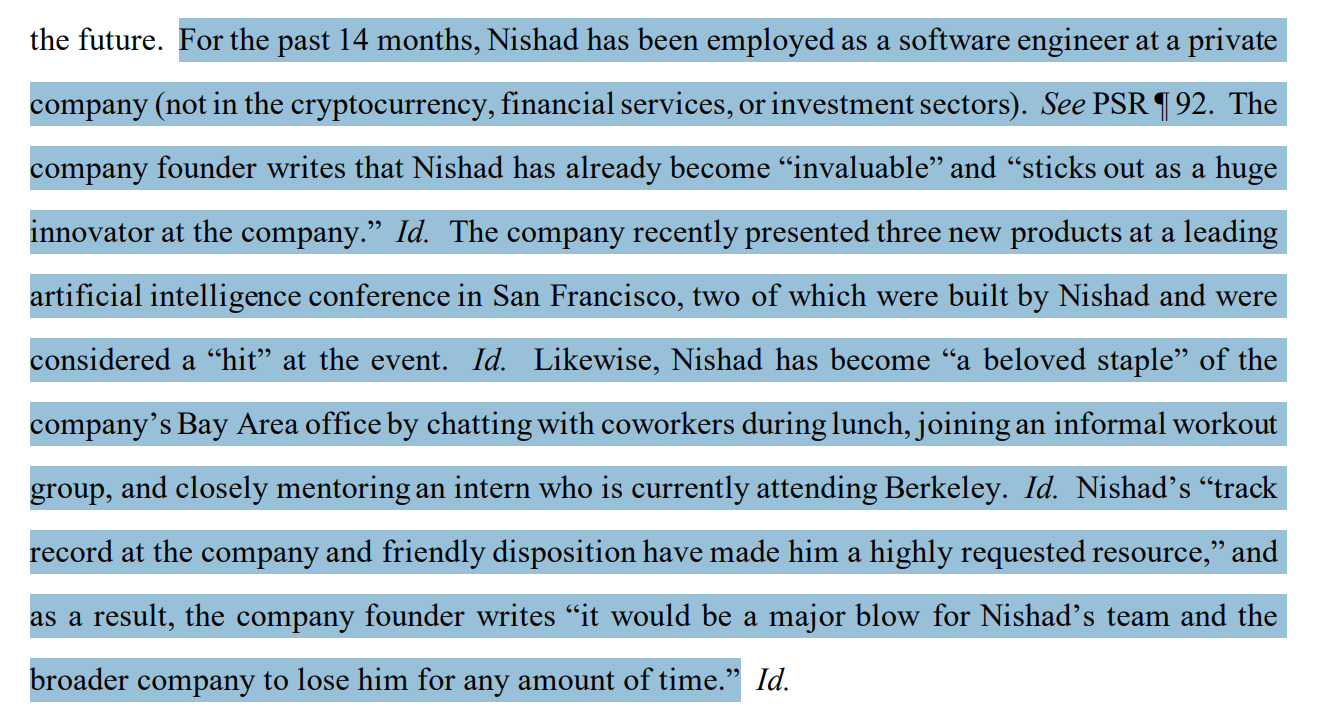
The for profit world seems more interested in effectiveness and in getting results than in canceling unpopular people compared to EA, which I find inefficient, and not the attitude I think is most appropriate to approach the worlds biggest problems.
As others have pointed out, she is (according to Manifund's website) now one of just two employees at an organization that, while certainly smaller than CG, has directed millions of dollars to hundreds of projects.
A very important difference from CG is that Manifund does not decide where the funds go, but is a grantmaking platform where donors themselves are deciding what to fund. Ellison is not deciding who gets millions (as a CG grantmaker would) but is facilitating donations to projects that donors want to fund, so while hopefully it's a very consequential role here influence and power over the funding landscape is much more minor.
At any rate, Manifund being small may limit the damage, but that's a separate question from whether the decision was defensible.
I don't think it's that separate: I mentioned it because I think it would be a bad choice at a much larger org while still being a good choice at manifund.
Meta note: In many ways, EA entails doing math for good. Naturally, it attracts a lot of quantitative-minded people some of whom are less qualitatively inclined. IMO, this sometimes leads people to miss the ways in which PR can be impact-relevant.
I agree, but I also think EAs are way overconfident in trying to predict what would make good PR or bad PR, and don't have great track record in this field.
If anyone will care about this at all, I think it's as likely as anything that it will be seen as Ellison trying to rehabilitate her image after her sentence.
Yarrow Bouchard 🔸 @ 2026-09-18T18:18 (+2)
Bringing it back to EA: I understand the argument that Manifund and Austin do not represent most of the EA community. But it's reasonable that outsiders might think they do if EA orgs don't take steps to distance themselves. I'm glad to see CEA doing so.
If the EA community endorses or even just tolerates the decision and allows Manifund, Austin, and Caroline to participate in the community, e.g., through events hosted by EA orgs like the CEA (which as far as I know has not yet been ruled out), then in that sense Manifund, Austin, and Caroline will represent the EA community.
The sanction against Manifund that Zachary Robinson announced yesterday is a great start. But there are additional straightforward steps that can and should be taken to dissociate effective altruism from the financial corruption Austin just committed and the financial crime Caroline committed and served prison time for.
If the EA community can't agree that financial corruption or financial crime is an ethical red line and won't take decisive action to discourage it, the EA community should be correctly understood — by everyone, including both community insiders and outsiders — as ethically compromised.
It's not really about how things look. It's about how things are. Caroline really did steal money. Austin really did reward her for it.
The EA community should not tolerate this:
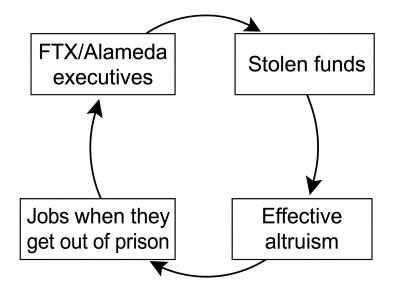
Manuel Del Río Rodríguez 🔹 @ 2026-09-18T13:42 (+3)
Perhaps I am missing some important context too. Some is likely pretty easy to spot: I didn't get interested in EA until after FTX, so I didn't experience either personally or indirectly most of the fallback and the negative consequences for people in the space. I am also the type of person who is very indifferent to PR considerations, and I lean much closer to Rationalist-flavored EA than the other flavor. And I am very positively biased towards Caroline, given the mental map I've made of her from reading about her, her blog and from all the minutiae of the FTX trial. Be that as it may, I find all the arguments you make here pretty rationally convincing (but then I would, wouldn't I?).
Yarrow Bouchard 🔸 @ 2026-09-16T05:43 (+14)
After some reflection, I realized what may be the worst part of this decision.
Austin Chen has decided to reward and endorse Caroline Ellison's crimes at FTX by giving her a job in exchange for the stolen money that FTX gave to Manifund. Austin explicitly said that this decision is out of "debt" to Caroline for the ill-gotten money FTX gave to Manifund. Austin's explicitly stated reasoning is: commit crimes that benefit me and I'll reward you.
Previously, Austin harshly criticized the EA community for its supposed disloyalty to Sam Bankman-Fried in the wake of the revelations of FTX's fraud.
In November 2022, Austin wrote of people in EA who denounced or dissociated themselves from Sam Bankman-Fried:
But from EA folks, this behavior strikes me as cowardly, coldhearted, opportunistic, bandwagon-y, two-faced and distasteful.
In April 2025, Austin said:
I think if you abandon people who have what I viewed as earnestly try to support you and your movement. If you just turn tail on them, be like, "oh yeah, no, actually SBF he was not acting according to our principles and we do not endorse this" and we like give up on all of the stuff that he did. Then when some future billionaire is looking at your movement, what will they think?
And:
...I think we should free SBF and put him to work.
This is a corrupt way to think. This is putting money above ethics.
If someone gives you $500,000 they stole and because of this (not in spite of it!) you give them a job in return, what else is this than corruption? What else is this than a reward for the crime? And an endorsement of the crime?
Nobody can control Austin's decisions and maybe nobody can change his mind. But EA organizations and individual members of the EA community can decide whether you can encourage criminality and engage in corruption and still be a part of the EA community. I think Austin and Manifund should be thrown out, along with Austin's other projects, Manifold and Manifest.
Enough is enough. The line has to be drawn here.
If you're wondering what it would mean to throw Austin and Manifund out of the EA community, here are some steps that could be taken:
- Ban Austin, Caroline, and any future Manifund employees from EA Globals and other EA conferences
- Ban Austin and Caroline from the EA Forum
- Stop working with or recommending Manifund
Only a few people have the ability to ban people from EA conferences or the EA Forum. But there are some steps anyone can take:
- Delete your Manifold account, if you have one
- Commit to not using or working with Manifund in the future
- Commit to not attending future Manifest conferences
- Commit to not working with Austin in the future
- Strongly condemn Austin's decision to hire Caroline Ellison
The EA community has the power to decide who it includes and who it excludes. It therefore has the moral responsibility for those decisions. Criminality and corruption should not be tolerated in the EA community.
James Fodor @ 2026-09-14T17:31 (+13)
This is why people don't like EA. Astonishingly, monumentally bad judgement.
David Mathers🔸 @ 2026-09-15T12:37 (+3)
This is one person's bad decision at one org as far as I can tell, that the vast majority of EAs seem to disagree with. Don't think we should be doing too much self-criticism over it.
James Fodor @ 2026-09-15T12:48 (+5)
You are missing two points:
1. The fact that a single person can make such an impactful decision despite the rest of the community being against it is a sign of poor governance.
2. People outside the EA community will not see it this way.
Ariel Simnegar 🔸 @ 2026-09-15T13:30 (+3)
On (1), on a practical level, how would you propose a community govern the hiring decisions of all affiliated orgs? At first impression, seems like only highly centralized governance could accomplish this, which would worry me more than the harm it could prevent.
David Mathers🔸 @ 2026-09-15T15:40 (+2)
I'm definitely not missing the second point, since I agree with it and its one of the reasons I think it's a bad decision. But that doesn't mean they'll be correct to see it as something "EAs" are responsible for.
On the first point, I agree with Ariel, I don't really see how the community can have multiple self-governing orgs and also prevent any of them from making bad hires. I don't think Austin would have responded to external pressure on this. And I'm not sure how much prior endorsement from big EA orgs Manifund had anyway.
Yarrow Bouchard 🔸 @ 2026-09-16T05:27 (+2)
There are straightforward steps that EA organizations and individuals in EA can take now. Here are a few of them:
- Delete your Manifold account, if you have one
- Commit to not using or working with Manifund in the future
- Commit to not attending future Manifest conferences
- Commit to not working with Austin Chen in the future
- Strongly condemn Austin's decision to hire Caroline Ellison
The primary goal now is not to influence Austin's actions. The primary goal now is to make it very clear whether effective altruism rewards and endorses financial crimes. Austin's actions reward and endorse Caroline Ellison's crimes and give her a job as repayment for Caroline giving Austin's organization stolen money. Is this the morality that effective altruism stands for? Or not?
If not, it is straightforward to take steps to make that clear. All EA organizations and all prominent individuals in EA or even non-prominent individuals should do that now.
I deleted my Manifold account after the Manifest racism scandal. I have even more reason to avoid Manifold, Manifund, and Manifest now. I strongly condemn this decision.
Effective Ventures, the Centre for Effective Altruism, 80,000 Hours, Giving What We Can, and other EA orgs should make statements. It could be something like this:
Our organization strongly disagrees with Austin Chen's decision to hire Caroline Ellison, who was convicted of financial crimes in relation to FTX, in a financial role at Manifund. We will not work with Manifund or Austin's other organizations in the future, or with Austin. While we support rehabilitation, this is not the way to do it. We strongly condemn the crimes committed at FTX and any attempt to reward or endorse them. Neither crime nor actions that celebrate or incentivize crime are welcome in the effective altruist community.
To be clear, the primary goal of such statements would not be to change Austin's mind, but to discourage criminality and corruption in effective altruism.
And if the EA can't do that, what good is EA? No good.
James Fodor @ 2026-09-15T16:59 (+2)
A first step would be to establish and strongly promote norms for governance structures that need to be in place for affiliation or accepting donations from an individual or organisation. The fact of the matter is these issues have never been prioritised by major community orgs and are rarely discussed until another scandal comes along.
Rachel N. @ 2026-09-13T17:33 (+12)
- An underlying assumption here seems to be not just that people deserve to make a living, but that forgiveness is inherently good. While this is a common axiom in the West, it is not obvious to me that this moral claim is correct.
- Two issues regarding communications:
- On a macro level: “Reputation” is not a vanity consideration. It is integral to the theory of change of many EA orgs, particularly those focused on AI policy. A random legislative staffer is unlikely to see the comments on this post, but they may see the upcoming Netflix series on FTX. A google search on “FTX and EA” now reveals this post: https://whatweare.substack.com/p/no-one-is-going-to-save-the-ea-brand. It's not impossible to imagine this hiring decision making it harder for AI policy orgs to secure meetings with staffers to advance important safety legislation.
- On a micro level: Most people in EA probably would have opposed this hire anyway, but this press release seems to have only engendered more concern and, frankly, confusion. Several people have sought clarity regarding the rationale for the hire as this statement implied a mixture of personal considerations. I was most perplexed by the section on transparency, which reads: “I apologize for our minor deception, in using a pseudonym over the last couple months. I still endorse having done this”. These two sentences seem contradictory and read as something like: “I’m sorry if you were offended.”
I understand why some EAs might be skeptical about the importance of communications. After all, lots of ineffective organizations have amazing comms. While good comms does not necessarily imply good work, bad comms often does indeed imply a real judgement issue, which one might reasonably expect would affect the core work as well.
Nathan Young @ 2026-09-12T18:45 (+12)
As I read this comment section, the story my mind generates is a people want to express 'this is bad and I want people to see that I think it's bad'. Is that how people who are writing the negative comments feel?
Or do you feel like you could be convinced this is fine/none of your business?
Cos personally I think I could be convinced this is a bad idea, or that Manifund should not be considered an org in good standing[1]. I don't think it would destroy me to come to that conclusion.
- ^
I probably do think that Manifund is not an easy safe org for your sweet friend who is new to EA, though I guess I think that of CEA and CG and Nonlinear too
James Herbert @ 2026-09-15T14:33 (+6)
Yes, partly. I want it visible that I think this is bad. A community with no formal membership has very little else. There's no board that can sanction Manifund and no membership to revoke, so what people say in public, under their own names, is close to the whole enforcement mechanism for community norms.
I certainly hope I could be convinced this is fine/none of my business!
For example, if the media covers this and don't draw connections with EA, that would update me towards 'none of my business' (right now I think there is a reasonably strong connection, but if informed outside observers disagree with me on this I'd become less certain). Or if someone could present me with case studies of individuals who were convicted of fraud and then went on to have successful finance-y careers without further misconduct, that would update me towards 'this is fine'.
Matrice Jacobine🔸🏳️⚧️ @ 2026-09-15T18:48 (+6)
case studies of individuals who were convicted of fraud and then went on to have successful finance-y careers without further misconduct
Claude says, with various caveats: Michael Milken, Steve Madden, Marc Rich, Dennis Kozlowski, Andrew Fastow.
James Herbert @ 2026-09-15T19:22 (+1)
Thanks!
nananana.nananana.heyhey.anon @ 2026-09-13T10:05 (+3)
I don’t follow your question. Can you re-state it differently?
It would not destroy me to come to a different conclusion.
I don’t think this answers your question, but I can easily sympathize with how someone in Austin’s shoes could find reasons to make this call that he sincerely believes are correct, while being a smart and compassionate person. I still strongly disagree with his decision here.
Nathan Young @ 2026-09-14T18:07 (+2)
Glad to hear it. I am curious if that is common here, or not (though I guess you can't answer that).
Capucine Griot @ 2026-09-14T19:38 (+11)
Even though I understand part of the reasoning behind this decision, and I sincerely wish Caroline Ellison well, I feel very uncomfortable with it. I'm particularly uneasy about the personal reasons given as part of the justification.
I think this was overall a poor decision, and it makes me question what kind of governance and decision-making process Manifund has, and whether anyone besides Austin was meaningfully involved.
Nathan Young @ 2026-09-12T05:53 (+11)
I weakly think that Austin can hire who he likes.
I moderately think that EA could do with caring a less about reputation and more about good work. Does Caroline do good work? Seems like the org will internalise that, so it's probably up to donors and other orgs to decide.
Seth Ariel Green 🔸 @ 2026-09-13T21:30 (+25)
I agree with both points here. A few general thoughts, echoing something I wrote in 2022.
- Very hard for an outsider to assess whether someone is likely to be good at a job. I generally don't like to second guess other people's hiring decisions.
- There are extreme cases where I'd second guess anyone. SBF is obviously a psychopath and hiring him would be insane. Likewise, there are cases when you don't hire the (narrowly conceived) ‘best’ person for the job. I would never hire Diddy to promote a party or produce a track, for instance.
- I don't think Caroline is such a case. I view her as a cautionary tale about getting sucked into the orbit of a charismatic psychopath when you're a young person. I'll never know what I would have done in her shoes. For what it's worth, I once applied to be SBF's friend in the Bahamas because it was advertised on the EA forum.
- If Caroline were hired at CG or CEA or a few other orgs, I'd be worried about reputational harms. Manifund is much more marginal than that. I think reputational harms will be commensurately marginal.
- One version of this point is to note that EA's critics are looking for anything to pounce on because we're a bunch of weirdos, and Austin's reasoning about this is definitely weird (as in 'unusual' rather than 'bad', whereas for some folks, these two senses of the word are indistinguishable). It is unbecoming and ignoble to live in fear of what one's least generous adversaries might say.
- Another version of this point is that many EAs believe very deeply in the power of ideas and thus are worried about second order effects of stating/living one's ideas, such as reputational harms and infohazards. I think these concerns are largely overblown. I think they make too much of our own importance and the extent to which people are paying attention to us whatsoever.
- Having said that, I think a mocking headline about this hire is likely. (But where? NYPost? Current Affairs? Wired? Sierra Club? London Review of Books? Our haters are an ideologically rich array. A real cosmic gumbo, you might say.)
- The strong feelings this post inspires suggests that the FTX trauma has not fully healed. I wonder if EAGs should have like, sessions or something where people who were affected by it can grieve together. Weren't we all?
Nathan Young @ 2026-09-12T20:04 (+2)
I also think it's brave of Austin to do this, and in general I like bravery, even if it causes people do things I don't like. Doesn't seem like a huge or secret kind of bravery either, which are sometimes time bad kinds.
Nathan Young @ 2026-09-12T15:46 (+2)
That said, I think this paragraph is kind of notable:
I felt a keen debt to the FTX Future Fund. They provided seed funding for Manifold. They funded the retreat which drew me into the EA community, and the conference where I met my wife. Much of Manifund’s work today is directly inspired by the Future Fund’s approach.
I also feel a debt to the Future Fund, they gave me my first grant for the work I now do. But I don't feel much debt towards Caroline there. Plus, perhaps, if i am to forgive her her debts, perhaps that should also cancel out benefits?
Austin @ 2026-09-12T16:36 (+7)
I believe the entire EA Bahamas Fellowship was Caroline's idea? (But to be clear, Joel Becker was the one who took over and organized most of it.)
One kind-of-funny detail in all this: Caroline herself interviewed, then rejected Manifold initially in Dec 2021. (I doubt she remembers this; I'd forgotten until this week.) It was a later Future Fund regrantor who got us into that fellowship.
Anyways: I agree that the Future Fund team definitely deserves more of the credit than FTX -- and also, FTX's creditors deserve a lot of that credit rather than FTX management. I've offered at times to support folks who worked on the Future Fund or FTX Foundation; happily I think they are all now off doing amazing things.
Nathan Young @ 2026-09-12T18:39 (+2)
I guess I am curious if the debt you feel brought her to your attention or changed your decision. I think I weakly endorse the former and weakly to moderately unendorse the latter.
Jeff Kaufman 🔸 @ 2026-09-14T13:53 (+10)
Adds additional context to https://revive.blog/b/worldoptimization on Manifold's new Blog Revival Project, with Austin pledging towards reviving his then-anonymous coworker's blog.
(Just found this interesting and mildly funny, not saying the pledging or project is bad. Though I agree with others that handling finances at a two-person org is very clearly a bad role for someone convicted of financial fraud, and "I felt a keen debt to the FTX Future Fund" should point the other way.)
Austin @ 2026-09-14T14:27 (+4)
Thanks for highlighting - to be clear, that was kind of a joke, and a bit of misdirection. (While, also, making a serious statement that I liked Caroline's blogging and hope to see more of it). I'm glad you saw the humor in it!
We never intended to follow through on having Caroline take any donation from me, of course.
Flo 🔸 @ 2026-09-14T15:41 (+2)
Wait, so pledges from you personally on the blog revival project site can just be retroactively declared a joke with no intention of paying out?
Jeff Kaufman 🔸 @ 2026-09-14T15:49 (+9)
We're in a bit of a pitchforks mood, but I don't think whether Austin and Caroline would have transferred this particular bit of money is a good target.
Flo 🔸 @ 2026-09-14T15:59 (+7)
Yes, sorry if I'm coming on to strong, it just feels like more “everything’s vibes, we just do whatever” for me
Austin @ 2026-09-14T15:52 (+7)
I believe I mentioned this verbally with Caroline before making the pledge. I haven't done this for any other other bloggers and have no intention for doing so.
Matrice Jacobine🔸🏳️⚧️ @ 2026-09-14T15:43 (+2)
Caroline presumably would just pay back?
Milli🔸 @ 2026-09-14T11:32 (+8)
Without commenting on this specific case, I think society in general is bad at dealing with people who have made large mistakes, especially former criminals.
I'm sad that PR concerns and risk aversion are legitimate reasons not to do (much) better.
To be clear: I don't condone crime, and FTX's leadership committed serious fraud.
huw @ 2026-09-12T04:07 (+6)
- Would you be able to speak more on why you decided to announce this publicly at all, rather than continue to use a pseudonym for Caroline and keep her away from outward-facing roles?
- Why do you believe that the EA-wide and Manifund-specific harms you’ve already acknowledged, are worthwhile to incur, and to what end?
- Do you believe there is some positive signalling value to be gained from announcing this that offsets the negative signalling?
- Did you specifically trade off broader harms to EA’s reputation in order to advance Manifund’s own reputation? (My sense is Manifund has a non-overlapping target audience with EA)
I’m struggling to understand why this had to be announced, given the harms that specifically come from publicising it.
Austin @ 2026-09-12T07:28 (+14)
We chose to announce it today because we figured we weren't going to be able to keep it under wraps forever; we didn't want to anyways, per Manifund's spirit of transparency; she was visiting town this week and in-person discussion/collaboration made the announcement easier; and my wife is due to give birth ~5 days and I didn't want to worry about the announcement while on paternity leave.
JennaS @ 2026-09-12T06:26 (+9)
One hypothesis is that someone else was going to announce it, so it was decided it would be better if he went ahead and did it.
huw @ 2026-09-12T07:15 (+2)
Then a line like ‘we did not intend to announce this, but decided to because it would have made it to light anyway’ would have sufficed, since there is a stated concern for transparency :)
EA NZ @ 2026-10-02T03:09 (+5)
EA NZ strongly disapproves of Manifund’s decision to hire Caroline Ellison. While we bear no ill will towards Austin or Caroline as individuals, placing a convicted fraudster in a role running a funding platform shows an egregious disregard for the risks and responsibilities involved. As a result, we will not be participating in or collaborating with any of Manifund’s projects for the foreseeable future. In the past, we have both received small amounts of funding and directed grants through Manifund’s platform, and found it to be a valuable service. However, we can no longer in good conscience endorse their work.
Remmelt @ 2026-09-23T00:00 (+4)
This is deeply problematic. I’m glad others in the community are noticing concerns here.
Alex Vermillion @ 2026-09-21T13:35 (+4)
For reference, see how this was covered in The Argument (an explicitly progressive Substack news magazine intended to not be ragebaity but to still show disagreements where they exist). This is roughly the nicest coverage this event will ever get.
Note: It is only covered very briefly before the paywall. I think it will still be useful for people to read.
Anna Daniel @ 2026-10-07T21:22 (+3)
I don't doubt the sincerity of Caroline's remorse, and people who have served their sentences need a path back to work. My view is that the path is better found by retraining to work in another sector away from handling or controlling other peoples' money.
From a governance perspective, no financial org should employ anyone convicted of financial fraud. Basic reasons why:
- Most regulators require a 'fit and proper person' test (for finance orgs but not charities I think)
- Culture: it signals integrity is negotiable
- Fiduciary duty: knowingly appointing a convicted financial fraud is hard to defend
- Client protection
- Stakeholder and donator / investor confidence
- Risk management and internal controls: fraud is a core risk
- Trust and brand
- Insurance premiums are high or refused if a convicted financial fraud is employed
- Legal liability: directors may face negligent hiring claims
- Some jurisdictions have 'clean slate' laws (e.g. acknowledging redemption), but finance orgs are often exempt.
Manifund is a charity not a regulated finance org so the rules are less stringent. I'd be interested to hear what safeguards the board has put in place – that would go a long way to addressing the concerns listed in this forum. It appears the CEO who made the hire is one of three (?) governing members of Manifund. What independent oversight exists? That is, who reviews financial controls and system access, and are any directors independent of the founders and of FTX-related matters?
River @ 2026-10-04T18:33 (+3)
I started wanting to be in Austin and Caroline's camp on this. Austin is a friend. I do not believe in disassociating from people for PR reasons. And I do believe in forgiveness and second chances up to a point. Caroline flipped and served her time. There should still be a place for her. If I were in a position to, I'd invite her to a game night or consider hiring her for a research role.
That said, after reading through all this, I think Austin has made a serious mistake. Two dominant points stand out for me. Firstly, Austin appears to feel some notion of reciprocity for the funding received from FTX. This sets off alarm bells. If someone funds me or my activities with stolen money, I would consider myself to be wronged by that. I expect I would feel hurt by them. That Austin not only feels gratitude, but apparently endorses acting on that feeling of gratitude, that shows very poor judgement.
Secondly, forgiveness and second chances does not mean disregarding reasonable caution. Caroline committed a serious financial fraud. I would not put her in any role that would require her to have access to an organizational bank account. Austin has put her in a role where she is one of two employees of an organization that exists to shuffle money around. For the next couple of months it appears she will be the sole employee not on leave. I cannot imagine that she won't have access to the organizational bank accounts. This, again, shows very poor judgment.
Austin @ 2026-10-05T00:04 (+2)
hi! as I've posted on X:
perhaps I really botched the writeup but I meant to say that feeling a debt to the future fund is why I'd consider the idea of hiring an unpopular, convicted individual, while many other people would just reject that idea prima facie
while the decision to actually hire Caroline comes from having interviewed her, work trialed her, and assessed her competence and skillset, and having considered Manifund's talent shortages
and as a quick point of clarification, I've returned to working after approximately a week of parental leave.
River @ 2026-10-05T22:31 (+1)
I am basically not on X/twitter. Is your claim that the Future Fund was meaningfully separate from FTX and Alameda? My understanding is that it got its money from FTX/Alameda, and that it was controlled by the same people, and your feeling of gratitude toward Caroline seems to suggest that as well.
Lee Wright @ 2026-09-13T09:52 (+3)
I'm worried this means that my org could now be taking on an unacceptable degree of counterparty, governance, and reputational risk.
This could potentially affect our funding if there's any evidence of a relationship; good governance and risk management practices are a documented condition of some of our larger grants.
______ @ 2026-09-18T20:43 (+2)
Strongly agree with titotal's comments, Zachary Robinson's comments, etc. Has anyone with relevant background reviewed Caroline's code commits and comments that Austin linked to in the post yet? An LLM I pointed it at found various issues with it and some of them seemed potentially serious. I don't think that evidence of serious bugs would change Austin's mind at this point, but maybe it could be helpful for others to know about.