Soil-arthropod-years affected per electrically stunned shrimp
By Vasco Grilo🔸 @ 2026-09-28T16:03 (+12)
This is a linkpost to https://claude.ai/code/artifact/13264ce5-1e12-4443-a2e4-0b9515102681
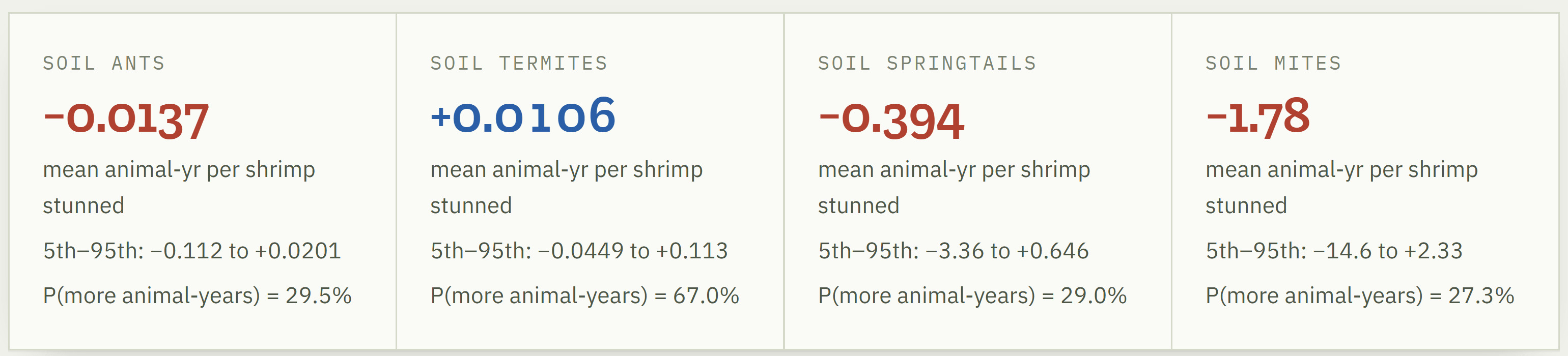
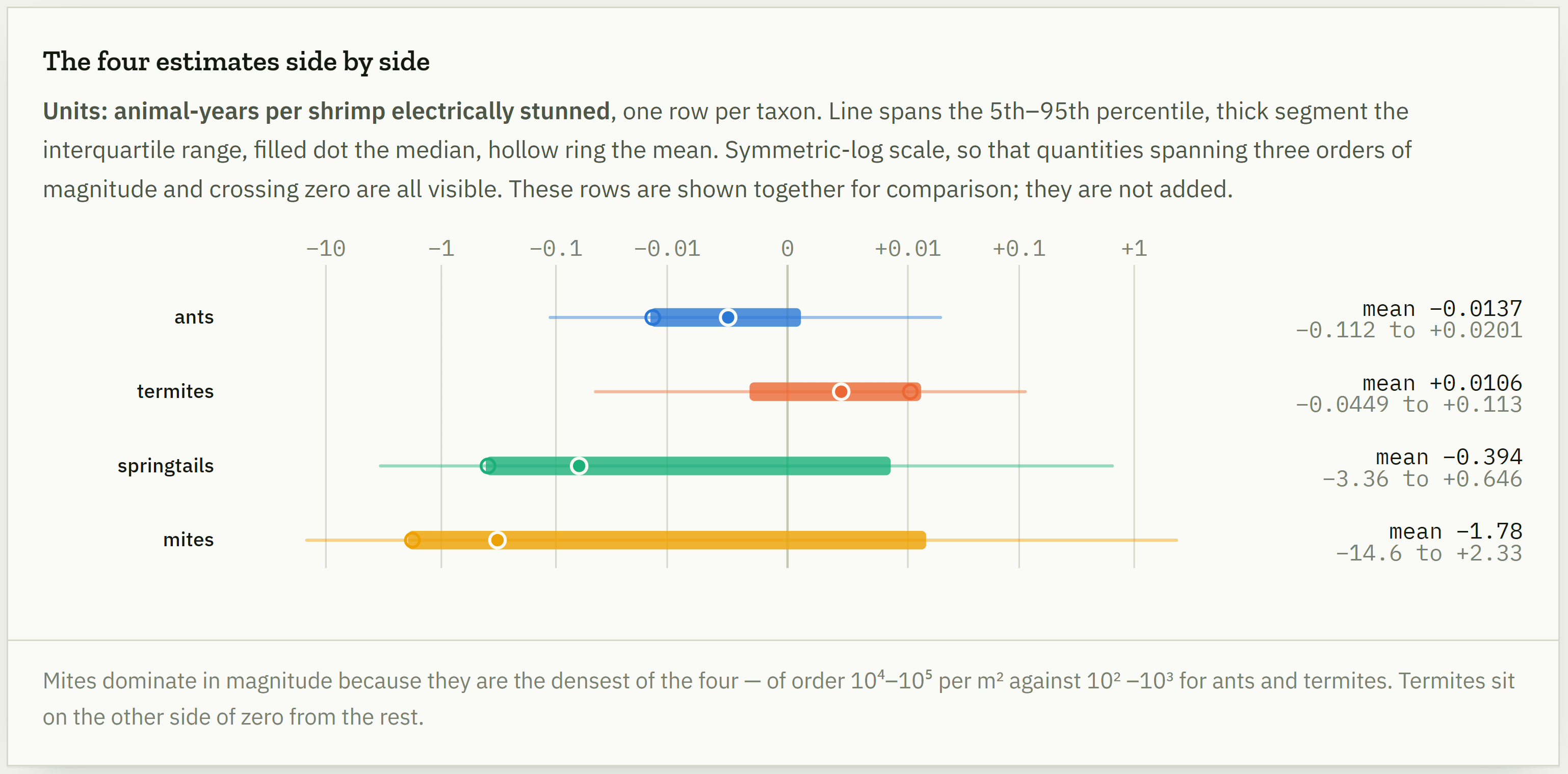
This is a linkpost to an artifact I built with Claude Opus 5 and 5.5 High analysing how electrically stunning farmed shrimps affects the living time of soil invertebrates. I looked into ants, termites, springtails, and mites. The main results are below. I believe electrically stunning farmed shrimps is the intervention that comes closest to robustly increasing welfare of those I am aware of. However, I continue to think it may change the welfare of soil invertebrates more or less than that of farmed shrimps. I can see a reduction of 0.394 soil-springtail-years, or 1.78 soil-mite-years changing welfare more than electrically stunning a shrimp.
J_R🔸 @ 2026-09-28T18:12 (+3)
Cool!
Though I found it a bit confusing to assume that the full price of the stunner is absorbed into the price, given SWP donate the stunners.
Vasco Grilo🔸 @ 2026-09-28T18:42 (+6)
Hello. Thanks. Assuming the stunners are subsidised has a small effect on the change in soil-arthropod-years per electrically stunned shrimp.
Who pays for the stunner. Scenario. The headline assumes the producer pays for it, as under a legal requirement to stun or unsubsidised adoption. Where SWP donates the stunner, as in its Humane Slaughter Initiative, only the running costs raise the producer's cost of stunning a shrimp: the mean cost falls by 32.2%, and every mean change in living time falls by about as much (33.0–34.1% in the simulation), with the probability of more living time unchanged. Full estimates are in the Scenarios section.
Here are the details.
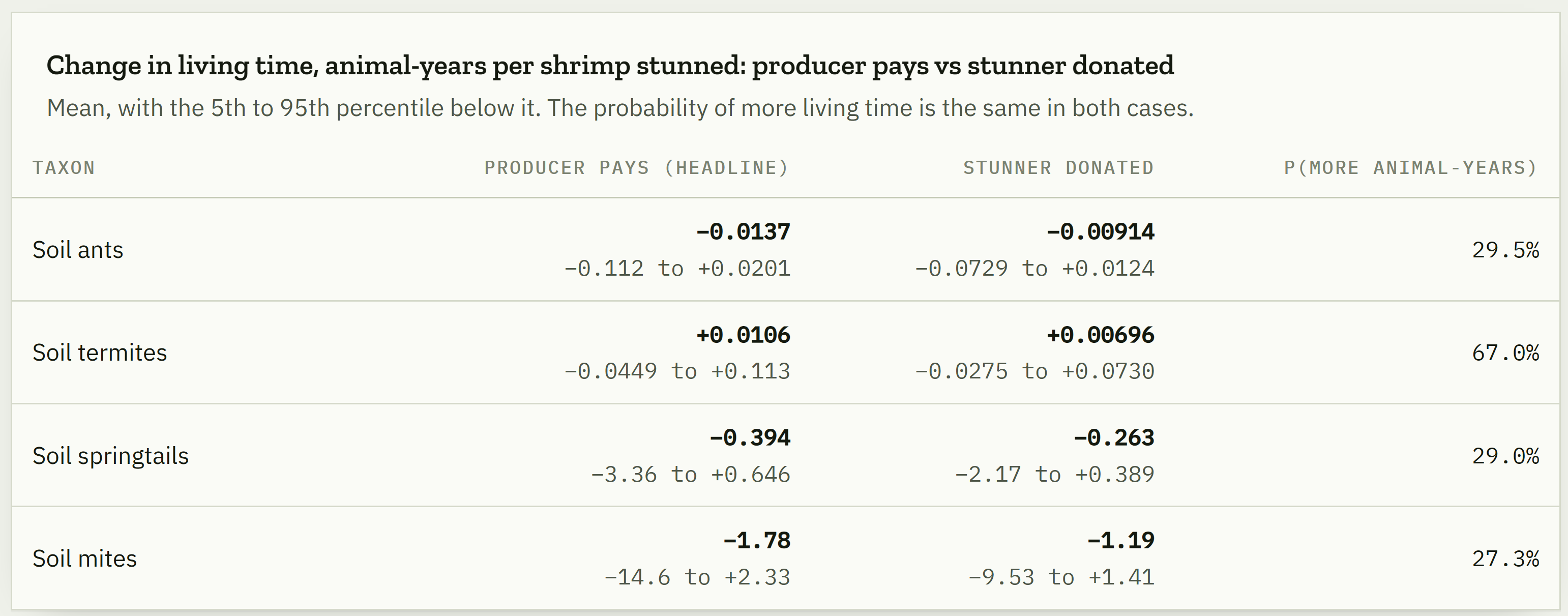
I assume the stunners are not subsidised in the baseline scenario because I am expecting subsidised stunners to stun a minority of the shrimps electrically stunned in the future. @Aaron Boddy🔸, who was the CEO of the Shrimp Welfare Project (SWP) until July 2026, commented the following on 7 Octoner 2024.
We’ve had some good indications recently that HSI does contribute to “locking-in” industry adoption, with Tesco and Sainsbury’s recently publishing welfare policies, building on similar wins in the past (such as M&S and Albert Heijn).
This has always been the Theory of Change for the HSI project. Although we’re very excited by how cost-effective it is in its own right, ultimately we want to catalyse industry-wide adoption - deploying stunners to the early adopters in order to build towards a tipping point that achieves critical mass. In other words, over the next few years we want to take the HSI program from Growth to Scale.