All pains are comparable?
By Vasco Grilo🔸 @ 2026-02-21T09:46 (+20)
Summary
- I agree there are pains which feel qualitatively different in the sense of having distinct properties. For example, annoying and excruciating pain as defined by the Welfare Footprint Institute (WFI).
- Some think there are pains whose intensity is incomparably/qualitatively worse than others. For instance, some believe averting an arbitrarily short time of excruciating pain in humans is better than averting an arbitrarily long time of annoying pain in humans. In contrast, I would prefer warming up slightly cold patches of soil for sufficiently many nematodes over averting 1 trillion human-years of extreme torture.
- Consider a human body as described by the state of all of its fundamental particles. Are there any 2 states which are only infinitesimally different whose pain intensities are not quantitatively comparable? I do not see how this could be possible. So I conclude the pain intensities for any 2 states of a human body are quantitatively comparable.
Pains can feel qualitatively different, and still have quantitatively comparable intensities
I agree there are pains which feel qualitatively different in the sense of having distinct properties. For example, annoying and excruciating pain as defined by WFI. Annoying pain “should not deter individuals from enjoying pleasant experiences with no short-term function (e.g., play) and positive social interactions”. “Sufferers can ignore this sensation most of the time”. In contrast, excruciating pain “would mark the threshold of Pain under which many people choose to take their lives rather than endure the Pain”. “Concealment of Pain is not possible”.
However, pains can have different properties, and still have quantitatively comparable intensities. Ice and liquid water have different properties, but their mass and temperature can still be quantitatively compared. Losing 1 s of life is qualitatively different from dying, but the loss of living time is still quantitatively comparable. For an alternative time until death of 50 years, dying would correspond to a loss of 1.58 billion s (= 50*365.25*24*60^2). I suspect the intensity of excruciating pain feels incomparably/qualitatively worse than that of annoying pain simply because it is way higher.
Warming up nematodes vs averting extreme torture in humans
Some think there are pains whose intensity is incomparably/qualitatively worse than others. For instance, some believe averting an arbitrarily short time of excruciating pain in humans is better than averting an arbitrarily long time of annoying pain in humans.
In contrast, I would say averting a sufficiently long time of a pain with an arbitrarily low intensity is better than averting an arbitrarily long time of a pain with an arbitrarily high intensity. As an extreme example, I would prefer warming up slightly cold patches of soil for sufficiently many nematodes over averting 1 trillion human-years of extreme torture.
Why I think all pains have quantitatively comparable intensities
Consider an experiment where someone keeps their hand in hot water for a given duration. Is there a temperature T for which the pain at temperature T + 10^-100 ºC is incomparably/qualitatively worse than the pain for temperature T? 10^-100 is 0.000…1 with 100 digits after the decimal point. The higher temperature could feel incomparably/qualitatively worse for a sufficiently large difference in temperature. For instance, 5 s at 100 ºC would certainly feel incomparably/qualitatively worse than 5 s at 50 ºC. Yet, the pain would feel practically the same for a super tiny difference in temperature like 10^-100 ºC. In this case, it is clear to me that the pain intensities would be quantitatively comparable, and practically feel the same. Moreover, this would hold across the whole spectrum of temperature. So I conclude the pain intensities for any 2 temperatures are quantitatively comparable.
Generalising, consider a human body as described by the state of all of its fundamental particles. Are there any 2 states which are only infinitesimally different whose pain intensities are not quantitatively comparable? I do not see how this could be possible. For example, it feels super counterintuitive to me that moving an electron by 10^-100 m could prevent the pains from being quantitatively comparable. There is lots of empirical evidence for practically negligible effects on subjective experiences for much larger changes. So I conclude the pain intensities for any 2 states of a human body are quantitatively comparable.
Furthermore, I think pain intensities are comparable across all organisms. It is “widely accepted by biochemists” that all life on Earth descended from a common ancestral cell population. So I assume one can go from any human state to any state of any other organism via a huge number of very small changes.
Generalising even further, I would say any 2 states of the universe are quantitatively comparable with respect to their expected total hedonistic welfare.
Acknowledgements
Thanks to Anonymous Person for a discussion which led me to publish this post. The views expressed in the post are my own.
Alfredo Parra 🔸 @ 2026-02-23T18:01 (+8)
Thanks for writing this, Vasco! And thanks for inviting me to comment given that you expected me to disagree with the conclusion (which I do :)). I'm still confused about these questions but I think there are two analogies from physics/mathematics that might apply here and cast doubt on the post's conclusions, namely, (1) phase transitions and (2) topological transformations.
NB: I recorded a voice note into Claude and then asked it to structure and clarify my thinking, which I then cleaned up.
Your argument, as I understand it, goes something like this:
- A human body can be described by the state of all its fundamental particles.
- For any two states that differ only infinitesimally, the pain intensities must be quantitatively comparable.
- You can get from any state to any other state via a chain of infinitesimal changes.
- Therefore, all pain intensities are quantitatively comparable.
I think (2) is doing a lot of heavy lifting here, and I don't think it's obviously true. The key issue is that continuous variation in underlying physical parameters does not entail continuous variation in the properties that emerge from them. This happens for example in phase transitions and topology.
Phase transitions
When you heat a ferromagnet continuously, nothing dramatic happens for a while. Then, at a specific critical temperature (the Curie temperature), ferromagnetism doesn't just decrease, but it vanishes entirely. The property "being able to attract iron" is not something that fades smoothly to zero. It disappears at a sharp threshold, even though the underlying control parameter (temperature) was varied continuously.
Similarly, when you cool certain materials, electrical resistance drops to exactly zero at a critical temperature (superconductivity). "Very low resistance" and "zero resistance" are not just quantitatively different. Superconductors exhibit qualitatively new phenomena (persistent currents, the Meissner effect, flux quantization) that materials with merely very low resistance simply do not have.
In our earlier exchange, I used the water/steam analogy, and you responded that we can still compare the temperature of water and steam. That's true, but I should have added that I think pain might not be analogous to temperature, but to some other property. Temperature is a property that varies smoothly across the phase boundary, but there are other properties that only exist in one phase. For example, steam can do mechanical work via expansion (it drives turbines); liquid water cannot. Liquid water has surface tension (it forms droplets, menisci, capillary action); steam doesn't. These properties aren't "less" or "more" across the transition. They're categorically present or absent.
So the question is: is pain intensity more like temperature (a quantity that varies smoothly across all physical states), or more like magnetism or surface tension (a property that can appear, disappear, or transform categorically / jump at critical thresholds)?
I think there's good reason to suspect the latter. For example, neurons themselves exhibit all-or-nothing action potentials. Below a voltage threshold, nothing propagates. Above it, a full spike fires. Continuous variation in input produces a binary output. If certain pain experiences depend on whether particular neural cascades fire or not, then the inference from "infinitesimal change in particle positions" to "infinitesimal change in pain intensity" breaks down at these thresholds.
Topological transformations
Consider a rubber sphere. You can stretch it, compress it, bend it, twist it however you like, and it remains topologically a sphere. But to turn it into a torus (a donut shape), you need to introduce a hole. The number of holes (the "genus") is an integer. It cannot change by 0.01. And yet this discrete invariant determines fundamental properties of the surface, like how many independent loops can exist on it.
Or consider a loop of string. You can deform it continuously all day long, but the moment a crossing is introduced and locked in, you get a knot, which is a topologically distinct object. The unknot and the trefoil knot are categorically different. You cannot "halfway" have a knot. Knot invariants are discrete, even though every local manipulation of the string is smooth.
Suppose the morally relevant feature of a conscious experience is something like a topological property of the neural dynamics: perhaps the structure of information integration, the geometry of recurrent loops, or the topology of attractors in the brain's state space. More concretely, if pain was, say, the degree of dissonance in the electromagnetic waves generated by the nervous system, then introducing a topological defect into the field could suddenly allow new levels of dissonance not possible without the defect.
If that's the case, then the argument "moving an electron by 10^-100 m cannot prevent the pains from being quantitatively comparable" would be analogous to arguing "stretching a rubber sphere by 10^-100 m cannot change its genus." For most configurations, that's true. But at a critical configuration, that tiny stretch is exactly what punctures the sphere and changes the genus from 0 to 1. The transition is sharp and local in parameter space.
So overall, I think the burden of proof is on showing that pain intensity actually behaves like temperature (smoothly varying, phase-invariant) rather than like magnetism, surface tension, or genus (categorically structured, with critical thresholds). I think it's more likely to be the latter (and that the symmetry theory of valence will be key in finding the solution).
My intuition is that the conclusion "I would prefer warming up slightly cold patches of soil for sufficiently many nematodes over averting 1 trillion human-years of extreme torture" should be a reductio ad absurdum for the argument, and maybe the two angles above show how one might escape such a conclusion.
I hope this helps clarify where I'm at!
Vasco Grilo🔸 @ 2026-02-23T20:31 (+4)
Hi Alfredo. Thanks for sharing your thoughts.
A human body can be described by the state of all its fundamental particles.
I am not sure the state of a human body is fully defined by the state of its fundamental particles, but I used this to mean all of its physical properties.
The key issue is that continuous variation in underlying physical parameters does not entail continuous variation in the properties that emerge from them.
For my argument to work, it is enough for pain intensity to be quantitatively comparable for infinitesimally different physical parameters. The pain intensity does not have to be a continuous function of the physical parameters. I actually suspect physical parameters can only vary discretely, in agreement with quantum mechanics. So I believe both physical parameters and pain intensity vary in infinitesimally small jumps.
When you heat a ferromagnet continuously, nothing dramatic happens for a while. Then, at a specific critical temperature (the Curie temperature), ferromagnetism doesn't just decrease, but it vanishes entirely. The property "being able to attract iron" is not something that fades smoothly to zero. It disappears at a sharp threshold, even though the underlying control parameter (temperature) was varied continuously.
This is not true. I wonder whether Claude hallucinated it. Spontaneous magnetisation (M) just below the Curie temperature is proportional to ("Curie temperature" - "temperature")^"exponent (0.34 for iron)". So spontaneous magnetisation smoothly goes to 0 as the temperature approaches the Curie temperature. In any case, spontaneous magnetisation would be comparable across any 2 temperatures even if it abrupty dropped to 0 near the Curie temperature. The spontaneous magnetisation for a temperature at least as high as the Curie temperature is 0 times that for a temperature below it.
For example, steam can do mechanical work via expansion (it drives turbines); liquid water cannot.
The mechanism via which steam does mechanical work is fundamentally the same as that through which liquid water does mechanical work in hydropower. In both cases, molecules of water collide with turbines, and make them spin. For the case of steam, water vapour molecules are accelerated by temperature. For the case of hydropower, liquid water molecules are accelerate by gravity. In any case, the mechanical work done by steam and liquid water is quantitatively comparable.
The density of water also varies smoothly as it boils. It increases linearly with the vapour quality, which is the mass of water vapour as a fraction of all the mass. For a vapour quality of 0, there is saturated liquid water, and the density matches that of liquid water at the boiling point. For a vapour quality of 1, there is saturated water vapour, and the density matches that of water vapour at the boiling point.
In the example above, an infinitesimal change in a physical property (temperature) leads to an abrupt change in another physical property (density), but the underlying physical state does not change infinitesimally (at the boiling point, an infinitesimal change in vapour quality results in an infinitesimal change in density). In any case, a physical property varying abrupty for an infinitesimal change in the underlying physical state would not undermine my argument. The physical property in one state would have to be quantitatively incomparable with that on another state. The density of water at different states is quantitatively comparable.
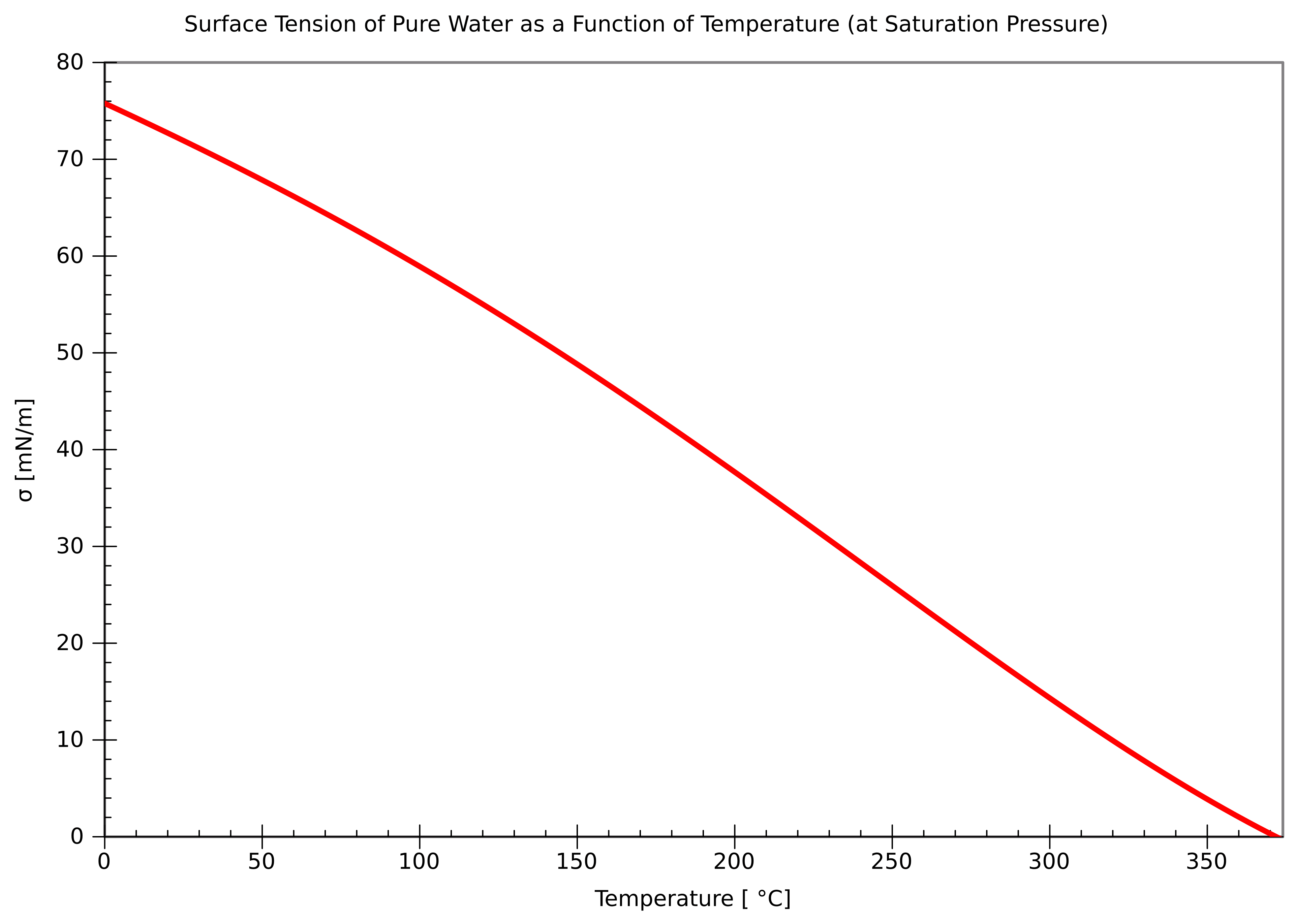
Liquid water has surface tension (it forms droplets, menisci, capillary action); steam doesn't.
Surface tension is technically not a property of liquid water or water vapour. It is a property of liquid–air interfaces, and it varies smoothly with temperature. The surface tension for the interface between liquid water and water vapour is different than that between liquid water and other gases.
Topological transformations
Are you practically arguing that some pain intensities are not quantitatively comparable, even if their underlying physical states only differ infinitesimally, because there are mathematical functions which are not continuous? I do not understand why the space of possible mathematical functions would provide any meaningful empirical evidence about pain intensities.
I think the burden of proof is on showing that pain intensity actually behaves like temperature
My core point is that infinitesimal changes in physical reality do not make pain intensities quantitatively incomrable. Physical reality is infinitesimally changing all the time, and personally experienced pain intensities seem very much quantitatively comparable. So I would say the burden of proof is on showing this is not the case.
I hope this helps clarify where I'm at!
Likewise. Thanks for the opportunity to clarify my position.
Alfredo Parra 🔸 @ 2026-02-24T18:56 (+4)
Nice response, thanks a lot! :) I might share some more thoughts soon (e.g., maybe the assumption that pain is a one-dimensional quantity could be doing some additional heavy lifting here; and I guess others have discussed problems with aggregationism, which may still apply even if all pains are comparable in the sense that you mean).
Vasco Grilo🔸 @ 2026-02-25T14:46 (+2)
I strongly endorse expectational total hedonistic utilitarianism. So I would say the pain of an individual has 3 relevant dimensions. Probability, duration, and hedonistic intensity. I personally only care about the product between these. However, I think my argument works even for more dimensions. I believe any pains are quantitatively comparable if the pains of any 2 infinitesimally different states are quantitatively comparable.
Vasco Grilo🔸 @ 2026-03-07T12:12 (+2)
I believe any pains are quantitatively comparable if the pains of any 2 infinitesimally different states are quantitatively comparable.
I think the weakest part of the strongest version of my argument is that it requires the pains of any 2 infinitesimally different states to be quantitatively comparable with certainty. If they are only quantitatively comparable with, for example, probability 99 %, pains which are 1 k infinitesimal steps apart would only be quantitatively comparable with probability 0.00432 % (= 0.99^(1*10^3)).
Jim Buhler @ 2026-02-21T13:45 (+8)
Fwiw, one can very well agree that all pains are comparable in theory, but that the difference between a pinprick and genuine torture is so large that, in practice, the latter will often dominate. I find this harder to "debunk" than antiaggregationism.
Given our deep uncertainty on i) how many pinpricks outweigh torture and ii) moral weights and welfare ranges,[1]I certainly don't find it implausible that nematodes, shrimp, or even chickens have experiences that are too mild, relative to other beings, to dominate EV calculations---despite their high numbers and assuming aggregationism.[2]
So sure, maybe, in principle, there is a number of warmed up nematodes that outbalances 1 trillion human-years of extreme torture. But this says nothing about tradeoffs we can(not) make between humans and nematodes in the real world.
- ^
Well, (i) matters only insofar as it is relevant to (ii), here, but I thought I'd acknowledge (i) separately, still.
- ^
And you said things that suggest you agree in this recent interview. You seemed to have deviated from your previous "nematodes (almost) surely dominate" view. Or did I miss something?
Vasco Grilo🔸 @ 2026-02-21T14:38 (+2)
Thanks for the clarifying comment, Jim. I agree with all your points. For individual (expected hedonistic) welfare per fully-healthy-animal-year proportional to "individual number of neurons"^"exponent 1", and "exponent 1" from 0.5 to 1.5, which I believe covers reasonable best guesses, I estimate that the absolute value of the total welfare of:
- Farmed shrimps ranges from 2.82*10^-7 to 0.282 times that of humans.
- Soil nematodes ranges from 0.00252 to 902 k times that of humans.
Moreover, the above ranges underestimate uncertainty due to considering a single type of model for the individual welfare per fully-healthy-animal-year. At the same time, the results for individual welfare per fully-healthy-animal-year proportional to "individual number of neurons"^"exponent 1" can be used to get results for individual welfare per fully-healthy-animal-year proportional to "proxy"^"exponent 2" if "proxy" is proportional to "individual number of neurons"^"exponent 3". All of "exponent 1", "exponent 2", and "exponent 3" can vary. I am using different numbers because they are not supposed to be the same.
And you said things that suggests you agree in this recent interview. You seemed to have deviated from your previous "nematodes obviously dominate" view. Or did I miss something?
I think my previous view was more "it is very difficult for effects on soil animals or ones with a similar number of neurons not to be the major driver of the overall effect in expectation". I would say this was my view in this post. The bullet of the summary starting with the following summarises it well. "I believe effects on soil animals are much larger than those on target beneficiaries". In any case, I was certainly overconfident about the dominance of effects on soil animals or ones with a similar number of neurons.