Prioritise soil animals over farmed invertebrates?
By Vasco Grilo🔸 @ 2025-11-15T09:58 (+49)
Summary
- I would say the total welfare of soil animals is overdetermined to be much larger than that of farmed invertebrates in absolute terms. The individual welfare per animal-year of soil ants and termites should not differ much from that of farmed invertebrates, and I calculate the population of soil ants and termites is 3.93 M times that of farmed black soldier fly (BSF) larvae and mealworms, and 652 k times that of farmed shrimps.
- Projects targeting soil animals receive way less funding than ones targeting farmed invertebrates. The Wild Animal Initiative (WAI) granted 460 k$ to projects targeting invertebrates until 7 November 2025, and I got no results for “ants”, “termites”, “springtails”, “mites”, or “nematodes” on their grantees page. In contrast, the Shrimp Welfare Project (SWP) received 2.9 M$ in 2024.
- I believe interventions changing land use can increase welfare much more cost-effectively than ones targeting farmed invertebrates accounting for effects on soil animals. I estimate funding the Centre for Exploratory Altruism Research’s (CEARCH’s) High Impact Philanthropy Fund (HIPF), which I calculate increases agricultural land by 1.29 k m2-years per $, changes the welfare of soil ants, termites, springtails, mites, and nematodes 3.43 k times as cost-effectively as SWP’s Humane Slaughter Initiative (HSI) increases the welfare of shrimps.
- I recommend research informing how to increase the welfare of soil animals over pursuing whatever land use change interventions naively seem to achieve that the most cost-effectively. I have little idea about whether funding HIPF, or any other way of changing land use increases or decreases welfare. I am very uncertain about what increases or decreases soil-animal-years, and whether soil animals have positive or negative lives.
- There is no escape from the uncertainty of the effects on soil animals if one wants to increase animal welfare accounting for all animals. I do not know about any interventions which robustly increase animal welfare due to dominant uncertain effects on soil animals. I conclude electrically stunning farmed shrimp changes the welfare of soil animals more than it increases the welfare of shrimps if it results in the replacement of more than 0.0374 % of the consumption of the affected farmed shrimp by farmed fish. I can easily see this happening for even a slight increase in the cost of shrimp.
- I know about 2 project proposals for researching the welfare of soil animals. They are not public, but one will most likely start next year. I hope there will be more related projects. You are welcome to fill this very short form if you are interested in funding research informing how to increase the welfare of soil animals.
The total welfare of soil animals is much larger in absolute terms
As illustrated below, I estimate the absolute value of the total welfare of soil animals is much larger than that of farmed invertebrates for individual welfare per animal-year proportional to “number of neurons”^“exponent of the number of neurons”. In the graph below, 1E+N means 1*10^N. For example, 1E+2 means 1*10^2 = 100. For my preferred exponent of the number of neurons of 0.5, the absolute value of the total welfare of soil ants, termites, springtails, mites, and nematodes is 2.04 billion (= 9.77*10^5/(4.80*10^-4)) times that of farmed BSF larvae and mealworms, and 3.46 M (= 9.77*10^5/0.282) times that of farmed shrimps.
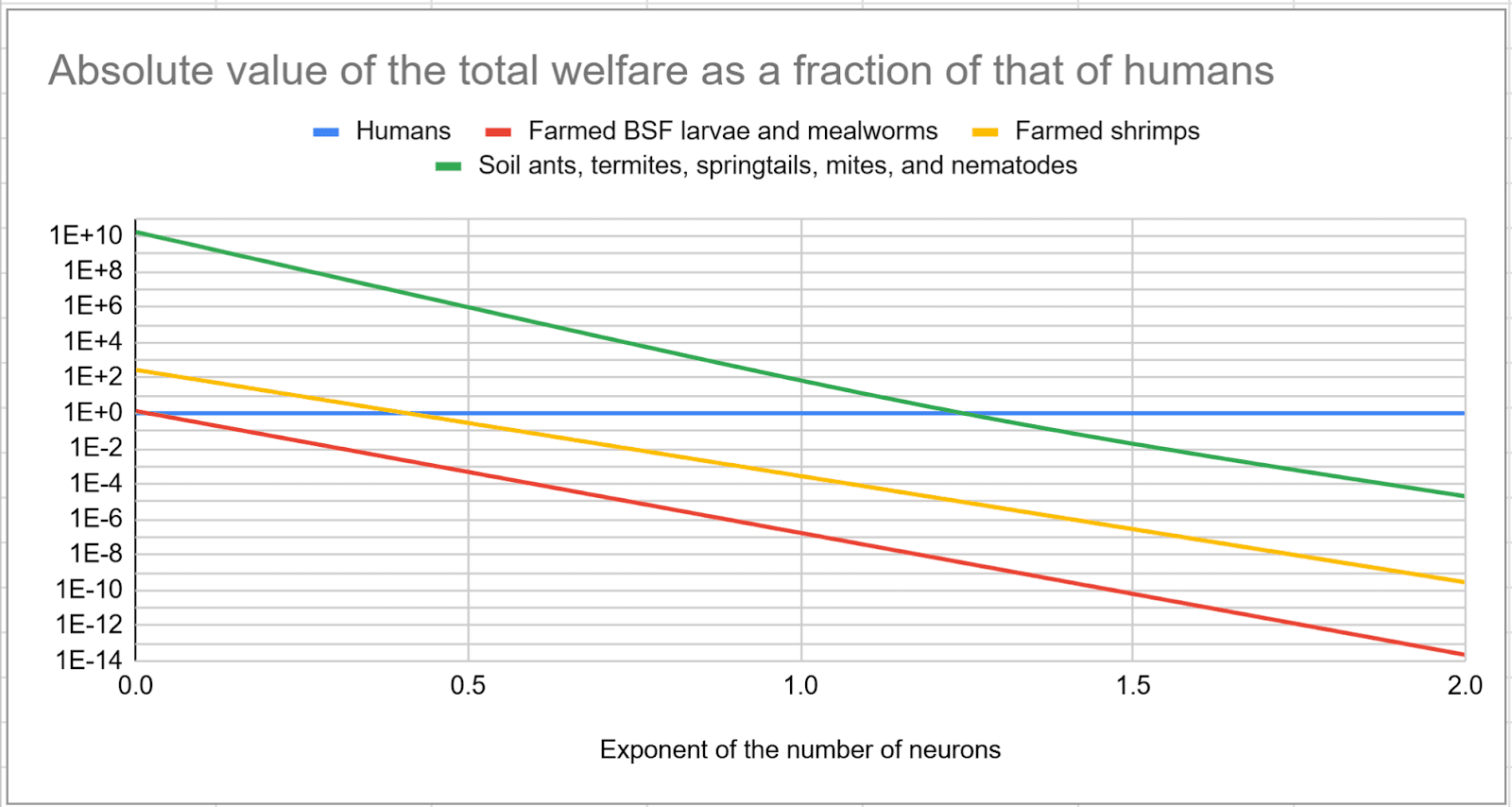
Animals with fewer neurons matter more for a low exponent. Holding the quality of living constant, for an exponent of:
- 0, all animals have the same individual welfare per animal-year.
- 0.5, the number of neurons has to become 100 (= 10^(1/0.5)) times as large for the individual welfare per animal-year to become 10 times as large.
- 1, the individual welfare per animal-year is proportional to the number of neurons, such that the number of neurons has to become 10 times as large for the individual welfare per animal-year to become 10 times as large.
As illustrated below, an exponent of 0.188 explains pretty well the welfare ranges in Bob Fischer’s book about comparing animal welfare across species, which contains what Rethink Priorities (RP) stands behind now. The blue dots are the welfare ranges from Bob’s book, and the red line represents the estimates for welfare ranges proportional to “number of neurons”^0.188. Shrimps have 9.30*10^-7 times as many neurons as humans, and are estimated to have a welfare range of 8 % that of humans in Bob’s book, and of 7.36 % that of humans for welfare ranges proportional to “number of neurons”^0.188.
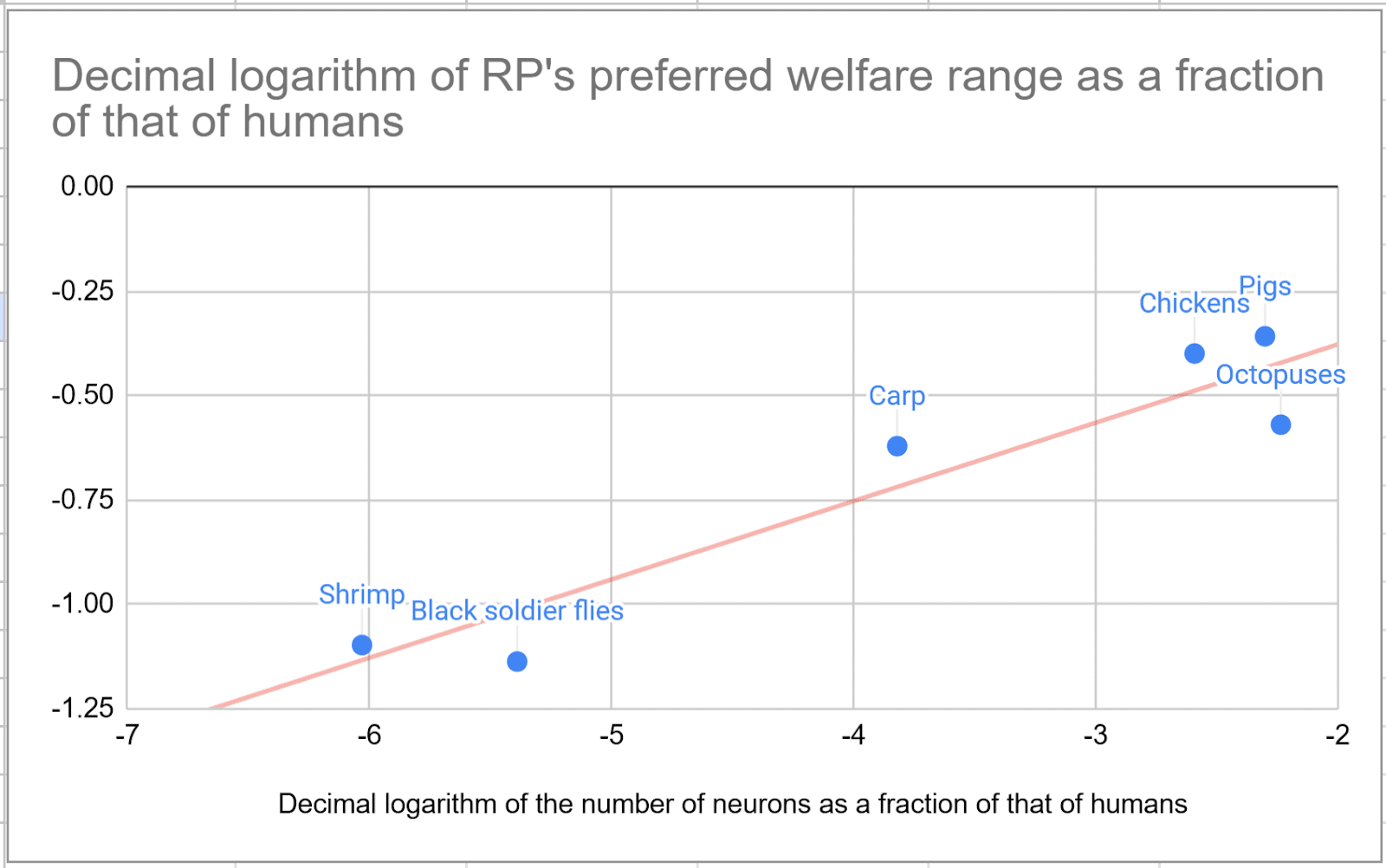
Individual welfare per animal-year might approach 0 much quicker once the number of neurons drops below a certain threshold. Bryan Caplan sets this threshold between cows and humans. Many in the effective altruism community may set it somewhere between nematodes and shrimp. I worry people are coming up with arbitrary thresholds which support their preexisting views. The above power law of the number of neurons explains the welfare ranges in Bob’s book pretty well over 6.03 (= -LOG10(9.30*10^-7)) orders of magnitude (OOMs) of the number of neurons. I calculate the number of neurons of soil nematodes, the soil animals with the fewest neurons, is 8.55 (= -LOG10(2.79*10^-9)) OOMs lower than that of humans. So a power law from soil nematodes to humans only covers 1.42 (= 8.55/6.03) times as many OOMs of the number of neurons as one from shrimps to humans.
In any case, I estimate the absolute value of the total welfare of soil animals is much larger than that of farmed invertebrates even if all soil animals with fewer neurons than shrimps had a total welfare of exactly 0. I calculate soil ants and termites have 2.91 (= 250*10^3/(86.0*10^3)) and 1.16 (= 100*10^3/(86.0*10^3)) times as many neurons as shrimp, so they would still matter. For my preferred exponent of the number of neurons of 0.5, I estimate the absolute value of the total welfare of soil ants and termites is 14.0 M (= 6.74*10^3/(4.80*10^-4)) times that of farmed BSF larvae and mealworms, and 23.9 k (= 6.74*10^3/0.282) times that of farmed shrimps.
I would say the total welfare of soil animals is overdetermined to be much larger than that of farmed invertebrates in absolute terms. The individual welfare per animal-year of soil ants and termites should not differ much from that of farmed invertebrates, and I calculate the population of soil ants and termites is 3.93 M (= 1.50*10^17/(3.82*10^10)) times that of farmed BSF larvae and mealworms, and 652 k (= 1.50*10^17/(2.30*10^11)) times that of farmed shrimps.
Projects targeting soil animals receive way less funding
Projects targeting (optimised for increasing the welfare of) soil animals receive way less funding than ones targeting farmed invertebrates. I am not aware of any ongoing project targeting soil animals. More broadly, WAI granted 460 k$ to projects targeting invertebrates until 7 November 2025, and I got no results for “ants”, “termites”, “springtails”, “mites”, or “nematodes” on their grantees page. In contrast, SWP received 2.9 M$ in 2024. I think they are the organisation receiving the most funds targeting farmed invertebrates.
Interventions changing land use can increase welfare much more cost-effectively than ones targeting farmed invertebrates
Increasing welfare as much as possible per $ need not imply targeting the animals with the most total welfare in absolute terms, and whose projects account for the least funding. However, I believe interventions changing land use can increase welfare much more cost-effectively than ones targeting farmed invertebrates accounting for effects on soil animals. For my preferred exponent of the number of neurons of 0.5, I estimate funding HIPF, which I calculate increases agricultural land by 1.29 k m2-years per $, changes the welfare of soil ants, termites, springtails, mites, and nematodes 3.43 k (= 70.6*10^3/20.6) times as cost-effectively as HSI increases the welfare of shrimps. I estimate funding HIPF changes the living time of soil animals by 5.07 billion animal-years per $, whereas I concluded HSI helps 15.0 k shrimps per $.
I recommend research informing how to increase the welfare of soil animals
I recommend research informing how to increase the welfare of soil animals over pursuing whatever land use change interventions naively seem to achieve that the most cost-effectively. I have little idea about whether funding HIPF, or any other way of changing land use increases or decreases welfare. I am very uncertain about what increases or decreases soil-animal-years, and whether soil animals have positive or negative lives. Research on the welfare of soil animals in different biomes would decrease the uncertainty about which land use changes increase their welfare.
Some may argue any attempts to research the welfare of soil animals are hopeless. I do not see how one can be so confident of this. There have hardly been any such attempts.
There is no escape from the uncertainty of the effects on soil animals
Lots of research may be needed before there are robust recommendations about how to increase the welfare of soil animals. Nevertheless, there is no escape from the uncertainty of the effects on soil animals if one wants to increase animal welfare accounting for all animals. I do not know about any interventions which robustly increase animal welfare due to dominant uncertain effects on soil animals. For my preferred exponent of the number of neurons of 0.5:
- I reckon GiveWell’s top charities change the welfare of soil ants, termites, springtails, mites, and nematodes 610 k times as much as they increase the welfare of humans.
- I calculate decreasing the consumption of chicken changes the welfare of soil ants, termites, springtails, mites, and nematodes 83.7 k times as much as it increases the welfare of chickens.
- I estimate cage-free welfare reforms change the welfare of soil ants, termites, springtails, mites, and nematodes 1.15 k times as much as they increase the welfare of chickens.
I suspect electrically stunning shrimp is one of the interventions outside research which more clearly increases welfare, as it narrowly focuses on decreasing pain during slaughter. Nonetheless, I still do not know whether it increases or decreases animal welfare due to dominant uncertain effects on soil animals. For my preferred exponent of the number of neurons of 0.5, I determined electrically stunning shrimp increases the welfare of these by 0.00144 QALY/shrimp. There are 94.3 shrimps per shrimp-kg. So I infer electrically stunning shrimp increases the welfare of these by 0.136 QALY/shrimp-kg (= 0.00144*94.3). For my preferred exponent of the number of neurons of 0.5, I estimate replacing farmed shrimp with farmed fish changes the welfare of soil ants, termites, springtails, mites, and nematodes by 364 QALY/shrimp-kg (= 522 - 158). So I conclude electrically stunning farmed shrimp changes the welfare of soil animals more than it increases the welfare of shrimps if it results in the replacement of more than 0.0374 % (= 0.136/364) of the consumption of the affected farmed shrimp by farmed fish. I can easily see this happening for even a slight increase in the cost of shrimp. Moreover, there are 3*10^29 soil archaea and bacteria, 613 M (= 3*10^29/(4.89*10^20)) times as many as soil nematodes (the most abundant soil animals). I would not be surprised if the effects on soil archaea and bacteria were much larger than those on soil animals, which further contributes to my very large uncertainty about whether electrically stunning shrimp increases or decreases welfare.
Interested in funding research informing how to increase the welfare of soil animals?
I know about 2 project proposals for researching the welfare of soil animals. They are not public, but one will most likely start next year. I hope there will be more related projects. You are welcome to fill this very short form if you are interested in funding research informing how to increase the welfare of soil animals.
Acknowledgements
Thanks to Anonymous Person for feedback on the draft. The views expressed in the post are my own.
shloka 🔸 @ 2025-11-28T21:35 (+28)
Hi Vasco! I was wondering if you've thought about the effects of land use change on soil nematodes at finer taxonomic resolutions. I think this could be relevant for the following reasons:
- There is some variation in neuron counts between nematode species. For example, Mermis negrescens is a grasshopper parasite that has ~1,000 neurons in its ventral nerve cord.
- Even though most soil nematodes have similar simple nervous systems, there is significant variation in their life history strategies. The equivalent of r vs K-selected life histories for nematodes is the colonizer-persister scale from 1 to 5. On the lower extreme, colonizers (roughly comparable to r-strategists) have high reproduction rates and experience large fluctuations in population density under uncertain environmental conditions. The Rhabditid family of nematodes, which includes C. elegans, is one such example. On the higher extreme, persisters (roughly comparable to K-strategists) have low reproduction rates and maintain population size in more stable conditions. The Thornematidae and Nygolaimidae families are examples of persisters. Of course, many nematode families fall somewhere in the middle. The colonizer-persister scale also probably obscures other important differences between nematode species, like variation in lifespan. I'm wondering if all this variation suggests that all soil nematodes shouldn't be thought of as a single group in such welfare analyses because some might have much lower welfare than others.
- Soil nematodes also have ecologically diverse roles: plant parasites, predators, animal parasites, and bacterial/fungal feeders. Land use change will probably differentially impact these functional groups (as well as colonizers vs. persisters). For example, this study suggests that intensively managed land might produce disturbance regimes that select for colonizers, who probably have worse lives than persisters. And here's another study that observed decreased predator nematodes population abundances after urbanization, which might be bad if predators have particularly good lives. If these studies are right, it seems really important to take local selective conditions into account to avoid land use changes that cause harm.
Thanks for your post, and I apologize if you've addressed this elsewhere!
Vasco Grilo🔸 @ 2025-12-04T19:17 (+2)
Welcome to the EA Forum, Shloka! Thanks for the great comment. I strongly upvoted it.
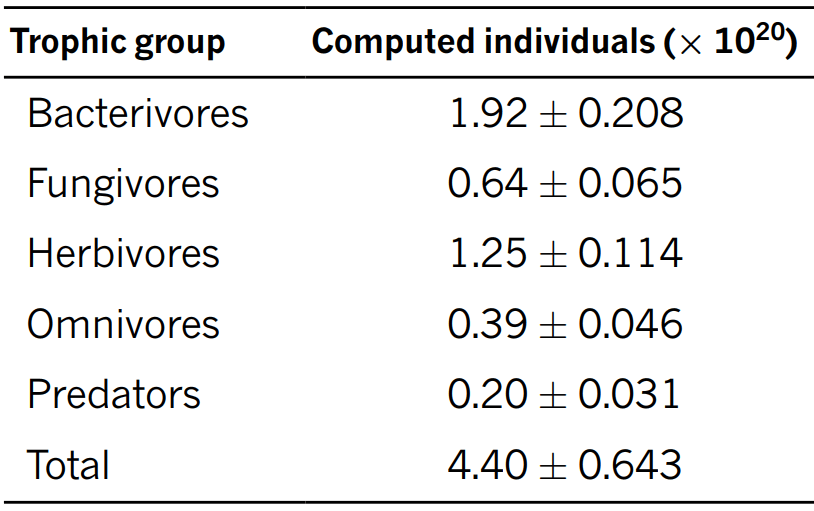
I have not looked into the effects of land use change on different groups of nematodes. From Table 1 of van den Hoogen et al. (2019), which is below, the most abundant soil nematodes are bacterivores and herbivores, so I speculate effects on these are the most important. However, I agree a given land use change may increase the welfare of nematodes of a given type, but decrease that of ones of a different type. This strengthens my conclusion that the priority is research informing how to increase the welfare of soil animals, not pursuing whatever land use change interventions naively seem to achieve that the most cost-effectively.
Jim Buhler @ 2025-11-16T06:59 (+9)
Interesting argument, thanks Vasco! Fwiw, I agree with all the high-level claims except maybe with this one (or at least with its level of precision):
I conclude electrically stunning farmed shrimp changes the welfare of soil animals more than it increases the welfare of shrimps if it results in the replacement of more than 0.0374 % of the consumption of the affected farmed shrimp by farmed fish. I can easily see this happening for even a slight increase in the cost of shrimp.
I think maybe we should be more uncertain about inter-species tradeoffs than you seem to be, here. Maybe there's a plausible world where shrimp welfare matters astronomically more than that of soil animals, to the point where this outbalances the fact that the latter are much more numerous. I currently don't know enough about the topic to find this less (or more) likely than your assumption that soil animal welfare dominates, and I suspect that even those who know much more than me about this should be much less precise in their estimates.
Importantly, I still agree with the main takeaway that we need more research on soil animal welfare (although it might end up not being a crux for me, given the above---I think red-teaming the various assumptions various people make about inter-species tradeoffs should also be a priority.).
Vasco Grilo🔸 @ 2025-11-16T11:54 (+2)
Thanks for the comment, Jim!
0.0374 % is my best guess, but I agree there is lots of uncertainty. For an exponent of the number of neurons of 0.188, which explains pretty well the welfare ranges in Bob's book about comparing animal welfare across species, the effects on soil animals would dominate even more easily. However, I would also not be surprised if 100 times as much consumption of the affected farmed shrimp, 3.74 % (= 100*3.74*10^-4), would have to be replaced by farmed fish for effects on soil animals to dominate, in which case I could easily electrically stunning shrimp increasing animal welfare.
My main takeaway from the section where I discuss eletrically stunning shrimp is that I do not really know whether it increases or decreases welfare. I would still believe this even if my preferred way of comparing welfare across species was certain to be right. There is plenty of uncertainty in whether electrically stunning farmed shrimps increases or decreases the welfare of soil animals, and in the replacement of the consumption of farmed shrimps by other foods.
I agree decreasing the uncertainty about comparing welfare across different potential beings should also be a priority. I just feel it is very hard to make progress on this in comparison to gaining a better understanding of the conditions of soil animals in different biomes.
Jim Buhler @ 2025-11-17T06:40 (+3)
My main takeaway from the section where I discuss eletrically stunning shrimp is that I do not really know whether it increases or decreases welfare. I would still believe this even if my preferred way of comparing welfare across species was certain to be right. There is plenty of uncertainty in whether electrically stunning farmed shrimps increases or decreases the welfare of soil animals, and in the replacement of the consumption of farmed shrimps by other foods.
Yup, agreed species tradeoffs are not the only source of deep uncertainty.
I agree decreasing the uncertainty about comparing welfare across different potential beings should also be a priority. I just feel it is very hard to make progress on this in comparison to gaining a better understanding of the conditions of soil animals in different biomes.
To be clear, to me, "making progress" may mean realizing that we should be and (tentatively?) remain deeply uncertain about inter-species tradeoffs[1] and hence prioritize interventions that are most likely good independently of (non-obvious) tradeoffs assumptions (e.g., interventions that are ecologically inert and avoid substitution effects, or close to that). I could imagine myself reaching such a conclusion quite quickly after diving into the literature on inter-species tradeoffs.[2]
- ^
Much more than what the moral weight project suggests us to be.
- ^
For instance, I wouldn't be surprised if I find out that anyone's precise-ish moral weights inevitably depend on way-too-strong assumptions about the nature of consciousness and how the importance of suffering scales with its severity.
Vasco Grilo🔸 @ 2025-11-17T12:51 (+2)
To be clear, to me, "making progress" may mean realizing that we should be and (tentatively?) remain deeply uncertain about inter-species tradeoffs[1] and hence prioritize interventions that are most likely good independently of (non-obvious) tradeoffs assumptions (e.g., interventions that are ecologically inert and avoid substitution effects, or close to that).
I am very pessimistic about finding interventions that robustly increase welfare in expectation in my view across all reasonably plausible ways of comparing welfare across individuals. In addition, I would be surprised if such interventions were the ones increasing welfare the most cost-effectively.
Jim Buhler @ 2025-11-17T13:26 (+3)
I partly share your pessimism. I hope we'll have occasions to discuss specific proposals soon!
I would be surprised if such interventions were the ones increasing welfare the most cost-effectively.
If you define cost-effectiveness as something close to "what's best in expectation according to my specific favorite among all the plausible ways of comparing welfare across individuals", I agree. I would also be surprised. I'm just---as you probably have realized---very sympathetic to Anthony and Mal's arguments (in the above-linked posts) that this is not what we should look for when we seek cost-effectiveness.
I saw you already discussed this and adjacent cruxes with them. I might write something relevant to this (precise vs imprecise beliefs, etc.) in the very context of moral weights at some point. I'll reach back to you then, and maybe we'll be able to hit finer-grained cruxes and advance this discussion. :)
Vasco Grilo🔸 @ 2025-11-17T13:39 (+2)
If you define cost-effectiveness as something close to "what's best in expectation according to my specific favorite among all the plausible ways of comparing welfare across individuals", I agree.
Yes, that is how I was thinking about it, with the caveat that the specific favourite would involve weighting many ways of comparing welfare by their plausibility, at least implicitly.
I saw you already discussed this and adjacent cruxes with them. I might write something relevant to this (precise vs imprecise beliefs, etc.) in the very context of moral weights at some point. I'll reach back to you then, and maybe we'll be able to hit finer-grained cruxes and advance this discussion. :)
Thanks for letting me know!
Vasco Grilo🔸 @ 2026-01-12T19:11 (+2)
I [Jim] think maybe we should be more uncertain about inter-species tradeoffs than you seem to be, here.
I agree I have underestimated the uncertainty in comparisons between the individual (expected hedonistic) welfare per unit time of different species. I now recommend decreasing this uncertainty.
Jim Buhler @ 2026-01-13T09:31 (+4)
Interesting, thanks for the update!
Vasco Grilo🔸 @ 2025-11-24T09:41 (+4)
Here is a discussion related to this post with Bob Fischer and Mal Graham, who "make most of the strategic and granting decisions for Arthropoda [Arthropoda Foundation]".
Vasco Grilo🔸 @ 2026-01-12T18:39 (+2)
I recommend research informing how to increase the welfare of soil animals over pursuing whatever land use change interventions naively seem to achieve that the most cost-effectively.
I currently recommend decreasing the uncertainty about how the (expected hedonistic) welfare per unit time of different organisms and digital systems compares with that of humans. I am now more pessimistic about the above. I have very little idea about whether existing interventions which robustly increase the welfare of humans or non-soil animals increase or decrease animal welfare due to potentially dominant uncertain effects on soil animals. Likewise, I do not know whether hypothetical interventions which robustly increased the welfare of soil animals would increase or decrease welfare due to potentially dominant uncertain effects on soil microorganisms.
Tristan Katz @ 2026-01-30T16:46 (+1)
Sorry I'm late to comment here, and I'm aware you've written a lot on this topic. But I think this post would benefit from an explanation as to why you're using neuron counts as a proxy for the importance of the animal's welfare.
As far as I'm aware, neuron count is not considered to be a good proxy or indicator of sentience, nor does it seem to be a good proxy for the intensity of experience (I'm not even aware of any good reason for assuming a difference in welfare range between sentient species, although I'm aware that this position is commonly held). Regarding the simple question of whether they're sentient, wouldn't it make more sense to base this on current evidence for sentience, or reasonable assumptions about what evidence future sentience research might produce, given the characteristics of these species?