Vegan defaults: Don't give up on the appeal to veganism yet
By Rakefet Cohen Ben-Arye 🔸 @ 2026-02-23T10:48 (+25)
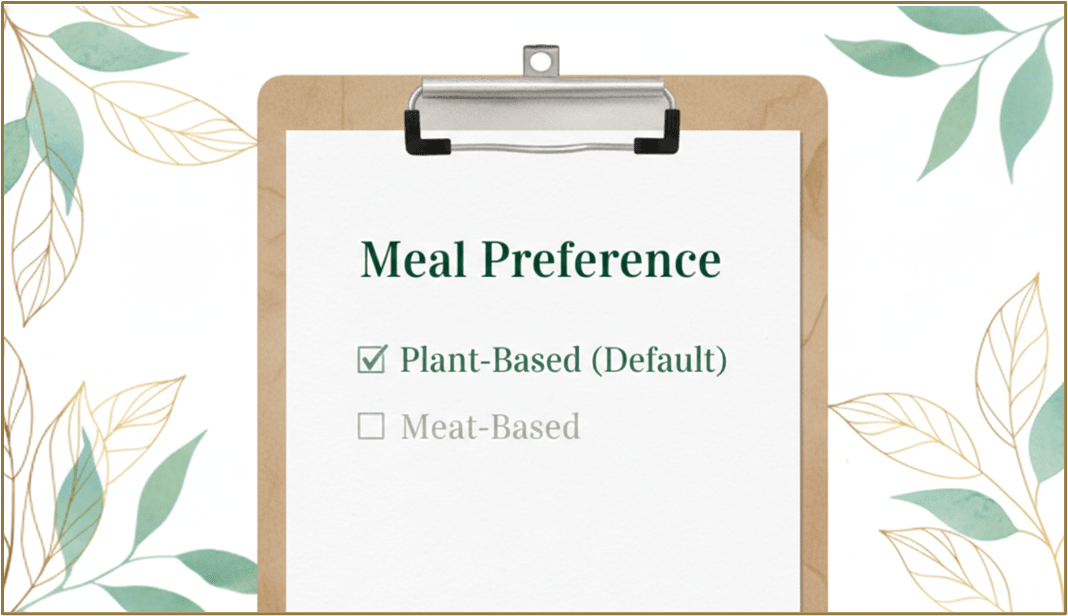
We turn to animal welfare partly because it seems like a more practical request, but what if we had a way to effectively nudge people toward a vegan diet with minimal reactance?
Enter: the default effect.
- See also my full presentation covering it.
- Listen to the NotebookLM 5-minute podcast
The default effect was popularized by Johnson and Goldstein in 2003, demonstrating how countries with similar cultures and religions show dramatic differences in organ donation after death, all because of choice architecture, simply whether the sign-up form included organ donation as the pre-selected choice you automatically got unless you declared otherwise, or the option you had to actively select in order to donate.
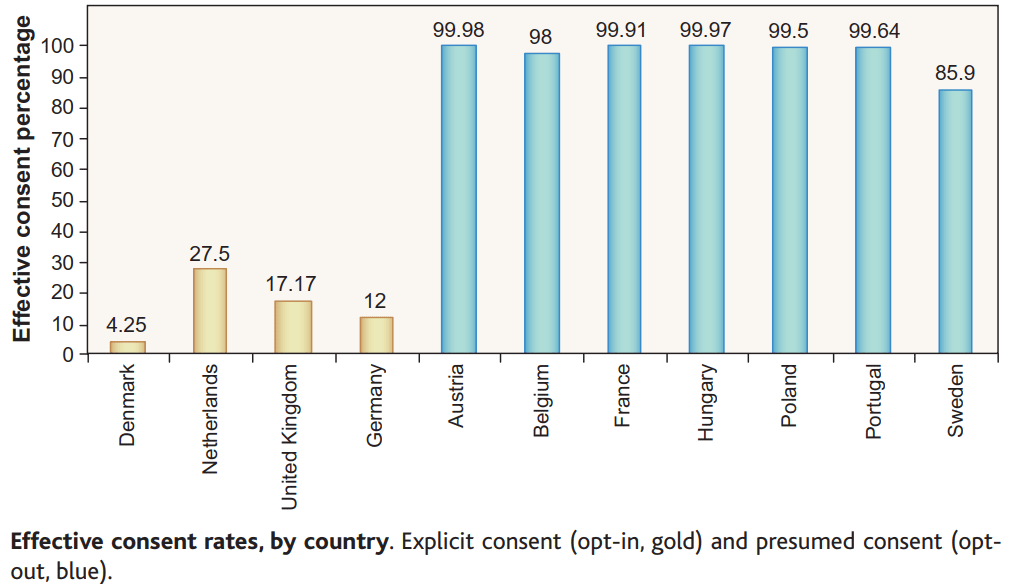
Source: Johnson and Goldstein, 2003.
It is a simple yet powerful way, and the most prominent nudge or behavioral intervention, to achieve massive results, with an effect size of 27.2%.
Similar results were shown for pension saving, insurance, and, of course, plant-based food choices, for example, at universities (Campbell-Arvai, Arvai, 2012; Kalof, 2014) and hospitals.
The effect was so robust that it was replicated many times and even reviewed (Meier, 2022), while continuing to pique researchers’ interest, as seen in (Ginn and Sparkmann, 2024; Zhang, 2024), resulting in at least two EA-aligned organizations or projects: 1. Greener By Default and 2. Default Veg by Better Food Foundation.
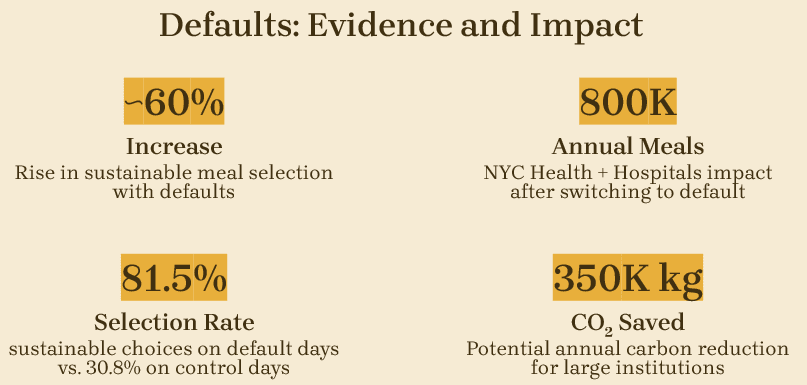
- On average, sustainable meal selection increases by 60% when a sustainable default is implemented.
- For example, hospitals in New York saw an impact of over 800,000 additional sustainable meals served annually after making the switch.
- The sustainable selection rate jumps to 81.5% on default days, compared to just 30.8% on control days.
- This has a significant impact on carbon reduction, with the potential to save 350,000 kilograms of CO₂ annually for large institutions.
What do you think would be the rate of resistance to such an effective nudge? You would be surprised to know that it was minimal, with an approval rate as high as 90% by the very same participants, as found by Hansen, Schilling, and Malthesen in 2019.
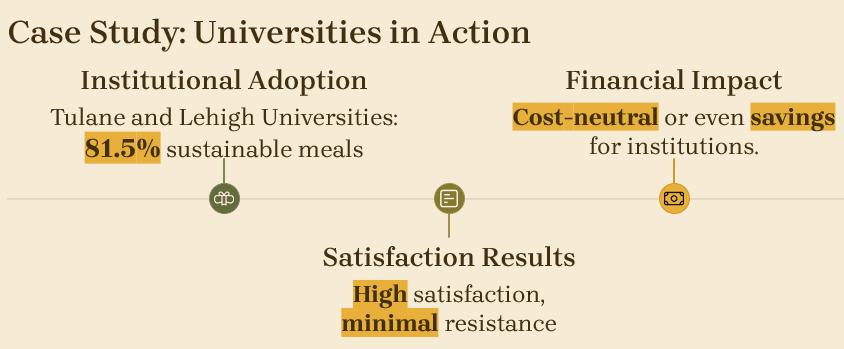
For example, Tulane and Lehigh Universities achieved an impressive 81.5% of meals on sustainable default days, showing strong institutional commitment.
Surveys indicated high satisfaction and minimal resistance from students and professors, demonstrating broad acceptance of the program.
The financial impact was cost-neutral or even generated savings for the institutions, making it a sustainable model.
These examples showcase how universities can effectively transition to more sustainable dining options, benefiting students, the environment, and the bottom line.
And here is food for thought:
People don’t resist veganism. They resist change.
Having to take an active stance or resist psychological inertia, rather than the source of the food, is unnatural for humans.
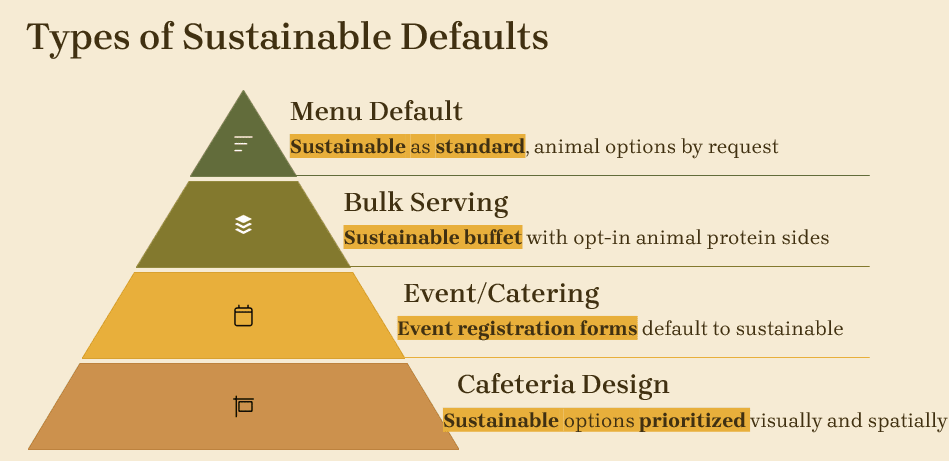
There are different types of sustainable defaults that organizations can implement:
- Menu Default: We set sustainable options as the standard, with animal products available only by request
- Bulk Serving: We provide a sustainable buffet, with optional animal protein sides
- Event or Catering: We default to sustainable event registration forms, with alternatives available by special selection
- Cafeteria Design: We prioritize sustainable options visually and spatially
The key is to shift the default so that sustainable is the standard, and non-sustainable is the exception that requires extra effort.
This helps normalize sustainable eating and makes it the easy, convenient choice for most people.
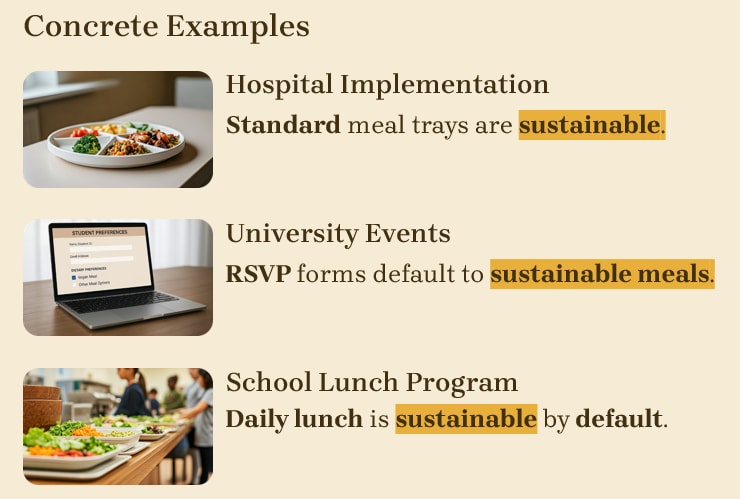
Three concrete examples of how we can implement sustainable options in different settings include a hospital, a university, and a school:
- For hospitals, the standard meal trays are sustainable, but patients can request meat options through a simple form.
- For university events, the RSVP forms default to sustainable meals, and attendees must actively opt out to request non-sustainable options.
In the school lunch program, the daily lunch is sustainable by default, and parents must submit a special form to request non-sustainable options for their children.
A caveat is that the effectiveness of defaults drops 19% after 24 months. A solution previously suggested to make the default effect last: meal rotation. Simply change the dishes daily. Repeat every week.
So, what can you do starting today?
- Talk to someone in leadership or food services: “What do you think about a vegan default?”
- Share what you learned today: in a message, a meeting, or on social media
- Start a small pilot: One event, one meeting, one meal with a vegan default
- Tell the story: Your success can inspire others to act.
We don't have to default to animal welfare, we can default to defaults.
Seth Ariel Green 🔸 @ 2026-02-23T18:16 (+10)
Ah my favorite subject/beloved nemesis, plant-based defaults!
I am a bit of a skeptic, as I laid out in Scaled up, I expect defaults to reduce meat consumption by ~1-2 pp. My basic point is that we don't have a good sense of the effect of these interventions on dietary change rather than meal change, and that some theoretical considerations might give us pause.
Regarding this essay specifically:
- You write "The default effect was popularized by Johnson and Goldstein in 2003, demonstrating how countries with similar cultures and religions show dramatic differences in organ donation after death, all because of choice architecture". Alas, when comparing countries that have opt-in vs opt-out policies, Arshad et al. (2019) find that “no significant difference was observed in rates of kidney (35.2 versus 42.3 respectively), non-renal (28.7 versus 20.9, respectively), or total solid organ transplantation (63.6 versus 61.7, respectively).”
- The NYC hospital data is not an RCT and doesn't offer much of an identification strategy so I'm never sure what to make of those numbers. That being said, I'm ready to accept in principle that hospitals are a particularly promising environment for defaults and for people rethinking their diets generally.
- The Ginn & Sparkman numbers are interesting but the decline in overall sales on plant-based default days is going to be a bit of a challenge for selling the strategy to institutions. On the other hand, Sodexo is apparently happy to scale them up so who knows.
- I am working on a plant-based default evaluation that I hope to share with the forum soon 😃
S. E. Seid @ 2026-02-25T23:57 (+1)
Great read! Thank you for the food for thought!
Eyal Ackerman @ 2026-02-23T15:36 (+1)
Good food for thought, thank you, Rakefet!
B12 @ 2026-02-23T15:12 (+1)
An interesting topic, simple and makes sense yet overlooked approach!
I guess people do tend to hide behind passively stickinng to the laied path as an excuse for bad behavior
Yulu @ 2026-02-23T12:00 (+1)
could be a very effective way with the least resistence :) thanks for sharing! very inspiring!