My disagreements with CEA’s approach to stewarding EA
By hbesceli @ 2026-05-28T17:35 (+324)
[Cross posted from my substack]
In their EA Forum post last year, CEA described their ‘principles-first approach to stewardship of the EA community’.
I'm a big fan of principles-first stewardship in principle. I think EA needs a steward, and I think that stewardship should be organised around EA's core principles.
But I think CEA’s particular growth-centric approach to principles-first stewardship is stewarding EA in the wrong direction.
I think that: The key question for principles-first stewardship should be "Is EA a place that embodies and nurtures EA principles?" I think there are serious reasons to worry that it isn't such a place - that EA has become more ideological and less truth-seeking over time, and that growth focused approaches to community building like CEAs are a big part of the reason why.
A summary of my main points:
- It seems to me that EA is dying. I’m less concerned here about growth metrics, and more concerned about the health of EA as a community and a moral/ intellectual project. It seems to me that EA is losing its question-nature, and also has become something that people are less and less willing to stand behind or participate in.
- Growth is not "Community Building 101". In EA it’s often assumed that the default way to build a community is to focus on growth. I think this is wrong, there are many ways to approach community building that don’t have this focus. And more importantly, I think that part of the cause of EA ‘dying’, is the strong focus on growth. This is because…
- The 'growth funnel' approach to EA community building is in tension with open truth-seeking. In practice, this approach involves funnelling people towards particular answers to ‘How can I do the most good’. If that’s the case it stops being an open or ‘living question’ - the bottom lines in EA are often in practice already written.
- EA community building doesn't serve the people who most deeply practice EA principles. Many experienced EAs are disengaged from the community and reluctant to identify with it. I think this is partly because EA community building isn't for them, and partly because EA isn't functioning well as a place that embodies EA principles. I think the focus on growth is a contributing factor to both of these things.
- FTX was a trust problem, not just a brand problem. Framing it as a branding problem leads to a strategy focused on communications and perception, when the deeper question is whether EA is worthy of the trust people place in it.
- CEA’s brand strategy is in tension with open truth-seeking. On a deeper level, it seems to me that CEA’s brand strategy involves constructing a positive narrative about EA at the expense of an accurate one. I think this is a mistake.
I worked at CEA from 2016 - 2021 on the EA Groups team and then again from 2025 - March 2026 as a Fund Manager at the EA Infrastructure Fund.
My views are informed by my time at CEA and in EA community building more broadly, though this post focuses on CEA's public strategy rather than internal information from working at CEA.
The EA community is something I care a lot about, and my guess is the same is true for all those working at CEA. Because of this I’ve been hoping to write a piece that is more ‘constructive disagreement in service of building a better community’ rather than ‘criticism’.
I think I haven’t succeeded at that - when reading the piece back it feels more combative than I would like. I’m sorry for that. This piece has been a challenge to write and ultimately it feels like a choice between publishing it as is or not at all. I’m hoping that it’s still worth posting even if the framing is more critical than I want it to be.
I’m aiming for strongly stated, weakly held.
I’m also grateful to Claude as well as multiple humans for feedback they’ve given on this piece.
It seems to me that EA is dying
The ‘Growing the EA Community’ section of CEA’s 2026 progress report gives metrics for growth across CEA’s engagement funnel, and also includes the following comment:
Anecdotally at least, it seems that we have already been largely successful in moving beyond narratives about the “death” of EA. I had a journalist tell me at the beginning of 2025 that they wanted to write a piece about how EA isn’t dead, but they couldn’t because they didn’t have the data to back it up; now we have receipts.
I think that, sadly, EA is in fact dying.
Though the kind of death I’m worried about isn't primarily about declining membership or engagement metrics. It's about the health of EA as a community and as a moral and intellectual project.
EA as a question
A common way of describing EA is as a ‘question, and not an ideology’. And EA’s question-nature seems to be a core part of what EA is - if EA were to become ideological, it would in an important sense no longer be EA.
But EA seems increasingly ideological to me, it seems to be a lot less concerned with asking and answering a genuinely open question, and a lot more concerned with causing people to follow established paths to impact.
I don't think I'm alone in having these concerns. A 2022 twitter poll found 70% of respondents saying "yes" to "Is effective altruism an ideology?"
Kerry Vaughan, previously Head of EA Grants and Individual Outreach at CEA, made a similar claim on twitter in 2022.
Any community organised around shared principles will, to some degree, converge on shared conclusions and perspectives - being completely non-ideological seems impossible, or at least the wrong target to aim for.
That said, I think the convergence that does exist within EA is increasingly better explained by social dynamics - selection effects, incentive structures, and how community building is implemented - than by open truth-seeking and application of EA principles, and EA is becoming more ideological over time.
EA as a community
It also seems to me that EA is dying as a community. For example:
- People are often reluctant to identify as EAs, and instead describe themselves as ‘EA-adjacent’. EA does not seem to be something that people seem willing to stand for or behind, especially for people who have been around EA for longer.
- Longer-standing EAs also don’t seem to engage much with EA infrastructure. Of the EAs I know who've been around for a while, I don't know any who are part of a local group, and only a small handful actively engage on the Forum.
- When people do engage with EA infrastructure, eg. attending EAG and so on, it seems to be less because EA is something that they are excited about/ care about, and want to participate in and contribute to - and more because engaging with EA is going to be in some way instrumentally beneficial.
- Many past leaders of EA no longer seem to support it, and many seem to actively disavow it.
Various posts which inform my conception of EA death
In her post Ayn Rand's model of "living money", Anna Salamon describes how processes can ‘lose their relationship to the unknown’, for example scientists that ‘get stuck defending some fixed theory’. I worry that EA is a process that is losing its touch with the unknown.
In his post On Sincerity, Joe Carlsmith differentiates between ‘fake’ and ‘real’ ways of asking a question ‘Should I do x?’. I worry that the question ‘How can I do the most good?’ as asked in EA contexts, is becoming increasingly less ‘real’.
In his post Geeks, Mops and sociopaths in subculture evolution, David Chapman gives a model of the lifecycle of subcultures, and describes how they can go from generative to hollow and focused on resource acquisition. I worry that EA is becoming less generative and more hollow in this way.
In the EA of yesteryear, people often discussed potential failure modes — dilution, ossification, disconnect between leadership and community (eg. see Rebecca Baron's post on movement collapse scenarios). My sense is that several of these are now actively playing out.
Growth is not "Community Building 101"
‘The cornerstone of momentum will be growth: this is Community Building 101’
This seems wrong to me.
Of other communities that I'm part of or know of, few focus strongly on growth, if at all (I like Richard Bartlett's writing on microsolidarity as an example of an approach to community building which isn't centred on growth).
If I had to complete 'growth is ___ 101', my answer would be 'startups'.
It seems to me that startup philosophy has heavily shaped how EA approaches community building. Both CEA and 80,000 Hours participated in Y Combinator. The main model for EA community building is the "engagement funnel." Strategy discussions are framed in terms of metrics, users, product-market fit, and scaling.
But building a truth-seeking community is quite different from building a startup. In particular, startups optimise for a legible, quantifiable goal - revenue, users, growth. "Doing the most good" is a lot less legible and quantifiable, and treating it like a startup metric is liable to run into Goodhart's Law: when a proxy for some value becomes the target of optimisation pressure, the proxy will cease to be a good proxy.
A big part of my story of the cause of death for EA: community building has focused on proxies like 'career changes,' and that focus has undermined the community's integrity as a place of open truth-seeking (more on this in the next section).
The growth funnel model is in tension with open truth-seeking
Targeting high impact careers and donations
A main focus of EA community building is growing EA's resources - talent and funding flowing into organisations viewed as high impact or EA aligned. Community building is often judged successful based on whether these goals are achieved.
There's a big tension here with EA being a community of open truth-seeking. If the purpose of the community is to funnel people toward conclusions that community builders have already reached, then "How can I do the most good?" isn't really an open question - the bottom line is already written.
An example of this - when I managed CEA's Community Building Grants programme (2018–2021), the main way we evaluated grants and made decisions about additional funding was through evaluating case studies - instances where a group member had gone on to land a role that was potentially impactful.
In retrospect, I think this was a mistake. This meant a setup where group organisers had a strong incentive to push members toward careers we'd recognise as "highly impactful," regardless of whether they agreed with the assessment or whether it made sense for the individual. It’s difficult to tell exactly what effect this had, though I imagine this put group organisers in a difficult position.
For example, group organisers often did 1-1 career advising, and I expect it to be very tricky to maintain openness about what career an advisee should do when their conclusion affects whether you will or won't receive further funding (if I knew a university guidance counselor’s job was dependent on people going into specific careers, I’d be very wary about students going to them for career support).
(My sense is that evaluating community building in this way is still relatively common practice, though I don’t actually know this to be the case)
As per the Peter Singer quote, "Beginning to reason is like stepping onto an escalator that leads upward and out of sight. Once we take the first step, the distance to be travelled is independent of our will and we cannot know in advance where we shall end." But within the EA funnel, we often have a pretty good guess of where people will end - in large part because the funnel is designed to take them there.
Not all EA community building metrics are about "high impact careers." Some target engagement itself - people becoming engaged EAs, growth of particular programmes, attendance at events. I think these are less distorting than career-change metrics, but similar problems can arise. It may not always be the most impactful thing for a given person to engage more deeply with EA. And growth of engagement metrics is only good if the ecosystem people are engaging with is actually functioning well.
Selection effects
Even without explicit growth efforts, communities naturally select for people who conform to the community's worldview - not just those who share its underlying principles. Eliezer Yudkowsky's Evaporative Cooling of Group Beliefs describes the basic dynamic.
The EA worldview includes:
- Explicit beliefs - eg. the importance of AI safety, animal welfare, global health
- Implicit assumptions - eg. a preference for quantitative methods, framing things in terms of economic theory, particular epistemological commitments. (see James Fodor's Effective Altruism is an Ideology, not (just) a Question for more on this)
- Principles - eg. scout mindset, impartiality etc.
Many people are genuinely committed to EA principles but don't share the full worldview - either the explicit conclusions or the implicit assumptions.
These people tend to get filtered out through subtle mechanisms. They're perceived as less "EA-aligned." They feel less of a sense of belonging. They're seen as weaker candidates for opportunities. They have less reason to engage, so they drift away and the community becomes more homogeneous.
Growth efforts that target engagement turbocharge these selection effects. It's much easier to generate engagement among people who already agree with the EA worldview than among those with reservations. Even a careful growth strategy will tend to pull in people who conform and push out people who don't.
To CEA's credit, there's a bunch of things they do that push against insularity - the criticism contest, principles-based EAG admissions, and a commitment to welcoming diverse cause prioritisations. I think these things are good. But I also think they function more as patches on a system whose structural dynamics push the other way.
And some are hard to implement at scale - assessing whether someone genuinely understands EA principles, versus just displaying EA identity markers (working at the right organisations, having read the right books, using the right language), is a much harder evaluation problem.
Growth is only good if EA is functioning well
CEA's strategy post gives two main justifications for growth:
‘Most directly, there's the impact people have through their careers or donations when they put EA principles into practice.’
It’s not obvious to me how much it makes sense to describe what happens in EA outreach as people putting EA principles into practice, as opposed to being led down a recruitment funnel. (I definitely think it’s part of the picture, but not the whole picture, and I worry that it’s becoming a smaller and smaller part of the picture).
If a primary justification for growth is that people will have more impact by applying EA principles, it seems to me to be important to be confident that that’s what is happening.
Another possible motivation for EA growth, which I think is relatively common, is thinking that EA-recommended areas are high impact, and that it's good to funnel people towards these (AI safety in particular, though not exclusively). If that's the motivation, I think it's more honest to do outreach for those areas directly.
‘And more indirectly, achieving growth would be strong evidence that EA is bouncing back from the damage done by FTX. It would be among the clearest possible signals to our stakeholders - funders, community builders, the community itself, potential community members, and the world at large - that EA is worth listening to, committing to, and investing in.’
This seems wrong to me as a matter of fact - I don’t think it’s the case that growth amounts to the clearest signal that EA is worth listening to, committing to, and investing in by various stakeholders.
Though even if it were the case, I think that this would be a sign that something was going wrong with EA. I’d hope that the clearest signal that EA is worth listening to would be that EA has true and valuable things to say, rather than that it’s growing. And if it turns out that stakeholders are more interested in whether EA is growing that whether it’s eg. saying true and valuable things, I think this is a sign that the strategy is focusing on the wrong stakeholders.
EA community building doesn't serve the people who embody EA most deeply
Many people who've been involved with EA for years - people whose careers, donations, and thinking have been deeply shaped by EA principles - don't describe themselves as EAs. They say "EA-adjacent," or they've dropped the label entirely.
My sense is the standard view here is that people don’t want to associate with EA because of reputational cost (and perhaps also that not affiliating with EA is in some way a 'defection'). I think reputational cost is part of what's going on.
Though I also think that for many experienced EAs, the community and culture no longer reflects their values, and it isn't something they want to stand behind. And I expect for some, it's because EA just doesn’t feel very alive any more.
Relatedly, experienced EAs don't seem to engage much with EA infrastructure. Of the EAs I know who've been around for a while, I don't know any who are part of a local group, and only a small handful actively engage on the Forum. This seems to be getting more pronounced over time.
I think a big part of what's going on is that EA community building isn't really for established EAs. It's for funnelling people toward established paths to impact. Once someone has reached the bottom of the funnel - once they've landed a ‘high impact’ role or made their career pivot - there isn't much reason for them to keep engaging. The funnel was designed to move them to an endpoint, not to support their ongoing development.
A related point - EA community building seems less about helping people have an impact by their own lights, and more about having an impact by the lights of the community builders. Will MacAskill has recently argued that EAs should feel a kind of "civic duty" to affiliate with and engage with EA. I'm not sure. I think part of the reason EAs don't feel this civic duty is that community building isn't designed to serve them but to affect them.
This feeds into EA's 'death’. A lot of what's most valuable about EA is implicit - virtues, patterns of thinking, cultural norms and such that are not easily formalised. If those people are disengaged, the community will fail to transmit much of what makes EA valuable.
A possible alternative approach would focus less on funnelling and more on creating something that the most thoughtful, experienced EAs genuinely want to be part of. Paul Graham's startup advice "make something people love" seems important here (my disinclination towards startups as a model for EA notwithstanding), though in particular, where the ‘people’ are those who embody EA principles the most.
FTX was a trust problem, not just a brand problem
My sense is that CEA's strategy frames the post-FTX challenge largely in terms of brand damage and recovery. The stewardship post talks about how "we've let critics define us and lost ground in public discourse," and the response focuses on communications, storytelling, and messaging.
There's some truth to the brand framing - people can and do end up with wild misunderstandings of EA, and better communication can help. But I think the deeper issue is different.
FTX didn't just happen to EA - it also happened within EA. SBF was supported, celebrated and elevated by many parts of EA leadership. The damage wasn't primarily to EA's brand; it was to the trust people had placed in EA - and that loss of trust was at least partially warranted.
This distinction matters because trust and brand call for different responses. A brand problem calls for better communications. A trust problem calls for becoming more trustworthy.
EA has a culture of deferring to leaders and people in positions of expertise, and for good reason - it's impossible for everyone to figure out everything from first principles, and relying on others' judgement is essential for doing good at scale. But this means it's very important for EA to be a trustworthy community. EA's impact depends a lot on people being able to trust each other, and on that trust being deserved.
The most important post-FTX question, to my mind, isn't "How can EA's brand recover?" but "How can EA become a community that's worthy of the trust people place in it?" That question leads to different priorities than a communications-focused strategy. It leads to questions about governance, transparency, accountability, and the quality of EA's internal epistemics.
CEA has done some work here which I think has been valuable - the Reflections and lessons from Effective Ventures post as an example. But in the overall strategy, this seems secondary to growth and brand recovery. I think the balance should be reversed. I worry that a strategy centred on "improving the brand" risks treating the symptom rather than the underlying condition.
CEA’s brand strategy is in tension with open truth-seeking
It seems to me that CEA is trying to create a positive narrative about EA. This is somewhat explicit in the ‘Improving the Brand’ section of the strategy document:
We want revitalized EA communications to be: Proactively driven by people aligned with EA principles, resulting in Honest and positive messaging [...]
I think that there’s a tough question for such a strategy - what if there are true and relevant things to say about EA that aren’t positive?
In general, the picture that CEA presents is often a lot more positive than the picture that I have. And CEA’s picture also seems importantly incomplete or inaccurate to me. For example:
- As above, I think the discussion of FTX in CEA’s strategy document misses the ways in which FTX was something that happened within EA, not just to it.
- It seems to me that EA is dying, whereas CEA thinks ‘we have already been largely successful in moving beyond narratives about the “death” of EA’
- To me the vibe of effectivealtruism.org seems more oriented to persuade rather than inform, as per this comment I made previously.
- It seems to me to be something of a stretch to call CEA’s strategy ‘principles-first stewardship’. I’d expect such a strategy to be a lot more focused on ensuring that EA is in fact a place that embodies EA principles than CEA’s actual strategy does.
I think that the attempt to create a positive narrative ends up running counter to ensuring people have a full understanding. And I think this is bad:
- This strategy will select against people that care about truth over positive narratives. Having people that care about truth seems very important for EA.
- It’s important for people to have self-awareness within EA. It’s important for people to have an accurate understanding of questions like ‘Is EA dying?’ and ‘Is EA trustworthy?’.
- On a personal level, I don’t like it. I don’t want to be in a community which is trying to cultivate my impressions in a positive direction. I would like it to be left up to me whether to view what is happening in EA positively or negatively.
What principles-first stewardship could look like
This post mostly focuses on ways in which CEA's approach diverges from my sense of 'principles-first stewardship'.
I want to give a few comments on what a 'principles-first approach to stewardship' would look like to me:
Primarily, I think this would be guided by the question: Is EA actually a place that embodies and nurtures EA principles, both individually and collectively? And the strategy would flow from taking seriously the possibility that the answer might be "not as much as we'd like."
This might mean:
Aiming to understand the question: Are EA community members applying EA principles? Are EA organisations? How can we tell? What do they need to support them in this?
Designing the EA community for truth-seeking, not conversion: Seeing success not as increased engagement metrics, but as a flourishing epistemic environment. This is a lot harder to measure, but a lot closer to the EA raison d'être.
Rebuilding from the core outward. Focus first on creating something that experienced, thoughtful EAs want to be part of and/ or are willing to stand behind.
A comms strategy that is based around aiming to inform rather than persuade. Ensuring that people have a full picture of what is going on with EA, warts and all.
Treating the post-FTX challenge as a trust problem as well as a brand problem. Focusing on ensuring that the community and ecosystem is worthy of the trust people put in it.
Taking seriously the possibility that the EA worldview has blind spots. Actively seeking out people who share EA principles but bring different worldviews and assumptions. Doing more good stuff like criticism contests.
I think CEA's current strategy puts growth and brand recovery at the centre, with epistemic health and trust as secondary concerns. In my view of ‘principles-first stewardship’, that would be reversed, not because growth and communications don't matter, but because they're only valuable insofar as the thing being grown and communicated about is actually good. And I think the question of whether EA is functioning well as a truth-seeking community deserves more attention than it’s getting.
Arden Koehler @ 2026-06-10T15:24 (+89)
It doesn't feel to me like EA is dying for the long-time EAs. I think I count as a long time EA, & to me it seems like it went through a bit of a fallow period post FTX but is back, & that the long-time EAs don't hang out on the forum / go to their local groups / talk about EA as much on twitter, but they still "do EA (i.e. work on & donate to important interventions)" & hang out with other EAs & talk & reason about how to do the most good, quite a lot.
I do think that, with shorter AI timelines, there's a feeling of there being less time for debate / intellectual exploration & more need to act quickly even under significant uncertainty. So that reduces the "EA as a question" vibe, which is reasonable to be sad about. But it seems pretty legit to me to be sensitive to that, since EA has always been about doing what seems genuinely good for the world not just talking / thinking hard about what's good.
Tristan Katz @ 2026-06-03T17:37 (+68)
I strongly disagree with this argument and feel that very little evidence has been provided in its support. Below I respond to what I take to be each of the main arguments (not in order, but in the order that makes sense to me):
1. EA as a question vs a project
From what I can tell, @hbesceli's argument mostly depends on the idea of EA as a question. But I strongly disagree with this. EA is and always has been about answering that question and putting the answer into practice. By encouraging EAs to change careers, to donate etc. CEA is encouraging the outcomes that EA aims at. I see this as a clearly good thing.
2. Is EA dying?
@hbesceli also offers arguments that EA is dying. These partly depend on their conception of the answer to (1), but also partly on twitter posts and things their friends have said about finding EA ideological or not wanting to identify with it. I just don't think this evindence is worth much. My own experience is that long-time EAs I know still identify as such, and I don't really care if people on twitter think EA is ideological - I care if it is in reality. The community building efforts in Switzerland where I live definitely still ask newcomers to question, to do their own cause-prioritization, and only offer established EA answers as ones they might want to consider.
3. Should community building focus on growth?
I think community building should focus on growth as well as asking questions. I also think it's ok for community builders to explain the answers that EA has generally settled on. This seems very analogous to the scientific community: it's perfectly normal and even good for a science teacher to tell you how the cell works, to explain how greenhouse gasses cause climate change, while still encouraging you to use the scientific method and question things. This is where EA is at: we want everything to be continuously questioned, but we have some answers and there is more value, frankly speaking, in spending more time on the less-answered questions. And just as the science teacher might encourage students to go become climate scientists or climate policymakers, I see no problem with EA funnelling people into AI safety careers.
4. Should EA community building serve experienced/highly engaged EAs?
Again, I disagree here and say "no". I would consider myself an established EA, and I have no problem with community building not being primarily for me. I want it to serve newcomers - they need it most, and they are the ones with the greatest potential to add new value to the world. EA community building served me in the past, and now I'm trying to serve it.
5. FTX
This is the one part that I agreed with, but I'm not sure why it's relevant. I do wish there was more of a responses from EA leadership to the FTX crisis, e.g. more accountability and steps taken to ensure it won't happen again. But this doesn't seem to be about community building.
6. Should CEA be positive about the EA brand?
But I do understand CEAs desire to bring revitalize the EA brand post-FTX. FTX was unfortunate, but EA is still great. We do want people to see the positive in it and be excited about that. I have no issue with that, and I think @hbesceli 's perspective here is largely informed by the above disagreements.
End note: This post has already gotten a lot of karma, so I am genuinely wondering what I'm missing. I'd like to know if the points I've made here make sense to others or not.
EuanMcLean @ 2026-06-09T16:08 (+4)
I also think it's ok for community builders to explain the answers that EA has generally settled on. This seems very analogous to the scientific community: it's perfectly normal and even good for a science teacher to tell you how the cell works, to explain how greenhouse gasses cause climate change, while still encouraging you to use the scientific method and question things.
Should we be as confident in the 'answers that EA has settled on' as a science teacher is in how a cell works?
Tristan Katz @ 2026-06-09T16:18 (+8)
Not as confident as cell biology. But maybe it's more analogous to economics or conservation biology. Like, I'm pretty confident that the broad strokes of cause prioritization that EA promotes make sense - but I wouldn't communicate it as undisputable fact, and I don't think community builders typically do either.
Arepo @ 2026-06-10T10:46 (+3)
I think there are many strong reasons to be sceptical of a lot of EA orthodoxy - many people including me have written about them at length (also keep an eye out for a post by titotal in the next few days that comes up with a magnitude estimate for such errors).
These reasons might turn out to be wrong, but I strongly disagree that e.g. classic longtermist/x-risk/AI doomer arguments are anywhere near the standard of economics - as evidenced e.g. by economists vigorously disagreeing with them.
Ben_West🔸 @ 2026-06-10T21:20 (+2)
I'm curious what you think economic orthodoxy is if Hanson's claim "[AI will cause the world economy to] double every few months or faster" is more of a disagreement with EA orthodoxy than economic orthodoxy?
(I'm also interested in what you think the EA orthodoxy is; "months-long doubling times" feels like a pretty mainstream view even amongst people working full time in AI safety, though I agree that it differs from, e.g. Eliezer Yudkowsky c. 2008.)
Tristan Katz @ 2026-06-10T11:41 (+2)
I'm a bit confused, but it all depends on what you mean by these terms so it would help if you specified.
Weak longtermism is basically how most people already think. The unique perspective EA adds is empirical points about the likelihood of those risks, which in at least some cases (nuclear, pandemics) are pretty undisputed. Strong longtermism is more disputed and I personally haven't seen community building efforts teach it as orthodoxy.
It's similar with AI: the Yudkowsky argument for catastrophe by default is not a consensus EA view, although it is shared by some. But risks like bioterrorism or the undermining democracy are widely held concerns and seem much harder to be dismissive of.
*Edit to add: I think how confident these things should be communicated all depends on the thing. But I think most of EA already does treat these topics differently. I'm sure there'll be exceptions but it seems extreme to say that EA shouldn't promote any answers to cause prioritization at all.
Shelby McIntyre 🔹 @ 2026-06-03T18:45 (+4)
I largely agree with your take, @Tristan Katz!
———
The original post falls in the category, for me, of “things I respect but don’t necessarily agree with.”
I think that if you have a movement where an old-timer is saying “hey, watch out, let’s make sure we continue to adhere to our principles” then that’s worth taking seriously. It would not be good to grow the movement but lose what actually makes it valuable in the process. (To an extent, this dilution is probably unavoidable… but it also seems like something to watch out for.)
I do think that there are some very valid criticisms to make of both EA and CEA. (Personal context: I worked at CEA for all of 8 months in 2024-25 and it was a very mixed bag. Some parts I absolutely loved. Some parts made understand why people love to gripe about EA. On the whole, a very eye-opening experience.)
On points 1 & 2:
I think the point the author made about not treating career transitions as the end-all, be-all metric is very good.
I have my own gripes about how we talk about careers in EA. Given how notoriously difficult it is to land an “EA job” (whatever that actually means), we should have better messaging about what other options are. (There’s an AIM (?) post about high v. low absorbency paths, which I think is a good start here. I think HIP also does a good job with this.) And don’t even get me started about how much we over-index on credentials!
When I advise mentees, for example, I tend to beat the drum about how there are a lot of different options and how getting one of those jobs is simply one of them… and that engaging with the principles and applying them to your own life/career path is the way to go. My hope is that has the double benefit of a) helping people avoid feeling like shit for not being the 1% all star with an Oxford degree who can actually freaking get hired and b) avoids the funnel effect that @hbesceli mentioned.
But, that dynamic is far from new. And I overall think that the vibes-based “EA is dying” claim is a bit overstated.
On points 5 & 6:
I dunno, I’m not really sure what people expect out of EA leadership beyond what EA leadership has done.
One of the things I learned while working at CEA was that the extent to which everybody who was working in EA at the time (I was not) had a crisis of confidence when FTX happened. Some of them seem still rather scarred by it.
On one hand, that suggests that @hbesceli is right and there’s more work to be done here because people need trust and closure. On the other hand, I think that’s a sign of how very seriously people took the scandal, and that is evidence to me for a community that cares deeply about trust and doing the right thing. Certainly, people less involved in EA at the time seemed to simply be far less bothered (especially after the initial news wave died down).
This may be a controversial opinion and perhaps I’m being too quick to forgive and forget, but… it seems to me like at some point, you have to just accept that there was 1 bad actor, move on, and get back to doing good work.
In any case, I think that it’s perfectly appropriate for CEA’s comms strategy to be focused on more positive messaging, especially to the extent that those comms are directed towards movement newbies or outsiders.
Jessica McCurdy🔸 @ 2026-06-08T15:09 (+48)
Hey Harri, thanks for writing this, and thanks to everyone engaging with it.
I lead the growth pillar at CEA, so I'll just speak to that (as opposed to diversifying funding or improving the brand, which are the other outward-facing pillars of CEA's 2025-26 strategy). Within talent growth, I am not going to be able to respond to every point made in your post or in the comments.
I won't pretend the answers here are obvious. Together with my team, I think about growth and its tradeoffs a lot, and one of the few things we’re sure about is that there are real opportunity costs in either direction, whether we take a more growth-centric approach or we don't. I think reasonable people can come to different conclusions about what's right to prioritize and to what degree.
An important part of my own model is that EA's question-nature matters, but a question that never gets acted on doesn't help anyone. The acting is where impact comes from. That's something we try to capture in our metrics, and part of why I think it's important to have metrics at all, to track whether impactful actions are being taken, not just whether the ideas are alive. That being said, there are no perfect metrics, they all come with downsides and risk of goodharting.
Our growth team, not to mention the rest of CEA, think it's really important that the EA community stays healthy. I am keen for people to share with us any data or evidence suggesting there are places where our actions are undermining the health of the community (e.g. not meeting established quality bars), so we can factor it into our strategy or tactics.
We recently wrote more on why we value growth and the risks that we're tracking in this post. And you can see more on how we think about maintaining quality with growth in this section (with more information on our G.R.O.W. principles here).
richard_ngo @ 2026-05-29T14:49 (+32)
One thing that this piece is missing: the extent to which Anthropic is now implicitly the cultural/financial/leadership center of EA.
Habryka has claimed that most EA talent is in Anthropic; I haven’t tried to evaluate this, and it depends on how you measure talent, but it doesn’t seem too far off. (Edit: as per this link, Habryka was actually talking about EA AI safety talent.)
It seems very plausible to me that the rest of EA will mainly end up serving as a recruiting pipeline for Anthropic. I’m interested in understanding the extent to which this is already happening.
This mostly seems bad to me, and therefore another argument against the view that student group success should be measured by career placements.
Previous discussion in this tweet thread: https://x.com/richardmcngo/status/2055991804319658273?s=46
Denkenberger🔸 @ 2026-05-30T01:00 (+30)
Habryka has claimed that most EA talent is in Anthropic; I haven’t tried to evaluate this, and it depends on how you measure talent, but it doesn’t seem too far off.
Habryka was talking about the subset of EA that does AI Safety - EA as a whole has much more talent than that.
One thing that this piece is missing: the extent to which Anthropic is now implicitly the cultural/financial/leadership center of EA.
It seems very plausible to me that the rest of EA will mainly end up serving as a recruiting pipeline for Anthropic. I’m interested in understanding the extent to which this is already happening.
I do think a lot of EAs are desperately hoping for an Anthropic IPO so they can help save millions of lives, prevent billions of animal-suffering years, build up resilience to pandemics, and do much more AI safety work. So Anthropic may become the financial center of EA, but at this point it's only in expectation. Also, I don't see how Anthropic is the cultural/leadership center of EA. Jobs at Anthropic are a tiny percent of the jobs that 80k recommends. Maybe I'm not aware of it, but I don't think people at Anthropic get a significant fraction of the current karma on the EA Forum, and I'm pretty sure not historically. Could you explain more your reasoning?
MichaelDickens @ 2026-05-30T01:08 (+21)
I don't think it's currently true that Anthropic is the cultural center of EA, but if it ends up driving most of EA money, then it could become so. On my view that's plausibly quite bad because typical Anthropic views about AI are far too reckless and too likely to get us all killed.
Benevolent_Rain @ 2026-06-03T04:41 (+2)
There is a possibly optimistic outcome here: That some significant portion of future donations will be put towards epistemic cultivation, criticism and diversity of thought in EA. In a sense, I think the Survival and Flourishing ecosystem is already spearheading interesting directions here, with a focus on AI epistemic tooling. Hopefully more will follow in diverse but similar directions, also looking to serve the EA community, or the questions we used to ask.
ElliotTep @ 2026-05-31T23:54 (+30)
I really like this post, and in general appreciate the ways you've been thinking about the EA community over the last few years, as someone who has been very close to community building, dissatisfied, and engaging to improve it, where I think most people just check out/give up.
One dynamic I see in this problem, that I don't think you talked about, is that formal community building is focused on serving new EAs and growth partly because formal community doesn't serve the most engaged members very well. This is because:
1. More engaged EAs in hubs often work in EA roles, and their cup is full, they don't want more events.
2. Community builders are often not well placed to serve them, as they've been around longer than the community builders have.
3. People who have been in EA for a while often have their community experience be in their friendship groups, coworking spaces, or with colleagues, that I think does fill that role quite well. These places all have filters where they're not open to everyone, which makes sense, but does create an awkward dynamic where the public EA community space ends up serving the newer EAs.
I do think more work could be done to move CEA's strategy in the direction you point towards. But they do have to grapple with these dynamics, which I think are just pretty hard to change dramatically.
Richard Y Chappell🔸 @ 2026-05-30T02:04 (+29)
I'm happy to see someone raising these challenges (and it's plausible to me that "whether EA is functioning well as a truth-seeking community deserves more attention than it’s getting"), but fwiw I remain glad that CEA in particular are leading from a position of greater confidence in EA.
I agree that "Growth is only good if EA is functioning well," but note also that missed growth would be extremely bad if EA is functioning well, so it's hardly costless to forsake potential growth. My personal view is optimistic: it seems like EA does a lot of good, and more people learning about the ideas and getting involved (perhaps taking the 🔶 10% pledge, or identifying and working on a neglected high-impact problem) would also be good. But if I'm wrong about that, I hope others would be able to bring to my attention the reasons why. So I certainly agree that maintaining a good epistemic environment and truth-seeking culture is also important!
Félix Dorn 🔸 @ 2026-05-29T09:08 (+27)
Thank you for writing this.
As a communications professional, I believe there is no point front loading an accurate picture of EA, warts and all, early in someone's journey with EA because at this point they do not care about this. They are looking to see whether EA can help them have an impact.
So I don't think the "persuasive vs. informative" framing is the right one, I see CEA's strategy as meeting people where they are, and trying to do this well, which indeed means simplifying the messaging a lot, especially early on, because it is a necessary condition to being heard.
Using 'persuasion' techniques, such as relying on social proof, is usually what it takes to be heard in a crowded information environment too, of course, 'persuasive' communications increases growth.
(I don't like the persuasive framing because it doesn't convey that good communications is about providing value to people, if you provide value, you just need people to see and decide to grab it, which is different from 'persuading'.)
It seems like you are pointing out that the community, steered by CEA's stewardship, is picking the wrong side on some trade-offs, like community size vs. strength of bonds. I wonder if you also see it as a trade-off, or do you think the problems you point at could be solved by investing resources to meet people further in their EA journey.
James Herbert @ 2026-06-03T17:14 (+24)
How much weight do you put on info like the community satisfaction section of the EA survey?
The data from 2024 suggests overall satisfaction has stayed stable:
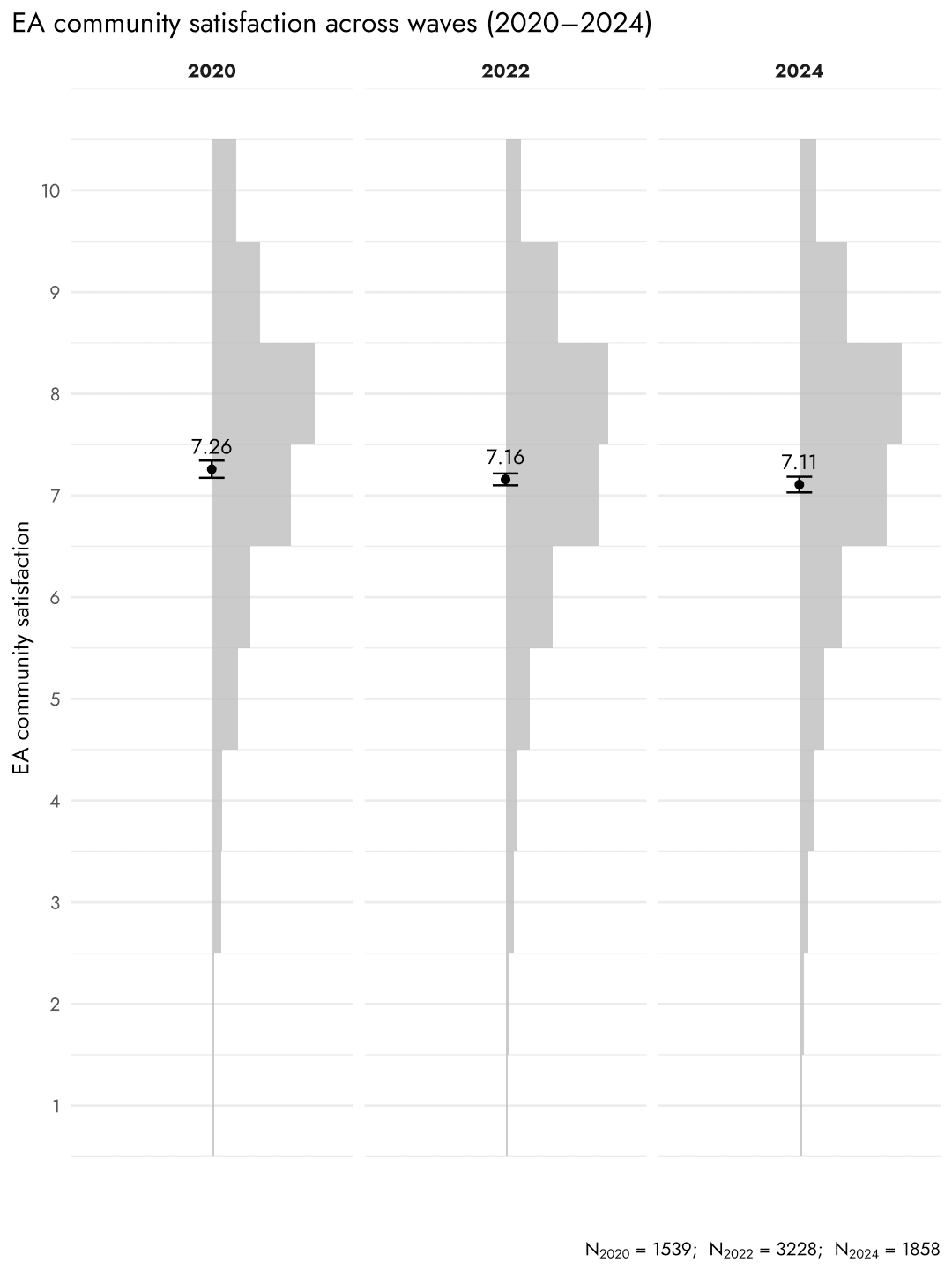
And self-assessed likelihood of retention doesn't seem to vary across cohorts:
But you appear to be right when you say older cohorts are less satisfied:
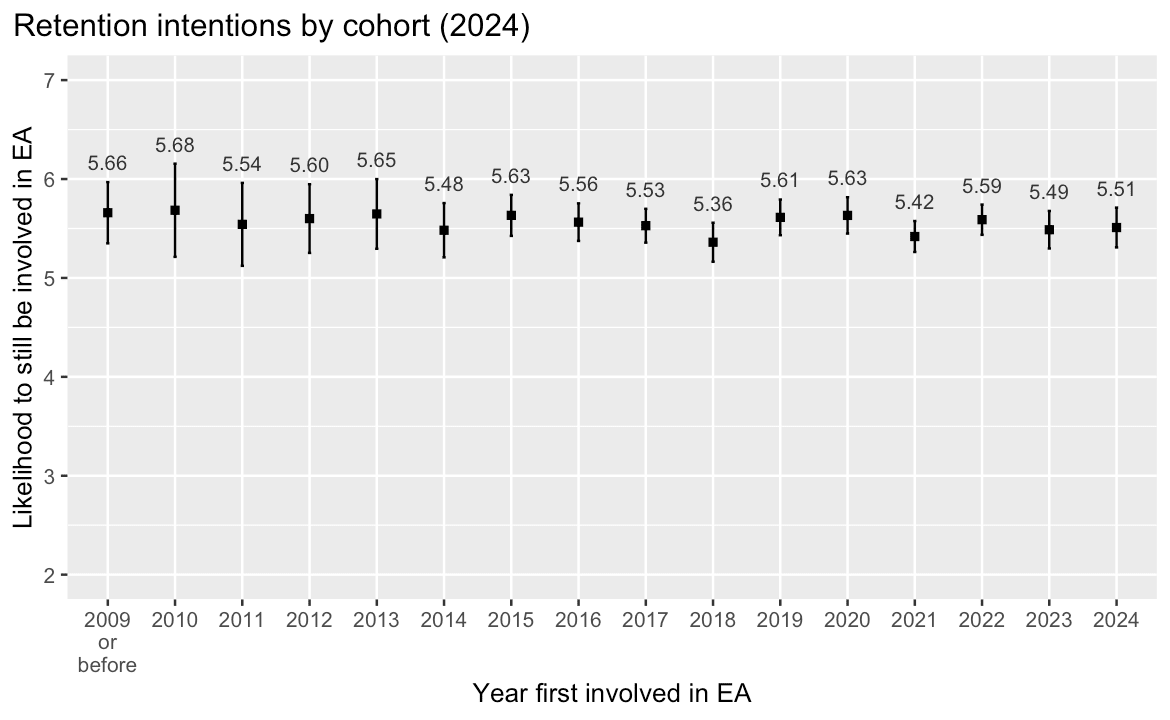
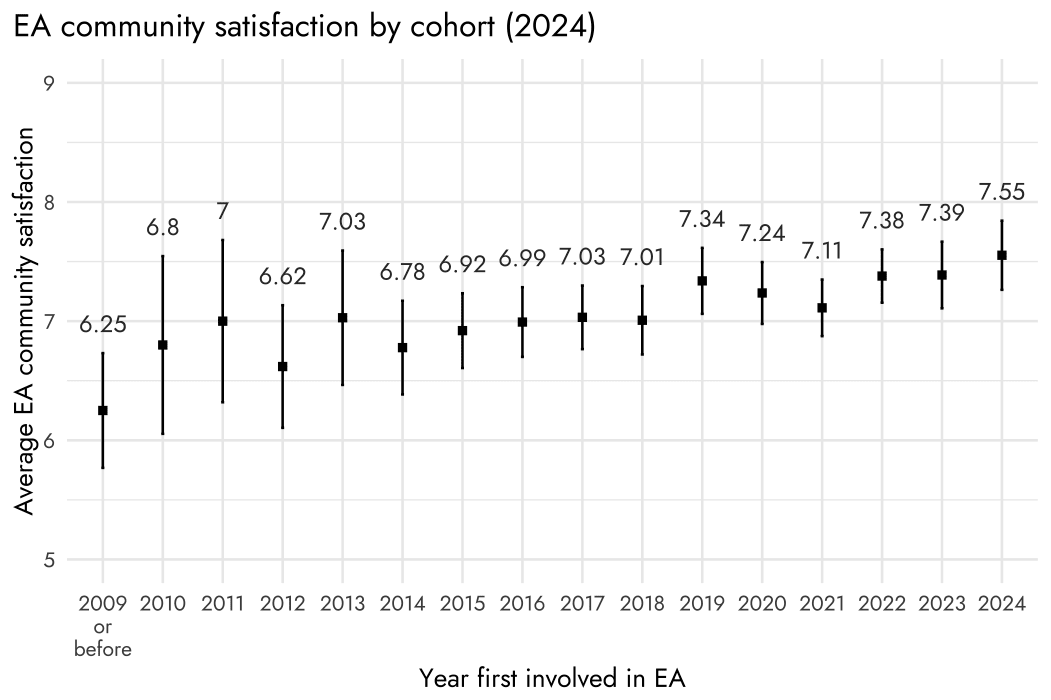
Obviously, there's a lot more to your post than worries about community satisfaction.
Fran @ 2026-06-03T17:51 (+8)
FWIW, the current CEO didn't join until Feb 2024 and the new growth strategy didn't come until maybe 6–12 months after. I think the effects of CEA's current approach wouldn't be captured in data until later. Although, this is still useful for showing that there isn't already a significant satisfaction trend that's been recorded.
James Herbert @ 2026-06-03T18:05 (+11)
Oh yes for sure. But I assume there will be another edition of the survey. There's a lot of vibe-based takes in this piece, which is fine, but it's also nice to look at the best data we have, which is probably this survey (and future editions of this survey). I want to know whether Harry thinks he will update his views as new data comes in.
Denkenberger🔸 @ 2026-05-30T00:43 (+20)
EA has a culture of deferring to leaders and people in positions of expertise, and for good reason - it's impossible for everyone to figure out everything from first principles, and relying on others' judgement is essential for doing good at scale.
A lot of people have said this, but compared to what? I assume compared to the ideal. Compared to the communities I have spent the most time in, I would say:
Environmentalism: defers far more
Unitarian Universalism: defers a lot more
Academia: defers significantly more
LessWrong: defers a little bit less
Longer-standing EAs also don’t seem to engage much with EA infrastructure. Of the EAs I know who've been around for a while, I don't know any who are part of a local group, and only a small handful actively engage on the Forum.
Many past leaders of EA no longer seem to support it, and many seem to actively disavow it.
I would love to hear more anecdata from other early EAs (I realize surveys would be really hard to run). I think it was around 2017 that @Benjamin_Todd estimated an attrition rate of about 2% per year from early EAs, so it would be interesting to hear an update on that. And again, it would be good to compare to other movements.
titotal @ 2026-05-30T08:42 (+15)
Academia: defers significantly more
This has not been my experience from 9 years of academia in physics and material science. Opinions published in scientific papers must be backed up with reference to actual evidence, not merely opinion. When deferral happens behind the scenes, it's usually justified by the person in question being an actual expert that knows their shit.
EA is far worse: I sometimes see people defer to random blog posters who have zero expertise in the subject they are talking about.
Denkenberger🔸 @ 2026-05-30T20:51 (+24)
As in my other comment, I am mixing deference to orthodoxy and leaders. I have similar experience duration in academia. I think questioning things like political left positions and the value of education is more discouraged in academia than questioning the common beliefs in EA. I think it also depends on the field. In some academic fields, there are specific camps with a lot of tribal behavior. There's a quote that science advances one funeral at a time. I think that EAs are more open to changing their opinions. There is also a lot of tribal behavior between fields in academia - I think there is significantly more bias towards one's strand of academia than towards one's strand of EA. Maybe that's not deference to leaders, but the questioning of the value of one's field in academia is uncommon. Whereas in EA, there is lots of questioning whether different strands are net negative.
However, I do agree that some EAs like taking contrary opinions and might defer to a random blogger against scientific consensus. Those EAs often have a low opinion of peer review, and are probably more often wrong than the scientific consensus.
Matrice Jacobine🔸🏳️⚧️ @ 2026-05-30T02:25 (+4)
Unitarian Universalism: defers a lot more
... who are those leaders of Unitarian Universalism that UUs are deferring a lot more than EAs defer to Moskovitz, Karnofsky, MacAskill, Ord?
Robi Rahman🔸 @ 2026-06-02T19:08 (+6)
The point of UU is to have certain differences from traditional religion. UU encourages questioning traditional religion, but it discourages questioning of UU's own positions.
EA encourages questioning of EA's principles. I could get hundreds of upvotes by writing a post about why ITN is a bad framework and should be ditched, whereas you'd get tarred and feathered for suggesting that a UU congregation should drop one of their seven principles.
Matrice Jacobine🔸🏳️⚧️ @ 2026-06-02T23:24 (+4)
I didn't knew about the seven principles of UU. Apparently those are:
- 1st Principle: The inherent worth and dignity of every person;
- 2nd Principle: Justice, equity and compassion in human relations;
- 3rd Principle: Acceptance of one another and encouragement to spiritual growth in our congregations;
- 4th Principle: A free and responsible search for truth and meaning;
- 5th Principle: The right of conscience and the use of the democratic process within our congregations and in society at large;
- 6th Principle: The goal of world community with peace, liberty, and justice for all;
- 7th Principle: Respect for the interdependent web of all existence of which we are a part.
Those seem quite a bit more fundamental than the ITN framework is for EA, and I'm sure there are more fundamental principles of EA that you would in fact get the same reaction if you said they should be ditched. (In fact, they would probably be basically the same ones?)
Denkenberger🔸 @ 2026-06-03T03:11 (+4)
I agree there is some overlap between these principles and EA principles. But I still think the EAs are more willing to debate them. For instance, the first implies torture is never justified (and this is a common view in UU), but some EAs will debate the cases where it could be justified. Also, maximizing utility does not necessarily push you to justice and equity. Spiritual growth does not apply to most of EA. And EAs generally question environmental/biodiversity principles.
Matrice Jacobine🔸🏳️⚧️ @ 2026-06-03T03:15 (+6)
I very much expect a speaker at an EA conference talking about the benefits of torture would be quickly shown the door. More to the point, this goes double for a speaker saying EAs should ditch the "doing good impartially based on reason and evidence" thing and instead pick a Great Leader to never criticize and embark on a crusade to genocide the inferior races.
Denkenberger🔸 @ 2026-05-30T02:41 (+5)
I'm blending deference to leaders and orthodoxy here. In UU, questioning of traditional theology is encouraged; questioning the views of the political left, much less so. Of course EA has its own orthodoxy, but questioning and criticism of it is much more encouraged. I think there has been more criticism of Moskovitz, Karnofsky, MacAskill, and Ord in EA than typical leaders in UU (e.g. ministers), but maybe your experience is different?
RyanCarey @ 2026-05-29T08:39 (+14)
Agreed. EA doesn't feel intellectually lively anymore. I do think things like forethought foundation and some discussions on AI twitter still are though. What's tough is that this community used to be associated with trust and intellectual life. You could get it all in one package deal. Whereas now we have to find our sense of belonging in one place, and our intellectual life in another, and probably neither of those is the current EA.
I guess the professionalization of EA/AIS meant that this separation would happen anyway, but it just happened in a particularly demoralizing manner.
D_M_x @ 2026-06-01T09:23 (+5)
You could get it all in one package deal. Whereas now we have to find our sense of belonging in one place, and our intellectual life in another
Very on point. Despite still living up to EA principles as I have for the past ~14 years, I have little interest in the remnants of the EA community institutions.
Gemma 🔸 @ 2026-06-01T10:15 (+11)
Thank you for writing this - my thoughts
I've always been a volunteer CB on the side of a day job so I've never been financially dependent on CEAs evaluation of my work.[1] Because I've always been community building for free, I've been optimising for creating events that the people I admire and want to learn from would want to attend. Also trying to convince other people to run similar events because I wanted to attend but didn't always have capacity for organising. Tbf I was also running events that were useful for me - ie. quarterly review co-working to make time for EA planning outside of my day job.
My take is community building is not recruiting and it's not fundraising.
Both of these are services that rely on a 1 to many relationship with career changers/donors.
If you were to stop this work, there is limited residual value.
To use an analogy from accounting: recruiting and fundraising are operating expenditure. You need to make the investment every year to get the same returns. Community building is more like capital expenditure - you're investing in assets from which you expect future value to flow. There are ongoing maintenance/upgrade costs but building something implies an asset outside of your labour.
The test is: if you stopped tomorrow, does anything exist if you stop working? Were you a single point of failure? If so, you are maybe more service provider than community builder.
CB Metrics I'd actually want to track:
* Number of connections within EA that someone would feel comfortable talking to about donations, career changes, or volunteering (similar to EAG metrics)
* Confidence talking through their reasoning and motivations with non-EA friends and family
* Quality of community infrastructure maintained by the group, and time this saves individual organisers - newsletters, event platforms, mailing lists
* Community experiments supported even when you're skeptical - giving people the chance to test something they're passionate about, coaching them through the pivot if it doesn't land
* "Elder" or "inactive" EAs who feel connected enough to be an asset: willing to do 1-on-1s, sit on boards, talk about their pledge
- ^
I'm now on the board of EA UK and have been frustrated with the lack of guidance on what they expect. The UK specifically is weird because CEA has a presence here
Gemma 🔸 @ 2026-06-01T10:15 (+20)
Tangent on GWWC fundraising/CB
I saw my role in local GWWC organising as maintaining existing pledgers rather than recruiting new ones - keeping the people who inspired my own commitment connected to each other and to the community. That sat badly with GWWC's BHAG of a million 10% pledgers, and is part of why they stopped supporting local groups.
I am worried about their current direction. If the expected lifetime value of a pledge is to be maintained, people shouldn't be encouraged to rush into a commitment they won't follow through on. I always encourage a trial pledge first, then celebrate when someone makes the full commitment. The fact that GWWC seems to be pivoting toward being a fundraising organisation gives me the ick.
Maybe I just think it's too important as a community building tool. Having your name on the GWWC list used to be a signal of moral seriousness and thoughtfulness. If pledge retention among newer cohorts continues to worsen, that signal degrades. Maybe 10% pledge and GWWC are actually different products and I'm a GWWC pledge girlie (ie. 10% is the floor). It's perhaps not efficient for paid staff time to be spent on it.
Idk in the age of AI, is it more valuable to have a person who is serious about their commitment to think carefully about where they can do the most good with their money; or more money from lots of sources?
IMO the asset is the pledger, not their money. Money is fungible, people are not.
Tbf maybe this is just because I'm not a utilitarian and I'm too conservative in my approach. The meta trap is real and time spent looking inward is less valuable than time spent looking at the worlds problems. Idk things are looking weird and I'm probably naive and romantic about the community.
James Rayton 🔸 @ 2026-06-03T16:19 (+5)
Thanks Gemma, and thank you for everything you've done running the London group, your impact as a pledger, and your broader commitment to promoting effective giving.
We're totally aligned that our community is vitally important to our mission. That's actually baked into our Big Hairy Audacious Goal: "a million people donating $3bn to effective charities." The two numbers aren't separable by design. The $3bn reflects our ultimate purpose, which is improving and saving lives, human and animal, now and into the future. But the million people reflects something we hold equally seriously: that this is a movement making effective giving a social norm.
This is relevant to your point about not rushing people into commitments they won't keep, and it's something we're so so so strongly aligned with. To have a million people donating $3bn we need to maintain the expected value that pledgers donate.
Also love your point about the Trial Pledge. It exists precisely because a thoughtful, sustained commitment is worth far more than an impulsive one that lapses. (Sneak preview from our next Impact Evaluation: Trial Pledgers who go on to take a 10% Pledge donate more over the course of their pledge!) This shapes how we think about good onboarding and stewardship, and makes us even more excited about bringing people into effective giving in a considered way.
Where I'd disagree slightly is the framing of community support as a choice between stewarding existing pledgers or inspiring new ones. Ideally we'd do both, and great community engagement should mean the two are mutually reinforced. If someone has an amazing experience they're more likely to recommend it to friends and family. Likewise, a growing community means existing pledgers can feel like early members of a large movement.
We withdrew from GWWC-branded groups primarily for operational reasons, including not having the capacity to put adequate safeguarding measures in place. The fact we hadn't clearly defined metrics for groups (inspiring new pledgers or supporting existing ones) is symptomatic of not having the capacity to work with leaders like you to co-manage groups at the standard we want.
That said, as our capacity grows, we want to bring this in-person community aspect back! That's why we're hiring for community engagement roles in San Francisco and London. Hopefully this will be the first step in building the capacity we need to support our community to the standard it deserves, reflecting and honouring the seriousness of the commitment.
Thank you again. Really glad you're raising this!
Gemma 🔸 @ 2026-06-03T17:47 (+6)
Thanks for this, James!
Apologies, my comment was a bit flippant and easy to say when I'm not the one making the difficult trade-offs 😅 FWIW I think it sounded like the right call at the time and I'll be the first to admit that my misty-eyed nostalgia doesn't scale.
Delighted that my vibes based speculation bares out in the data - excited to read that report 👀
Giving significantly and effectively should be a norm - it's really exciting that you guys will have additional capacity for in-person support!!
I'm looking forward to working with whoever ends up in the London role!! (If it could be you - pls pls apply 👆🏻👆🏻)
Robi Rahman🔸 @ 2026-06-02T19:13 (+2)
To use an analogy from accounting: recruiting and fundraising are operating expenditure. You need to make the investment every year to get the same returns. Community building is more like capital expenditure - you're investing in assets from which you expect future value to flow.
Surely recruiting is a capital expenditure in this framework?
Gemma 🔸 @ 2026-06-02T21:37 (+4)
Great clarification question
So recruiting isn't capital expenditure because the entity does not own or control its employees. Employees can resign whenever and, unless they are also shareholders, they don't have a stake in maximising the profitability of the enterprise (beyond retaining their job).
Maybe my analogy isnt actually great here - maybe I'm the better analogy is shareholders. Or maybe I'm a hammer viewing everything as a nail 😂
I like Matt Reardons comparison to sports culture :
EA can learn a lot from sports culture, particularly the sense that everyone is on the same page in wanting the team to win no matter what. The primary aspect of this I’m drawn to is that sports fans very rarely ask “what’s in it for me, personally?” On this analogy, I think it’s a mistake for EA orgs to present themselves as recruiting players (direct workers) rather than fans (donors). If you focus on recruiting fans, the players recruit themselves! And you have fans instead of varyingly-disgruntled passed-over players.
He uses the term "recruiting" here but I don't think you need to recruit fans, you just need the sport to be enough fun to watch and for there to be existing fan infrastructure and culture to absorb new people.
I see my role as community builder as a someone building and maintaining infrastructure for other fans and giving them support if they're interested in going pro.
The infrastructure and the culture is the asset.
Shelby McIntyre 🔹 @ 2026-06-03T18:54 (+1)
@Gemma 🔸, I had not seen that sports metaphor but it’s so good! Thanks for sharing!
Benevolent_Rain @ 2026-06-03T10:44 (+10)
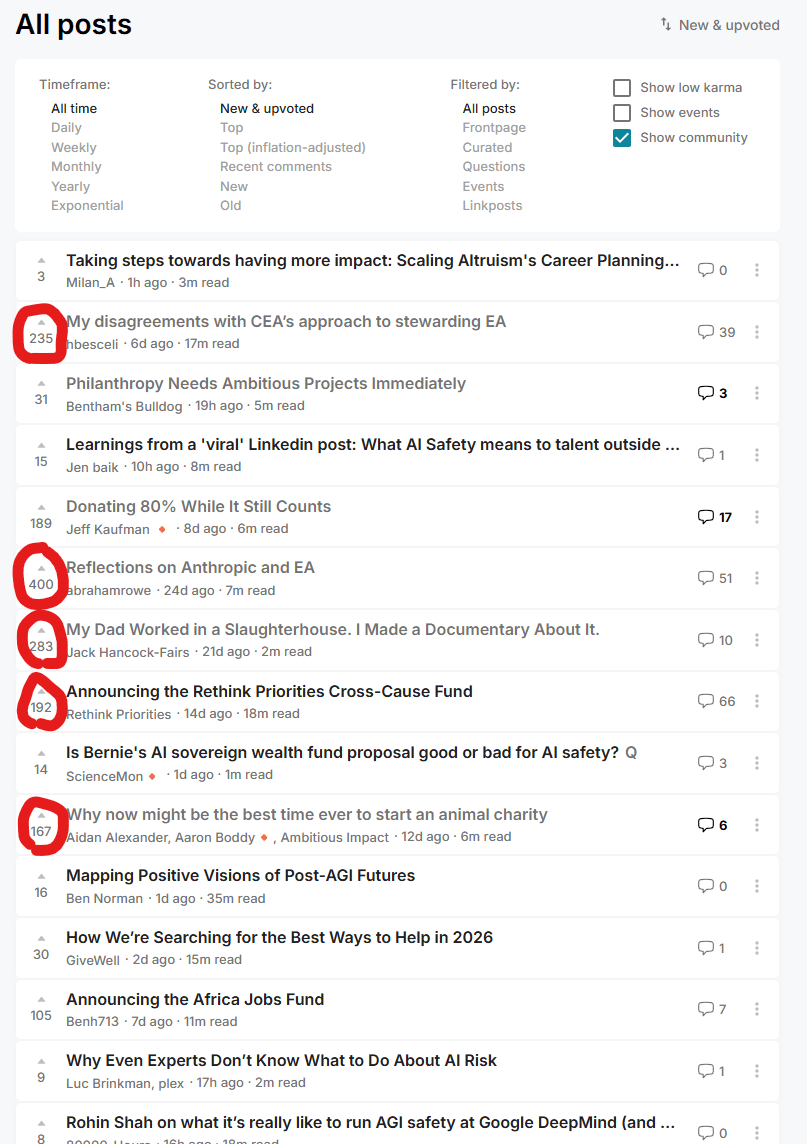
Is it dying though? Maybe I have some filter I forgot to turn off but on new and upvoted posts, 5 out of the 6 highest karma ones are about EA criticism (including this one!) as well as global health and animal welfare. Anecdotal, but perhaps hopeful? Maybe there is more diversity and epistemic humility than we get from the podcasts and other sources biased towards funder priorities? If that is true, how can we stay in touch with this? It feels kind of like regular news media dominated by wars and accidents while the world is also amazing and getting better.
Denkenberger🔸 @ 2026-05-30T21:04 (+9)
But EA seems increasingly ideological to me, it seems to be a lot less concerned with asking and answering a genuinely open question, and a lot more concerned with causing people to follow established paths to impact.
That may be true, though I would note that EA should have been more open to new causes in the beginning, until it did a bunch of research and found promising cause areas. I will also note that there is evidence that EA is still open to new cause areas, such as the recent shift from focusing on AI catastrophes to making AI futures go well (not to mention many individual EAs shifting between cause areas within EA).
But if EA were more ideological, does this mean it is dying? Maybe it is a worse fit for some people as a community. But I think the most important question is, "Is EA having more positive impact?" I agree that that is not just a function of jobs switched and money moved. But overall, I think it is having more positive impact, so I would not call that dying.
Davidmanheim @ 2026-06-10T07:22 (+7)
I partly agree with these concerns, but think the solution should be very different. As I've argued for quite some time, EA should not be a community, but should be much larger. That is, EA needs to be a movement, not a question.
What would this look like? I think three central points capture most of this, with the latter two emerging from the first.
- Effective Altruism as a community, or affiliation, or description, isn't a goal.
- Giving effectively needs to be about giving effectively, not about identity.
- Career choice needs to be about people and goals, not about movement building.
I think this incidentally addresses the problems with the growth funnel model; we're not trying to get people into groups, we're trying to get them to give effectively and pick careers that are impactful. This is directly in contrast with your claim that we should be aiming for engagement instead of trying to aim for concrete goals. In fact, promoting community is exactly where you'd expect Goodharting and self-promotion in place of concrete goals, and self-dealing and community building replace impact.
This also addresses selection effects - if we're not focused on community, we don't need to select on beliefs. Anyone donating to any cause they choose effectively is signing on. Any progress towards goals that improve the present and future is success, regardless of whether it comes from those affiliated with our community.
And according to this model, we're far more successful than CEA will ever be able to take credit for, because it's one organization, and is not what matters for whether EA succeeds.
So is the Gates Foundation EA? Not if we care about community and direct affiliation, but absolutely if we care about goals. Is Progress Studies EA? Not if we focus on affiliation, but yes if we care about effective career focuses and decision making. Are Vitalik Buterin, or Michael Bloomberg, or Eric Schmidt, or MacKenzie Scott (Bezos) effectively giving? Not if we care about which cause areas are being supported, but yes if we care about the ethos of picking causes, trying to figure out how to actually do good, and voting with dollars donated.
Perhaps it doesn't even matter whether people hate effective altruism as a movement, if they are raising money for the global poor. I think the change in culture around giving has been enormous, and it's partially due to the movement to give money effectively and care about changing the world, even if the movement itself is, as the post claims, dying.
I think principles first stewardship is a partial answer to how to move forward, but I also want the idea of EA as a brand to die. As I have said in the past, I hope that EA does not meaningfully exist in the future, and that it's seen as a movement which succeeded; to the extent that the shell remains, it shouldn't matter. The fact that many younger people reject feminism or wokeness doesn't mean that the movements lost, it often means they were successful enough that it's hard to even question the things they started out to accomplish. And yes, the organizations left over from the successes of movements like feminism and civil rights keep pushing, but the principal successes are behind them. Their current work may be good, or damaging, or whatever, but it doesn't matter, because they won the fights they were built to have.
I want that for EA. I want a future where EA as a community doesn't matter, but effective giving and caring about impact are so commonplace people don't realize they were once unusual. And I think that's a path we're actually able to continue walking, and a goal we could reach - even without EA as a brand.
Kestrel🔸 @ 2026-06-01T08:42 (+7)
An absolutely critical point of building an EA community that works for established members is
- the established members contribute financially to this community infrastructure
- the established members accept a "slightly less than professional" experience that costs less money to organize
- the established members give useful critical feedback to the organisers about what they want to see in their group, accepting that they are essentially employing the community builder to steward them
the organisers, being funded and guided via existing members who attend the group, adopt a design habit of welcoming newcomers who find their way there, and being open to more people joining, but not making the whole of the community for them. In particular it doesn't compromise on its epistemics or seeking discipline for outreach purposes, except in notably newcomer-focused spaces.
These kind of culture norms have to start at the local group level. I would like to see city groups take membership subscriptions, for example.
Kirsten @ 2026-06-02T17:49 (+4)
I've advocated for this in London; I think the incentives are better. But it's obviously a hard sell.
Kestrel🔸 @ 2026-06-02T19:09 (+4)
It shouldn't be such a hard sell. Why, when well stewarded meta-EA is such a ridiculously high-impact giving opportunity, and EA is full of givers searching for impact, do so few of us give to EA infrastructure?
Ultimately I think this is going to have to come from individual pledgers / EtGers who take control of their local groups via donations and reshape them into something that works for people in EA for the long haul.
Kirsten @ 2026-06-05T09:56 (+6)
It's not such a hard sell for donors, although many of us feel on some level that protecting toddlers from malaria is more impactful than running EA socials.
The people I could never convince were the community organisers themselves. They had a guaranteed salary from philanthropic foundations; why would they give that up?
Clara Torres Latorre 🔸 @ 2026-06-02T21:11 (+1)
I've been thinking about this for a while since I read your post about it:
It would feel very weird and conflict-of-interest-y to fund someone in my local group to be a paid organizer, right now we're a bunch of volunteers running it.
You say well stewarded meta-EA is very high impact. I agree in theory, but I'm not sure about how to know if something is well stewarded in practise.
Kestrel🔸 @ 2026-06-03T07:52 (+12)
Yes, learning how to recognize (and fund) good stewardship is a hard skill.
But I feel that (some) genuinely committed, longer-term EAs are exactly the kind of people who may actually be able to sit down with each other to do that.
I am speaking with experience of being a Quaker (the other seeking-focused moral ambition cult I hang out in), and the answer the Quakers have is to fund administrators, not pastors. That is, the people who take salaries for community building essentially take direction from the volunteer community organisers and get all the niggly administrative bits sorted out to ensure that the "job" of a voluntary community organiser remains fun and meaningful rather than overly stressful. It also means it costs a lot less - you don't need that many administrators.
I could see this model working fairly well for a longer-term EA group. And it's basically how the EA Forum works: paid administrators keep the platform going and enforce basic discipline standards, "volunteer" EAs post whatever they're working on. And one could argue most of EAG works like this too: CEA hosts the space and food and Swapcard and enforces basic conduct standards for 1:1s, and leaves the EAs to all get on with EA-ing.
Clara Torres Latorre 🔸 @ 2026-06-03T10:52 (+1)
I find this quite useful to avoid the failure mode that worries me the most, namely, that once one derives a source of income from being a community builder, their incentives start to look like "do whatever gets me renovated" and less like "do whatever I really believe is most impactful".
So separating the operations layer (professional), from the more ideological/opinionable layer (not paid) seems like a very good idea to me.
The analogy with quakers having pastor and administrator roles separated is helpful to me to put words on why I have complicated feelings about EA paid CB roles, because they are in some sense both.
Andreas Jessen🔸 @ 2026-06-01T16:23 (+5)
Thanks for this post. I especially found your point on treating the post-FTX challenge as a trust problem valuable. I always had a slightly bad feeling about this trend of trying to minimize reputational risks and distancing oneself from stuff that others might find controversial. After reading your post I have now more clarity regarding that.
Focussing on outward appearance comes with the risk of losing intellectual honesty and might not even be very effective at improving outward appearance as it is only treating the symptoms and might even seem deceptive or as if we had something to hide. I am not saying that one shouldn't care about outward appearance at all, but maybe it shouldn't be the main focus of dealing with the post-FTX challenge but rather thinking about it as a trust problem should be. The main priority should be to ensure that our community is worthy of our trust and that it creates value. I am aware that this is already happening to some degree, and I am not sure if it is possible to judge how much of it is by looking how much is publicly talked about it is, but if it is then outward appearance of EA is currently too much of a focus and making sure that EA is trustworthy, honest and true to its principles maybe deserves a little more attention.
Having a community worthy of our trust and one that is true to its original principles gets harder the larger the community gets, and it also gets harder when the community grows faster. I get the point that growing slower comes at a cost and more good can be done with a larger community but when slower growth means a healthier community that exists in a meaningful way for longer, then maybe that is a price we should be willing to pay.
Duncan Sabien's "Make more Grayspaces" is also interesting in this context. It describes a possible solution for how a growing community can stay true to its values. I am not sure if this solution would work for EA, but I found the description of the problem quite compelling.
Buck @ 2026-05-30T17:39 (+4)
.
Ariel Simnegar 🔸 @ 2026-05-30T18:19 (+39)
If you’re saying EA forum engagement may be net negative and are willing to engage on that here, I’d be curious to understand your perspective on that.
Speaking for myself, reading and engaging on this forum ~2y ago helped me substantially with my cause prioritization in my donations and my identification as an EA community member. Now that the forum isn’t as active as it was, I’ve been wanting to push myself to contribute more, as a public service with the hope that others will benefit the same way.
What’s been informing your perspective?
Robi Rahman🔸 @ 2026-06-02T19:11 (+35)
it's full of dumb criticisms and bitter, jealous people
Really? It's full of this stuff? I've been reading it for 5+ years and barely seen this. Can someone who agrees with this provide examples?
Marcus Abramovitch 🔸 @ 2026-06-03T18:27 (+6)
I disagree that it is full of this stuff. It does exist, though I don't find the stuff to get surfaced much.
Gemma 🔸 @ 2026-06-01T10:41 (+32)
Lol, IMO this comment is kinda rude and disrespectful.
What is "effective" or "altruistic" about it?
This isn't LessWrong. Dumb people can do good effectively if they are disciplined, thoughtful and careful. Haven't you ever asked a stupid question?
It might not be the best use of your time to be kind, helpful and supportive to people trying to do good better. But if not, why are you here?
NickLaing @ 2026-06-02T05:07 (+22)
With all its flaws, this forum remains probably the best place on the internet where a wide range of people can come together and discuss doing good.
As an overactive user, I just haven't seen much of what you describe. I've hardly seen anything I'd call corrosive, and where are these "bitter, jealous people" you speak of?
"As a long-time EA, I don't engage here because the EA Forum is awful and corrosive: it's full of dumb criticisms and bitter, jealous people, and it's hard to imagine anything good coming from engaging with it"
I'll agree with you that we make dumb criticisms, I've made more than my my fair share. But I think that can be a feature as much of a bug. We're all fumbling around trying to figure out the best way to do good, and making stupid arguments along the way is part of the process. Dumb criticism can be a step on the path of figuring out how to be moreright.
Michael St Jules 🔸 @ 2026-06-01T16:26 (+14)
Do you think this is AI safety-specific, because LessWrong pulls the people who have engaged most deeply with AI safety, and so the EA Forum is left primarily with people who aren't as into or understand arguments around AI safety?
Or, do you think this is generally bad across causes, and the EA Forum is net negative for other causes, too?
Chris Leong @ 2026-05-29T08:45 (+4)
I think I might have previously posted this as a comment on another post, but I'll share here as well:
"Recently I’ve been thinking about how the EA community is not what it used to be and how it’s unlikely to ever be like that again (EA resonated strongly in a social context that no longer exists). But, of course, there’s a saying ‘when one door closes, another opens’. This leads to the question: ’What could EA be instead?’.
I'll quote from Communities are Not Fungible:
“But a community that took twenty years to develop its particular structure of norms and mutual knowledge cannot be regrown in twenty years, because the conditions that shaped it no longer exist. The people are older, the context has changed, and the specific convergance of circumstances that brought those particular individuals together in that particular configuration at that particular time is gone. Communities are path-dependent in the strongest possible sense: their current state is a function of their entire history, and you can’t rerun the history.”
Contexts change and what resonates during one time period is different from what resonates in another.”
I can see two paths forward:
• Defining a new vision for where we find ourselves today
• Managed decline[1]
- ^
Which sounds bad, but sometimes may actually be the best strategy.
contact_antitype @ 2026-06-08T01:36 (+3)
I appreciate this reading it as a critique, but I really have no way to tell if the claims add up to the conclusion.
For example: growth can be bad, EA strikes many as an ideology, fewer people self-ID as EA, EA's funnel seems in confict with truth seeking, the central/corporate pressure seems at odds with community building -- those are all worth keeping in mind. I just don't know if they add up to a damning outcome or not.
Yarrow Bouchard 🔸 @ 2026-05-30T01:29 (+3)
I sense this post has insightful and important things to say, but it’s written in a way that’s so abstract that I find it hard to follow. I’ve read several posts like this on the EA Forum. Posts like this desperately need lots of concrete, specific examples described in plain English. The best would be telling stories (anecdotes) that illustrate a problem you’re trying to talk about.
This part I think I can understand and agree with:
EA community building seems less about helping people have an impact by their own lights, and more about having an impact by the lights of the community builders.
Concretely, I infer this means whether it’s 80,000 Hours’ career advising, EA groups at universities doing outreach, interactions at EA conferences, or whatever else, the EA veterans are ultimately just trying to evangelize to the EA newbies. Which is not what the EA newbies want them to do, nor what the EA veterans are leading the newbies to believe is going to happen. Am I right?
This too:
FTX didn't just happen to EA - it also happened within EA. SBF was supported, celebrated and elevated by many parts of EA leadership. The damage wasn't primarily to EA's brand; it was to the trust people had placed in EA - and that loss of trust was at least partially warranted.
To quote the writer Matt Yglesias:
I understand the various reasons why people can't speak in detail about certain things would I would love to see the issues discussed in "EA and the current funding situation" get revisited in light of the fact that the funding situation has changed a lot. It seems to me that when money became more abundant that didn't just make it easier for certain grant proposals to get approved, but was seen as having big-picture strategic implications. When I go back and read the post, the arguments seem sound to me. But beyond not reflecting knowledge of wrongdoing at FTX (hard to find blame here) they seem to not reflect awareness of Bankman-Fried's overall attitude toward risk which I think should have been knowable.
I’d add it wasn’t just Sam Bankman-Fried’s attitude toward risk that was knowable. It was also the riskiness of crypto. Shouldn’t people have been expecting there was a decent chance FTX would blow up, even without any financial crimes?
Besides community building and FTX, the third major example in this post is the Centre for Effective Altruism’s communications strategy or brand strategy. The Centre for Effective Altruism describes this in general, abstract terms that leave me guessing what they mean, concretely and specifically. This post responds to the CEA’s description of its strategy in terms that are also abstract and general.
Who is right and who is wrong? What is the disagreement even about? Is there an actual disagreement or are people just talking past each other? I don’t know. We’d need specific examples of what it would look like to have “honest and positive” messaging versus neutral and purely informative messaging.
I do agree that it feels like EA is dying, but, for all I know, my reasons for feeling that way might be the exact opposite of yours.
Clara Torres Latorre 🔸 @ 2026-05-28T18:22 (+3)
Fantastic post, thank you for airing it.
Something that I can say at a personal level is: I find it very hard to trust a paid community builder, be it a priest, an amateur orchestra conductor or an EA community builder. I see conflicts of interest everywhere.
On the other hand, I think growing the movement makes sense, and having people dedicated to it makes sense, so if someone is doing it you want to measure how they are doing, etc
I find it very hard to reconcile.
Vasco Grilo🔸 @ 2026-06-04T05:33 (+2)
Hi Harri. Great post.
Pato🔹⏸️ @ 2026-09-11T23:21 (+1)
To fight this disadvantage of innovating and having unpopular views, we should have a prize for people who do it and are then proven right.
You could try to do something like prediction markets about EA stuff, but more important than money, I think we should instrumentalize more the strong drive for social status that exists to foster specific things we'd like to see in EA.
This could be done by awarding symbolic physical prizes in EAGs, for example. If it were like rare yearly things and the prizes said things like "You were right" or "You were less wrong" or "Apology form to..." I can see them being cherished.
effectivenieztcheanism @ 2026-08-27T16:49 (+1)
As a random bystander and anthropology hobbyist, a meta observation is that a community that can garner this level of internal debate abt the community itself on a non social media, old skool forum is pretty alive. 2cs
Oliveyoil @ 2026-06-09T15:45 (+1)
`I agree with this article. I would be interested to hear people's thoughts on whether CEA having so much power in the EA ecosystem is bad. I feel like having so much power suppresses criticism and I think people need to recognise that CEA is not EA and try to think freely from this monolithic organisation is good.
OGTutzauer🔸 @ 2026-06-03T15:29 (+1)
EA Lund hasn't been myopically focused on career changes, regardless of what would make CEA fund us more. We focus on a breadth of goals for our members, and my impression is that most local groups think similarly, some actively encouraging critique of EA blind spots. I think this generalizes, as the Groups Resource Center recommends posts like this one to new community builders. I also experience that community builders are more principled and value-aligned than most, and therefore least likely to Goodhart by only pushing career changes.
That said, I agree about the truth-seeking being lacking at times. My go-to example is the often repeated selling point of x-risk, here quoted from the new 80k book:
A strong candidate for the most effective way to help future generations is to prevent a catastrophe that ends civilization, since such a catastrophe would prevent future generations from even existing.
Emphasis mine, to highlight an assumption of the total view of population ethics. Rejecting that importantly shifts priorities in ways that aren't talked about, despite most EAs being wildly uncertain about their population ethics.
SiobhanBall @ 2026-05-28T18:46 (+1)
Great post, not sure what to suggest. Thanks for publishing.