Why did CEA buy Wytham Abbey?
By Jeroen Willems🔸 @ 2022-12-06T14:46 (+140)
Edit to add (9/1/2023): This post was written quickly and I judged things prematurely. I also regret not reaching out to Effective Ventures before posting it. Regarding my current opinion on the Abbey: I don't have anything really useful to say that isn't mentioned by others. The goal of this post was to ask a question and gather information, mostly because I was very surprised. I don't have a strong opinion on the purchase anymore and the ones I have are with high uncertainty. More thoughts in my case for transparent spending.
Yesterday morning I woke up and saw this tweet by Émile Torres: https://twitter.com/xriskology/status/1599511179738505216
I was shocked, angry and upset at first. Especially since it appears that the estate was for sale last year for 15 million pounds: https://twitter.com/RhiannonDauster/status/1599539148565934086
I'm not a big fan of Émile's writing and how they often misrepresent the EA movement. But that's not what this question is about, because they do raise a good point here: Why did CEA buy this property? My trust in CEA has been a bit shaky lately, and this doesn't help.
Apparently it was already mentioned in the New Yorker piece: https://www.newyorker.com/magazine/2022/08/15/the-reluctant-prophet-of-effective-altruism#:~:text=Last year%2C the Centre for Effective Altruism bought Wytham Abbey%2C a palatial estate near Oxford%2C built in 1480. Money%2C which no longer seemed an object%2C was increasingly being reinvested in the community itself.
"Last year, the Centre for Effective Altruism bought Wytham Abbey, a palatial estate near Oxford, built in 1480. Money, which no longer seemed an object, was increasingly being reinvested in the community itself."
For some reason I glanced over it at the time, or I just didn't realize the seriousness of it.
Upon more research, I came across this comment by Shakeel Hashim: "In April, Effective Ventures purchased Wytham Abbey and some land around it (but <1% of the 2,500 acre estate you're suggesting). Wytham is in the process of being established as a convening centre to run workshops and meetings that bring together people to think seriously about how to address important problems in the world. The vision is modelled on traditional specialist conference centres, e.g. Oberwolfach, The Rockefeller Foundation Bellagio Center or the Brocher Foundation.
The purchase was made from a large grant made specifically for this. There was no money from FTX or affiliated individuals or organizations." https://forum.effectivealtruism.org/posts/Et7oPMu6czhEd8ExW/why-you-re-not-hearing-as-much-from-ea-orgs-as-you-d-like?commentId=uRDZKw24mYe2NP4eq
I'm very relieved to hear money from individual donors wasn't used. And the <1% suggests 15 million pounds perhaps wasn't spent. Still, I'd love to hear and understand more about this project and why CEA thinks it's cost-effective. What is the EV calculation behind it?
Like the New Yorker piece points out, with more funding there has been a lot of spending within the movement itself. And that's fine, great even. This way more outreach can be done and the movement can grow. But we don't want to be too self-serving, and I'm scared too much of this thinking will lead to rationalizing lavish expenses (and I'm afraid this is already happening). There needs to be more transparency behind big expenses.
Edit to add: If this expense has been made a while back, why not announce it then?
Owen Cotton-Barratt @ 2022-12-06T23:35 (+504)
Hey,
First I want to explain that I think it's misleading to think of this as a CEA decision (I've edited to be more explicit about this). To explain that I need to disambiguate between:
- CEA, the project that runs the EA Forum, EA Global, etc.
- This is what I think ~everyone usually thinks of when they think of "CEA", as it's the group that's been making public use of that brand
- CEA, the former name of a legal entity which hosts lots of projects (including #1)
- This is a legacy naming issue ...
- The name of the legal entity was originally intended as a background brand to house 80,000 Hours and Giving What We Can; other projects have been added since, especially in recent years
- Since then the idea of "effective altruism" has become somewhat popular in its own right! And one of the projects within the entity started making good use of the name "CEA"
- We’ve now renamed the legal entity to EVF, basically in order to avoid this kind of ambiguity!
- This is a legacy naming issue ...
Wytham Abbey was bought by #2, and isn’t directly related to #1, except for being housed within the same legal entity. I was the person who owned the early development of the project idea, and fundraised for it. (The funding comes from a grant specifically for this project, and is not FTX-related.) I brought it to the rest of the board of EVF to ask for fiscal sponsorship (i.e. I would direct the funding to EVF and EVF would buy the property and employ staff to work on the project). So EVF made two decisions here: they approved fiscal sponsorship, agreeing to take funds for this new project; and they then followed through and bought the property with the funds that had been earmarked for that. The second of these is technically a decision to buy the building (and was done by a legal entity at the time called CEA), but at that point it was fulfilling an obligation to the donor, so it would have been wild to decide anything else. The first is a real decision, but the decision was to offer sponsorship to a project that would likely otherwise have happened through another vehicle, not to use funds to buy a building rather than for another purpose. Neither of these decisions were made by any staff of the group people generally understand as "CEA". (All of this ambiguity/confusion is on us, not on readers.)
I’d also like to speak briefly to the “why” — i.e. why I thought this was a good idea. The central case was this:
I’ve personally been very impressed by specialist conference centres. When I was doing my PhD, I think the best workshops I went to were at Oberwolfach, a mathematics research centre funded by the German government. Later I went to an extremely productive workshop on ethical issues in measuring the global burden of disease at the Brocher Foundation. Talking to other researchers, including in other fields, I don’t think my impression was an outlier. Having an immersive environment which was more about exploring new ideas than showing off results was just very good for intellectual progress. In theory this would be possible without specialist venues, but researchers want to spend time thinking about ideas not event logistics. Having a venue which makes itself available to experts hosting events avoids this issue.
In the last few years, I’ve been seeing the rise of what seems to me an extremely important cluster of ideas — around asking what’s most important to do in the world, and taking chains of reasoning from there seriously. I think this can lead to tentative answers like “effective altruism” or “averting existential risk”, but for open-minded intellectual exploration I think it’s better to have the focus on questions than answers. I thought it would be great if we could facilitate more intellectual work of this type, and the specialist-venue model was a promising one to try. We will experiment with a variety of event types.
We had various calculations about costings, which made it look somewhere between “moderately money-saving” and “mildly money-spending” vs renting venues for events that would happen anyway, depending on various assumptions e.g. about usage that we couldn’t get great data on before running the experiment. The main case for the project was not a cost-saving one, but that if it was a success it could generate many more valuable workshops than would otherwise exist. Note that this is a much less expensive experiment than it may look on face value, since we retain the underlying asset of the building.
We wanted to be close to Oxford for easy access to the intellectual communities there. (Property prices weren’t falling off significantly with distance until travel time from Oxford and London had become significantly higher.) We looked at a lot of properties online, and visited the three properties we found for sale with 20+ bedrooms within about 50 minutes of Oxford. These were all "country houses", which are commonly repurposed as event venues in England. The other two were cheaper (one ~£6M and one ~£9M at the end of a competitive process; compared to a purchase price for Wytham of a bit under £15M) but needed significantly more work before they were usable, which would have added large expense (running into the millions) and delay (likely years). (And renovation expense isn’t obviously recoverable if one sells — it depends on how much the buyers want the same things from the property as you do.)
We thought Wytham had the most long-term potential as a venue because it had multiple large common rooms that could take >40 people. The other properties had one large room each holding perhaps a max of 40, but there would be pressure on this space since it would be wanted as both a dining space and for workshop sessions, and would also reduce flexibility of use for meetings (extra construction might have been able to address this, but it was a big question mark whether you could get planning consent). Wytham also benefited from being somewhat larger (about 27,000 sq ft vs roughly 20,000 sq ft for each of the other two) and a more accessible location. Overall we thought that a combination of factors made it the most appropriate choice.
I did feel a little nervous about the optical effects, but think it’s better to let decisions be guided less by what we think looks good, and more by what we think is good — ultimately this was a decision I felt happy to defend.
On why we hadn’t posted publicly about this before: I'm not a fan of trying to create hype. I thought the natural time to post about the project publicly would be when we were ready to accept public applications to run events, and it felt a bit gauche to post before that. Now that there's a public discussion, of course, it seemed worth explaining some of the thinking.
I hope this is helpful.
Arepo @ 2022-12-08T22:49 (+136)
This comment sounds qualitatively reasonable, but it needs a quantitative complement - it could have been made virtually verbatim had the cost been £1.5m or £150m. I would like to hear the case for why it was actually worth £15m.
Also, a lot of people are talking about 'optics', with the implication that the irrational public will misunderstand the +EV of such a decision. But 'bad optics' don't come from nowhere - they come from a very reasonable worry that over time, people who influence a lot of money have some risk of, if not becoming corrupt, at least getting carried away with that influence and rationalising away things like this.
I think we should always take such possibilities seriously, not to imply anyone has actually done anything wildly irresponsible, but to insure against anyone doing so - and to keep grey areas as thin as possible. And I'm increasingly worried that CEA are seriously undertransparent in ways that suggest they don't think such risks could materialise - which increases my credence that they could. So while I could be convinced this was a reasonable use of funds, I think the decision not to 'hype' it builds a dangerous precedent.
Davidmanheim @ 2022-12-11T10:42 (+21)
You can check how many events GPI, FHI, and CEA have run in Oxford, requiring renting hotels, etc., and the associated costs. I know that GPI runs at least a couple such events per year. Given that, I think that over the next 10-20 years, £15m isn't outside the realm of plausible direct costs saved, especially if it's available for other groups to rent in order to help cover costs.
That said, the cost-benefit analysis could be more transparent. On the other hand, I don't think that private donors should be required to justify their decisions, regardless of the vehicle used. But I do think that CEA is the wrong place for this to be done, given that they aren't even likely to be a key user of the space. (Edit: Owen's explanation, that this was done by the parent org of CEA, means I will withdraw the last claim.)
Arepo @ 2022-12-11T13:48 (+13)
I accept that it's plausibly in the realm, but that's not very helpful for knowing whether it's actually worthwhile - plausibility is a very low bar.
the other hand, I don't think that private donors should be required to justify their decisions
This doesn't seem like a good blanket policy. If private donors can use a charity to buy large luxury goods, it raises worries about that charity becoming a tax haven, or a reward for favours, or any other number of such hard-to-predefine but questionable activities. There are legal implications around charities taking too much of their money from a single donor for exactly that reason.
I don't think we're there yet, but, per above, I would like to see more discussion from CEA of the risks associated with moving in that direction.
But I do think that CEA is the wrong place for this to be done, given that they aren't even likely to be a key user of the space.
Agree. I don't mind the idea of a sort of EA special projects orgs that has relatively high autonomy, but I don't want that org to also be the face of the community - as I understand it, that's basically how we ended up with FTXgate. We'd also probably want them to source funding from a wide range of sources to avoid the unilateralists' curse, which this situation is at least flirting with.
Davidmanheim @ 2022-12-12T12:45 (+8)
I think we mostly agree, but don't think this was unilateralists' curse, and it isn't even close. Many people were aware of or involved in discussions about this, and having multiple donors doesn't guarantee not falling into unilateralism.
Arepo @ 2022-12-12T13:04 (+2)
I agree on what we agree and disagree about :)
Re unilateralism obviously more donors isn't anything like a guarantee, but is one of hopefully many safeguards. On the other hand, many people approving of it here (assuming they broadly did) doesn't mean it's not a form of unilateralism depending on how those people were included in the discussion - if, for eg, they were all major CEA funders and staff, there's likely to be extreme selection bias in their opinions on the relevant questions.
Davidmanheim @ 2022-12-12T16:56 (+10)
I'm telling you that, as someone who hasn't ever worked for or with CEA directly, I spoke with a couple people about this months before it happened. Clearly, plenty of people were aware, and discussed this - and I didn't know the price tag, but thought that a center for retreats focused on global priorities and related topics near Oxford sounded like a very good idea. I still think it is, and honestly don't think that it's unreasonable as a potential investment into priorities research. Of course, given the current post-FTX situation, it would obviously not have been considered if the project was being proposed today.
Nicholas Wagner @ 2022-12-08T01:55 (+63)
Can you say who funded the dedicated grant?
Susan II @ 2022-12-08T18:28 (+18)
I feel like this is pretty important. I think this is basically fine if it's a billionaire who thinks CEA needs real estate, and less fine if it is incestuous funding from another EA group.
RobertJones @ 2022-12-11T11:14 (+14)
I think the key question is whether the money would counterfactually have been available for another purpose. OCB half-implies it wouldn't have been by saying that buying the property fulfiled an obligation to the donor, but then I'm confused by the claim "we retain the underlying asset". If EVF holds the asset subject to an obligation only to use it as a specialist conference centre, it's unable to realise the value. On the other hand, it would seem surprising if the donation was made on the condition that it must be used to buy the building, but then EVF could do whatever it liked with it (including immediately reselling it).
If EVF is in fact able to resell the building now, then the argument that it was an ear-marked donation is weak, because EVF is making a decision now to hold the asset rather than sell it to raise funds for other EA causes.
hamburga @ 2022-12-15T17:44 (+1)
I take the silence as a no :(
Will Bradshaw @ 2022-12-15T18:03 (+13)
It was OpenPhil, see here.
Geoffrey Miller @ 2022-12-07T03:31 (+62)
Owen - this sounds totally reasonable to me.
Max Planck Institutes had a dedicated conference center in the Alps (Schloss Ringberg) that is hugely inspirational, and that promotes intensive collaboration, brain-storming, and discussion very effectively.
Likewise for the Center for Advanced Study in the Behavioral Sciences at Stanford -- the panoramic views over the San Francisco Bay, the ease of both formal and informal interaction, and the optimal degree of proximity to the main campus (near, but not too near), promote very good high-level thinking and exchange of ideas.
I've been to about 70 conferences in my academic career, and I'm noticed that the aesthetics, antiquity, and uniqueness of the venue can have a significant effect on the seriousness with which people take ideas and conversations, and the creativity of their thinking. And, of course, it's much easier to attract great talent and busy thinkers to attractive venues. Moreover, I suspect that meeting in a building constructed in 1480 might help promote long-termism and multi-century thinking.
It's hard to quantify the effects that an uplifting, distinctive, and beautiful venue can have on the quality and depth of intellectual and moral collaboration. But I think it's a real effect. And Wytham Abbey seems, IMHO, to be an excellent choice to capitalize on that effect.
Mrtea @ 2022-12-08T21:02 (+118)
The problem to me seems to be that "being hard to quantify" in this case very easily enables rationalizing spending money on fancy venues. I'm also not convinced that non-EA institutions spending money on fancy venues is a good argument for also doing so or an argument that fancy venues enable better research. These institutions probably just use fancy venues because it is self serving. As they don't usually promote doing the most good by being effective, I guess that nobody cares much that they do that.
Personally, I think that a certain level of comfort is helpful, e.g. having single / double rooms for everybody so they can sleep well or don't needing to cook etc. However, I'm very skeptical of anything above that being worth the money.
I don't want to be adversarial, but I just have to note how much your comment reads to me and other people I spoke to like motivated reasoning. I think it's very problematic if EA advocates for cost effectiveness on the one hand and then lightly spends a lot of money on fancy stuff which seems self serving.
projectionconfusion @ 2022-12-09T15:46 (+56)
Agreed. The whole founding insight of the EA movement was the importance of rigorously measuring value for money. The same logic is used to justify every warm and fuzzy but low value charity. And it's entirely reasonable to be very worried when major figures in the EA movement revert to that kind of reasoning when it's in their self interest.
RobertJones @ 2022-12-11T11:26 (+10)
Yes. It seems very plausible that conferences are good and also that conferences in attractive venues are better, but it seems surprising that this would be the most effective use of the money.
Guy Raveh @ 2022-12-08T15:39 (+50)
First of all - I'm really glad you wrote this comment. This is exactly the kind of transparency I want to see from EA orgs.
On the other hand, I want to push back against your now last paragraph (on why you didn't write about this before). I strongly think that it's wrong to wait for criticism before you explain big and important decisions (like spending 15 million pounds on a castle). The fact that criticism arose here is basically random, and is a result of outside critics looking in. In a better state of affairs, you want the EA community to know about the things they need to look at and maybe criticise. Otherwise there's a big chance they'll miss things.
In other words, I think it's very important that major EA orgs proactively share the information and reasoning about big decisions.
Michael_PJ @ 2022-12-09T00:15 (+15)
This sort of comment sounds good in the abstract, but what specific process would you propose that you think would actually achieve this? CEA has to post all project proposals over a certain amount to the EA forum? Are people actually going to read them? What if they only appeal to specific funders? How much of a tax on the time of CEA staff are we willing to pay in order to get this additional transparency?
lastmistborn @ 2022-12-09T00:27 (+39)
Personally, I think something like a quarterly report on incoming funds and outgoing expenses, ongoing projects and cost breakdowns, and expected and achieved outcomes would work very well. This is something I'd expect of any chariry or NGO that values effectiveness and empirical backing, and particularly from one that places it at the center of its mission statement, so I struggle to think of it as a "tax" on the time of CEA workers rather than something that should be an accepted and factored in cost of doing business.
Michael_PJ @ 2022-12-09T09:20 (+23)
The grandparent comment asks for decisions to be explained before criticism appears. Your proposal (which I do think is fairly reasonable) would not have helped in this case: Wytham Abbey would have got a nice explanation in the next quarterly report after it got done, i.e. far too late.
You would instead require ongoing, very proactive transparency on a per-decision basis in order to really pre-empt criticism.
I struggle to think of it as a "tax" on the time of CEA workers rather than something that should be an accepted and factored in cost of doing business.
I put a negative framing on it and you put a positive one, but it's a cost that prevents staff from doing other things with their time and so should be prioritised and not just put onto an unbounded queue of "stuff that should be done".
lastmistborn @ 2022-12-09T09:36 (+18)
The grandparent comment asks for decisions to be explained before criticism appears. Your proposal (which I do think is fairly reasonable) would not have helped in this case: Wytham Abbey would have got a nice explanation in the next quarterly report after it got done, i.e. far too late.
I think my broader frame around the issue affected how I read the parent comment. I took it as the problem being a general issue in EA transparency - my general thinking on a lot of the criticisms from within EA was something along the lines of the lack of transparency as a general issue is the larger problem, if EAs knew there would be a report/justification coming, it would not have been such an issue within the community. I do see your point now, although I do think there are some pretty easy ways around it, like determining a reasonably high bar on the basis of CEA's general spending-per-line-item that would necessitate a kind of "this is a big deal" announcement.
I put a negative framing on it and you put a positive one, but it's a cost that prevents staff from doing other things with their time and so should be prioritised and not just put onto an unbounded queue of "stuff that should be done".
I agree that it is a cost, like all other things. On the point of prioritization, I would argue that because of EA principles being so heavily tied into cost effectiveness and empiricism, treating this as something that can be foregone to give CEA staff to do other stuff that should be done is not only hypocritical, it's bad epistemically insofar as it implies that EAs (or at least EAs who work at CEA) are not beholden to the same principles of transparency and epistemic rigor that they expect from other similar organizations, ie. "we are above these principles for some reason or other".
Michael_PJ @ 2022-12-10T16:09 (+2)
I think this is all pretty reasonable, but also I suspect I might think that existing similar organisations were doing too much of this kind of transparency activity.
Guy Raveh @ 2022-12-09T08:22 (+17)
CEA has to post all project proposals over a certain amount to the EA forum?
Yes, that sounds about it. Although I would add decisions that are not very expensive but are very influential.
What if they only appeal to specific funders?
What do you mean?
How much of a tax on the time of CEA staff are we willing to pay in order to get this additional transparency?
A significant amount. This is well worth it. Although in practice I don't imagine there are that many decisions of this calibre. I would guess about 2-10 per year?
Michael_PJ @ 2022-12-09T09:25 (+20)
A significant amount. This is well worth it.
That's pretty unclear to me. We are in the position of maximum hindsight bias. An unusual and bad event has happened, that's the classic point at which people overreact about precautions.
Guy Raveh @ 2022-12-09T09:40 (+10)
I've been writing the same calls for transparency for months. This has nothing to do with FTX.
RobBensinger @ 2022-12-10T21:56 (+8)
I strongly think that it's wrong to wait for criticism before you explain big and important decisions (like spending 15 million pounds on a castle).
I disagree with this. The property may well increase in value over time, and be sold at a profit if EAs sell it. I don't think EAs should publicly discuss every investment they make at the $20M level (except insofar as public discussion is useful for all decisions), and if there's a potential direct altruistic benefit to the investment then that makes it less important to publicly debate, not more important.
(Analogy: if a person deciding to invest $20 million in a for-profit startup with zero direct altruistic benefit requires no special oversight, then a person deciding to invest $20 million in a for-profit startup that also has potential altruistic benefits suggests even less use for oversight, since we've now added a potentially nice and useful feature to an action that was already fine and acceptable beforehand. Altruistic side-effects shouldn't increase the suspiciousness of an action that already makes sense on its own terms.)
See also Oliver's point, "Purchase price - resale price will probably end up in the $1-$3MM range."
Siao Si @ 2022-12-11T00:23 (+13)
I'm not sure about this particular case, but I don't think the value of the property increasing over time is a generally good argument for why investments need not be publicly discussed. A lot of potential altruistic spending has benefits that accrue over time, where the benefits of money spent earlier outweighs the benefits of money spent later - as has been discussed extensively when comparing giving now vs. giving later.
The whole premise of EA is that resources should be spent in effective ways, and potential altruistic benefits is no excuse for an ineffective spending of money.
Guy Raveh @ 2022-12-10T22:32 (+4)
-
Would you still disagree if this were an outright 15M£ expense?
-
This is a very risky investment. I don't know what Oliver's point is based on, but I saw another (equally baseless) opinion online that since they bought it right before a market crash, chances are they've already lost millions. I'd probably not feel the same way about some diverse investment portfolio, but millions in a single real estate investment? This does require significant oversight.
-
Re: your analogy - I both disagree with the claim and with the fact that this is analogous. CEA is not like a person and should not be treated as one; they're an organisation purporting to represent the entire movement. And when people do something that they hope have a big impact, if it's important to them that it's positive, broad oversight is much more important than if it was an investment with no chance of a big impact.
RobBensinger @ 2022-12-11T04:52 (+22)
Would you still disagree if this were an outright 15M£ expense?
E.g., if EAs overpaid 30M£ for a property that resells at 15M£? I'd be a bit surprised they couldn't get a better deal, but I wouldn't feel concerned without knowing more details.
Seems to me that EA tends to underspend on this category of thing far more than they overspend, so I'd expect much more directional bias toward risk aversion than risk-seeking, toward naive virtue signaling over wealth signaling, toward Charity-Navigator-ish overhead-minimizing over inflated salaries, etc. And I naively expect EVF to err in this direction more than a lot of EAs, to over-scrutinize this kind of decision, etc. I would need more information than just "they cared enough about a single property with unusual features to overpay by 15M£" to update much from that prior.
We also have far more money right now than we know how to efficiently spend on lowering the probability that the world is destroyed. We shouldn't waste that money in large quantities, since efficient ways to use it may open up in the future; but I'd again expect EA to be drastically under-spending on weird-looking ways to use money to un-bottleneck us, as opposed to EA being corrupt country-estate-lovers.
It's good that there's nonzero worry about simple corruption, since we want to notice early warning signs in a world where EAs do just become corrupt and money-hungry (and we also want to notice if specific individual EAs or pseudo-EAs acquire influence in the community and try to dishonestly use it for personal gain). But it's not high on my list of ways EA is currently burning utility, or currently at risk of burning utility.
nikos @ 2022-12-15T10:45 (+1)
I'm confused why you wouldn't feel concerned about EA potentially wasting 15M pounds (talking about your hypothetical example, not the real purchase). I feel that would mean that EA is not living up to its own standards of using evidence and reasoning to help others in the best possible way.
RobBensinger @ 2022-12-16T02:31 (+13)
Since EA isn't optimizing the goal "flip houses to make a profit", I expect us to often be willing to pay more for properties than we'd expect to sell them for. Paying 2x is surprising, but it doesn't shock me if that sort of thing is worth it for some reason I'm not currently tracking.
MIRI recently spent a year scouring tens of thousands of properties in the US, trying to find a single one that met conditions like "has enough room to fit a few dozen people", "it's legal to modify the buildings or construct a new one on the land if we want to", and "near but not within an urban center". We ultimately failed to find a single property that we were happy with, and gave up.
Things might be easier outside the US, but the whole experience updated me a lot about how hard it is to find properties that are both big and flexible / likely to satisfy more than 2-3 criteria at once.
At a high level, seems to me like EA has spent a lot more than 15M£ on bets that are vastly more uncertain and dependent-on-contested-models than "will we want space to house researchers or host meetings?". Whether discussion and colocation is useful is one of the only things I expect EAs to not disagree about; most other categories of activity depend on much more complicated stories, and are heavily about placing bets on more specific models of how the future is likely to go, what object-level actions to prioritize over other actions, etc.
jacquesthibs @ 2022-12-10T17:45 (+43)
Can we all just agree that if you’re gonna make some funding decision with horrendous optics, you should be expected to justify the decision with actual numbers and plans?
Would be nice if we actually knew how many conferences/retreats were going to be held at the EA castle.
It might be justifiable (I got a tremendous amount of value being in Berkeley and London offices for 2 month stints), but now we’re here talking about it, and it obviously looks bad to anyone skeptical about EA. Some will take it badly regardless, but come on. Even if other movements/institutions way overspend on bad stuff, let’s not use that as an excuse in EA.
The “EA will justify any purchase for the good of humanity” argument will just continue to pop up. I know many EAs who are aware of this and constantly concerned about overspending and rationalizing a purchase. As much as critics act like this is never a consideration and EAs are just naively self-rationalizing any purchase, it’s certainly not the case for most EAs I’ve met. It’s just that an EA castle with very little communication is easy ammo for critics when it comes to rationalizing purchases.
One failed/bad project is mostly bad for the people involved, but reputational risk is bad for the entire movement. We should not take this lightly.
vaniver @ 2022-12-12T20:02 (+9)
Can we all just agree that if you’re gonna make some funding decision with horrendous optics, you should be expected to justify the decision with actual numbers and plans?
Justify to who? I would like to have an EA that has some individual initiative, where people can make decisions using their resources to try to seek good outcomes. I agree that when actions have negative externalities, external checks would help. But it's not obvious to me that those external checks weren't passed in this case*, and if you want to propose a specific standard we should try to figure out whether or not that standard would actually help with optics.
Like, if the purchase of Wytham Abbey had been posted on the EA forum, and some people had said it was a good idea and some people said it was a bad idea, and then the funders went ahead and bought it, would our optics situation look any different now? Is the idea that if anyone posted that it was a bad idea, they shouldn't have bought it?
[And we need to then investigate whether or not adding this friction to the process ends up harming it on net; property sales are different in lots of places, but there are some where adding a week to the "should we do this?" decision-making process means implicitly choosing not to buy any reasonably-priced property, since inventory moves too quickly, and only overpriced property stays on the market for more than a week.]
* I don't remember being consulted about Wytham, but I'm friends with the people running it and broadly trust their judgment, and guess that they checked with people as to whether or not they thought it was a good idea. I wasn't consulted about the specific place Irena ended up buying, but I was consulted somewhat on whether or not Irena should buy a venue, and I thought she should, going so far as being willing to support it with some of my charitable giving, which ended up not being necessary.
Larks @ 2022-12-07T03:16 (+40)
Thanks for sharing your detailed thought process Owen, and I definitely appreciate the penultimate paragraph.
Owen Cotton-Barratt @ 2022-12-08T13:47 (+5)
(I edited in a way which changed which paragraph was penultimate. I believe Larks was referring to the content which is now expanded on in paragraphs starting "We wanted ..." and "We thought ...".)
Jelle Donders @ 2022-12-07T20:46 (+32)
Sounds like a reasonable decision to me, but I do wonder why the reasoning behind such large and not immediately obvious decisions isn't communicated publicly more often.
let decisions be guided less by what we think looks good, and more by what we think is good
Totally agree, as long as you give people the opportunity to figure out why you think it's good.
Anyway, thanks for clarifying!
Grayden @ 2022-12-08T10:20 (+30)
In general I would agree that it's better to do what is good rather than what looks good. However, when you are the face of a global movement, optics have a meaningful financial implication. Imagine if this bad press made 1 billionaire 0.1% less likely to get involved with EA. That calculation would dominate any potential efficiency savings from insourcing a service provider.
Michael_PJ @ 2022-12-09T00:12 (+43)
I used to think this and I increasingly don't. Doing good thing is what we're all about. Doing good things even if it looks bad in the tabloid press is good publicity to the people who actually care about doing good, and they're more important to us than the rest.
I think an EA that was weirder and more unapologetic about doing its stuff attracts more of the right kind of people and can generally get on with things more than an EA that frantically tries to massage it's optics to appeal to everyone.
Devon Fritz @ 2022-12-09T15:55 (+9)
I am having a hard time here and speckled throughout the rest of this post with people writing that we are doing the "good thing" and we should do that and not just what looks good with the "good thing" in question being buying a castle and not say, caring about wild animal suffering.
Michael_PJ @ 2022-12-10T15:15 (+11)
I guess I've gone off into the abstract argument about whether we should care about optics or not. I don't mean to assert that buying Wytham Abbey was a good thing to do, I just think that we should argue about whether it was a good thing to do, not whether it looks like a good thing to do.
Grayden @ 2022-12-11T14:21 (+2)
I'm arguing that deciding whether or not it is a good thing should include the PR impact (i.e. a weak consequentialist approach). I don't care if things look bad, unless that perception leads bad outcomes. In this case, I think the perception could lead to bad outcomes that dominate the good outcomes in the expected value calculation
RobBensinger @ 2022-12-10T21:58 (+3)
I very much agree with Michael here.
Neel Nanda @ 2022-12-08T17:05 (+22)
I think this kind of reasoning is difficult to follow in practice, and likely to do more harm than good. Eg, I expect some billionaires are drawn to a movement that says fuck PR and actually tries to do what's important - what if trying to account for PR has a 0.1% chance of putting off those billionaires? Etc.
At the very least, "do what is actually good rather than just what looks good" seems like a valid philosophy to follow if trying to do good, even after accounting for optics - trying to account for optics can easily be misleading, paralysing, etc.
freedomandutility @ 2022-12-12T12:09 (+3)
EA is all about uncertain EV calculations - I don’t see why we should exclude optics when calculating EV. We should just embrace the uncertainty and try our best.
The only part of EA that doesn’t involve super uncertain EV calculations which can be misleading and paralysing is randomista development.
Neel Nanda @ 2022-12-12T12:36 (+12)
This is fair, and I don't want to argue that optics don't matter at all or that we shouldn't try to think about them.
My argument is more that actually properly accounting for optics in your EV calculations is really hard, and that most naive attempts to do so can easily do more harm than good. And that I think people can easily underestimate the costs of caring less about truth or effectiveness or integrity, and overestimate the costs of being legibly popular or safe from criticism. Generally, people have a strong desire to be popular and to fit in, and I think this can significantly bias thinking around optics! I particularly think this is the case with naive expected value calculations of the form "if there's even a 0.1% chance of bad outcome X we should not do this, because X would be super bad". Because it's easy to anchor on some particularly salient example of X, and miss out on a bunch of other tail risk considerations.
The "annoying people by showing that we care more about style than substance" was an example of a counter-veiling consideration that argues in the opposite direction and could also be super bad.
This argument is motivated by the same reasoning as the "don't kill people to steal their organs, even if it seems like a really good idea at the time, and you're confident no one will ever find out" argument.
Grayden @ 2022-12-13T11:24 (+3)
Thanks, Neel. This is a very helpful comment. I now don't think our views are too far apart.
Neel Nanda @ 2022-12-13T12:16 (+3)
Thanks! Glad to hear it. This classic Yudkowsky post is a significant motivator. Key quote:
But if you are running on corrupted hardware, then the reflective observation that it seems like a righteous and altruistic act to seize power for yourself—this seeming may not be be much evidence for the proposition that seizing power is in fact the action that will most benefit the tribe.
By the power of naive realism, the corrupted hardware that you run on, and the corrupted seemings that it computes, will seem like the fabric of the very world itself—simply the way-things-are.
And so we have the bizarre-seeming rule: "For the good of the tribe, do not cheat to seize power even when it would provide a net benefit to the tribe."
Grayden @ 2022-12-09T22:32 (+2)
In general, I agree with you (as I say in my first sentence), but
- EV’s objectives are the promotion of EA, i.e. PR is it’s raisin d’etre.
- in this case, the benefit seems like a rounding error (maybe you could argue it would save ~£100k p.a.) compared to the PR potential. Even if it’s hard to assess the PR impact (and I acknowledge it could go either way), it’s negligent not to consider it.
Max Pietsch @ 2022-12-08T19:11 (+21)
A large portion of your rationale is based on the intellectually stimulating effects of being surrounded by nice things. Do you think the people in the building will feel great when there's such negative media coverage, and they feel the guilt of such an opulent purchase? If I were invited to this place, I'd feel uncomfortable and guilty all the time. There's already a bunch of negative media coverage. It's not going to stop. And it's not going to make the program participants feel inspired.
EricHerboso @ 2022-12-08T03:30 (+16)
I did feel a little nervous about the optical effects, but think it’s better to let decisions be guided less by what we think looks good, and more by what we think is good — ultimately this was a decision I felt happy to defend.
While I understand this sentiment, optics can sometimes matter much more than you may at first expect. In this specific case, the kneejerk response of many people on social media of this seeming incongruity (a seemingly extravagant purchase by a main EA org) can potentially cement negative sentiment. By itself, maybe it's not that bad. But in combination with the other previous bad press we have from the FTX debacle, people will get in their heads that "EA = BAD". I'm literally seeing major philosophers who might otherwise be receptive to EA being completely turned off because of tweets about Wytham Abbey.
This isn't to say that the purchase shouldn't have been made. But you specifically said that you think the general rule should be that we make decisions about what we think is good rather than by what looks good. While technically I agree with this, I think that blindly following such a rule puts us in a state of mind where we are at risk of underestimating just how bad optics can become.
Jay Bailey @ 2022-12-08T04:01 (+64)
I can see this point, but I'm curious - how would you feel about the reverse? Let's say that CEA chose not to buy it, and instead did conferences the normal way. A few months later, you're talking to someone from CEA, and they say something like:
Yeah, we were thinking of buying a nice place for these retreats, which would have been cheaper in the long run, but we realised that would probably make us look bad. So we decided to eat the extra cost and use conference halls instead, in order to help EA's reputation.
Would you be at all concerned by this statement, or would that be a totally reasonable tradeoff to make?
RobBensinger @ 2022-12-10T22:04 (+12)
+1 to Jay's point. I would probably just give up on working with EAs if this sort of reasoning were dominant to that degree? I don't think EA can have much positive effect on the world if we're obsessed with reputation-optimizing to that degree; it's the sort of thing that can sound reasonable to worry about on paper, but in practice tends to cause more harm than good to fixate on in a big way.
(More reputational harm than reputational benefit, of the sort that matters most for EA's ability to do the most good; and also more substantive harm than substantive benefit.
Being optics-obsessed is not a good look! I think this is currently the largest reputational problem EA currently actually faces: we promote too much of a culture of fearing and obsessing over optics and reputational risks.)
Sam Battis @ 2023-02-07T19:51 (+9)
I think a movement is shaped to a rather large degree by its optics/culture, because that is what will determine who joins and to a lesser extent, who stays when things go wrong.
It seems plausible to me that a culture of somewhat spartan frugality, which seems (from my relatively uninformed perspective) like it was a larger part of the movement in the past, would have a larger positive impact on EA conferences than the stimulating-ness of the site. There's something poetic about working harder in less onerous conditions than others would, forgoing luxury for extra donations, that I would imagine is at least as animating to the types of people in EA as scenery.
Beyond that, preserving core cultural aspects of a movement, even if the cost is substantial, is crucial to the story that the movement aims to tell.
Most people who are EAs today were inspired by the story of scrappy people gathering in whatever way is cheapest and most accessible, cheeks flushed with intellectual passion, figuring out how to stretch their dollars for the greater good. I think this aesthetic differs substantially from that of AI researchers in a castle, in terms of both losing the "slumming it out for the world" vibe and focusing on the reduction of an existential risk in a way that only a few people can understand rather than global development in a way that everyone can understand.
I'm sure the AI researchers are extremely competent and flushed with intellectual passion for the greatest good too, regardless of where they're working. Maybe even more so in the castles. I am solely critiquing the optics and their potential cultural effect.
I have little formal evidence for this except the interest in and occasional resistance to the shift towards longtermism that seems widespread on the forum and a few external articles on EA. But I strongly suspect that "people with a career relating to longtermism" is an attractive archetypal representation of the epitome EA to far fewer people than "person who argues about the best place to donate, and donates as much as they can", because the latter is much more relatable and attainable.
Perhaps an EA mostly focused on attracting select candidates for high impact careers will be more impactful than an EA attempting to make a wide, diffuse cultural impact by including many grassroots supporters. However, it seems that this runs the risk of modifying the target audience of EA from "everyone, because nearly everyone can afford at least 1% with a giving pledge" to .1% of the population of developed countries.
To me, it is at least plausible that the sheer cost of losing the grassroots-y story, paid in fewer, perhaps less-ideologically-committed new recruits, and a generally less positive public view of things related to effective altruism and rationality, could swing the net effect in the other direction. I think the mainstream being influenced over time to be more concerned with sentient beings, more concerned with rationality and calculating expected values on all sorts of purchases/donations, etc is a major potential positive impact that a more outward-facing EA could make.
If EA loses hold of the narrative and becomes, in the eye of the public, "sketchy, naive Masonic elites who only care about their own pet projects, future beings and animals", I believe the cost to both EA and broader society will be high. Anecdotally, I have seen external articles critiquing EA from these angles, but never from the angle "EA worries too much about its own image".
Closed Limelike Curves @ 2022-12-10T16:56 (+4)
I refuse to believe that renting out a conference hall would actually have cost more.
Investing £15,000,000 a year would yield roughly £1,000,000 a year on the stock market. If you are spending a million pounds on the venue alone for a 1,000 person conference, you are not doing it right. A convention hall typically runs in the tens of thousands of dollars, not the millions. This is a 100x markup.
𝕮𝖎𝖓𝖊𝖗𝖆 @ 2022-12-10T18:12 (+15)
This comment suggests that renting conference venues in Oxford can be pretty expensive:
Your cost estimates seems to be in the wrong order of magnitude.
Closed Limelike Curves @ 2022-12-10T20:24 (+3)
The calculations there are completely correct under the assumption that the space is being used 365 days a year, which strikes me as wildly implausible. I was working on the assumption the is space used a few days each year. If this space is actually being occupied 100% of the time, I’d gladly retract my criticism.
Jay Bailey @ 2022-12-11T10:10 (+9)
The actual usage of the abbey is very likely to be somewhere between these two numbers. Definitely I would expect it to be used far more than for one major conference per year, but I wouldn't expect 100% usage either.
EricHerboso @ 2022-12-08T05:00 (+3)
It depends. In isolation, that statement does seem concerning to me, like they may have been overestimating the potential negative optics.
What matters to me here is whether sufficient thought was put into all the different aspects. Clearly, they thought a lot about the non-optics stuff. I have no way of easily evaluating those kinds of statements, as I have very little experience organizing conferences. But I’m concerned that maybe there wasn’t sufficient thought given to just how bad the optics can get with this sort of thing.
My career has been in communications, so I'm used to thinking about PR risks and advocating for thinking about those aspects. Perhaps I'm posting here with a bias from that point of view. If I were in a room with decision-makers, I'd expect my comments here to be balanced by arguments on the other side.
Even so, my suspicion is that, if you write something like "do what really is good rather than just what seems good", you're more likely to be underestimating rather than overestimating PR risks.
RobBensinger @ 2022-12-10T22:43 (+65)
FWIW, as someone who also works in communications, I strongly disagree here and think EA spends massively too much of its mental energy thinking about optics.
More specifically:
I tend to criticize virtue ethics and deontology a lot more than I praise them -- IMO these are approaches that often go badly wrong. But I think PR (for a community like EA) is an area where deontology-like adherence to "behave honestly and with integrity" and virtue-ethics-like focus on "be the sort of person internally who you would find most admirable and virtuous" tends to have far better consequences than "select the action that naively looks as though it will make others like you the most".
If you're an EA and you want to improve EA's reputation, my main advice to you is going to look very virtue-ethics-flavored: be brave, be thoughtful, be discerning, be honest, be honorable, be fair, be compassionate, be trustworthy; and insofar as you're not those things, be honest about it (because honesty is on the list, and is paramount to trusting everything else about your apparent virtues); and let your reputation organically follow from the visible signs of those internal traits of yours, rather than being a thing you work hard on optimizing separately from optimizing whether you're actually an awesome person.
Have integrity, and speak truth even when you're scared to, and be the sort of person you'd have found inspiring to run into in your early days at EA, if someone could read your mind and see the generators of your behavior.
Do stuff that you feel really and deeply proud of, rather than stuff that you'd be embarrassed by if someone fully understood what you were doing and why, context and all.
I think that for all or nearly-all EAs, that should pretty much be the entire focus of their thoughts about EA's reputation.
Holden Karnofsky @ 2022-12-16T19:20 (+32)
My take is about 90% in agreement with this.
The other 10% is something like: "But sometimes adding time and care to how, when, and whether you say something can be a big deal. It could have real effects on the first impressions you, and the ideas and communities and memes you care about, make on people who (a) could have a lot to contribute on goals you care about; (b) are the sort of folks for whom first impressions matter."
10% is maybe an average. I think it should be lower (5%?) for an early-career person who's prioritizing exploration, experimentation and learning. I think it should be higher (20%?) for someone who's in a high-stakes position, has a lot of people scrutinizing what they say, and would lose the opportunity to do a lot of valuable things if they substantially increased the time they spent clearing up misunderstandings.
I wish it could be 0% instead of 5-20%, and this emphatically includes what I wish for myself. I deeply wish I could constantly express myself in exploratory, incautious ways - including saying things colorfully and vividly, saying things I'm not even sure I believe, and generally 'trying on' all kinds of ideas and messages. This is my natural way of being; but I feel like I’ve got pretty unambiguous reasons to think it’s a bad idea.
If you want to defend 0%, can you give me something here beyond your intuition? The stakes are high (and I think "Heuristics are almost never >90% right" is a pretty good prior).
projectionconfusion @ 2022-12-09T15:52 (+2)
Frankly I would think that there was finally someone with a modicum of sense and understanding of basic PR working in the area. And upgrade my views of the competency of the organisation accordingly.
Also I'd not that "this will save money in the long run" is a fairly big claim that has not been justified. There are literally hundreds of conference venues within a reasonable distance of Oxford, all of which are run by professional event managers who are able to take advantage of specialisation and economies of scale. Making it difficult to believe
Cullen_OKeefe @ 2022-12-09T23:00 (+43)
The main problem with lavishness, IMHO, is not optics per se, but rather that it's extremely easy for people to trick themselves into believing that spending money on their own comfort/lifestyle/accommodations is net-good-despite-looking-bad (for productivity reasons or whatever). This generalizes to the community level.
(To be clear, this is not to say that we should never follow such reasoning. It's just a serious pitfall. This is also not original—others have certainly brought this up.)
MaxRa @ 2022-12-08T10:20 (+25)
Also, I imagine having communicated the reasoning behind the purchase publicly before the criticisms would have gone some way in reducing the bad optics, especially for onlookers who were inclined to spend a little bit of time to understand both perspectives. So thinking more about the optics doesn't necessarily lead you to not do the thing.
AlasdairPR @ 2022-12-08T03:43 (+15)
"I did feel a little nervous about the optical effects"
Was there no less-extravagant-looking conference space for sale?
Bob Jacobs @ 2022-12-08T15:15 (+3)
Or at least a cheaper one? With better access to public transport?
This seems overbudget and public transport is not only better for the environment, it's also more egalitarian. It would allow people from more impoverished backgrounds to more easily join our community, which - given our demographics - might be something we want to encourage.
EDIT: Yes I'm aware that you could reach the estate via public transport, the connection is just very bad (on the weekend you have to do a 26 minute walk), that's why I said "better acces" not "at all accessible".
Tessa @ 2022-12-08T16:23 (+36)
This is not a comment on the cheapness point, but in case this feels relevant, private vehicles are not necessary to access this venue― from the Oxford rail station you can catch public buses that drop you off about a 2-minute walk from the venue. It's a 20 minute bus ride, and the buses don't come super often (every 60 minutes, I think?) but I just wanted to be clear that you can access this space via public transport.
RobertJones @ 2022-12-11T11:42 (+15)
Presumably it would be easy to arrange a conference minibus to shuttle attendees to and from the station. This seems like the least of the project's problems.
Neel Nanda @ 2022-12-08T17:07 (+9)
It would allow people from more impoverished backgrounds to more easily join our community, which - given our demographics - might be something we want to encourage.
I would be surprised if public transport links were important for accessibility to lower-income demographics, in this specific context. Covering transport costs is common for events, and the last time I went there a train ticket from London to Oxford is pricier than a taxi ride from the station to Wytham.
Rebecca @ 2022-12-08T16:04 (+2)
My understanding is the retreats will be mostly for academics working in the relevant fields, not the EA community, so I’m not sure this applies.
Closed Limelike Curves @ 2022-12-10T16:48 (+13)
A typical researcher might make £100,000 a year. £15,000,000 is roughly £1,000,000 a year if invested in the stock market. So you could hire 5 researchers to work full-time, in perpetuity.
Conferences are cool, but do you really think they generate as much research as 5 full time researchers would? As a researcher, I can tell you flat-out the answer is no. I could do much more with 5 people working for me than I could by going to even a thousand conferences.
Ben Millwood @ 2022-12-15T10:38 (+9)
You can't always turn more money into more researchers. You need people who can mentor and direct them, and you need to find people who are good fits for the position, and most of the people who are most interesting to you are also interesting to other employers. In general, I don't think finding salaries for such people was the bottleneck.
ChristianKleineidam @ 2022-12-12T15:51 (+2)
Investing money into the stock market and investing money into real estate are similar. In both cases, the value of your capital can rise or fall over time.
Closed Limelike Curves @ 2022-12-17T02:41 (+1)
The value of both can both rise or fall, but real estate is only an investment when rented out. Otherwise, it's a durable consumption good. In particular, the EMH* implies the expected value of buying real estate and renting it out must be equal to the expected return on stocks. Otherwise, people would stop sell stocks (driving their price down, and therefore the rate of return up) and then buy real estate to lease it out.
*While it's entirely plausible the EMH doesn't hold, no analysis arguing this is presented, and I don't think that placing bets on certain sectors of the economy is a particularly good idea for a charity. Notably, arguments against the EMH almost all fall on the side of suggesting the housing market is currently overvalued because of structural deficiencies (like the inability to short housing) and subsidies that make buying cheaper for individual homeowners (but not charities)
.
ChristianKleineidam @ 2023-01-19T12:32 (+1)
There's plenty of real estate investment that does not depend on the real estate being rented out. That's why laws get passed that require some real estate to be rented out.
One of the attributes of real estate is that it's a lot less liquid than stocks and economic theory suggests that market participants should pay a premium for liquidity.
Finally, it's wrong to say that anything with less expected returns than stocks is no investment. People all the time invest money in treasury bonds that have less expected returns.
particlemania @ 2022-12-10T21:19 (+1)
What do you think about MSRI (https://www.msri.org/web/cms) and Simons Institute (https://simons.berkeley.edu/), btw?
Closed Limelike Curves @ 2022-12-10T22:30 (+1)
Not sure, I don’t know all that much about them, unfortunately.
Devin Kalish @ 2022-12-07T12:09 (+11)
Thanks, this is indeed helpful. I would also like to know though, what made this property “the most appropriate” out of the three in a bit greater detail if possible. How did its cost compare to the others? Its amenities? I think many people in this thread agree that it might have been worth it to buy some center like this, but still question whether this particular property was the most cost effective one.
Owen Cotton-Barratt @ 2022-12-08T13:45 (+9)
I've edited my reply to add a bit more detail on this point.
Devin Kalish @ 2022-12-08T15:44 (+11)
Thanks, I appreciate the added information! I'm not sure I'm convinced that this was worthwhile, but I feel like I now have a much better understanding of the case for it.
Vasco Grilo @ 2022-12-09T12:40 (+9)
Thanks for explaining!
I did feel a little nervous about the optical effects, but think it’s better to let decisions be guided less by what we think looks good, and more by what we think is good — ultimately this was a decision I felt happy to defend.
I like this point.
Henry Howard @ 2022-12-10T23:57 (+7)
I think this was a terrible idea
I think you've overestimated the value of a dedicated conference centre. The important ideas in EA so far haven't come from conversations over tea and scones at conference centres but are either common sense ("do the most good", "the future matters") or have come from dedicated field trials and RCTs.
I also think you've underestimated the damage this will do to the EA brand. The hummus and baguettes signal an earnestness. Abbey signals scam.
I'm confident that this will be remembered as one of CEA's worst decisions.
Danny Donabedi @ 2022-12-11T02:31 (+9)
It’s sad you’re getting downvoted. A manor and 25 acres of nothingness adds nearly nothing to EA when some other space, for instance the hall of a large parish or church, even abandoned ones, could have been (on an as needed basis) rented out / purchased instead— for a fraction of the cost — when conferences or workshops are needed.
Imagine the extent of scrutiny the manor's purchase would face in early EA. It wouldn’t be pretty.
turchin @ 2022-12-13T11:02 (+2)
How much are electricity, maintenance and property tax for this venue? Historic building may require expensive restoration and are subject to complex regulation.
Grayden @ 2022-12-19T00:00 (+1)
I’m not qualified to comment on the calculations but did you hire a real estate consultant and venue manager to advise?
freedomandutility @ 2022-12-12T12:04 (+1)
I think it’s plausible that this purchase saves money, but I strongly disagree with your view of optics.
“think it’s better to let decisions be guided less by what we think looks good, and more by what we think is good”
What looks good has important effects on EA community building, the diffusion of EA ideas and on the ability to promote EA ideas in politics, especially over the longer term.
Whether a decision looks good, i.e, the indirect, long term effects of the decision on EA’s reputation, is a very important factor on determining on whether a decision is good, i.e, approximately maximises expected value.
I’m disappointed that someone at CEA / EV thinks it makes sense to put optics aside and entirely focus on the short-term, direct effects of a decision when calculating expected value - also seems weirdly at odds with longtermist thinking!
ClaireZabel @ 2022-12-14T21:02 (+309)
Hey, I wanted to clarify that Open Phil gave most of the funding for the purchase of Wytham Abbey (a small part of the costs were also committed by Owen and his wife, as a signal of “skin in the game”). I run the Longtermist EA Community Growth program at Open Phil (we recently launched a parallel program for EA community growth for global health and wellbeing, which I don’t run) and I was the grant investigator for this grant, so I probably have the most context on it from the side of the donor. I’m also on the board of the Effective Ventures Foundation (EVF).
Why did we make the grant? There are two things I’d like to discuss about this, the process we used/context we were in, and our take on the case for the grant. I’ll start with the former.
Process and context: At the time we committed the funding (November 2021, though the purchase wasn’t completed until April 2022), there was a lot more apparent funding available than there is today, both from Open Phil and from the Future Fund. Existential risk reduction and related efforts seemed to us to have a funding overhang, and we were actively looking for more ways to spend money to support more good work, especially by encouraging more people to dedicate their careers to addressing the associated risks. Also, given the large amounts of funding available at the time, and relatively lower number of grantmakers, we wanted to experiment with decentralizing some influence over funding to other people with experience in the space who understood our long-run priorities but had visions for how to use the funding that were somewhat different from our grantmakers’.
So, we were experimenting with more defaulting to saying “yes” to shovel-ready grant requests that seemed aimed at our core priorities, especially when they didn’t require enormous amounts of funding. (As others have noted and as I’ll explain below, we modeled the amount of funding at stake here as being in the low millions of dollars, rather than the higher sticker price, since it was to purchase a durable asset that can be resold.)
What did we think about this grant? In the abstract, we thought the idea of buying real estate to use for events was a reasonable one.
When evaluating a grant, my team tends to focus on the question “to what extent (per dollar) will this grant result in more promising people focusing their careers on doing as much good as possible in our longtermist focus areas?” (Other Open Philanthropy programs use different criteria.) I and other people on my team have invested a fair amount in collecting data and developing metrics for evaluating the value-for-money of grants aimed at this goal, though also it’s still a work in progress in many ways.
When we surveyed ~200 people involved or interested in longtermist work, we found that many had been strongly influenced by in-person events they’d attended, particularly ones where people relatively new to a topic came into contact with relatively experienced people working full-time in that area. (Some other data and our general experiences in the space are largely supportive of this too). Overall, we feel fairly confident in-person events like workshops, learning retreats, and conferences can be very impactful for people considering big career changes, and have historically often been good value-for-money via helping people interested in our longtermist focus areas make professional connections and deepen their understanding about these topics.
We support projects that cumulatively run dozens of events per year (disproportionately in the Bay Area and UK), and we saw several reasons a venue purchase could be valuable for both increasing the number and quality of impactful events, and potentially saving some money:
- The number of events was growing fast.
- Suitable venues are often of limited availability and book up far in advance, making more spontaneous events challenging.
- Rented venues sometimes have issues that aren’t discovered until an event has begun (and we’ve seen events go substantially worse, or have to execute difficult mid-event moves, because of issues arising with the venues after the event was already underway).
- Ops capacity to organize before and after events is a resource we value highly. Organizing and preparing for events takes more time and may go worse on average when you need to orient to the layout of different venues, move in and out all the equipment, learn about new areas (and travel to/from them) and available vendors that the event allows, etc.
- Renting venues varies a lot in price, but venues for events near top EA hubs can be very expensive. Often, the cost of the venues was in the $30-100k range (though there were also smaller, shorter events aimed at students with venue costs in the $10k-ish range, and large conferences can be much more expensive).
- Other locations are often cheaper, but have a more difficult time attracting busy professionals, relative to ones that take place near where they live, and demand more time from ops staff, senior staff, and (sometimes) instructors helping with events (and, we generally highly value all those folks’ time, even if they are willing to travel).
The fact that the funding was going to be used to purchase a durable asset means that for the purposes of our cost-effectiveness analysis, we modeled the financial stakes as being somewhere in the low millions (rather than the meaningfully higher sticker price of the property). Our grantees also stood to potentially save money through the investment, since they wouldn’t end up paying rental costs to run their events. We still wouldn’t have been surprised if the investment turned out net negative from a financial perspective, but losing most of the investment seemed unlikely. Given this model of the costs, we thought it was consistent with our overall experiment in lowering barriers to longtermist funding to “default to yes” for a shovel-ready grant.
We discussed Owen’s reasoning behind selecting this kind of venue, and we thought it broadly made sense. The main goal was to have a venue relatively near Oxford with sufficient capacity for the types of events we thought could be highly impactful.
Despite the points above, we were relatively uncertain about this specific opportunity, and there was some internal debate over the amount and structure of our funding; we also expressed our uncertainty to Owen.
We were mainly uncertain about:
- Owen being the person driving this forward, despite him not wanting to be the main point person actually helping oversee the property and run relevant events over the next few years
- Whether refurbishing and maintaining the property would end up being much more time-consuming and expensive than Owen forecasted
- Whether the process was moving too quickly and whether more should be done to investigate the state and expected value of the property, and whether a better opportunity might arise in the coming years
- Whether the number and kinds of events (and the value of those events) had been sufficiently well-scoped, and whether this venue would prove a good fit for a sufficient fraction of them.
Internally at OP (including with our communications team), we discussed how this would reflect on us somewhat, but mostly from the perspective of us as a funder, rather than the wider ecosystem as a whole. I think that it was a mistake on my part that the funding conversations didn’t focus more on that broader question, and I regret it, though I think we should have a high bar to rejecting otherwise solid-seeming grants on optics grounds because that kind of approach can be hard to limit and then can end up being surprisingly costly to impact. (My recollection is that we thought of it mainly as a longtermist/existential risk reduction field resource and didn’t think enough about how what was then called CEA providing fiscal sponsorship might make it sound more like an EA project.)
We also told Owen that we would want to check in about venue usage and think about the value it was generating in terms of the community growth metrics we generally use, and discuss selling the property if it didn’t seem like things were going well. (Proceeds from a sale would be used as general funding within EVF, and that funding would replace some of our and other funders’ future grants to EVF.)
Where do I stand on this grant now? With the huge decline in available funds since November 2021, I don’t know whether we’d make this grant again today. I still think it could turn out to be importantly effort-saving and event-increasing-and-improving relative to regularly renting one-off event venues, and it could also lead to a higher number of impactful events being run. But it’s currently too soon to say whether the usage will justify the investment. If we were considering a similar grant now, we’d want to get more into the details of modeling the effective financial cost (incorporating the resale possibility), hammering out plans and predictions for future operations and usage, etc. but I think we might consider it to be good enough value-for-money that we’d want to go forward with some possible projects in this vein.
Why isn’t there a published grant page right now? (This isn’t my domain but) we typically aim to publish grants within three months of when we make our initial payment, but we're currently working through a backlog of older grants. Wytham is one of many grants in that category.
Abby Hoskin @ 2022-12-15T00:23 (+61)
Thanks for sharing this info, Claire!
I think your team correctly concluded that in-person events are enormously valuable for people making big career changes, but running in-person events are expensive and super logistically challenging. I think logistics are somewhat undervalued in the EA community, e.g. I read a lot of criticism along the lines of, "Why don't community organizers or EAGs just do some extremely time costly thing," without much appreciation for how hard it is to get things to happen.
From this perspective, lowering the barrier for in-person events by buying a conference venue seems like a reasonable investment. It's fine to scrutinize the details (were there better deals given location/size constraints?), but I would like more critics of this purchase to acknowledge how buying a conference center has a lot of benefits.
Jack Lewars @ 2022-12-15T08:28 (+56)
Hi Claire - thanks for the extra info here, which is very helpful.
Can you say whether you/Open Phil considered anything here to be a conflict of interest and if so how you managed that?
At a first glance, a trustee of EVF recommending a grant of £10m+ to EVF on behalf of their employer seems like a CoI.
ClaireZabel @ 2023-01-05T20:24 (+7)
Hey Jack, this comment might help answer your question.
Jack Lewars @ 2023-01-06T10:41 (+11)
Hi Claire,
Thanks for coming back to this comment.
I have heard it said that large funders often ask for a seat on the Board of charities they fund. I've never actually heard of a concrete example of this, but I'm happy to take it on faith.
What I'm more surprised about is that the funder would appoint someone to the Board who then assesses grant applications from that nonprofit. This is surely an unavoidable conflict of interest - the Board member has a direct interest in gaining the grant for the nonprofit, even if it's not in the grantor's best interests to award it. Is there any way this could not be considered a conflict of interest?
It also seems easy to defuse this conflict, by having other staff at the grantor assess the grant application. Surely someone else at Open Phil could have assessed this application?
Candidly, I'm astounded that someone can assess a £10m+ grant application on behalf of their employer, when they sit on the Board of the applicant.
Larks @ 2023-01-07T03:13 (+28)
I have heard it said that large funders often ask for a seat on the Board of charities they fund. I've never actually heard of a concrete example of this, but I'm happy to take it on faith.
It is definitely the case that large investors in startups often take board seats, to help oversee the company, make sure their investment is being spent wisely, and gather information to help decide on subsequent investments. Indeed, I would consider this to be a best practice, and if a >50% investor didn't take a board seat it would be worth asking why not!
Similarly, rather than causing a problem for OpenPhil, I think of Claire's joining the CEA board as being an action she took on behalf of OpenPhil.
Jack Lewars @ 2023-01-08T22:29 (+12)
Hi Larks,
Yes indeed - I do know of many examples of this. But I don't know of any in the charitable sector. Do you? Every time I have asked people for an example of this, they have used the same example you have from the private sector.
I think this is worth investigating for two reasons. First, I think it may be one of those things that everybody knows is true, except it isn't. I've worked in nonprofits for 12 years and have submitted at least 200 funding bids and won funding from at least 50 unique grantmakers and I have never come across this. (Btw, if it exists, I think it may be a US thing, where most of my experience with grantors has been in the UK.)
Second, I think it would be useful to see how the inherent conflict of interest is handled when this happens (if it does happen). Because, for example, it seems a very simple way to negate the conflict of interest would be for one person from the grantmaker to sit on the Board, and another to assess that charity's future grant applications. I wonder if that is common, or if it more common to have someone sit on both sides of the transaction, because their extra understanding outweighs the CoI.
Larks @ 2023-01-09T04:34 (+2)
But I don't know of any in the charitable sector. Do you?
I'm afraid I'm much more familiar with how the private sector works than the non-EA charitable sector so can't directly answer that question, sorry.
Jason @ 2023-01-07T00:05 (+14)
I think you've only asked the first of the three relevant questions -- is there a conflict? is it waivable? has it been waived?
I think this one is waivable jointly by Open Phil and the ultimate donor. Open Phil, to whom the presumptive duty of conflict-free advice is owed, can determine that the benefits of having someone with inside knowledge evaluate the grant outweighs the concern about a dual role. And it is pretty clear that Open Phil has done so. If Open Phil is making a grant recommendation to a funder, the dual relationship should be -- and hopefully was -- known to that funder.
Jack Lewars @ 2023-01-08T22:48 (+7)
I see your point Jason, and don't dispute that Open Phil has chosen to waive any CoI, or that they may have felt that the advantages outweighed the conflict.
But I'm not sure that is really the relevant question (or at least, not the only relevant question), because any org can choose to waive a CoI - it doesn't necessarily mean it should have. Or, to put it another way, it's possible for an organisation to overlook a CoI but for the CoI still to exist and to be material.
For example, a common CoI is that someone on the Board offers paid services to the charity (or a business or person connected to that Board member offers paid services).
There are then guidelines for how the Board should assess this against the market, and (which is relevant in this case) exclude the conflicted Board member from discussions. They can then accept the offer and pay for the services.
However, despite all this, imagine it came to light that my wife had offered services to One for the World, and had been accepted, and then had made, say, $300k doing this in the last 3 years. And imagine we followed the relevant procedure in her winning this business. I am still very sceptical that it would be sufficient to say "well OFTW waived the conflict of interest" and expect this to past muster. Certainly I doubt that would pass our audit.
For a relevant real life example, this actually happened recently with the NRA, who commissioned millions of dollars of services from Wayne LaPierre and his wife, and are now being sued for corruption and have their charitable registration under threat. Clearly it wasn't considered sufficient for them to say 'we waived the conflict of interest' here.
To be clear, I'm obviously not suggesting at all that this Open Phil situation is analogous to the NRA - I'm just saying that 'we looked at the conflict of interest and decided it was ok' isn't the end of the discussion (and isn't a conclusive defence).
And, as I keep coming back to, I think there was a really simple way to negate this entire discussion and the appearance of a conflict, simply by having literally anyone else at Open Phil do the grant investigation (although I acknowledge that this grant will have gone through multiple levels of sign off and review).
Jason @ 2023-01-09T01:25 (+15)
Thanks for the insightful comment, Jack. I should have been clearer that "is it waivable" has both a procedural and a substantive component -- a non-conflicted organizational authority needs to determine that waiver is in the best interests of the organization. And it's certainly reasonable for people to think that it would have been preferable for OP to take a different approach.
But on the known facts, I conclude that a decision to waive would be reasonable on the best-interests standard: Claire had no personal interest in the grant outcome, and is basically on EVF's board at OP's request as its representative-of-sorts (rather than her happening to be on the board of a grant-seeking organization for her personal reasons). I still think there is a COI there, but I would rate it as fairly mild when viewed through the eyes of an observer with knowledge of all relevant facts.
I don't think the alternative of having someone else do the grant investigation actually achieves the same benefit to OP. If you think Claire has a COI and needs to recuse, then she needs to be walled off from OP's evaluation of this grant altogether. But that defeats OP's presumed purpose of having Claire on EVF's board in the first place -- to be able to use the information and experience she obtained in evaluating grant proposals instead of relying more heavily on EVF's submissions. If OP thinks that is an important advantage, having the grant investigator on EVF's board seems to be the only way to get it. I guess you could have a different grant investigator with Claire merely providing input in some fashion . . . but in my book, that's just getting some of the potential benefit while accepting some of the COI. I think that's an important distinction from your OFTW hypothetical -- in that hypothetical, there were likely other vendors from whom the organization could have purchased the same services from.
Finally, there are some other background facts that make me apply a more deferential standard of review to OP's waiver decision here:
- I don't think either OP or the ultimate donor are publicly-supported charities in any meaningful sense of that characterization. I am less flexible with COI waivers for publicly-supported charities, because the waiving authority is serving as a psuedo-proxy/trustee for the relevant stakeholders (donors, in the case of a grant) whose individual consent is not practical to obtain.
- As you mentioned, presumably the grant would have gone through multiple levels of sign off and review.
- If the person with a conflict has too much sway in the organization, a reasonable observer could question whether the waiver decisionmaker can actually decide whether to waive in an impartial manner. I don't have any reason to believe Claire has anywhere near the kind of influence at OP that, say, LaPierre did at NRA.
I think you are absolutely right to be vigilant about COI issues, and I would probably agree with your position if some of these facts were different. I'm just not concerned by this one on these facts.
RobertJones @ 2022-12-15T12:34 (+40)
It's no concern of mine how OP spends its money, but since it's come up here: I don't think your cost estimate can be correct.
Firstly, OP doesn't have the asset, so its resale value is irrelevant to you. It's all very well to say that proceeds would be used for EVF's general funding which would funge against OP's future grants, but (a) there doesn't seem to be anything stopping EVF from using the proceeds for some specific project which OP wouldn't otherwise fund and (b) it's possible to imagine a scenario in which OP ceases to fund EVF and there's nothing to funge against. It seems to me that OP should just treat it as a grant of £15m (or whatever it was) to EVF. Presumably when you publish a grant report, that's what it will say.
Secondly, this has been discussed elsewhere, but the cost can't be a flat few million from EVF's perspective. Consider for example the case where the project is huge success and the property is held in perpetuity. Ex hypothesi it was a sound grant, but the whole £15m (or whatever) has been expended, plus some further amount for ongoing maintenance.
One possible counterfactual is that EVF buys the property and lets it for income. Gross rental yields in Oxfordshire are 4-5%, so EVF would receive a counterfactual income of at least £600k. In fact a property like that would be difficult to let as is: there are various ways one might generate income from it in practice, including running it as a conference centre for profit, but £600k pa should be an approximate floor on a reasonable commercial income (assuming the sale price to have been fair). By using the property for its own purposes EVF foregoes that income, so the cost to it is at least that much per year, and the total cost will depend on how long it's held. By definition, the income considered in perpetuity will capitalise at the fair purchase price.
But in fact EVF would never have bought the property for that purpose, for at least two reasons. Firstly, EVF doesn't endorse investing to give. Secondly, if EVF did want to invest £15m for income, buying a single property in Oxfordshire would not represente a prudent investment strategy. It's a very niche property and the resale value is going to depend on what purchasers happen to be in the market in the material time. Of course that might work out very favourably, but the opposite possibility is approximately equally likely.
Since in general EVF considers it can do better things with £15m than invest it for 4% yield, the opportunity cost must be higher than £600k pa. In fact EVF should probably know what it's discount rate is, which would make the calculation straightforward.
Neel Nanda @ 2022-12-15T23:08 (+9)
It seems to me that OP should just treat it as a grant of £15m (or whatever it was) to EVF. Presumably when you publish a grant report, that's what it will say.
I think you make reasonable points that OP should consider it to be worth more than the resale difference, but there's a big range between that and £15m. If there's, eg, a 10% chance of this significant a break happening in the next 4 years, that would put the costs at 0.9 * resale difference + 0.1 * £15m. Do you think it's reasonable to put a much higher probability on this?
Plus, EVF provides services to a lot of charities, so the main way I expect OpenPhil would decide they do not want money to remain with EVF would be if they decide that EVF itself is doing a bad job, or EVF otherwise significantly deviates from their values. Which is totally possible! But it seems reasonable to bet against.
RobertJones @ 2022-12-16T09:04 (+13)
I'm afraid I think this is fundamentally the wrong way to look at it. If you make a grant £X to allow another organisation to buy an asset, the fact that the donee ends up with a valuable asset is obviously an argument in favour of the grant, but you've still made a grant for £X. You can't offset the value of the asset, because it isn't your asset.
It may be that in making the grant for £X, you're saving yourself making a series of future grants (in the case the cost of hiring venues for the conferences/retreats), and in that sense it may be financially advantageous, but you still have made a grant of £X, which needs to justified on its merits, just as you would have had to justify the counterfactual series of future grants. Fundamentally what seems to have happened here is that value of the events themselves has been taken for granted, even though they were being very significantly prefunded.
Guy Raveh @ 2022-12-16T08:37 (+2)
How do you put a meaningful probability on this? That 10% number is totally arbitrary.
I could equally say that the growing number of governance problems in EVF discussed in this forum make it 80% likely that it would be disavowed in the coming years. (This number is still meaningless)
Neel Nanda @ 2022-12-16T12:16 (+13)
This is a pretty uncertain question, and I'm not arguing that there's a precise or rigorous way to answer it! But you can't not put a probability on it - ultimately, everything we do is making a decision under uncertainty, and implicitly putting a probability on things. Eg, OpenPhil is implicitly putting a, say, less than 10% probability of EVF taking the money and running.
I'm making 10% explicit for illustrative purposes, and if I were making a grant here I'd be trying to think through the clearest evidence for or against (notably, I think that EVF has a decent track record, even if CEA as a whole doesn't, has had so for a while, and provides a significant amount of infrastructure to a range of orgs doing good work, so I'd put the probability of such a large break that the money is basically burned as fairly low). And I think it's generally unwise to make decisions that strongly rest on some specific and brittle assumptions re the right numbers. But if plausible feeling numbers don't greatly shift the decision, this feels like useful data.
jai @ 2022-12-14T22:06 (+26)
Given the massive decline in expected EA liquidity since the purchase and the fact that the purchase was largely justified on the grounds that as a durable asset it could be converted back into liquid funds with minimal loss, why not sell it now?.
Habryka @ 2022-12-14T23:02 (+47)
Seems worth it to check whether it breaks even given a lot of the fixed costs (like transaction costs) have been paid. If it breaks even, we can keep it. If it doesn't, we can sell it, but committing to selling it right now seems like it would waste a bunch of valuable information that can be (relatively) cheaply obtained right now.
RayTaylor @ 2023-02-22T13:29 (+4)
Isn't that "sunk cost fallacy" ?
If it's the right decision to sell and use the money a better way, that still applies, whether or not there is a small loss. To have a loss might be somewhat embarrassing, but truth is truth.
Anyway, in the UK you can put a property up for sale at an ideal price, and see what offers come in. It's hard to know for sure what price you will get without doing that.
freedomandutility @ 2022-12-15T12:57 (+25)
This reads as though the approach to grant making was “is this positive EV” rather than “does this maximise EV”, which seems bad.
iamnotalawyer @ 2022-12-23T23:27 (+23)
Thank you Claire.
Just to understand fully: in your role in OpenPhil in November 2021, you acted as the key decision-maker to award a grant of ~£15m to the Effective Values Foundation while simultaneously acting as a Director of the Effective Values Foundation (appointment confirmed on 18 July 2019.)
Or have I misunderstood the role of "grant investigator" or some aspect of the timing?
ClaireZabel @ 2023-01-05T01:04 (+19)
That’s correct. It’s common for large funders of organizations to serve on the boards of organizations they support, and I joined the EVF board partly because we foresaw synergies between the roles (including for me acting as grant investigator on EVF grants). Leadership at both organizations are aware I am in both roles.
Also, though you didn’t ask: I don’t receive any compensation for my work as an EVF board member.
Holly Morgan @ 2022-12-24T06:29 (+3)
Relevant discussion on another post.
DMMF @ 2022-12-15T19:55 (+14)
I appreciate it may be worthwhile for OP to fund the acquisition of a dedicated EA events space, but the shift from:
"we should fund a dedicated EA events space"
to
"we should specifically fund the purchase of Wytham Abbey"
is alarming given the obvious challenges with Wytham Abbey (both with the property and the COI issues).
If EVF or OP wanted to purchase a dedicated event space and solicited applications/proposals for it, given all of the stated concerns, I am confident Wytham Abbey would not have won. I think it is worthwhile for OP to reflect on what went wrong here.
LukeDing @ 2023-01-10T23:41 (+11)
How much professional advice on the cost and resource requirements on refurbishing and maintaining the property did Owen obtain? I note this is a Grade 1 listed building.
MaxRa @ 2022-12-15T11:55 (+5)
Thanks for the explaining the reasoning, it reads very reasonable to me and I appreciate you taking the time!
I wonder if you changed your mind on communicating Open Phil's funding decisions going forward. Random thoughts from me:
- IIRC the info on your grant pages is usually very sparse.
- If you focus on communicating funding decisions that seem somewhat novel and large, it might not require so much extra time.
- Better understanding your reasoning would increase the level of trust that interested and well-meaning outsiders have towards you and the EA community more broadly.
- Understanding your thinking better might help potential grantees to know what type of projects seem worth pitching to you.
And just a minor curiosity, would be really interested in hearing more about what kind of issues to look out for when renting venues:
- Rented venues sometimes have issues that aren’t discovered until an event has begun (and we’ve seen events go substantially worse, or have to execute difficult mid-event moves, because of issues arising with the venues after the event was already underway).
Jeroen_W @ 2022-12-14T21:40 (+3)
I really appreciate this response, thank you! I would like to hear more about the grant page publishing process.
Ramiro @ 2022-12-15T21:45 (+1)
Thanks for finally providing an answer for this, but it's still unclear why Owen Cotton Barrat [see the edit] said the donor wanted to remain anonymous. [EDIT: OCB didn't say sich a thing. But it's still unclear why (a) he couldn't disclose the donors' identities, nor (b) why he claimed that the funds were specifically for this purchase, so implying that effective altruists couldn't spend the 15mi any other way]
Aaron Gertler @ 2022-12-16T00:09 (+10)
When did he say that? I just looked at his main comment and didn't see anything like this, though I could be missing something obvious.
Ramiro @ 2022-12-16T09:54 (+5)
you're right. OCB didn't say sich a thing. I included a disclaimer above, instead of erasing the comment. But it's still unclear, at least for me, why (a) OCB couldn't disclose the donors' identities, nor (b) why he claimed that the funds were specifically for this purchase, so implying that effective altruists couldn't spend the 15mi any other way.
Geoffrey Miller @ 2022-12-06T16:59 (+141)
Just to set some context: 15 million pounds may sound like a lot of money to young academics and researchers, or to buyers of residential real estate (e.g. typical single family homes). It may look like 'lavish spending'.
But it's really not a lot compared to typical buildings for academic departments on and around university campuses.
I've worked in a dozen universities over the last 35+ years, and we frequently see announcements of new buildings being constructed for 10-50 million dollars -- even in state universities with relatively limited budgets.
This 2016 review of building costs in higher education is slightly outdated now (given high inflation rates since then), but it reports a typical cost of $800/square feet for new academic buildings.
Consider a modest building for a medium-sized department like mine (e.g. 25 faculty, 70 grad students, 15 staff, etc.). The building (Logan Hall, UNM) is 55,000 gross square feet, so its build cost new would be about $44 million.
Costs for new building in the Oxford area are probably even higher, and greatly complicated by British zoning and building regulations within the Oxford Green Belt.
Long story short, 15 million pounds might sound like a lot for Wytham Abbey, but it's not out of line for an academic research/conference center, and it's arguably fairly cheap, given the extremely high complexity and cost of building in south-east England.
joko @ 2022-12-06T18:32 (+41)
I appreciate the context, thank you. However, two points came to mind:
- It seems like the purpose is quite different from the medium-sized university department you described, running workshops and retreats vs what standard academic departments do (offices, lecture halls, labs). So I'm not sure how good the comparison is
- You point out that in the context of university buildings, it's not a lot of money. But in the context of CEA's other spending, it does seem like a lot. CEA received $14 million in funding from FTX[1], which has been discussed a lot. So it's understandable that spending a supposedly similar amount of money on a single venue without much public explanation will raise some eyebrows.
Either way, I don't think anyone can really judge whether the investment was a good decision based on the currently availabe information. Which is why I'd appreciate a more detailed explanation from CEA.
- ^
number taken from the wiki entry on CEA. I chose to use this comparison because I couldn't immediately find recent numbers for how much money CEA is spending in total, but I assume that 15 million is a significant portion of it.
RobBensinger @ 2022-12-10T22:55 (+25)
CEA received $14 million in funding from FTX, which has been discussed a lot.
Discussed because it was received from FTX, or discussed because $14 million is a ton of money for EA and EA-writ-large should always debate spending and investments at that scale?
I see forty-four Open Phil grants at the $10+ million level on https://www.openphilanthropy.org/grants/?sort=high-to-low#categories. How many of these were extensively debated on the EA Forum before the grant was made, or ought to have been?
Given that purchase price minus resale price would probably be more like $1 million for a property like this, though, a fairer comparison might be to look at every time EA has spent at least $1 million on something. (As a start, Open Phil has made 399 grants at the $1+ million level.)
I really don't think those should all receive extensive public debate.
Jeroen_W @ 2022-12-11T00:04 (+4)
Open Phil at least publishes decent explanations on their grants. CEA/EV should do this as well.
Arepo @ 2022-12-08T23:11 (+4)
Agree. The absolute value seems much less important than the relative value to CEA, since it gives us some evidence of how they might spend a scaled-up budget.
Geoffrey Miller @ 2022-12-06T21:49 (+4)
joko - these are fair points.
I'm not sure how to compare Wytham Abbey, in terms of building size, form, functions, square footage, renovation costs, grounds, upkeep, etc to a standard university building. But of course, a standard university building at a regional state university in the US is quite different from a Grade 1 listed manor house built in 1480.
Max Pietsch @ 2022-12-08T19:20 (+6)
It's not just about the money. The money calculations can make complete sense and everyone still feel uncomfortable going there and people are turned off from EA.
It's the fact that it's a mansion which has had a bunch of rich people live in it.
If it were a modern conference center which cost 30 million pounds, it wouldn't get as much bad headlines. Consider these two headlines:
"EA group buys a big conference center"
"EA group buys a mansion, the previous residents have included Oliver Cromwell, Elizabeth I, etc."
which looks worse?
edited: I replaced "castle" with "mansion" and replaced "owners" with "residents".
SeeYouAnon @ 2022-12-08T20:44 (+42)
Just for clarity's sake: it is not a castle and it was never owned by Oliver Cromwell or Elizabeth I.
On the first point, castles and manor houses are quite different things.
On the second point, Cromwell and Elizabeth were both visitors to the building. They never owned it.
Relatedly, there's a common joke told in UK manor houses: "And this, this is the one bed in England that Elizabeth I never slept in". The point is that Elizabeth did yearly tours where she would travel the country and stay in lots of manor houses (it meant she didn't have to pay for her own upkeep but could instead make the lords host her). For this reason, quite a lot of manor houses have a room that Elizabeth I slept in. I'm not claiming it's not a big deal at all, but I am noting that I think without context it's easy to misstate how big a deal it is.
Max Pietsch @ 2022-12-08T22:04 (+5)
edit: I spoke with my American friends and they also referred to it as "a castle or whatever", so I guess it's normal for Americans to think in those words.
The average person reading this news in the US on Twitter or a newspaper isn't going to think, "oh well, it's only a manor house, not a castle".
Your point could be totally accurate but I don't think you're addressing the point of how the public will perceive it, which is what I am concerned about. And yeah it's totally unfair that people will form knee jerk reactions and everyone should really investigate claims that they read, but that's not the reality we live in.
(Will Bradshaw made a good point about how perception of this purchase could be different in the UK vs the US. In the US we don't know what a manor house is, but y'all might in the UK or Europe in general.)
Do you think that the perception will be, "meh, no big deal, that's just a manor house," and that people will differentiate between a manor house and a castle, or that they will consider the difference between a resident and owner in a significant way? If so, then yeah there may just be a cultural divide here.
SeeYouAnon @ 2022-12-08T22:12 (+10)
To be clear, the distinction isn't between resident and owner. It's between owner and guest. I do not believe Elizabeth I resided at Wytham except in the sense that she stayed as a guest. So unless people in the US use "reside" to mean "stayed in the house once as a guest" then I do not think Elizabeth ever resided at Wytham Abbey.
On the more general point, I agree that my comment didn't address your central claims. It wasn't intended to. I think the central claim is worth making and discussing, I also just think it's worth discussing it in accurate terms. My comment was intended to address this issue of accuracy.
It may be true that people won't generally investigate the claims they make, but I believe that we should care about what the truth actually is in forum discussions. I think as much as possible, forum posts and comments should not misrepresent. Of course, it will happen sometimes and is no big deal, but in such cases I think it is a good thing if someone corrects a misrepresentation.
Will Bradshaw @ 2022-12-08T22:14 (+3)
To the extent that any media backlash is the result of Americans making assumptions about other countries they don't know much about, I'm a lot less sympathetic to the claim that CEA (a UK-based charity buying a venue in the UK!) should make otherwise-suboptimal purchasing decisions in order to avoid it.
(EDITed to tone down unnecessarily hurtful language.)
lastmistborn @ 2022-12-08T22:34 (+8)
As someone who is neither American nor from the UK I think manor vs castle is a distinction without difference. It's an extremely ostentatious purchase in any case and claiming that not being well versed in the nuances of palatial UK buildings is ignorant or offensive is at best severely off putting.
Max Pietsch @ 2022-12-08T22:26 (+4)
My point isn't really whether it's a castle or not. Sometimes I use words interchangeably, like calling a turkey a chicken. I think my point was about media perception or something... yeah sorry if I'm not super smart.
It's not really nice to call people ignorant and presumptuous, and doesn't lead to super great dialogue. I don't think it really becomes EA to look down on other people, call them ignorant and presumptuous because they didn't use the right words. A lot of people upvoted your comment, which makes me question whether I want to engage with EA more.
Yeah I might be ignorant. The people who hear about this manor house and are turned off from EA might be ignorant. So *** them right? They suck! But then EA is just sort of doomed to be this irrelevant movement that nobody wants to be part of because it is critical of other people and doesn't care about what anybody else thinks or feels.
Will Bradshaw @ 2022-12-09T02:05 (+23)
I'm sorry I hurt your feelings. I wrote my comment quickly before leaving my computer and didn't put enough thought into my phrasing.
I do think there's something real I'm gesturing at here -- something like "Americans should be more humble in judging the offensiveness of things done in other cultures". But I also think you're probably pointing at a real dynamic affecting the conversation around this purchase, that is useful to have in our models, and I'm grateful that you did that.
Max Pietsch @ 2022-12-09T20:20 (+9)
It's not just you. Before I wrote a reply sort of calling out the insults, your post had way more upvotes than any of my comments. I think there's something systemic about the EA forum which doesn't encourage good dialogue (I'm suspicious of the numbers at the top of comments, for starters).
I totally agreed with you when you pointed out that Americans and people from the UK might have different perspectives on this topic. So yeah, there's something real you're gesturing at. It's a cultural difference. People from different economic backgrounds probably also look at this purchase differently.
That said, I don't think this purchase was particularly frugal in any cultural context. Even Owen Cotton-Barratt, who played a big role in getting the manor house purchased, said (in the comment above) he thought the beautiful surroundings would be inspiring and it wasn't done as a cost saving sort of thing.
And yeah, I know I was making a useful point about the real dynamic affecting the conversation! What I wrote wasn't written perfectly, but the fact remains it's a big fancy mansion.
I made the comment that the average person reading a headline isn't going to think "hey it was actually only $10 million, not $15 million," they're just going to think "hey that's a big fancy mansion where a bunch of rich people stayed, purchased by a charity" - and we've already seen this in headlines (so yeah, of course it's a valid point, however poorly worded) and the fact that my comment was corrected in some ways which largely ignored the main thing I was arguing, and then the comment correcting me was upvoted 27 times compared to my upvote of 7, really says a lot about the lack of this platform for good dialogue and listening to others. I am just saying, it's not you, you don't need to feel bad, but I'm kind of venting that this platform isn't great for dialogue and I wonder who thought that copying reddit (with the upvote, downvote thing) would lead to a good format for intellectual dialogue and an exchange of ideas. Feel free to ignore this paragraph (or whatever you want) but I'm just sort of venting at this point. I mean the counter-argument is that the people who read my comment might have agreed if it had been worded better, but I have a hard time believing that because in addition how much your comment was originally upvoted. I think people just had an opinion, and then read something they agreed with, and then upvoted that, just like they do on every damn forum on the internet, and your comment was no different, and that's cool man I mean lots of people get upset and write mean things on the internet, you shouldn't feel bad, but let's just all go ahead and admit that this forum isn't enlightened or a great place for dialogue or any of that, and it's maybe 20% better than the YouTube comment section, which is the absolute asshole of the earth in terms of intelligent dialogue. Okay, sorry, done with my complete rant.
SeeYouAnon @ 2022-12-09T20:57 (+29)
Your comment made false claims, and these false claims substantially exaggerated the issue (which isn't to say there isn't a serious issue left worth addressing after the claims are corrected and the exaggerated removed). I assumed (and still assume) this was just a well-intentioned mistake on your end.
I pointed out that these claims were false. This wasn't intended as an attack on you (people can go back and look at the comment and judge for themselves whether it was appropriate). Because I assumed (and still assume) you are interested in the truth, my assumption was that you would reply with something like, "Oh, that's my bad. I've edited accordingly", before turning back to discuss the substantive issue.
Had you done that, I think that people would have moved on to discussing the substance of your concern (I doubt that anyone much cares about this discussion of clarifications, in and of itself).
Instead, your response felt to me fairly dismissive. It did not feel to me like you truly acknowledged that you'd made a mistake here. I think this choice on your end was well intentioned, and I can see where you were coming from: I think you were just trying to drag people's attention back to what you see as the core issue.
Unfortunately, I think that not simply acknowledging the mistake can be misinterpreted as you not really being interested in the truth and as instead just trying to score points. It is somewhat natural that this might make people uninterested in engaging with you, because you might not look to them like a good faith actor.
I think the EA Forum is far from perfect, in many ways (perhaps including some that you point to), but I do think you're underestimating how much this is a reaction to what looks like a failure to acknowledge misrepresentation.
By the way, I'm not sure whether it will come across this way, but the fact that I'm writing this message reflects the fact that I do genuinely believe you're a good faith actor, and also reflects the fact that I think you deserve an attempt at an explanation. I hope that my genuine desire for productive conversation comes across, though I wouldn't be surprised if I have communicated poorly at some point in this message. If so, I apologise.
Max Pietsch @ 2022-12-11T02:18 (+4)
Thanks for your perspective.
You could be right that people argued against my point because I wrote "castle" instead of "manor house" and "owned" instead of "stayed at". To me, those felt like details that are kind of incidental to the main point, even if they did exaggerate the point, and so correcting them was this way to undermine my argument without really engaging with me.
I think we definitely had different opinions. On the whole yeah of course we're both acting in our best faith haha. I'm just a guy who doesn't keep track of details as much as long as the meaning is the same (like mixing up "chicken" with "turkey") and you're someone who places a high value on factual correctness, even when the facts don't change the underlying argument. Are you someone who corrects friends when they're talking? Everyone has a different personality, and yeah we're definitely all acting in good faith.
Kind of regardless of all this I do think that people on the internet upvote what they already believe in, regardless of misuse of words. You haven't totally convinced me there, but you're right I think that misuse of words played some part. It's just that if people (such as you) wanted to engage me in a good faith manner I'd hope they say "hey I understand your point here and here, but you used the terms here and here incorrectly", but instead you corrected me (without addressing my point) and another guy called me pompous and ignorant.
Last thing I do just want to say we both have good intentions and we both felt each other's comments were dismissive. Perhaps we would both rewrite things if we could go back in time. We're not writing books here, we probably aren't proofreading, and we probably just have different ways of looking at the world. I disagree that people are neutral in what they upvote and write online, and I still think that people upvote what they agree with, without giving things substantive thought. You haven't changed my mind on that. But yeah you're right it didn't exactly help things that I used the wrong words.
Let's just move on. Thanks for your thoughts! We both have a lot of effective altruisming to do and I'm not sure this is it.
edit: I think there's also potentially a trend on this forum to be positive about EA, regardless of all the talk about red teaming. So it's very possible that one explanation of why everyone in disagreement to this and other comments I've written is that they go against EA decisions somehow. There's also a lot of comments here which support the decision to buy the manor house. Honestly, when I compare this to my experience on reddit.com/r/effectivealtruism where everyone was like WTF this purchase is terrible and the one negative comment I made there, someone else agreed with me. So yeah overall just seems a bit of dogpiling and cliquish, which isn't too surprising because that's how the internet works. I think upvoting and downvoting is a terrible terrible idea for listening to others and having independent thoughts.
I'd be curious about why you think my comment about optics was also heavily downvoted (well, first it was upvoted, then downvoted). There weren't any word mixups in that case. So to me it seems like there's some explanation besides word mixups, which you are claiming is the main reason. (Indeed I think that may have been your main reason for not agreeing with my comment, but there isn't much evidence that it's the reason for negative reaction in general to that comment. I mean even in your comment you said you think that's why, but don't provide much evidence (other than people upvoting your comment, again, but it's sort of weird to think that the evidence for why people are reacting on a forum would be how they react to ideas about why they react a certain way)).
SeeYouAnon @ 2022-12-11T09:23 (+3)
Max Pietsch @ 2022-12-11T22:58 (+2)
It's a little disappointing that one of the main things you got out of my response was a potential personal attack. Definitely wasn't meant that way. Yeah this conversation isn't really helping either of us. Take care.
Linch @ 2022-12-08T22:50 (+2)
I think you're the first native(?) English speaker I've met who uses "turkey" and "chicken" interchangeably fwiw.
Max Pietsch @ 2022-12-08T22:58 (+5)
Yeah my point was that I personally mix up words sometimes. Did I not write that clearly? I didn't mean that everyone does it.
MichaelStJules @ 2022-12-11T22:57 (+2)
'Castle' has definitions that don’t require military fortification, and could often be used less formally that way (maybe more so in North America?):
"a massive or imposing house" https://www.merriam-webster.com/dictionary/castle
"a large magnificent house, esp when the present or former home of a nobleman or prince" https://www.collinsdictionary.com/dictionary/english/castle https://www.dictionary.com/browse/castle
"a large building or group of buildings fortified with thick walls, battlements, and often a moat; castles were the strongholds of noblemen in the Middle Ages 2. any massive dwelling somewhat like this"
"a large and stately residence, esp. one, with high walls and towers, that imitates the form of a medieval castle" https://www.collinsdictionary.com/dictionary/english/castle
You need to scroll a bit for some of these alternate definitions, though.
'Mansion' and 'estate house' are listed as synonyms here, too: https://www.thesaurus.com/browse/castle
Personally, and as a Canadian who mostly learned about castles in French, I probably wouldn't use castle (or chateau) even informally to describe Wyntham Abbey, since it's not as big (especially as tall) as how I imagine castles to be. My images of 'manor' and 'mansion' are also smaller and more compact than Wytham Abbey, too, though. 'Estate' seems about right.
Will Bradshaw @ 2022-12-08T19:29 (+29)
I wonder to what degree there's an America/Europe divide (or at least a UK/non-UK divide) here.
From my perspective as an (admittedly fairly well-off) Brit, the English countryside is littered with these kinds of manor houses. Seriously, they're everywhere. Turning them into conference centres is honestly a better use for them than most common alternatives.
(Not making a claim about whether the Wytham purchase was a good idea all-things-considered -- I currently lean weakly towards "no" -- just commenting on this specific aspect.)
Will Bradshaw @ 2022-12-08T21:18 (+14)
For calibration, I'd guess that there are probably 20+ properties (90% CI roughly 10-200) within a 90-minute drive of where I grew up that fall into roughly the same reference class as Wytham Abbey. Including several actual castles, though very few of those would be for sale.
Max Pietsch @ 2022-12-08T20:05 (+4)
I live in America so that theory checks out in my case at least.
Linch @ 2022-12-09T01:26 (+111)
I'm confused why people keep insisting this is a "CEA" decision even after Owen Cotton-Barratt's clarification (which I assume everyone commenting has read).
I see the process on deciding to purchase Wytham Abbey as:
- Owen Cotton-Barratt made a proposal to spend ~$15M for a conference center
- His funder(s) were willing to give him money.
- Effective Ventures agreed to be a fiscal sponsor.
To the extent that anyone is responsible for this decision, it's primarily (1) Owen, and (2) his funder(s). I don't think (3) is much to blame here. Also, CEA the organization is distinct from EV, their fiscal sponsor.
I think if you think this is an ineffective use of limited resources, you absolutely should feel entitled to critique it! In many ways this is what our movement is about! But I think you should place the burden of blame on the actual decision-makers, and not vaguely associated institutions.
Jeff Kaufman @ 2022-12-09T15:04 (+48)
People are talking about a purchase in April 2022, at which point the organization doing the purchasing really was "CEA". For example, you'd say "why did Google start a self-driving car project?" and not "why did Alphabet start a self-driving car project?", since at the time they started the project the umbrella organization was still called "Google".
I also think it's hard to get people to start using a new name for an organization: people still colloquially used "Google" for "Alphabet" for years. And that was with a big marketing push, while this transition has been much quieter and somewhat uneven:
-
The 2022-09-13 post announcing the change doesn't show any sort of diagram, and makes it sound like the change is from [CEA [core, 80k, GWWC, etc]] to [CEA [EV ops, core, 80k, GWWC, etc]] and not to [EVF [CEA, 80k, GWWC, ...]. See the confusion in the comments and "We didn't want to make a big deal about this rebrand".
-
CEA's footer didn't switch to EVF until 2022-10-26 (old, new).
-
The footer on EA Funds said it was part of CEA, not EAF, until I wrote to them to ask on 2022-11-28.
-
CEA's "team" page still called the umbrella organization "CEA" until 2022-11-30 (old, new).
-
There are still many references to "CEA UK" on CEA's site, even though (pretty sure) it's no longer a thing. Ex, Owen's page says he's a trustee of CEA UK, but I think should instead say a trustee of EVF. [EDIT: I found ~10 places like this and wrote to EVF]
-
The US branch of EVF is still called CEA today.
Owen Cotton-Barratt @ 2022-12-11T02:24 (+12)
The purchase was in April 2022 not in 2021; however the rest of your comment seems fair.
Jeff Kaufman @ 2022-12-11T02:45 (+2)
Thanks! Edited!
Davidmanheim @ 2022-12-12T17:29 (+11)
I tentatively think this is wrong, and calling it EVF is both clearer, and important in ensuring people understand what happened.
If I say "Google is manipulating results to benefit some groups over others," you'd interpret that differently than if I said "Google maps directions is manipulating results to benefit some groups over others." And if I said "Google invests heavily in AI safety" you'd think I meant something different than Deepmind's safety research.
By saying "CEA bought a castle," they are implying (or incorrectly inferring) that the organization that people donate to named CEA is the same as the one that bought the castle. Yes, the two organizations are related, but phrasing it that way seems pretty actively misleading, and disambiguating seems critical.
Will Bradshaw @ 2022-12-12T19:29 (+9)
they are implying (or incorrectly inferring) that the organization that people donate to named CEA is the same as the one that bought the castle
The organization that people donate to is the same as the one that bought the manor house. CEA has no legal existence distinct from EVF; any distinction between the two is purely a matter of internal organization within the legal entity now called EVF (but called CEA at the time of the purchase).
(Also, I'd be happier if people here wouldn't amplify the "castle" meme. It's not a castle.)
Aleks_K @ 2022-12-13T14:23 (+5)
When the building (it's not a castle) was bought (in early 2021), the name of the organisation that bought it was CEA. The change at some point after that to Effective Ventures. It's unclear how much governance-wise a separate 'umbrella CEA' existed to a 'core CEA' at the point of the purchase, but even now, CEA does not seem to have a board separate from Effective Ventures, and it's ultimately the same people that hare fully responsible and it's legally the same organisation that people donated to (unclear what kind of restrictions could put on their donations at which point in time). Note that this is different from your Google/Deepmind example, as both of these are separte legal entities (albeit owned by the same umbrella company).
Jeff Kaufman @ 2022-12-12T18:11 (+4)
That people should use "EVF" to refer to the umbrella organization and "CEA" to refer to the community building org when talking about things happening after the rebranding is uncontroversial, no? My comment isn't "go ahead and keep saying CEA when you mean the umbrella org" but instead that (a) what phrasing to use for events before the rebranding isn't obvious and (b) because rebranding is hard it's not surprising some people will still call the umbrella organization "CEA".
Your "Google" examples don't feel clarifying to me because they're in the present tense and about things that haven't recently gone through rebranding, and so avoid both (a) and (b).
The way Owen started his comment, by explicitly talking about the two 'CEA's, is great, BTW.
Davidmanheim @ 2022-12-12T18:24 (+2)
I think we mostly agree - but I would claim that if you're interested in clarity, calling the umbrella organization pre-renaming "CEA" is confusing, and that if you're not calling it EVF, you should at least disambiguate clearly.
Aleks_K @ 2022-12-09T12:19 (+14)
This might be because Owen is (at least according to CEA's website) part of CEA's 'team' as a strategic advisor and trustee of CEA UK. It's not obvious (at least not obvious enough to avoid confusion) in which capacity Owen is speaking here and assuming that's in relation to one of his roles at CEA is not that farfetched (even if it might not be correct).
Also, CEA is not distinct from EV, they are a project/brand of EV, but legally fully part of it. (There is no such thing as a 'fiscal sponsor' in UK law.) It's unclear to me how much CEA have their own governance structure.
Jeff Kaufman @ 2022-12-11T02:48 (+2)
While Owen's page does say "trustee of CEA UK" I'm pretty sure it should say "trustee of EVF". I've written to EVF to point this out (along with some other places that need fixing)
Aleks_K @ 2022-12-12T17:05 (+3)
I'd also guess that this is the case, but it helps create the confusion that CEA is involved.
Davidmanheim @ 2022-12-12T17:22 (+13)
I think if you think this is an ineffective use of limited resources, you absolutely should feel entitled to critique it! In many ways this is what our movement is about! ...
Strongly disagree here - despite liking Linch and respecting his work, I think this mindset is actively harmful, and needs to be pointed out and pushed back against.
The movement is about inspiring people to investigate what is or will be effective at improving the world in an impartial welfarist sense, and then to actively invest personally, financially, and professionally in making that happen. Attacking people for doing something you think is sub-optimal seems completely unrelated - and is often detrimental. I keep seeing the assumption that "someone is involved in EA" implies "I should criticize them if they aren't doing what I think is optimally good." That's both horrible as epistemics, and a recipe for a really dysfunctional community - and it needs to stop.
Will Bradshaw @ 2022-12-15T02:58 (+5)
I downvoted this, mainly for the last sentence (specifically "it needs to stop"), though I quite strongly disagree with the rest as well.
Davidmanheim @ 2022-12-15T09:12 (+3)
I'm surprised, but happy you engaged - I think that it's reasonable to disagree, and I'd love to understand more about why. However, I don't understand the mindset, which you seem to support, that says "it's fine to tell people you barely know that they are acting sub-optimally, even if plausibly positive" but that it's wrong, per your downvote, to do what I did, and tell someone to stop doing something that I think is bad for the social dynamics in EA. (And note that I have said very similar things, publicly, more than once, before now.)
I am not saying not to discuss the decision, and whether it was optimal - I am saying that trying to address "the actual decision makers" is not a good norm. Of course, if your position was that it is inappropriate to publicly criticize others generally, it would make sense to agree with my main point, and still downvote me for publicly telling Linch 'I think this is bad,' and potentially you could tell me that privately. (But I don't think that would have been helpful here, especially because a number of people seem to have the same opinion, given the number of disagree votes.)
My point, however, was that criticizing people because they did something less than optimally good is generally unacceptable unless you know them well. In my view, telling people not to do something harmful has a lower bar, and maybe that's people's criticism here. (But that's not how I read most of the discussion - and it definitely wasn't what Linch's comment said was "what [EA] is all about".) I do think I know Linch well enough that he would be OK with me criticizing things he's doing, though I would likely have done so in private in other circumstances. However, in my view, publicly criticizing people you don't know for ineffective but plausibly positive things, or worse, what I saw here, encouraging the community generally to publicly criticize specific people for such things, is very harmful, and, as I said, I think it needs to stop.
Will Bradshaw @ 2022-12-15T14:24 (+16)
I think a culture of critique and debate, where people are expected to argue for their resource allocation decisions (or at least major ones involving large amounts of resources), is core to what I see as making EA a promising approach to improving the world. For various reasons, I also prefer as many of these conversations as possible to happen publicly. I'm much less excited about a version of EA where all the important conversations happen in private, & publicly everyone is nice and deferential and stays quiet when they see large amount of resources being spent in ways that they think are ineffective or problematic.
Donating large amounts of money to build a nice theatre is probably mildly good for the world, but if someone was spending EA money to do this I'd absolutely want to see public pushback and critique, and in the absence of that my default assumption would be that the culture would decay to ~uselessness over time.
(I also think it's generally a mistake to draw a strong qualitative distinction between "harmful" and "suboptimally good", here and elsewhere. Strong omission/commission distinctions are usually a mistake, and what ultimately matters in both cases is the value of what you did relative to the alternatives.)
In terms of why I downvoted rather than just disagreevoting, I think the comment was phrased as an explicit attempt at moral policing/shaming ("horrible", "dysfunctional", "needs to stop"). I would like to see less of this on the Forum, especially given that I think the position being enforced would be bad for the community and the world.
Davidmanheim @ 2022-12-15T15:34 (+4)
I think that proposing impact models for an intervention someone is considering and discussion values of the variables and the structure is great. That isn't what we're discussing here - this has basically just been social shaming and talking about and playing level three. Even aside from that, the correct place for discussion of impact is the people who are considering giving. That means that when Givewell publishes recommendations, they are suggesting everyone give money, and public criticism is absolutely warranted. And post-hoc "lessons learned" written by uninvolved people seems less defensible - but even that requires at least considering the value proposition, and proposing what you think is wrong. What happened here was none of that.
I also think that policing optimality (not drawing "a strong qualitative distinction between 'harmful' and 'suboptimally good'") is even worse than an optimizing mindset, which itself is a problem, as I argued there.
Will Bradshaw @ 2022-12-15T16:34 (+3)
At this point, it might be helpful if you pointed to some specific things you think Linch was endorsing that you think "need to stop". It sounds here like you have some specific examples in mind, and it's unclear how much I/you/Linch would have different opinions about those specific cases.
I continue to disagree with your general claims, which seem to point towards a (strong form of a) "our giving is our business" attitude that I think runs counter to building an effective and epistemically healthy EA community, especially once we're at the scale of £15m gifts.
Regarding optimality, while I disagree with a lot of the pushback against optimising mindset I've seen recently, I think focusing on this is something of a red herring in this context; Linch's original claim that you contested was that we should "feel entitled to critique" "ineffective use of limited resources". Weakening the goal from finding the optimal thing to merely finding exceptionally good things doesn't have much bearing on that claim IMO -- there will still be many uses of money that fall far short of that bar, and deploying large amounts of resources on those things should result in criticism.
(I also still think "was this harmful or not" is not a particularly useful heuristic in cases close to the zero line, and I don't think we should draw much of a distinction between "slightly harmful in expectation" and "slightly good in expectation", as long as both are much worse than other counterfactual options. This claim also survives a weakening of the EA goal away from strict optimisation.)
Davidmanheim @ 2022-12-15T20:20 (+14)
Thanks for taking this back to the object level!
Types of things that I object to:
First, I think much of the discussion in the comments to this post are an example - it's generally bad when criticism of what someone else did isn't "this has concrete negative value" or even "this erodes a norm that we have agreed on," and is instead "this will make others think differently in ways that harms reputations, regardless of the object level impact."
Second, criticism of individuals, without any relationship with them. In this case, until we found out that this was funded by an openphil grant - which definitely makes criticism far more reasonable - the criticism was of an unknown donor. If Owen had a non-EA rich contact who he convinced to give the donation, perhaps because they think that academic retreats are great, and that more castles should be used as conference centers, I think it would be a very bad idea to publicly tell them that they shouldn't have given money to a project that you think looks bad, with very little analysis.
Third, all resources are by definition limited, and there is a huge difference between criticizing the use of limited community resources, compared to criticizing the use of personal resources. For example, I've had EAs tell me that I'd really be more effective if I moved to a different city, for example. They are correct, I'd be more impactful as an EA if I was located elsewhere - but I have a family, and prioritize them, and really don't think that people who just met me should "feel entitled to critique" the use of my personal limited time and energy. (But, yes, several EAs have done so shortly after meeting me, because that's evidently the norm in the community. Which I think is "horrible", "dysfunctional", and "needs to stop.") Similarly, I sometimes do ineffective things with my money. I think that's actually good - which is why I said so. But even if I wasn't interested in publicly defending my donations to my local synagogue, I don't think it's anyone else's place to try to correct me.
Separately, I think we disagree about the expected value of the project. If we ignore PR, (which I think we almost all always should, in favor of questions of norms and ethics,) I think this is nowhere near "close to the zero line," and think that it's obviously reasonably high expected value, even if it's not as effective as whichever top charity you'd prefer. And I think we agree that there's no useful dividing line between slightly net good and slightly net harmful, and I certainly did not intend to imply that the issue here was that it was close to such a line, and since it was barely above the line, it shouldn't be criticized. Instead, I'm arguing the point we disagree about, which was optimizing mindset, given that I think this was obviously a reasonably valuable investment.
And to explain my claim that it's clearly valuable, first, there is tons of retained value in real estate, so the expected cost of the purchase was very small, except for opportunity cost of doing other things with the money - which I think was clearly understood to be far lower when the decision was made.
And the benefit is potentially very large. There is a strong potential for really useful retreats and conferences, better than most of the ones which have occurred already within EA. I know several papers that came out of previous GPI conferences, and the conferences would have been much better if they didn't have everyone staying in different parts of Oxford, splitting up and making ad-hoc collaborations harder. In contrast, I found events like "Palmcone," which was run by Lightcone over a week at a resort, incredibly valuable, and had several important connections and projects kickstarted. It was easily worth a multiple of the price of the flight, specifically because it was the type of immersive retreat that this would allow -several days of unstructured discussions with a relatively small group of people, which was really helped by being in a very nice location. However, I heard from people at Lightcone that the only reason it was possible was that the venue was available at a steeply discounted price due to a cancellation.
lastmistborn @ 2022-12-09T20:33 (+10)
CEA or EV is the ultimate decision maker and owns the building. Owen Cotton-Barratt made a proposal and they accepted, which they didn't have to do. I don't think it's helpful or productive to individualize decisions and responsibility in the way you're suggesting.
Neel Nanda @ 2022-12-10T00:36 (+8)
CEA or EV is the ultimate decision maker and owns the building.
What do you mean by ultimate decision maker here? I think that fiscal sponsor is a pretty weird role, and doesn't imply much responsibility. I mostly see it as a weird role that exists for legal reasons, where EV provides a useful service for smaller orgs and projects who don't want to fully incorporate on their own. I think that applying some minimal bar for "is this org's work worth supporting" seems good, but that it's not their job to carefully evaluate whether they agree with everything that org is doing, or whether it meets a cost effectiveness bar. IMO it seems pretty bad if small orgs need to be constantly stressed about EV pulling fiscal support if EV disagrees with a decision, and I don't think EV should be trying to do the evaluative job of a grantmaker (though I'm pro some orgs existing to evaluate projects, grantmaker or no)
lastmistborn @ 2022-12-10T01:13 (+9)
I could be getting this completely wrong, and please correct me if I am, but EV is the ultimate decision maker in the sense that they bought and will be running the building - Owen Cotton-Baratt brought EVF a proposal and a donor to do something, and they accepted to do it and are now doing it. Owen or the donor did not buy the building, will not be running the programs out of it - EVF will, if not directly then as a project run within the legal entity of EVF (the statement that they will employing staff to work makes me believe its the former) much like CEA. I'm truly very confused as to how EVF is not the decision maker here and would greatly appreciate an explanation.
Neel Nanda @ 2022-12-10T14:42 (+27)
Ah. I don't have much inside knowledge here, but my understanding was that Owen (and other people on his team) is the one running the project - organising what programs run (or coordinating with the external groups organising them), making strategic decisions for the space, etc. And that EVF are only involved for some logistical things where you need a fiscal sponsor, but not actually running the project.
I believe EVF have historically had similar relationships with a bunch of other orgs, eg EA Funds or Giving What We Can (this may no longer be true). My understanding is that EVF specialises in giving the necessary kind of logistical/legal support to projects, which otherwise basically run themselves (including having their own ops staff dealing with day-to-day things)
lastmistborn @ 2022-12-11T03:25 (+3)
Thank you for the explanation, I understand your point of view better now. That being said, the way you explained still reads to me more as Owen and his team running a project (albeit with a high degree of autonomy) for EVF than EVF acting a facilitator. But in either case, EVF was ultimate decision maker and they are the organization that bought the building. I don't think the degree of separation is significant enough to say that this was not an EVF decision or that EVF is not responsible for it.
I agree with your points about EVF micromanaging the projects of its subsidiaries under threat of pulling out being undesirable, but I don't think they apply very well here. This is because a) the decision was not whether org X's action was a cost effective ot reasonable one but whether this action should be taken under the stewardship and sponsorship of EVF in the first place, b) because it was a very high stakes decision simply in terms of initial and ongoing costs, and c) the degree of involvement that EVF will have seems to be enough that this should be treated as an EVF project regardless. The last point is the one I'm most unsure about and is based on a lot of comments in this thread justifying the choice of Oxford as a venue because of the convenience for CEA staff, although I'm unclear how much of that is based on actual information about how the venue will be used versus speculation from commenters.
Additionally, if this is a situation where the Abbey is going to be run independently from EVF and with a dedicated team, I think further justification of Oxford should be necessary, both because of the high cost of the area and because if how difficult it is to get UK visas (which would arguably diminish the expected value as it limits the use and the range of activities- I'll admit to some bias here because I've had a number of friends and colleagues get rejected for UK visas for legitimate work and education travel for workshops and conferences over the past couple months and I'm not certain how common that it is. Still, it seems like selecting somewhere in the Schengen zone or Eastern Europe where you can still have the "pleasant surroundings" for a cheaper price and with less economic and time costs involved in being able to actually get there might have been a good thing to consider)
Will Bradshaw @ 2022-12-09T14:33 (+10)
I don't find this compelling. The statement "The Centre for Effective Altruism spent £15m on a country manor house" is completely true as written. I don't think the extra details substantially change the moral or optical picture here.
Davidmanheim @ 2022-12-12T17:29 (+4)
See my other comment explaining why I disagree with this.
Will Bradshaw @ 2022-12-12T19:27 (+2)
Which part? The claim that an entity called CEA bought a manor house, or the claim that the extra details don't substantially change the picture?
I claim the first of these is uncomplicatedly factually correct. The second is obviously more subjective.
Davidmanheim @ 2022-12-14T10:24 (+4)
On the first point, "factually correct" doesn't mean "not misleading," especially when some details are omitted. Which was the second point, but "I said something factually correct" doesn't really seem like much of a defense against the claim that the extra details matter.
BrownHairedEevee @ 2022-12-12T04:53 (+3)
That's a distinction without a difference. EV was spun out from CEA, and for the purposes of this discussion, they are basically the same organization.
Linch @ 2022-12-12T05:01 (+21)
One important difference is that when you're donating to CEA, you're donating to CEA the organization, not EV (formerly CEA) the fiscal sponsor. If I gave money to CEA, I have a right to ask the money is put to good uses. I do not have such a direct claim to other projects under the EV umbrella (like GovAI or asterisk or Longview) . Similarly, if I donate to GovAI, I do not have a right to question them about the actions of CEA. The non-consequentialist part of my rights here, aside from the general belief that all actions should be directed to further the good, is from general affiliation as part of the same loosely connected social movement or community.
Will Bradshaw @ 2022-12-15T14:39 (+3)
It's currently my impression that the use of the term "fiscal sponsor" here (& elsewhere in these comments) misleads more than it enlightens.
When you donate "to CEA" or "to GovAI" (or GWWC or 80K or etc etc), you're making a donation to EVF. You're making a restricted donation, but a lot of charities have multiple programs and enable restricted donations. This isn't fundamentally (or legally) distinct from donating to GiveDirectly and restricting it to going to their Africa programs instead of their US ones.
BrownHairedEevee @ 2022-12-12T07:39 (+2)
I appreciate this response, and I re-read Owen's comment which explains that the "CEA" that authorized the Wytham purchase was always an umbrella organization that houses multiple projects, including "CEA" the community building organization, and that none of CEA proper's staff were involved in the decision.
The sense in which they're "the same org" to me is that CEA and EVF, besides being legally part of the same nonprofit, are tightly connected organizations that form the center of the EA community. Not all of EVF's projects are "central" parts of the EA network – for example, GovAI is cause-specific – but many of them are, like 80K, GWWC, and Asterisk. As Wytham will likely be used for EA community-building events, it seems to fall into this category.
Nathan Young @ 2022-12-06T15:22 (+102)
edited numbers
I think if you run a lot of conferences it can make sense to own a conference centre.
Let's say it replaces 50 days of 30-person conferences a year, which normally cost $1000 a head in terms of the venue. That's $1.5mn. (Staff and food costs are on top in both cases).
Does this place cost more than that in terms of mortgage payments and upkeep costs I dunno, seems comparable.. So it seems plausible that it's a good spend. I'd guess 70% that if I knew more I'd probably think it was reasonable.
MathiasKB @ 2022-12-06T17:26 (+127)
Additionally I would add that it is not a depreciative asset and can be sold again at a later date, returning the money spent. Of course you have to deduct the counterfactual returns of investing that money, but my intuition is generally that owning land is a fine investment if it saves you from paying rent.
matthew.vandermerwe @ 2022-12-06T18:40 (+50)
Agreed. And from perspective of the EA portfolio, the investment has some diversification benefits. YTD Oxford property prices are up +8% , whereas the rest of the EA portfolio (Meta/Asana/crypto) has dropped >50%.
John G. Halstead @ 2022-12-06T20:02 (+21)
side point on a pet peeve. Raw house price increases don't account for the cost of improvements and renovations and the effect they might have on the value of property. eg Some houses might have gained in value because the owners added a bedroom
david_reinstein @ 2022-12-10T18:05 (+10)
Relevant.
Also I’m sure it’s said a million times in this thread but upkeep may be high for this property.
NickLaing @ 2022-12-12T13:50 (+2)
Hasn't actually been said that much and is a really important point
RobertJones @ 2022-12-11T12:08 (+9)
In the case of individuals, owning land is commonly better than renting for tax reasons (because you aren't taxed on the counterfactual rent). Since EVF is a charity, it is tax exempt, so the same logic wouldn't apply.
It is true of course that this isn't a flat cost of £15m, but you have to take into account the cost of converting the property (to the extent that the conversions aren't valuable to a prospective purchaser), the transaction costs (although these are lower than you might think because EVF should benefit from an SLDT exemption) and the maintenance costs (which will be large for a property of that character), in addition to the counterfactual income forgone.
Considered as an investment it suffers from the usual problem of property investment, which is that it's very lumpy. The exposure is specifically this particular manor house in Oxfordshire, which makes it riskier than a balanced commercial property portfolio.
richard_ngo @ 2022-12-06T17:34 (+110)
I also think people likely significantly underestimate the costs of running conferences. From what I understand, $2000 per person is a pretty standard number even for a 3-day conference, if hosted in a standard hotel convention center. I'm not claiming that EA should host many conferences which are that expensive - just that buying a property to host them could relatively quickly become cost-effective.
Others have commented that you could get a much cheaper venue. I'm skeptical, though. For external-facing events you want a hotel-quality venue, and I don't expect that getting one with 30 rooms anywhere near a major city is going to be much cheaper.
Aleks_K @ 2022-12-09T11:04 (+12)
Most of the costs of running conferences don't come from the cost of the (pure real estate) costs of the property. (You'd still incur lots of the $2,000 if you run an event at Wytham Abbey, the only bits that you aren't paying for are the pure capital costs for the property, part of the profit margin and costs for times the venue is otherwise empty.)
Charlie_Guthmann @ 2022-12-09T00:25 (+3)
I'm not sure how I even feel about the price tag mattering considering it is an investment we can sell later but very quick research shows that there is a 13,000 square foot hotel (12 rooms) in the heart of Chicago for 300,000 a room. So conservatively we could guess that a similar building in downtown chicago would go for about 9 mil. And that is in pretty much the most expensive area in the city - If we are willing to go within an hour of the city center I think you could get something of comparable quality for ~5 million or maybe even less.
Not saying Chicago would be the right place but I would call it a major city (totally biased though).
Nathan Young @ 2022-12-06T16:35 (+91)
Reasonable criticism from Keith
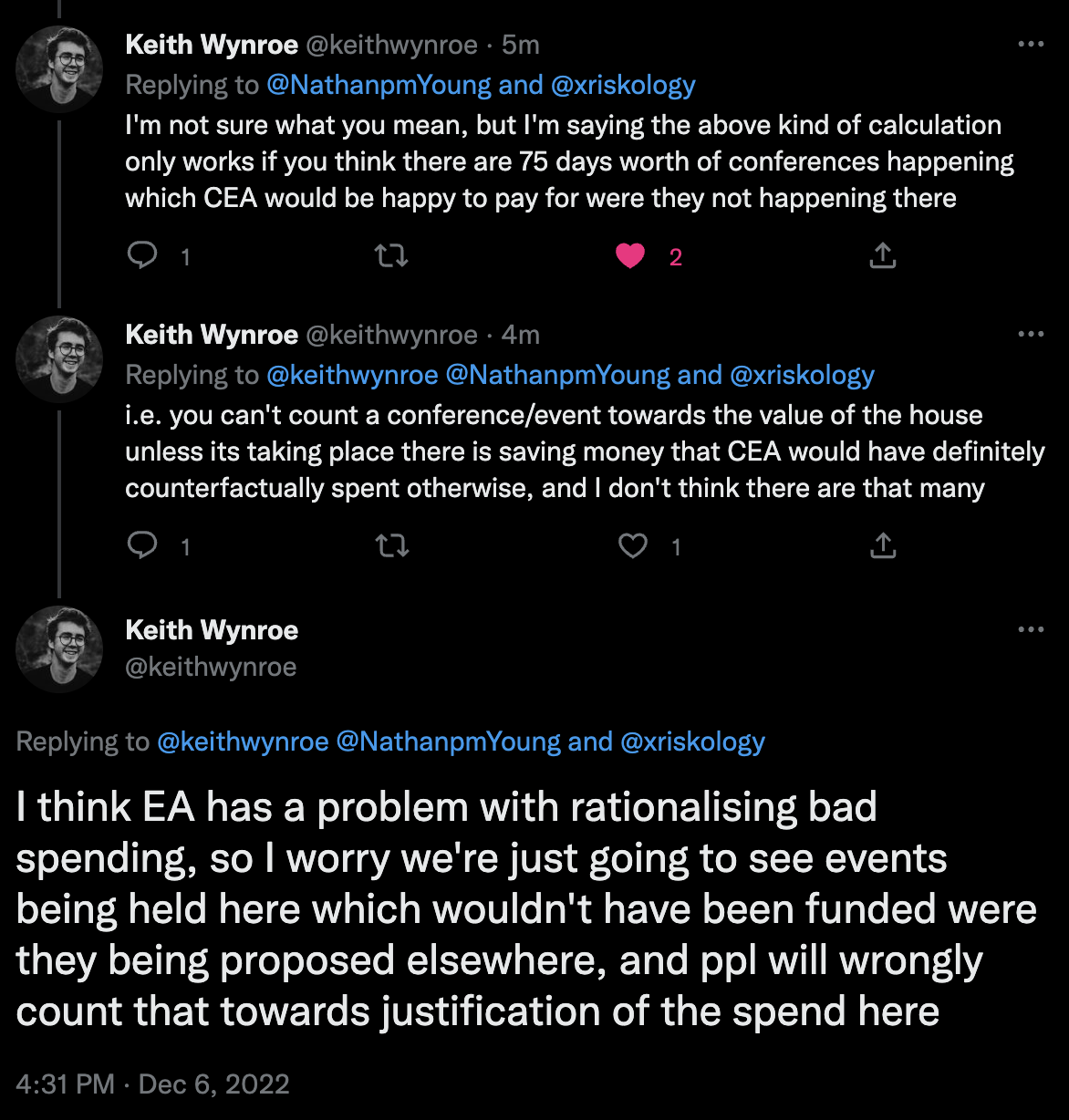
weeatquince @ 2022-12-07T00:18 (+55)
I really like that you found a counter argument to your own post and posted it. Go you :-)
Rockwell @ 2022-12-06T15:28 (+79)
Adding to this, there is the substantial staff time of identifying and setting up each venue that can be saved by owning a single venue and using that single venue for storage (which also means likely savings on supplies that can more easily be reused).
There's still, however, a larger question about the cost-effectiveness of EAs organizing conferences and retreats at scale.
James Ozden @ 2022-12-06T16:42 (+38)
Do people think it's plausible that CEA (and affiliates) will run 100 x 30-person events per year in Oxford alone? Doing one every 3.5 days seems unlikely and I expect the real number to be much closer to 50 or less.
Edit: I actually realise it will have to be 50 x 30-person retreats, assuming each workshop/event/retreat lasts 2 days. So it would be 2 days per week for basically all 52 weeks, which I still think is on the high side.
Habryka @ 2022-12-06T20:40 (+53)
Yeah, I think something around that number is pretty likely. As an example, we have a much smaller house that we rent near Berkeley that is useful for 10-15 person retreats, and we've had pretty close to 75% utilization with stuff that I think would have otherwise required renting an AirBnB (I think some fraction of those would have been fine with a smaller AirBnB, but would have required then setting up that space and dealing with a bunch of overhead).
Nathan Young @ 2022-12-06T17:11 (+3)
100 days worth seems pretty plausible, yeah. After all, you would basically push any UK conference here, right?
James Ozden @ 2022-12-06T17:29 (+13)
So you think something roughly like a 2-day workshop every week of the year? I think that's possible yeah but still not very likely (like 20% likelihood). Also you're saying conference but these events are max 30 people so seem much more like workshops / events / retreats than a conference?
Do you have a sense for how many of these happen in the UK right now? I still think this is <50 per year and closer to 30. I also think it wouldn't be worth it for groups north of (approx.) Newcastle due to travel times etc.
MatthewDahlhausen @ 2022-12-06T16:35 (+29)
Judging from similar estates in the area, the Abbey must've cost at least $10,000,000 [EDIT: from other comments it cost 15,000,000 pounds (~$21 million at time of purchase)]. A 30 person conference could easily be held in an office. Regardless, no way CEA hosts 100 of them near Oxford every year. I'm guessing the upkeep costs of the Abbey alone cost more than rent for a generous office.
Besides, if they did want to buy a venue, they could have found one for much cheaper.
This is a luxury purchase. It's made to make visitors feel important and prestigious. It is rightly being criticized and mocked by those outside CEA. WTF were they thinking?
AdamGleave @ 2022-12-06T21:47 (+66)
A 30 person office could not house the people attending, so you'd need to add costs of a hotel/AirBnB/renting nearby houses if going down that option. Even taking into account that commercial rest estate is usually more expensive than residential, I'd expect the attendee accommodation cost to be greater than the office rental simply because people need more living space than they do conference space.
Additionally in my experience retreats tend to go much better if everyone is on-site in one location: it encourages more spontaneous interaction outside of the scheduled time. There are also benefits to being outside a city center (too easy for people to get distracted and wander off otherwise).
Was Wytham a wise investment? I'm not sure, I'd love to see a calculation on it, and it probably comes down to things like the eventual utilization rate. But I think a fairer reference class would be "renting a conference center plus hotel" than "renting a 30-person office".
CaroJ @ 2022-12-07T14:37 (+8)
I agree with Adam here about the fact that it's better to host all attendees in one place during retreats.
However, I am not sure of the number of bedrooms that Wytham has. It could be that a lot of attendees have to rent bedrooms outside of Wytham anyways, which makes the deal worse.
Jack Lewars @ 2022-12-07T10:52 (+27)
I am really torn on this purchase, but just to add some info/one data point - OFTW ran its first conference in a while this year in Philadelphia and I was genuinely shocked at the costs. Hotel plus professional conference venue plus locking you in to caterers that charge a premium... It came out at $1000/head for 1.25 days (although this also included travel, which was average $500/head). And I really truly think we couldn't have held that conference in a cleared out office space.
That said, it is possible that something equally functional was available for cheaper, and with better optics.
MichaelStJules @ 2022-12-06T23:43 (+8)
Can much larger conferences be held there, like EAG or EAGx? Use each individual room as a meeting room, and a few big halls for large gatherings, possibly adding to the building if necessary.
lincolnq @ 2022-12-06T21:46 (+69)
[note: I don't work for CEA, but I did recently invest in a house to live in and do events in.] I wrote a piece on my blog about why. Here's what I wrote:
Real estate purchases can make sense for financial planning reasons in some cases. This money should not be considered to trade off against, e.g., donations to effective charities. Instead it should trade off against short-term rental budgets for retreats, conferences, etc. And because banks are willing to loan against real estate at very good rates, it is surprisingly cheap to invest in real estate, requiring little cash upfront and low ongoing interest costs. And you can make use of it while you own it. So if you can either use your real estate effectively, or rent it out when not in use, you should be approaching cost-competitiveness with short term rentals.
One risk to making effective use of the real estate is that you can’t just pay for what you need at every moment, you have to buy the whole thing and then waste any unused bits. This risk is compensated by commensurate upside - that of making the whole thing relatively cheaper. So if you have knowledge of how much utilization you’re expecting to get from some real estate (and that utilization is higher than whatever the market / existing owners get) then you’re likely to be beating the market by buying the property.
All the above analysis is all else being equal. But realistically, the venue you choose for an event has a major effect on everything that happens at the event. Some venues will be conducive to smaller conversations; some will force everyone into one room. Some venues will attract fancy people; others will attract nerds, or frugal types, or creative types, or whatever.
One venue isn’t right for every type of event. But I’ve done enough event planning at rented venues to know that sometimes the event will go fine at whatever venues are easily available on the market, and other times I am making substantial tradeoffs.
Occasionally my event has requirements that won’t work for an available hotel or airbnb. An example of this I can think of was wanting attendees to be able to relax in the evenings somewhere that was private, quiet and had no time pressure/social demands. The hotel rentable rooms felt very stuffy, the hotel bar was too public, and there were no available airbnbs that were big enough. In general, the short term rental market is not that liquid and doesn’t have huge amounts of inventory; if you don’t see what you want you might just be out of luck. Whereas if you buy, you can guarantee availability, and customize things to your liking. Such customizations, if done well, pay off event after event. If you believe (as I do) that facilities have a big impact on the quality of an experience, then it’s easy to see how such an investment would pay off, even if it is more expensive than whatever you would be able to get in the rental market.
I haven’t spoken to the CEA folks involved in the Wytham Abbey decision, but I assume they were thinking along similar lines when they pulled the trigger on this. To me, the critique in this thread is quite overblown - I think most of the shock is coming from over indexing on how things look (fancy estates, large numbers) rather than the economic and practical realities.
Jan_Kulveit @ 2022-12-11T11:16 (+64)
I wanted to provide some context on the recently purchased events venue near Prague that has been discussed here in one of the subthreads. The subthread contains some misleading content, and is not clearly visible, so I am posting this as a top level comment to provide more information on the project. It is extremely long, sorry.
1. My relationship to the project
2. Context for Forum readers
3. Context for outsiders
4. About the project
5. About the venue
6. Communication timelines
1. My relationship to the project
The project is led by Irena Kotikova and was something she started thinking about and working on multiple years ago, before the FTX Future Fund existed.
I am not the recipient of the grant, nor am I responsible for the funding decision: I’m involved in the project as chairman of ESPR, which is a Czech non-profit housing part of the Hostacov project. The ESPR association decided to fiscally sponsor the project because it aligned with our mission (improving epistemics) and we already had the necessary “equivalency determination” to receive tax-exempt funding from a US foundation. However, the Hostacov project is independent and the property is owned by a separate legal entity. The ESPR association is not involved in the operation of the property.
I personally believe the project is good and I’m happy to defend it in my private capacity. The following comments are mine and not made on behalf of the project or its funder. I expect Irena to comment on this as well. (Even more context: I am friends with Irena and have collaborated with her on many projects.)
2. Context for EAs
Irena and I were fairly involved with the Czech government’s Covid response. Our efforts were at least partially successful and likely contributed to preventing thousands of death and preventing some economic damage. However, it also made us quite unpopular among anti-vax and anti-lockdown activists. (In the US context, you can imagine these groups as falling somewhere between the Great Barrington Declaration and QAnon.)
Based on one online media report, these circles noticed the venue purchase and are trying to frame our involvement in a false negative light, ranging from "me and Irena were aware of fraud within FTX" to "both we and FTX are part of an Illuminati conspiracy, we likely knew about the pandemic before it happened, our covid response efforts were part of the plot, and the grant is an expression of gratitude from the Illuminati". Obviously bizarre, but sadly not harmless.
As a result, please note that the Czech media and these Covid sceptics might well find this discussion. So, anything you write on this post could easily be selectively quoted or otherwise used against you or me. I am not trying to prevent people expressing their opinions, but would ask that any speculation (or, for example, digging for the physical addresses of vaguely related entities) be done with the above in mind.
3. Context for outsiders (you can skip if you have followed the forum in past month)
In case you’re not familiar with FTX and its ill-fated philanthropy: FTX was a large crypto exchange that went bankrupt in early November. Soon after it was revealed that its founder, Sam Bankman-Fried, lied about the state of their assets and may have used client money in a fraudulent way. I recommend Spencer Greenberg's podcast for more details.
FTX founded a charity, the FTX Future Fund / Foundation. The foundation was small compared to FTX, but quickly became a significant funder in several areas that I find important - AI safety, pandemic preparedness, catastrophic risks, tools to support collective epistemology, teaching critical thinking, etc.
Regardless of what exactly happened at FTX, the result is extremely bad for everyone. First of all for FTX customers - it is unclear what fraction will be returned to them in the bankruptcy proceedings. But it is also bad for people who worked at the FTX Foundation, grant recipients, and those who were promised grants but received nothing.
According to its website, the FTX Foundation has given out hundreds of grants, more than $130M by summer 2022. If they continued their pace, by November this was likely well over $200M. The group of recipients is diverse, from research groups at about half of the top 10 universities in the relevant fields, to tiny non-profits and individuals. Personally, I think that most of the grants were beneficial.
What I want to emphasise is that the grant recipients have done nothing wrong and have nothing to be ashamed of or apologise for.
The implication "you got a grant from a foundation that was sponsored by FTX" => "what you are doing is suspicious" is nonsense.
Unfortunately, some parts of online space are attempting to paint grant recipients as themselves scandalous or immoral, and shaming them. From what I have seen, this is based on ignoring context or on a clearly wrong framing:
1. Suggestive framing like "they got a grant not long before bankruptcy". The implication is that grantees should have done – in addition to basic due diligence about the FTX Foundation being a legitimate entity and usual anti-money laundering – some sort of brilliant investigation to discover that FTX was going to go bankrupt in a few months because of fraud inside it.
This is clearly an unreasonable demand. Ironically, if someone had reliable information proving the insolvency of FTX a few months ago, such information would be extremely valuable - it seems likely that the market worth of this info would be greater than total FTX Foundation donations.
2. Ignoring causality. For example, Irena was working on the discussed project for years. It isn't the case the SBF conceived this.
3. Thinking the grant recipients can just send the money back now. Grants are governed by contracts; organizations are governed by laws and bylaws. What should someone who has received money from the FTX Foundation do? Intuitively, one might think it best to immediately send the money "back" to FTX creditors. In practice, at least for a Czech non-profit, this would be likely illegal: a non-profit governed under Czech law cannot just take a donation it received from the Foundation for a specific purpose and send it to a private entity in the Bahamas. The reasonable option seems to be to wait for how the court proceedings develop, and adhere to contracts and the law. (This is not a legal advice)
4. Liability. Both the law and commonsense protect you if you took an action in good faith, as the grantees did.
4. About the project
As I mentioned earlier, this project hasn’t been announced yet.
While I’m not speaking on behalf of the project, I can try to explain why it seems good, and something like this should exist, from my personal perspective.
I. First, I believe the venue should not be thought of as "EAs for EAs" but rather as something that aims to improve the world. How? By providing a space for topics that are adjacent to EA, such as good epistemics, sanity in times of rapid change, increasingly strong AI, and existential security.
A typical use I imagine is an 'epistemics workshop for decision-makers', with most of the guests not being EAs, but decision-makers or researchers. There are many possible events of the type 'some people should meet and think about something' or 'some people should meet and learn something' where the people meeting and learning is someone else than effective altruists, yet the whole event is quite impactful. In the above mentioned case, you can for example imagine someone working on e.g. regulation of AI in some non-EA capacity understanding better how to think in probability distributions and how to evaluate conflicting statements by various parties.
Overall, I think interventions of this type could be reasonably high-leverage.
II. Second, I believe that the space in which an event is held can make a significant impact on its success. It can easily contribute around 20% to some intuitive "goodness" metric. A stable and amazing venue can also create interesting feedback loops. For example, some people care more about research progress than money and if they have a positive experience at the venue, they may want to return even if monetary incentives point elsewhere.
III. Third, historically, EA and EA-adjacent organisations based in Prague have provided a lot of operational support for various events run by other organisations. This gives me data on the demand for this type of venue.
5. The venue
The venue is a castle located about an hour and a half from Vaclav Havel Airport. Previously, it was operated as a hotel and often hosted events such as weddings or corporate meetings. In its current state, it can host around 60 people, and there is potential for expansion.
The specific venue was selected after Irena scouted for venues for years and investigated dozens of alternatives. I have seen some of the alternatives and, in my opinion, the decisive factor was that the venue was ready to use.
Some of the alternatives were much cheaper but usually required years of expensive reconstruction. Running some of the events I would be excited to happen now seems much more impactful than doing them in 3 years.
Another question could be, why there, and not in some entirely different place. In my view, given the growth of the fields in question, there is a space for multiple venues in different locations, with different use cases.
Compared to the venues in Oxford and near Berkeley, this venue is significantly cheaper, somewhat larger and in better shape.
In terms of travel: the venue is well-located in continental Europe (roughly midway between Berlin and Vienna). Prague Airport has direct flights to most of Europe and travel time from almost any big European airport to the venue is less than 5 hours. In my view, this makes the venue viable for events in Europe longer than roughly 3 or 4 days, and basically globally, for week-long events or longer.
…also, to reiterate, contrary to rumour, the property is not owned by Irena Kotíková or Czech EA association or "EA Prague". Also it's probably worth understanding for people involved, the project is mostly a lot of work, not some sort of leisure spending.
6. Communication timelines
Buying a venue of this size takes time. In this case, it involved multiple checks by lawyers, accountants, and technicians. The grant agreement was signed in July, the transaction was not actually completed and visible in the registry until mid-October. It would have been odd to announce the purchase before the transaction was complete.
IrenaK @ 2022-12-11T11:24 (+73)
Since I’m running the project in question (not Wytham Abbey), I would like to share my perspective as well. (I reached out to the author of the comment, Bob, in a DM asking him to remove the previously posted addresses and we chatted briefly about some of these points privately but I also want to share my answers publicly.)
- ESPR can't return the property or the money at the moment because there is currently no mechanism that we are aware of that would make it possible to legally send money "back to FTX" such that it would reliably make its way back to customers who lost their money. We will wait and see how the bankruptcy proceedings play out which will likely take years. For now, I have a responsibility to the staff, to the property, and to the project.
- This project is not an EA project. It covers a broader scope of world-improving activities and organizations. It is not part of the Czech EA organization. I also personally don’t own the property - I’m the CEO of a separate organization (not ESPR, not CZEA) that owns it.
- You ask that this purchase be disclosed publicly - this was always the plan. The transaction is very fresh and has only been finalized this week. We are in the process of making adjustments to the place before announcing its existence and an open call for applications for events.
- Much has been discussed on the forum recently about the cost-effectiveness of purchasing property and about optics. I’ve been running various events for over 10 years and I’ve seen firsthand how places, where they happen, influence their outcomes. I’ve also seen how the lack of appropriate and ready-to-use venues was the reason for great events not happening. I wanted to create an inspiring and functional space that can help people to think, discuss and create good things - I’ve been developing the idea over the last couple of years. I’m happy to go into more details about the project and its vision but again, I would like to be able to officially announce it first.
- This is an experimental project which has a theory of change that is well thought out but remains uncertain. We will see what happens once we are up and running and able to see the outcomes. Should it be the case that it seems like it doesn’t generate sufficient value and broadly speaking “doesn’t work” it will most certainly be reconsidered. The property can be sold and the money can go toward other projects.
Bob Jacobs @ 2022-12-11T13:23 (+19)
I am the writer of the subthread Jan is responding to. You can find my reply here.
Jelle Donders @ 2022-12-06T18:45 (+54)
Regardless of whether there is an economic argument to be made for this decision, as Nathan Young and others are implying, large expenses being clearly communicated and justified seems like a worthwhile endeavor for the sake of transparency alone. If people are finding out about "EA buying a castle" from Émile Torres or the New Yorker (EDIT: and we can't point to any kind of public statement or justification), then we're probably doing something wrong.
Aaron Gertler @ 2022-12-07T04:16 (+46)
(Written in a personal capacity, unrelated to my job)
I agree with some of this, but not the last sentence.
Emile's audience is very different from CEA's audience (or the audience of anyone in EA). Many people will "find out" things from them, regardless of how EA orgs share information.
I also think they would have written exactly the same Twitter thread regardless of what was shared, for exactly the same audience (people who follow them specifically to see exaggerated takedowns of EA-related things). A public post about the Abbey probably kicks off that thread earlier, but I don't think it changes the content.
In general, thinking about what Torres will say is of limited use, because they tend to show everything in the worst possible light (often lying in order to do so).
Jelle Donders @ 2022-12-07T20:23 (+27)
Good point, I didn't make clear what I meant with the last sentence. Would this rephrasing make sense to you?
If people are finding out about "EA buying a castle" from Émile Torres or the New Yorker and we can't point to any kind of public statement or justification, then we're probably doing something wrong
I also agree the content of some of these criticisms wouldn't change even if there were a public post, but I don't think the same applies to people's responses to it. If a reasonable person stumbles across Torres or the New Yorker criticizing EA for buying a castle, they would probably be a lot more forgiving towards EA if they can be pointed to a page on CEA's website that provides an explanation behind the decision, written before any of these criticisms, as opposed to finding a complete lack of records or acknowledgements on (C)EA's side.
In general, taking reasoning transparency more seriously seems like low hanging fruit for making the communication from EA orgs to both the movement and the public at large more robust, though I might be missing something, in which case I'd love if someone could point it out to me.
Aaron Gertler @ 2022-12-07T22:20 (+11)
I think that the existence of a page would mollify maybe 10% of the people who liked Torres' post, and it also runs the risk of sparking additional attention (maybe drawing in people to attack EV for running so many events or providing material for people to quote-tweet derisively).
I believe in reasoning transparency and try to write up my own decisions in a lot of detail. I think this is a good thing to do for the sake of the people who like and care about your work. But I don't expect it to help much with motivated critics or the general public.
(One counterpoint: If anyone from the general public cares about long explanatory writeups on the economics of buying an abbey, I'd expect those people to be the types most likely to become interested in EA. But those are also the people I'd expect to not be engaging with Torres, so I don't know how big the effect is.)
Rebecca @ 2022-12-07T23:57 (+20)
I think that sort of long writeup can help signal thoughtfulness even if people aren’t actually going to read through it
Neel Nanda @ 2022-12-08T17:10 (+13)
One counterpoint: If anyone from the general public cares about long explanatory writeups on the economics of buying an abbey, I'd expect those people to be the types most likely to become interested in EA. But those are also the people I'd expect to not be engaging with Torres, so I don't know how big the effect is.
I'm unconvinced by this part - I think that Torres is clearly a bad faith actor, but am sure this isn't legible to many in their audience. I expect they appeal to different subcultures, but that at least some of their audience would be EA receptive.
Owen Cotton-Barratt @ 2022-12-08T13:50 (+9)
FYI: I added a brief explanation of why we hadn't posted publicly about it before now to the end of my answer.
Jeroen_W @ 2022-12-06T21:45 (+19)
Currently I get the impression EA has more critics than supporters, with critical tweets getting thousands of likes and the most popular supportive tweets just hundreds. My impression might be wrong, but yeah I feel like we're definitely doing things wrong PR wise.
Violet Hour @ 2022-12-07T18:28 (+23)
I disagree with this inference. If I’d heard that (say) supportive feminist tweets were routinely getting fewer retweets than tweets critical of feminism, I don’t think I’d believe that feminists were “definitely doing things wrong PR-wise”. Tweet numbers could be relevant evidence, given some wider context, like “there’s a social trend where the most controversial and peripheral feminist ideas get disproportionately promulgated, at the expense of more central and popular ideas”, but I’m not convinced EA is in a similar situation.
I don’t have a view on whether buying Wytham was a good idea, but I do agree with Owen that we should “let decisions be guided less by what we think looks good, and more by what we think is good”. I want people to act on important ideas, and I think it’s bad when people are turned away from important ideas — but one important idea I want to spread is Owen’s, where we emphasize the virtue of performing actions you can ultimately stand behind, even if the action has bad optics.
slg @ 2022-12-07T02:37 (+16)
This point is boring, but I don't think Twitter gives an accurate picture of what the world thinks about EA. I still think there is a point in sometimes reacting to bad-faith arguments and continuing to i) put out good explanations of EA-ish ideas and ii) writing up thoughts on what went wrong. But communicating too fast, before, e.g., we have an improved understanding of the FTX situation, seems bad.
Also, as a semi-good analogy for the Wytham question, the World Economic Forum draws massive protests every year but is still widely respected among important circles.
HaydnBelfield @ 2022-12-06T20:04 (+47)
Just for context on event costs
Wilton Park
They do lots of workshops on international security. Their events cost around £54,000 for two nights.
(see page 14 of their Annual Report: "In 2020/21, we delivered 128 (76 in 2019/20) events at average net revenue of £13k (£54k in 2019/20). The lower average net revenue this year was due to the reduced income generated from virtual events compared to that generated by face to face events in 2019/20. Virtual events are shorter, generally lasting half a day, compared to face to face events which are generally for two nights.")
West Court, Jesus College, Cambridge
I've been to several academic workshops and conferences here. Their prices are, for a 24 hour (overnight) rate:
| West Court single ensuite | from £205 |
Let's say 100 attendees overnight for 3 days (a weekend workshop) in the cheapest rooms: £200*100*3 = £60,000.
Shakeel offers the further examples of "traditional specialist conference centres, e.g. Oberwolfach, The Rockefeller Foundation Bellagio Center or the Brocher Foundation."
50 events (one a week) like these a year would cost £3m (£60,000*50=£3,000,000). So break even (assuming £15m was the actual cost) in 5 years - quicker if they paid less, which seems likely.
No idea if this is a good use of money, just sharing some information for context.
matthew.vandermerwe @ 2022-12-07T11:33 (+76)
This break even analysis would be more appropriate if the £15m had been ~burned, rather than invested in an asset which can be sold.
If I buy a house for £100k cash and it saves me £10k/year in rent (net costs), then after 10 years I've broken even in the sense of [cash out]=[cash in], but I also now have an asset worth £100k (+10y price change), so I'm doing much better than 'even'.
Hauke Hillebrandt @ 2022-12-07T12:24 (+21)
Agreed.. a good way to think about this is that since you get ~5% annual returns on stocks, annual rent equivalent is ~5% of the property value, and so the opportunity cost is spending ~$750k/y or $62.5k per month on conference accommodation.
HaydnBelfield @ 2022-12-07T11:41 (+7)
I agree
tugbazsen @ 2022-12-06T20:10 (+14)
I imagine the event costs above include the costs for staff (including janitorial etc.) and food, as well as the upkeep of the properties, which is not included in the ~15M figure and I imagine would be considerable, particularly considering the historical value of the Abbey, meaning the break even point would be farther away than 5 years, although it's hard to say how far without more information
HaydnBelfield @ 2022-12-06T23:16 (+8)
Yeah the breakeven point is a super rough figure, originally wasn't going to include it. Paying for staff and food would push out, more events or hiring out for events would bring closer, etc. Main thing I wanted to add to the conversation is a sense of how expensive workshops and retreats are.
Wilton Park and West Court are both historic, so thought they'd be good comparisons (and ones I know).
Aleks_K @ 2022-12-08T12:01 (+4)
Your analasis ignores that the prices you quote contain a lot more than the pure real estate costs, but also running costs, that Wytham Abbey of course would also have to incure, such as:
- Mainenance, renovations, etc (this can be quite a lot for an old and listed building)
- Utilities, etc. (Again, this is a large old space not built to modern standards and this is probably quite high)
- Costs for IT equipment that needs to be regularly replaced, furniture that needs to be replace ocasionally, any kind of office supplies etc provided
- Council tax
- Costs for cleaning, etc
- Costs for staff managing the space
- (Potentially, not sure if the prices you quote include this or not) catering and other services provided
- I probably forgot something.
Also I doubt that the organisations that run these venues occur a lot of profit, so the total costs they charge are probably mainly the things above plus some capital costs for the building plus costs for the time the building is not occupied.
NickLaing @ 2022-12-08T06:36 (+46)
There are some good arguments for buying this thing, but why were these things below not done? I struggle to find arguments against these important actions which seem like basic due diligence. I would appreciate people giving reasons why these things might not have happened as I haven't seen it no the thread.
- Publish publicly information about big spends when they happen
- Clearly state the reasons for the purchase including positives, potential negatives and counterfactuals in laymans terms.
- Publish the math on this vs. running conferences elsewhere. If Givewell can do it, surely CEA can publish their math.
- Acknowledge publicly that although on balance the purchase was judged t be worthwhile, the optics are likely to look terrible to most people, who (whether right or wrong) are likely to see it as supposed do gooders buying themselves a mansion.
I'm not against this purchase (uncertain), but confused why these steps weren't taken when it was bought, and haven't been done yet (although this can be rectified). I'm not asking for democracy, only asking for both the core principles of EA to be published and a bare minimum of transparency.
And one extra point, I think after the SBF scandal, a higher degree of transparency than before will be needed to turn this negative PR tide.
Magnus Hambleton @ 2022-12-07T20:59 (+45)
This is honestly really embarrassing. I've read the comments and I don't want to argue that the economic calculus doesn't stack up, but the optics here makes this extremely EV negative. Every journalist is looking for material to write about EA since the SBF debacle and this kind of stuff is prime material.
Individual high profile media pieces can significantly reduce donations for years and years, kill startups and organisations and make it harder to find people to partner with due to lowered reputation. I have friends, colleagues and family message me about Wytham abbey and it makes me embarrassed, they are now less likely to donate to causes we care about here. I will not defend this decision to them, regardless of what the economic calculus around conferences/event costs says.
I got into EA for the empathetic and rational approach to doing good and I will continue donating to EA causes and using EA methodology for those same reasons. However, for outsiders, EA is a coherent "movement" that you "support" by donating. This must be taken into consideration when you act under the "EA brand". This movement is big now and needs to be careful about the way this brand is managed, because, as unsexy as it is, both current and future donations depends on that brand.
Aaron Gertler @ 2022-12-07T22:37 (+33)
I will not defend this decision to them, regardless of what the economic calculus around conferences/event costs says.
What do you think would happen if you responded to a friend's question with something like this?
"Yes, they purchased this property as a way to save money on event hosting + lodging for attendees. They host a ton of people for events each year, so they think the space will pay for itself over time. It's also an asset that can be held long-term, instead of money going down the drain on rental costs. A lot of large organizations own centers like this to host events.
"Zero public donations went into this — it was bought with a grant specifically for this project."
You're obviously under no obligation to spend time/energy doing this kind of thing! But I'm curious how you think the people messaging you would react.
(I've had a lot of conversations with my parents over the years about weird EA things, and I find that it's good practice for my other comms work.)
*****
I agree that large purchases can be spun in embarrassing ways, but I'm not sure how orgs are meant to respond to this. Does the risk of bad press mean that no one in EA can purchase a building over a certain price, and buildings should be rented instead? Or that buildings can be purchased, but they have to be bland newer buildings instead of fancy-looking older buildings?
I'm a big fan of communicating more clearly about decisions like this, especially when there's PR risk inherent to the project. But I'm very wary of PR concerns stopping people from making sound decisions about infrastructure.
*****
Also, the "I will not defend this decision to them" point could extend to things like e.g. spending any amount of money on AI alignment, which is also weird and embarrassing to talk about.
No one is obligated to defend AI work, either — I'd be happy to have thousands of people just advocating for malaria funding in their spare time! — but I don't like when people argue that AI alignment is bad for the EA brand and should thus be deemphasized (I've been seeing a lot of this lately in the media).
Jeroen_W @ 2022-12-07T22:47 (+6)
Thanks for sharing, Aaron! I really appreciate these short explanations. One of my biggest worries was that this would be something difficult to explain to outsiders, but you helped to reduce that worry significantly.
Aaron Gertler @ 2022-12-07T22:59 (+5)
I don't know whether my explanation will actually hold up! Haven't had the chance to test it.
But if you use it anywhere, let me know how it goes :-)
Magnus Hambleton @ 2022-12-09T07:20 (+4)
This is basically what I said, but thank you for the template answer, it's good to have one. A few people have argued that it feels like this move shows that EA has reverted to the default path that charitable organisations take where they end up bloated and spending lots of money on ops, HR and lobbying. I'm not saying I believe this, but I think it's bad for this image to be validated in any way.
projectionconfusion @ 2022-12-09T16:16 (+16)
Yeah this is my biggest concern. The whole value proposition of EA was to get away from the normal failure modes of charities. If they are falling into the same traps of using shoddy reasoning to justify self serving behaviour that's a major structural problem, not just a matter of a single decision.
Will Bradshaw @ 2022-12-09T14:35 (+9)
A few people have argued that it feels like this move shows that EA has reverted to the default path that charitable organisations take where they end up bloated and spending lots of money on ops, HR and lobbying.
I think it's probably correct to update in that direction based on this. (Though probably not all the way.)
AllAmericanBreakfast @ 2022-12-07T21:16 (+19)
This conference center can drive donations in multiple ways: by improving the quality of projects and ideas, by increasing the points of contact with EA, by becoming an object of media attention, and by provoking reactions within EA to the conference center’s existence and symbolism.
To argue that negative press makes this conference center extremely net negative, it’s not enough to say it’s going to generate bad press. That bad press needs to cause people who were previously going to become substantial donors to EA to reconsider their decision. And that effect needs to have no substantial counterbalance from the other ways the conference center can drive donations.
Beyond this, the conference center can also be net positive EV even if it has a net negative effect on donations. If it cuts out donations in half, but triples the effectiveness of the money we do spend, then it’s paying for itself in utilons.
Neel Nanda @ 2022-12-08T17:20 (+21)
Beyond this, the conference center can also be net positive EV even if it has a net negative effect on donations. If it cuts out donations in half, but triples the effectiveness of the money we do spend, then it’s paying for itself in utilons.
I think this overstates the case significantly. Beyond specific disagreements with the numbers, Wytham's influence on the movement is likely more local, while harm to donations is likely more global, meaning that I expect the net effects are unlikely to balance in Wytham's favour.
AllAmericanBreakfast @ 2022-12-08T18:26 (+4)
I chose my words carefully here, and phrased my comment as a hypothetical pathway by which the conference center could be net positive EV with a negative effect on donations. The likelihood that it is in fact positive EV is an entirely separate question. We don't have data on that - not even the bad tweets and press we're getting right now is evidence of the effect on donations. Obviously, we're never going to have great data and we'll have to do reasoning under uncertainty. But I don't think we should update much on twitter. Until someone really digs in and writes the analysis, I'm withholding judgment.
Magnus Hambleton @ 2022-12-09T07:25 (+4)
I understand that, but this kind of thing fuels the fire of snark against the EA movement. Tweets like these are a great example of taking this out of context and using it to undermine the entire point of EA. I don't think it makes sense to spend all our time optimising away opportunities for snark, but in this case it would have been so easily avoided: don't buy a mansion, or if you do, get the granter buy it and lease it to you for 100 years or something.
I think the optics are particularly bad because english old stone mansions code as particularly luxurious in an american context — the price tag becomes much less important than the pictures of what looks like old school opulence.
Of course this can have a net positive EV, but if you're holding me to the standard of finding specific future donors we have lost because of this, then I would like to hold you to the standard of pointing out specific future ideas and projects that this enables that will generate positive EV.
AllAmericanBreakfast @ 2022-12-09T07:35 (+3)
As I said in my reply to Neel, I am outlining a hypothetical, not making a claim about what the consequences on donations or ideas will be. I just don’t see very much value coming out of casual comments, although I think it’s natural that people are reacting to all the twitter vitriol (but I encourage everyone to delete twitter). I am keeping an open mind about the abbey, and my comment attempts to explain why.
Neel Nanda @ 2022-12-08T17:19 (+9)
I have friends, colleagues and family message me about Wytham abbey and it makes me embarrassed
Thanks for sharing this data! I didn't realise this was such a big EA news story, and this is an update for me in that EA should care more about optics. I'm curious how EA engaged/familiar these people were?
Magnus Hambleton @ 2022-12-09T07:26 (+4)
They generally only know about EA through me, or by being tech-adjacent (VC, startup founders etc). No one I know who is an actual EA donor has messaged me about this, but I would consider all of them to be potential donors.
EricHerboso @ 2022-12-09T13:10 (+45)
That may be the case with those in your social circle, but several existing EA donors have been vocally upset on the EA subreddit. One question we've had to answer there multiple times is whether GiveWell had anything to do with this, because, if so, they would cease their donations there.
People on the EA subreddit are generally more casual than the people that come here to the EA Forum. But comments like this are typical in the last few days:
"I really have trouble believing that someone who has even vaguely brushed up against the insights of EA would buy a mansion. In fact, I could think of few acts that would be more bluntly and vulgarly antithetical to EA."
These are not anti-EA zealots posting on social media about how this kind of thing disgusts them, using this opportunity as a chance to strike (though some of those also exist). No, these are actual EAs — they may not be as engaged as EA Forum users, but they care enough to join the subreddit, to donate to EA orgs, and to participate in light EA discussions on reddit. They are really not happy about the purchase of Wytham Abbey.
Magnus Hambleton @ 2022-12-10T15:44 (+2)
I honestly only really know ~5 people who would consider themselves EAs and none of them tend to stay on top of current events much, they just donate every year to EA orgs. Haven't heard anything from them, but I am not so embedded in the community. Agree that my perspective is not necessarily typical here but I also can't tell if your comment is meant to dispute something I said or if you are agreeing?
Jason @ 2022-12-06T15:50 (+45)
The "large grant made specifically for this" explanation is unconvincing without more. Did a grantor come up with this idea independently, or did CEA choose to approach a grantor with this idea (as opposed to other pitches it could have made for someone with that kind of money to spend)? If so, why did CEA decide this was the best ask for a huge grant? To the extent the "large grant" comment was meant to reassure donors that their money wasn't used for this, money is fungible.
It's certainly plausible the decision made economic sense, but in that case CEA needs to publish the math. That's not an unreasonable ask for a marquee organization in a movement focused on maximing social benefit for resources devoted to charitable purposes.
Bob Jacobs @ 2022-12-08T14:19 (+8)
The "large grant made specifically for this" explanation is unconvincing without more. Did a grantor come up with this idea independently, or did CEA choose to approach a grantor with this idea (as opposed to other pitches it could have made for someone with that kind of money to spend)?
This section of Owen's reply seems to imply the latter:
I was the person who owned the early development of the project idea, and fundraised for it. (The funding comes from a grant specifically for this project, and is not FTX-related.) I brought it to the rest of the board of EVF to ask for fiscal sponsorship (i.e. I would direct the funding to EVF and EVF would buy the property and employ staff to work on the project).
Although I suppose it is possible he sought out a funder but the funder was only willing to pay for this specific one.
Jan_Kulveit @ 2022-12-06T19:49 (+42)
I'm not going to comment on the emotional/anger/PR side, but here are some numbers for the discussion to be somewhat connected with Oxford conference accommodation reality; speaking just in my personal capacity as someone who did run events in Oxford.
According to the first public price list in my google results, conference accommodation in a college in Oxford in 2020 was >£70 (standard room) + >$45 on meals + >~$1000 for 4 lecture rooms, per day. With a 30 person event, it's >£4500 per day. With 40 ppl and more lecture rooms, it would be more like >£6k/day, just for space and food.
Multiplying it with days per year, it's >£2.2M/y. To get realistic comparisons, you would need to adjust for many other factors sometimes of order 0.3-3x, like occupancy, costs of adjusting venues to your needs, costs of the staff,... In impact calculation, you would also need to adjust for counterfactual loses such as "not able to run an event because everything good is either booked a year in advance, or even more expensive than the college price list" where having a friendly venue can cause the event to counterfactually happen at all.
tugbazsen @ 2022-12-06T20:05 (+8)
As someone who has experience with this, what do you (or others doing coet calculations in this thread) think about the cost/benefit of having this type of dedicated venue in a less expensive location and moving these types of events out of Oxford, which seems to be a particularly expensive area? Your calculation seems to imply that the events would be frequent enough that the staff would be working on them full time, and room and board being a major factor implies that the expectation is that most people would be traveling for them anyway. In this case, why is Oxford the basis for cost calculations?
AdamGleave @ 2022-12-06T21:56 (+51)
For people not familiar with the UK, the London metropolitan area houses 20% of the UK's population, and a disproportionate share of the economic and research activity. The London-Cambridge-Oxford triangle in particular is by far the research powerhouse of the country, although there are of course some good universities elsewhere (e.g. Durham, St Andrews in the north). Unfortunately, anywhere within an hour's travel of London is going to be expensive. Although I'm sure you can find somewhat cheaper options than Oxford, I expect the cost savings will be modest (noting Oxford is already cheaper than central London), and you'll likely lose something else (e.g. location is harder to get to, or is some grungy commuter town).
I would like to hear if CEA considered non-Oxford locations (as there's an obvious natural bias given CEA is headquartered in Oxford), but it wouldn't surprise me if the benefit of CEA staff (who will often be running the events) having easy access to the venue genuinely outweighed any likely modest cost savings from locating elsewhere.
projectionconfusion @ 2022-12-09T16:10 (+7)
You can get to Luton, Milton Keynes, Stevenage or a number of other small London satellite towns in less than 2 hours from Oxford, and less than 1 from central London. These are all pretty banal collections of concrete buildings, but would allow you to buy a venue for a fraction of the cost. It seems hard to escape the conclusion that this decision was mainly made based on a Manor house in Oxford being more aesthetically appealing than a concrete office building on an industrial estate or small town centre.
Edward Kmett @ 2022-12-10T13:54 (+31)
The lack of a 2 hour commute is nothing to sneeze at though. CFAR has (had? I haven't checked in on it lately) a venue a couple of hours away from Berkeley that they've used for organizing workshops and events, and the tribulations of organizing getting everyone to and from the venue pretty much ensured it was only used for running 4-5 day events. It made it significantly more difficult for folks at CFAR or MIRI to pop up to make "guest appearances" at workshops and the like significantly reducing value to participants.
Speaking from personal experience, that distance rather complicated the value proposition for me, for whether it was worth showing up for a day at the end of an event to get to know some of the participants.
At the end of the day, the optics seem poor, but the actual cost for the space seems to be what I'd expect for a space that can sleep that many people, zoned so you can use them as actual bedrooms and have people stay on site. By the time it is kitted out in proper group-house density with beds in every nook and cranny you can find, you'd be able to fit a rather large number of attendees into the space.
You can go grab some concrete office space in an industrial park somewhere, but at the end of the day you generally can't legally have people sleep in that office space -- no matter what Elon is trying to do with Twitter HQ this month, so you'd wind up needing to sublet nearby apartments and the like for attendees, assuming you can find ones that legally allow you to do so, or pay premiums for hotel stays.
Part of why the CFAR venue wound up as far outside of Berkeley as it did, was they literally couldn't find any place closer that would legally let them treat it like a bed and breakfast for hosting attendees.
https://www.rationality.org/resources/updates/2017/cfar-2017-venue-update is an older post describing the rationale for purchasing the space I mentioned above.
Habryka and the rest of the Lightcone Infrastructure team seem to be wrangling the same sort of considerations as they try to provide gathering space for EA and rationalist folks in the bay area, today, except there a roughly equivalent amount of funding doesn't buy anything like a fancy-looking but run-down historical abbey.
lastmistborn @ 2022-12-06T22:16 (+3)
Thank you, this is a good part of what I wanted to know.
Closed Limelike Curves @ 2022-12-10T20:30 (+3)
Is Wytham Abbey being used 365 days a year, though? A couple thousand a day is a perfectly reasonable cost for a conference. But why would you need to own a space that large permanently? I’d be just as shocked at the idea of renting out Oxford College’s conference hall 365 days a year. Nobody is having that many conferences.
Jan_Kulveit @ 2022-12-11T14:36 (+6)
I noted the same in the following sentence: To get realistic comparisons, you would need to adjust for many other factors sometimes of order 0.3-3x, like occupancy, costs of adjusting venues to your needs, costs of the staff,...
For example, if you use your venue 65% of time, you should multiply the mentioned figure by 0.65.
What's pushing in the opposite direction is for example this: if you use a rented venue, and often spend 1-2 days before and 1 day after the event on setting it up according to your needs / returning to original state, you need to account for that. For e.g. 5 days event, it can increase the rented venue cost by 20-40%.
How various considerations add up is hard to say in the abstract.
Jason @ 2022-12-12T14:45 (+33)
I wonder how much of the emotion people feel on this issue is coming from feeling let down by other charities and Big Charity in general, and a difficult-to-articulate concern that this purchase could represent the first baby steps down a path many charities have slid down in the past.
I suggest that a decent number of charities have started off pretty effective (at least in comparison to others in their cause area), and have drifted downward over time due to "capture" of the charity (cf. the idea of regulatory capture). Unlike for-profit firms, charities don't have shareholders who will boot their management or sell the company if the firm loses sight of its reason for existence (for for-profits, to make shareholders money). So there is always a risk that a charity will become unduly influenced by insiders' desires and interests rather than focused on its intended beneficiaries and objectives. To be clear, I don't mean that insiders raid the charity to their own financial advantage -- I mean just the sort of problems we see in a lot of ineffective charities today. Those problems built up slowly over time.
Charities -- and social movements -- need explicit guardrails in place to mitigate against the risk of capture. Public reasons-giving is one of those guardrails. Some sort of external accountability is another.
I am undecided on the wisdom of purchasing this property, but I think the use of guardrails could have dampened the "optics" concern people are talking about.
Jeff Kaufman @ 2022-12-06T16:22 (+33)
I'm confused by this post and title: it opens as if this is a question that doesn't have an answer yet, but as you note Shakeel did already answer in the comment you linked to. Is this post to say that you don't find his answer satisfactory? To draw more attention to it?
MatthewDahlhausen @ 2022-12-06T16:48 (+33)
That comment isn't really an answer. It's just saying "CEA got a grant to purchase a venue dedicated to fancy retreats". The post is asking for an explanation as to why CEA thought this was necessary, useful, and why did they pick such an expensive venue in particular. The comment doesn't answer that.
Jeroen_W @ 2022-12-06T20:00 (+5)
Yeah, basically what Matthew says.
Jeroen_W @ 2022-12-06T14:51 (+32)
Initially this was going to be a post rather than a question, where I would argue all expenses by CEA/EV above $500k should be publicly defended and explained with a detailed expected value calculation. But after pitching something similar under Nathan's post and getting 17 disagree votes I decided it was probably a bad idea: https://forum.effectivealtruism.org/posts/CnAhPPsMWAxBm7pii/what-specific-changes-should-we-as-a-community-make-to-the?commentId=oa5xFokTTTb3maPwB
Still, I'd love to hear: Why is asking for more transparency behind CEA/EV's expenses a bad idea? Lots of individuals donate to them, so I feel like they deserve to know.
Neel Nanda @ 2022-12-08T17:16 (+42)
My personal take is that funders owe explanations to their donors, but not necessarily to the public or to the broader EA community (though it's nice!). In this case, since the grant wasn't really funded by CEA, this seems totally fine (though I do agree that, if it was bought by CEA, and many EAs donated to CEA, then justifying this publicly is probably good).
If it was a large funder with private funding, like OpenPhil, it feels much less clear to me. My guess is that general transparency is pretty good, and being able to receive high-quality external feedback is high value, but I'm not convinced that high-quality external feedback happens very often (and think that, eg, this post and the surrounding comments don't meet that bar). I find Holden's thoughts on this fairly persuasive. And I think that needing to make all decisions externally legible with clear, long justifications, seems plausibly more effort than is worth. Though I'm pretty in favour of the brief public grants databases they have.
Pranay K @ 2022-12-06T15:14 (+26)
Hey Jeroen! I personally would love to see the argument for your idea that CEA should publicly defend expenses over $500k.
I can imagine that the disagree votes can be pretty encouraging, but consider the 'overall karma' was positive, I think people (including myself) would be interested in seeing your reasoning - even if they (initially) disagree.
When I read your initial comment, my thoughts were "Yes! Wait, actually no. Maybe? What would be the difficulties?". So I'd love to see a post elaborating on the ideas you've already thought up.
Jason @ 2022-12-06T16:39 (+8)
Part of what the idea needs -- and was impossible for Jeroen to say in the context of Nathan's post due to the length limit -- is a ramp-up plan and limiting principles to prevent it from becoming more burdensome than it is worth. So it's not realistic to implement this in a single year. As far as limiting principles: once there has been an explanation for "we spent X on the community health team and here's a explanation why," we should not expect another public explanation unless that funding line significantly changes (or perhaps all significant line items come up for re-explanation at 5-10 year intervals). Or perhaps there should be a first-stage listing of expenses, with the time/resources spent to publish a detailed rationale for most of them only if enough stakeholders request that in a poll.
The "detailed expected value calculation" may be a bit much for certain expenses. I realize it is heretical to say so, but not all organization expenses are subject to rigorous cost/benefit analyses.
tugbazsen @ 2022-12-06T19:37 (+12)
I was confused by the disagree votes on your proposal and would also like to hear more about the reasoning behind them - I'd even argue that 500k is too high a bar for spending transparency. I feel like the value of this kind of transparency would by far outweigh the costs in time and effort by setting a good example and "practicing what you preach" alone. As a major representative of EA and a major funding body, CEA should hold itself to the same standards of cost effectiveness and transparency that we would expect of other NGOs. Additionally, having to publish a writeup like thet would incentivize rigorous and clear thinking, and seeing the calculations and reasoning in action would make CEA's general approach clearer. I think it's reasonable to expect a report on spending choices and the reasoning behind them ~every 3-6 months if doing it on an item-by-item basis is too burdensome.
Guy Raveh @ 2022-12-06T21:34 (+5)
I would support transparency and explanations of the kind that Hashim already provided. I think the idea that things should be justified by explicit expected value calculations, although it sometimes seems like a core EA idea, is not actually a good one. We usually can't predict and quantify the kind of outcomes we are trying to achieve, and such attempts are more misguiding than useful.
Jason @ 2022-12-06T15:39 (+3)
The instructions on that post were, in my opinion, confusing. They included "Agreevote if you think [the proposed topics] are well-framed" for inclusion in a polis poll. I think that makes interpretation of "disagreevote" in that thread very difficult. For myself, I thought your core idea was a good one but not well-framed ("defended" sounded too adversarial).
Pagw @ 2022-12-06T21:28 (+29)
As a subsidiary question, can anyone say how the property has been used so far eg the rough sum over meetings of number of attendees times length of meeting in days? Or some other measure of utilisation/cost saving?
PCO Moore @ 2022-12-08T06:50 (+28)
While I do think there is some merit in the argument that the purchase ultimately yields a net positive, I'm a bit more skeptical than most of the benefits of specialist venues, if you consider all the possible alternatives:
- A lot of intellectual work can be done remotely (the EA and rationalist forums being a good example of this)
- Ordinary intellectual work which needs in person collaboration can happen in an office
- Freer types of intellectual work which need in person collaboration can sometimes be successfully accomplished by just picking a convenient place for people to meet, such as a particular person's house, a café, or, if you're lucky enough, a park
- And if you need more space and quiet, you can more cheaply rent access to a large house somewhere in the country, in a way that more than offsets the additional costs of transportation, as many companies do for their yearly retreats. (This assumes a rich country such as the UK). In France, for example, it is 15 times more expensive to rent a few square feet of Parisian real state than a whole manor deep in the country.
- Unless you need specific equipment, of course, in which case ou definitely require some kind of "lab".
With that being said, I have a sense that the same purchasing decision would have raised no eyebrows had it been made by the University of Oxford itself. Such decisions are made by the University of Oxford all the time. (Well, perhaps student activists would have found something to protest about it, but it would have been linked to some symbolic matter about the history of the place rather than the financials).
To the extent that the Centre of Effective Altruism is pursuing a long term intellectual project that seeks to study how to do the most good with the same rigor the University of Oxford brings to other endeavours, either you should not be shocked by this, or you should be shocked by the fact that the University of Oxford owns so much real estate. (I am generally more puzzled than shocked about things, so I'll leave it up to you to determine which angry emotion this evokes.)
This however does not seem to be the case. I am not too familiar with EA institutions, but it seems to me that the Centre of Effective Altruism is more akin to the seat of a movement of people trying to be altruistic in a particular way. As a result, it becomes an organization which - whether inadvertently or not - advertises its own goodness. "We are good, and you should be good like us too". For a number of complex reasons, people have a mental model that members of a movement of this kind should live in relative frugality and that if they don't, they are hypocrites. (Perhaps they should live like monks... say, in a religious building made of stone surrounded by lush greenery. But also... it shouldn't be called an abbey, and they should be poor. Funny creatures aren't we.)
Not sure what to make of this, but it would seem to have implications for the proper delineation of "intellectual" and "movement" wings of EA, as well as the consideration of optics whenever switching from "is"to "ought" modes.
BrownHairedEevee @ 2022-12-11T19:00 (+6)
Perhaps they should live like monks... say, in a religious building made of stone surrounded by lush greenery. But also... it shouldn't be called an abbey, and they should be poor.
I'm nitpicking, but I think that's what an abbey is.
abbey: the building or buildings occupied by a community of monks or nuns.
LeonardDung @ 2022-12-10T17:39 (+23)
This will overlap a great deal with what other people have said, but I will still take the chance to write down my personal (current) takeaway from this discussion:
I feel like I cannot evaluate whether buying Wytham Abbey was a good decision. A reason for this is that I possess no relevant expertise at all, i.e., I have basically no specific knowledge of how to evaluate the cost-effectiveness of purchasing real estate. But my impression is that this is not the key reason: Even if I had more expertise, it seems to me that there is not enough public information to actually make a qualified judgement on whether buying this building was cost-effective (both when excluding and when including anticipated “PR effects“). The explanation provided by Owen Cotton-Barratt is illuminating but it’s still a great deal removed from what you would need to build a detailed enough model of the relevant considerations for the decision to properly scrutinize its reasoning. To do this, you would need numerical estimates regarding many factors, e.g., the estimated number of conferences taking place in the new building and the probability that the funder financing the purchase would have donated an equivalent amount of money to another effective cause instead, if the building were not purchased by CEA.
In particular, there is not enough public information to confirm that the decision was the result of a plausible cost-effectiveness analysis rather than a (perhaps unconsciously caused) self-serving rationalization of lavish spending. Ruling out this concern seems important, and not just for “PR” reasons: Becoming less mission-oriented and increasing self-serving expenses while growing is a common failure mode for charities. Perhaps, in the absence of contrary evidence, it should even be our default expectation that this happens (to some extent). In particular, these effects are more likely when a charity is not very transparent about the actions it takes and the reasons for them and when the actions (e.g., buying fancy buildings) are very liable to this kind of rationalization and can be explained by these effects. If important decisions of CEA are not explained and justified publicly, outsiders cannot get evidence to the contrary, i.e., evidence that decisions are made because there is a plausible case that they are the most (altruistically) cost-effective actions.
I am not sure whether the analogy is appropriate but consider that the main reason why we trust, and place much weight on, Givewell’s charity recommendations is because they publish detailed analyses supporting their recommendations. If that was not the case, if one would have to simply take their recommendations on trust, it would seem foolish to me to be very confident that Givewell’s recommendations are actually supported by good arguments (In particular, that the detailed analysis is public and can be scrutinized should increase my confidence in the recommendations, even in case I myself didn’t actually read them). Analogously, if there is no sufficient public justification of most of CEA’s concrete actions, maybe I (and people in a similar epistemic position, e.g., not personally knowing people who actually work at CEA etc.) should not have a high confidence that their decisions are usually reasonable?
If this is broadly correct, then it seems plausible that CEA should focus more on transparency, i.e., publicly and prominently reporting, explaining and justifying their most important decisions (also mentioning uncertainties and counteracting considerations, of course). I am curious whether these thoughts seem broadly correct to people. I should emphasize that I am not very familiar with and haven’t thought long about most of this, I am mostly synthesizing comments made in the discussion so far which seemed plausible to me.
Jenny K E @ 2022-12-06T17:15 (+17)
I learned about this ten months ago, personally, and (in an informal peer context) spoke to one of the people involved about it. The person in question defended the decision by saying they intended to run retreats and ask "Hamming questions". They added that the £15m was an investment, since the castle ("technically it's not a castle") wouldn't depreciate in value. Also, they opined that the EA community as a whole shouldn't have a veto on every large purchase, because consensus decision-making is infeasible on that scale and is likely to result in vetos for tons of potentially valuable proposals.
I think I agree with the third point at least to some extent, but that's a meta level point, and the object level points did not seem like good arguments for buying a £15m castle. I came away from the conversation believing this was not a reasonable use of funds and with my opinion of CEA* lowered.
I didn't, and still don't, know what to do about this sort of thing. Changing how an EA org acts is hard; maybe public pressure helps, but I suspect a lot of the difficulties are in changing organizational norms and policies, and I don't have a good sense of what would be useful policies or what wouldn't be. I do have the intuition that having a larger number of distinct EA orgs would be good, so CEA has less influence individually.
*I understand CEA to be an umbrella organization housing a number of sub-orgs, and so I remain unsure how far this negative update should propagate; certainly I'm sure there are folks who work in other branches of CEA who had nothing to do with this and no say in it.
[ETA: Changed "their decision" to "the decision" upon receiving a reminder that the person in question was (probably) not the person who had actually made the original decision to buy the castle.]
Jason @ 2022-12-06T19:11 (+25)
In response to the person's point about decisionmaking, there are ways to promote accountability to all donors, the community, and the general public without turning every decision into a referendum with veto power. Providing sufficiently detailed business justifications after the fact for purchases like this is one of them.
If "the general public" strikes a nerve with anyone, recall that the grantor's home country likely provided an indirect tax subsidy of several million pounds or equivalent on this. If one does not like public scrutiny, one does not have to apply for favored tax status. Then it would be none of the general public's business.
tugbazsen @ 2022-12-06T19:40 (+12)
Strongly agree with this - accountability and transparency does not mean voting by consensus ot committee. I would be interested in hearing what disagree voters find objectionable about this comment.
projectionconfusion @ 2022-12-09T16:22 (+4)
If you're an organisation that solicits donations part of your basic obligations in your relationship with your donors is to be clear about whatyyou have spent money on in the past, and intend to spend it on in the future, so that people can look at that and make a reasonable judgement about what their donation is likely to be used for
Bob Jacobs @ 2022-12-08T14:36 (+16)
Just wanted to answer this edited question:
Edit to add: If this expense has been made a while back, why not announce it then?
They did mention it on August 2nd:
What is Wytham Abbey?
The project is under development. In time, all being well, it will function as a workshop venue in Oxford.
Although I would like to point out that it was going to be revealed in the New Yorker a few days later.
Last year, the Centre for Effective Altruism bought Wytham Abbey, a palatial estate near Oxford, built in 1480.
It is possible that they were allowed to preview the article and were trying to get ahead of it.
Rockwell @ 2022-12-06T19:51 (+7)
Others please correct me if I'm wrong, but my understanding was that the intended use of Wytham Abbey was specifically for non-EA/EA-adjacent programming, ie retreats currently organized by CEA would largely not be moved to WA. I'm not sure if that is still the intent and if I understood it correctly when it was explained to me ~8 months ago, but this seems relevant to the discussion if accurate.
Guy Raveh @ 2022-12-11T20:25 (+3)
Having EVF, the umbrella org of a bunch of explicitly EA orgs, buy a venue to run non-EA events in particular seems worse, doesn't it?
DonyChristie @ 2022-12-06T20:39 (+4)
Super hazy on my end, but I think I talked to the particular CEA person who offhandedly said when I asked about the price that they told CEA they wanted a venue for retreats, and then some other actor(s) at CEA handled it, and the first person was surprised (ish?) at the cost originally.
The property looked really cool but I don't know what specific sorts of retreats they plan to host. For comparison, CFAR has a mansion for retreats but AFAIK I didn't get an impression from the outside that they were utilizing it to the extent they could be, so I would probably hold a similar impression with regard to Wytham unless I saw evidence of activity otherwise.
Chris Leong @ 2022-12-07T00:02 (+8)
Do they still have the mansion given that they aren’t even running retreats any more?
Jan_Kulveit @ 2022-12-07T07:11 (+9)
Just flagging that the claim in the question is false - CFAR did run 4 public workshops in the autumn (although not in the mentioned venue), and did run various smaller retreats in the venue in 2022.
Chris Leong @ 2022-12-07T13:17 (+5)
Thanks for the correction.
AmmonLam @ 2022-12-09T05:25 (+3)
I’ve see many comments about how many days of a year the Abbey can be reasonably used for EA events.
On the days that EA are not hosting events, the venue could also be rented out for conferences for other organizations , so we should take those into account as well.
Raemon @ 2022-12-09T07:08 (+36)
A related, important consideration when Lightcone arranged to buy the Rose Garden Inn (for similar reasons as Wytham Abbey), is that the Inn can also be resold if it turns out not to be as valuable. So thinking of this as "15 million spent" isn't really right here.
Edward Kmett @ 2022-12-10T14:13 (+36)
The Rose Garden Inn is even something at a comparable price point to pressure test against. As in it is the same ballpark general distance to most of the potential users, roughly the same price, within a factor of 2 in room count, etc. but way more run down, and as recent breakins have shown, though perhaps way more vulnerable to people just walking on premises and stealing construction materials as they work to fix it up.
I do think the Lightcone example is a large part of why I'm not up in arms about this. They've demonstrated in their existing somewhat smaller spaces that with the spaces they have they get ridiculously high utilization: ~75% utilization of a house they use for events, packed guest spaces, overflowing the office, etc.
At the end of the day there's a reason why real estate is considered an investment. None of the uses folks are going to put it to as a venue are going to appreciably damage that investment, and from an annual operating expense perspective, it is likely significantly cheaper than renting office/retreat space, and putting folks up in hotels.
There's something to be said for going somewhere and staying immersed in what you are doing, especially when its most likely cheaper than the more disruptive alternative.
Habryka @ 2022-12-10T21:14 (+24)
To communicate the rough fermi here, we were paying around $1.5MM per year for 14,000 sq. ft. of WeWork office space in Berkeley (including upkeep, utilities, etc.)[1]. We ended up getting a loan for the Rose Garden Inn for $20MM ($16.5MM for cost plus $3.5MM for renovations) at 5% annual interest rate, so we are paying $1MM in interest a year (and will likely pay around $500k or so in utilities, upkeep, etc.), for the same total of $1.5MM/yr.
The Rose Garden Inn has about 21,000 sq. ft. of usable indoor space, has zoning that allows us substantially more flexibility (since it's a hotel we can run retreats there, which of course we can't really do in an office, at least without making someone in the city angry as Twitter has recently demonstrated), and also has about 15,000 sq. ft. of usable outdoor space, most of which actually gets used quite regularly since Berkeley weather is pretty great. So the overall available and usable space is around 2x for about the same basic price (while I think also being much better for suited for what we want to do with it in many other ways).
I think the math checks out less super obviously for Wytham Abbey, but it seems pretty plausible to me that it does.
- ^
We did recently scale back down to 7,000 sq. ft. again
Edward Kmett @ 2022-12-10T21:28 (+3)
On the flip side, it seems the Abbey is likely to require less in the way of upfront renovations, which seem to me to be the significant at-risk part of the Inn, because the sorts of changes you're likely to want to make it a good venue for running workshops probably make it an objectively worse 'hotel', which is what almost anyone else would be buying the space to get.
It seems the two are within a factor of 2 of each other for long term cost, most likely in your favor, while they may have you beat a bit in terms of non-recoverable conversion expense.
In the end it is surprisingly close, all things considered, given quite how different Oxford and Berkeley are.
Habryka @ 2022-12-10T21:53 (+6)
I've very vaguely heard that the renovation costs might end up on the same order of magnitude as well, I think partially because CEA hired an external design firm to do things, whereas Lightcone is doing things in our usual in-house, highly-incremental and local way (we are working extremely closely with a small team of contractors that we hand-picked, and don't have any kind of design-firm middleman). Though I also don't think they started construction yet, so this might still change.
I think this will look better on paper for us because Lightcone doesn't pay market rate for its employees, but will probably overall end up worse for us if you take into account counterfactual earning rate. I still think it's the right call because it allows us to be more adaptive while we are doing it, and hopefully produce a better result.
DonyChristie @ 2022-12-10T20:06 (+5)
Rose Garden cost on the order of $10-20 million?
Habryka @ 2022-12-10T21:04 (+8)
$16.5MM, plus probably around $3.5MM in renovations.
Aleks_K @ 2022-12-08T12:07 (+1)
What I'm wondering is why the benifactor gave the money for the building to EV rather than buying the building themselves and just allow EV to use it for free. This would likely have avoided all the optics issues and I guess would have had some other advantages.
Jason @ 2022-12-08T13:08 (+3)
Without knowing who the benefactor was, the possibility of unfavorable tax treatment for the buy-and-donate-a-lease approach comes to mind.
Linch @ 2022-12-10T06:25 (+4)
Also if the benefactor changes their mind (as e.g. might happen after all the recent negative PR), then EV would lose both their moral high ground and also $15M of real estate.
RobertJones @ 2022-12-11T12:33 (+2)
Apart from other considerations, the benefactor would have been liable for c£750k of SDLT, for which EVF can claim a charitable exemption.