Would democracy and good values recover after civilisational collapse?
By OscarD🔸 @ 2026-03-29T17:42 (+27)
[Content warning that considering billions of people dying can be distressing. I do not emote in this doc, but at times I was struck by the terribleness of it all. I originally wrote this in September 2025, and have only made minor edits since. Thanks to many people who left comments, who I will not name here in case they don’t want to be publicly associated with these ideas.]
***
Consider the following motivating scenario: In the lead-up to ASI, the laggard country gets spooked, starts a war, the war escalates, a large fraction of the world’s nukes are detonated over cities, there is a severe nuclear winter, and world population quickly falls to <1B.
It has previously been argued that one additional downside of a nuclear winter, apart form the obvious ones, is that democratic governance may collapse, and society may become more warlike and viscious. I argue that this is too hasty, and we should actually be quite unsure about whether the world will have better or worse values and institutions after collapse and recovery.
Motivation
Nuclear winter would be bad. Need we investigate further? There are a few tentative reasons to:
- In some analyses of international relations in the lead-up to ASI, there is an increased risk of war, including nuclear war. Some interventions will be good from both a reducing-war-risk perspective and a reducing-misalignment-risk perspective (e.g. US-China Track I dialogues on AI standards). Other interventions might have tradeoffs (e.g. aggressive sabotage of an adversary’s AGI project could buy time for safety work, while also increasing the risk of escalation). To understand the moral value of such actions, it is important to know from a longtermist perspective what the effects of a severe nuclear winter might be. This includes the prospects of recovery of good values/institutions.
- Maybe we can try to improve values post-collapse? E.g. by making sure we include some relevant EA and other moral literature in resilient libraries.
Investigating specific arguments in past work
The question of democracy and good values recovering after a collapse is addressed in Beckstead (2015) and MacAskill (2025).[1] Related but distinct work from Rodriguez (2020, 2022) considers the probability of extinction and stagnation, respectively, following a collapse.
MacAskill and Beckstead suggest that values generally, and democracy in particular, will be worse in expectation after a collapse. I investigated each of the main arguments given for this claim in the literature. Overall, I think that a post-collapse civilisation is quite likely to recover/retain democracy. But mainly, I am uncertain, and want to push back on the confidence in the existing literature.
MacAskill/Beckstead: Democracies will be differentially destroyed[2]
Overall: seems incorrect; democracies will probably disproportionately survive well.
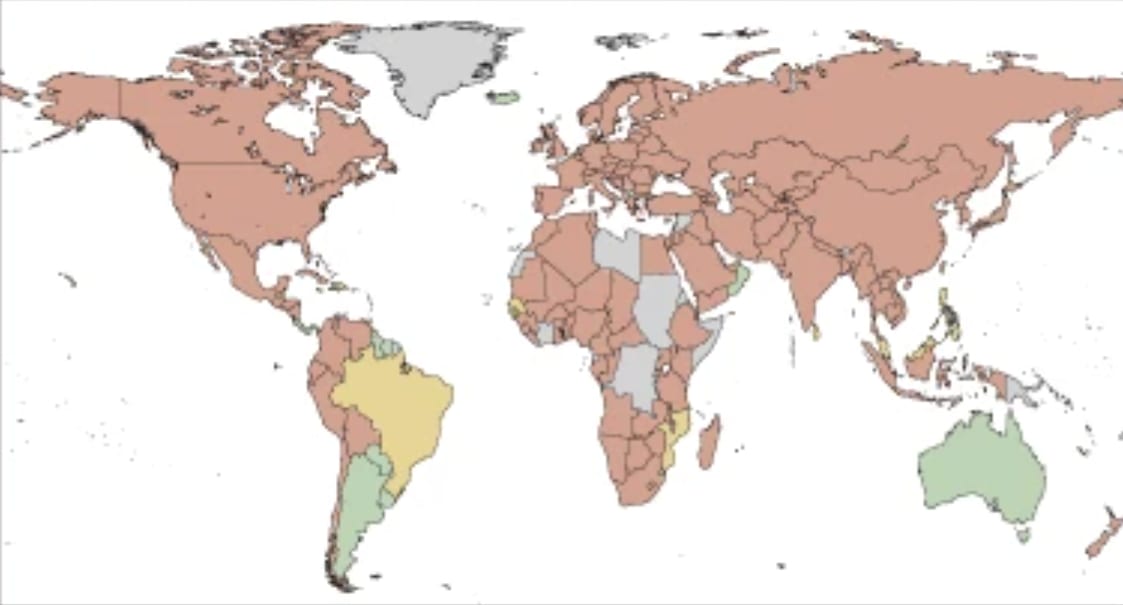
- Yes, the US and EU will be major targets for nukes, and so will be very badly affected. But much of Africa, the Middle East, China and Russia will also be similarly badly affected. In fact (based on querying LLMs), the least affected regions seem likely to be Australia/New Zealand, Southern South America, and (possibly) South Africa. See e.g. here (image copied below).
- Being coastal is good (fishing + thermal mass of the Ocean maintaining higher temperatures)
- Having a relatively high carrying capacity compared to population density is good (a proxy for this could be being a net exporter of food).
- Being far away from where nukes will likely be detonated is good (and soot will be worse throughout the Northern Hemisphere generally).
- One study estimated, “The island nations of Australia, New Zealand, Iceland, the Solomon Islands, and Vanuatu appear most resilient to ASRS [abrupt sunlight reduction scenarios].”
- These regions are unusually democratic. So if anything, the effect seems to be the opposite of what is claimed.
MacAskill: The world is currently unusually democratic[3]
Unclear what to think overall; I expect that a post-collapse civilisation would be democratic, but probably agree with MacAskill that in expectation it will be less democratic than today (given today is unusually democratic).
The modern world is far more democratic than previously. So the argument goes, the rise and extent of democracy is historically contingent, and so if all existing political institutions are destroyed and human civilisation needs to rebuild, we would expect the new civilisation to be less democratic than ours on base rates. The contingency of democracy seems very hard to estimate! But here are a few other relevant considerations:
- If there are many fairly isolated surviving communities post-collapse, and some fraction of them become democracies, the key question is not so much how many will become democracies, but whether the one/s that go on to reindustrialise and re-colonise the world will be democracies. I think there is good evidence that democracy/inclusive political institutions are supportive of long-run economic growth (see Why Nations Fail). So if democracy/liberalism are (causally or otherwise) associated with economic growth, the eventual inheritors of the earth are likely to be democratic.
- If civilisation takes tens to hundreds of years to reindustrialise (but maybe not thousands?) there will probably still be moderately strong cultural memories of the value of democracy in e.g. Australia/New Zealand, and some aspirations to return to it. So even though democracy may initially disappear, it is more likely to re-emerge.
- [Anthropics is confusing; unsure if this argument works.] If the world had no democracies, a reasoner would likely not think to ask ‘how common are democracies on re-rolls of history?’. So the fact that we are asking this question is some anthropic evidence that we live in an unusually democratic timeline.
[Weak evidence.[4]] Democracy seems to have arisen on ~4 independent occasions in human history (Ancient Greece, Ancient India, Iroquois, and Tlaxcala), with all other democracies culturally downstream of these (especially Greece). This is based on Claude compiling 74 major civilisations in history, and assigning scores for how democratic, and how causally connected to a past democratic civilisation, they were (data). I quickly manually checked all edge cases.
I’m not sure what fancy statistics one could reasonably do with this data. My qualitative takeaway is that the emergence of democracy is quite rare, but perhaps less rare than I expected (Athens was the only independent democratic origin I was aware of going into this research). So if there are more than a few dozen independent polities post-collapse, I expect at least one of them to develop some democratic elements.
MacAskill/Beckstead: Post-collapse values will be worse in expectation[5]
Overall: Mixed, I expect ~similarly good values.
- In some sense, it is very unsurprising that at each point in time, people in that culture will say that the world’s values are unusually good, given that one is a product of those values. (ie, Romans were probably self-congratulatory about their moral progress, too.)
- That said, I think the inside view argument for moral progress is very strong, and overcomes this prior skepticism that we live at an especially enlightened time.
- In the short term after a nuclear war, plausibly the more ruthless people will differentially survive (by looting resources). But perhaps on the timescale of years, communities that coordinate and cooperate unusually well may survive better than the stereotypical post-apocalyptic lone ranger. So, on selection effects alone, it is unclear whether ‘cooperate’ or ‘defect’ values will become more common – I lean towards cooperators surviving better overall.
- As MacAskill notes (fn25), one could hope that non-extinction catastrophes will be useful warning shots, making the civilisation that re-emerges post-collapse somewhat wiser and less keen to rush headlong into reckless technological development (e.g. ASI). But I agree with MacAskill that this seems like a small effect, and that it could even go the other way, with post-collapse international relations being more suspicious and combative than before.
- I expect there would be some reversion to the mean (assuming current values are unusually good), but not all the way given there would still be moderately strong cultural/values transmission from pre to post collapse. E.g. re slavery being wrong.
- ^
See also discussion in Aldred (2022)
- ^
MacAskill: “First, they might literally destroy existing democracies. This would make the future less likely to be governed democratically”.
Beckstead: “Once again, especially if the catastrophe disproportionately struck particularly important areas, there could be a stoppage/stall in social progress, or a great decrease in the comparative power of open societies in comparison with authoritarian regimes.”
- ^
Macaskill: “it seems to me that the level of democratisation we have in the world today is fairly contingent, and higher than we should expect given a reroll of history”.
- ^
Democracy plausibly would have arisen around the time of industrialization regardless of if there were historical antecedents. And evaluating how democratic past civilizations were, and whether these were independent origins or not, and what we can infer from this, seems just generally messy.
- ^
MacAskill: “I would expect that a post-catastrophe global culture would be less cooperative, less trusting, less impartial, and less morally open-minded; all of which are bad signs for getting to a better future.”
Beckstead: “A global catastrophe could stall—or even reverse—social progress from a utilitarian-type perspective. Once again, especially if the catastrophe disproportionately struck particularly important areas, there could be a stoppage/stall in social progress, or a great decrease in the comparative power of open societies in comparison with authoritarian regimes.”
Denkenberger🔸 @ 2026-04-02T00:35 (+8)
Even if you think democracy and good values would eventually recover if the world stayed not too different from our history, there are other failure modes. First, the world could be more susceptible to global totalitarianism, which could create permanent lock in. Second, temporary worse values could influence the values of AGI, which then could be locked in.