What if the third wave is a puddle?
By Morgan Fairless @ 2026-07-29T19:56 (+134)
This is a linkpost to https://morganfairless.substack.com/p/what-if-the-third-wave-is-a-puddle
The world of private philanthropy may be in for a period of large growth. News of Coefficient Giving increasing their funding for GiveWell to one billion in the near-term, and the general growth of the effective giving community as reported by Giving What We Can, make it difficult for even hardcore sceptics (and I probably count myself among this curmudgeonly crowd) to stick to the view that we are in business as usual.
There are many reasons to believe that this expected growth will happen, and I’d be remiss to not mention Nan Ransohoff’s great piece on the matter. This article was a catalyst. Where before board members and execs who were particularly clued into the Bay area may have expected to see this change in the size of the giving market, Nan’s piece gave this a name and salience. The third wave of philanthropy materialized slowly, and then all at once.
This possibility of increased funding has now taken the shape of a near certainty in some circles. Besides the perfunctory “it may not happen” at the end of a long pitch, it is not uncommon to sit in conversations that assume the existence of this funding, and to see decisions being made with this funding in mind. I have no particular individuals or organizations in mind when I write this, and I am keeping in mind many others who are, in my view, acting very responsibly.
I find there is good reason for moderation and patience when it comes to this third wave, and in the following few paragraphs I want to make the case for this.
No such money
Money can easily come and go. It has not been that long since a philanthropic movement saw the floor taken from under its feet. This is not just speculation: there were many learnings for the effective altruist movement from the Sam Bankman-Fried/FTX saga, ranging from avoiding overreliance on one donor or a narrow set of them to staying savvy about optics. From the that debacle, many organizations came to learn that funding is fickle, and a risk-informed approach does well to remember this.
There are eerie similarities between this mounting expectation for funds in 2026, and the speak of “funding overhangs” and “megaprojects” coming from the expectation that Sam Bankman-Fried’s FTX would give much of its profits away. At the time, much ink was spilled about how this money could be spent well, and in the end very little of that actually materialized.
At the end of the day, much of the speculated inflow in funds would come from two US-based companies. For all I know, this expectation is largely based on whispers and expectations. In London, it materializes as a concern with visiting and being in the Bay area, bringing home mounds of cash in triumph.
I don’t think this “no money” scenario is the likeliest, but it is worth pausing to realize that much of this expectation comes from speculation, and it is certainly possible that the money does not materialize at all. As a reminder, many smart people believe that much of the valuation underpinning AI companies to date is ephemeral, and keep pointing to several signs that we may be in a bubble, or at least a light bubbling.
Smaller amounts
One other plausible scenario is one of much smaller growth than anticipated. I personally think we are on this path. This could materialize in many ways, but primarily could happen through corrections in the valuation of these large companies, and moderation of the giving ambitions of the individuals involved.
Nick Allardice, from GiveDirectly, points out that Nan’s napkin math relies on giving rates far larger than the 1.2% rate of giving base rate by the ultra wealthy to date. I truly wish for the individuals to be end up donating their vast wealth, yet it is easy to imagine how the increased amount of attention and courting on this select group of people is creating a sort of self-fulfilling cycle of expectation.
Valuations are also not hard cash. Another scenario that leads to lower rates of giving is the high likelihood of ensuing corrections in the valuation of the main companies, which are yet to find commercially viable models, and have faced deep criticism.
A more modest version of the third wave than what was predicted would very easily put us in the realm of the trickle rather than the wave. While a shock to the system may warrant much chin stroking, a slow progressive increase would not.
Absorption
Another frequent concern is that some philanthropic spaces do not have the capacity to absorb major increases in funding.
This issue is palpable in the animal welfare movement, which is expecting to receive much of the increased philanthropic attention. This space has much fewer organizations, and lacks good evidence on what may work well and scale. This section does not really apply to that space. In the animal welfare space, I think a surge of new efforts may indeed be the best answer to increased funding, given the dire need for proven solutions and implementers.
However, for the global health and development fields, the absorption question sounds to me as a question easily reframed as “how do we absorb this funding?”
The absorption challenge is not a field-wide problem, it is a problem for the individual organizations that wish to access those funds and do not have the capacity to absorb it, due to their organizational set ups and lack of scale. For funders, it’s a question of speed of disbursement.
Second, the absorption problem is more complex than much of the discussion gives credit for. As Allardice points out in his piece on the absorption problem, the issue is that absorbing this type of money is highly difficult, and usually comes down to market size. The idea that the solution to lack of capacity for absorbing billions in the next year is to create new organizations today, ignores the long and winding road to test and scale.
Finally, the global health and development field is blessed with many great opportunities to give at scale. If there’s a windfall or steady increase in giving over the years, many programs across global health and livelihoods could productively absorb funds, cost-effectively. Just to name a few, Rachel Glennester and Leah R. Rosenzweig point out vaccine uptake and cash transfer programs in themselves could absorb a huge proportion of these funds, through government spending, GAVI, and organizations such as GiveDirectly. None of these could absorb all funds, all the time.
What next?
An influx of new money in a sector desperate to turn cash into good deeds is something to celebrate. Many of the preparations incurred might be good to make regardless of the outcome of this third wave. I can see the argument for each individual change in strategy in light of this, and recognize that fully ignoring the possibility of substantial inflows would be a failure in fiduciary duty.
However, it is difficult not to also notice a sense of competition for the attention of these maybe-funders, as well as a rush of strategic adjustments, and investment in absorbency plans that may remain outsized to the flows that actually materialize. To the extent that a philanthropic market exists, this is the closest I’ve ever seen to a bubble.
The issues that preoccupy us in our respective sectors are large and deeply problematic, a sense of urgency certainly fits. There are many things to like about this moment in the non-profit space, and in particular love the ambition for transformational change, at scale. This is something to preserve and cherish.
My words of caution here are not intended to stop the thinking on how to best scale, or to curtail the sense of unbounded ambition. Urgency, however, can lead to rash decisions, and lack of criticality.
The core point is that we should prioritize two-way doors, things that are robust to multiple funding scenarios. A risk-conscious approach would keep in mind that If this transformation in the philanthropic market does not materialize, the downside could be very bad:
- Unnatural growth in staff count, funding and complexity can undermine organizational stability.
- Strategies designed in a rush may prove over-ambitious and poorly thought out.
- Hiring sprees that anticipate funding that does not materialize will inevitably lead to layoffs.
- Time which could have been spent supporting natural growth curves, could be wasted chasing unsustainable paths.
In light of this, the advice no one asked for can be summarized in four points:
- Continue to plan for scale and think of new ambitious projects
- Keep well in mind that the wave may not happen or (most probably) could be smaller.
- Prioritize organizational strategies that are reversible and avoid lock-in
- Fight against a sense of urgency when it builds up.
Views my own. Thanks to Chris Ivey and Aidan Alexander who gave thoughtful feedback. I used no LLM tools in the production of this text - the humans were harsh enough.
NickLaing @ 2026-07-31T06:46 (+23)
Thanks for this ace article Morgan, I especially like "Fight against a sense of urgency when it builds up."
I love this a lot and can already feel this among other orgs. A few people have said "Nick, think about how you could absorb more money soon" and I've been asked 3 times in the last 6 months by donors something like "could you take an extra 3-5 million dollars right now".
These questions aren't unreasonable, but the donors also need to be careful to not ramp up that urgency too much among us doers.
I feel like a lot of orgs will scramble to find ways to "absorb" money and grow. I think this will be a far bigger problem with the already-big BINGOs more than smaller orgs, because their claims to be able to absorb an extra 500 million or whatever will be both more public and more plausible.
We should be especially suspicious of orgs proposing brand new activities in the midst of this felt urgency that deviate from what they have been doing for some time.
My one disagreement is that "vaccine uptake and cash transfer programs in themselves could absorb a huge proportion of these funds, through government spending, GAVI, and organizations such as GiveDirectly." I don't think the Math maths on this front, and the CDG article doesn't answer this question well either.
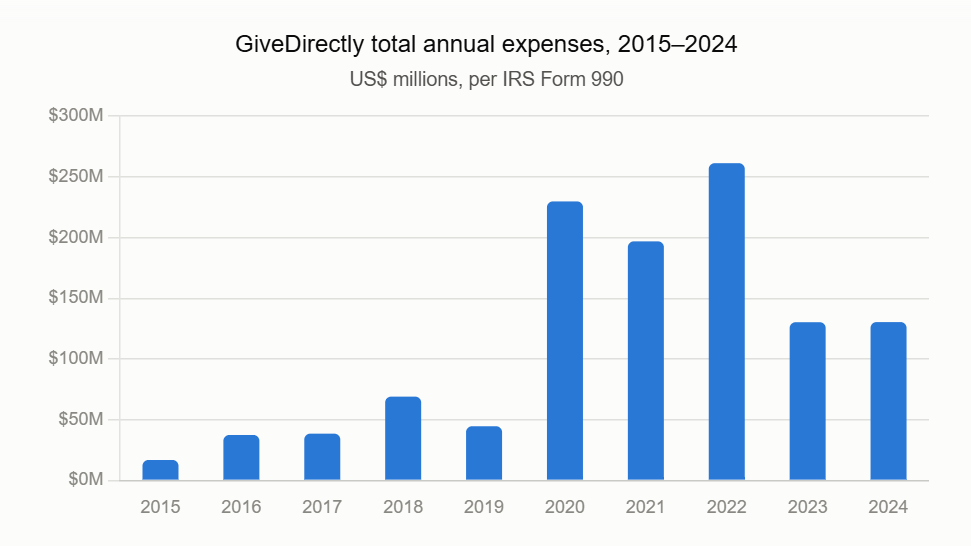
Looking at GiveDirectly specifically who might be the best placed org in the whole world to absorb lots of money cost-effectively and quickly, they say on their website they could spend 1.4 Billion in the next 3 years (sounds reasonable). The most they have ever spent in a year is 250 million dollars - I wouldn't think more than doubling this year on year would be realistic.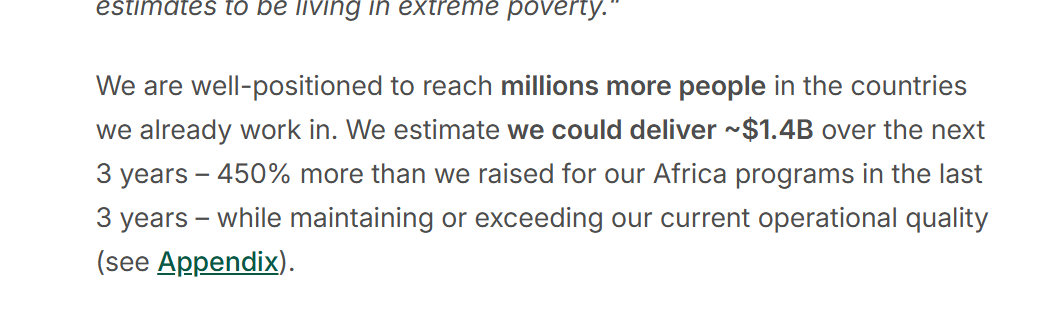
The last thing I would want to do is give money to low-income governments to give away. This would be an absolute corruption fest and extremely poorly targeted. There's already good evidence of this - look at Uganda's recent cash giveaway program... GAVI could probably absorb a decent chunk, but we also don't want to disrupt their program of forcing countries to slowly take over their own vaccine spend.
NickAllardice @ 2026-08-01T03:51 (+7)
We should probably update that part of the website, current best estimate for our (GiveDirectly’s) ability to absorb is ~$1B in next 12 months, and growing quickly beyond that horizon. Will write a longer post with forecasts and timelines sometime soon.
I agree with the more general point you’re making though; even $1B is a small fraction of the numbers some people are throwing around and the operational reality of spending money effectively at scale is poorly understood.
Mark Aiken @ 2026-08-02T18:32 (+13)
Thanks Morgan, this is a valuable perspective.
One observation from an adjacent world: absorption capacity is treated here as a new and poorly understood problem, but it’s a mature discipline in the multilateral, development and humanitarian ecosystems. Surge absorption has been studied and managed there for decades, with identified tools and processes - eg absorptive-capacity assessments before scale-up, phased disbursement tied to implementation rates, pooled funds that spread money across implementers when no single organisation can absorb it, and monitoring systems that flag when spending outruns capacity.
The failure modes you list (unnatural growth, rushed strategy, hiring ahead of funding that doesn't materialise, and plus, corruption) are also well documented there, from post-tsunami aid to large global health scale-ups. We know from experience that absorption fails at the organisational level before it fails at the field level; phased growth outperforms step-change growth; and reversibility ("two-way doors") is exactly the right design principle.
So I'd add one suggestion to your four: the sector doesn't need to derive this knowledge from first principles. There are many practitioners with extensive (decades-long) of experience planning, budgeting and disbursing at the scale you are concerned about. As one example, the budget of the Syria Humanitarian Needs and Response plan for 2026 is $2.9b, covering health, education, food security, water and sanitation. The experience of these practitioners who have disbursed at billion-dollar scale through these exact dynamics is currently almost invisible to this ecosystem. Importing that expertise seems cheaper than re-learning the hard lessons.
https://reliefweb.int/attachments/28e3e5cb-a476-44ee-9cb7-f69625bdf31a/syrian_arab_republic_2026_humanitarian_needs_and_response_plan.pdf
Tom Vargas @ 2026-07-29T21:27 (+8)
I think being skeptical here is probably smart. But even if Nan is off by some order of magnitude, and we believe there is some low probability the money comes through, the amounts of new philanthropic funding are very plausibly still very large, especially considering what goes into certain cause areas.
I find your advice to organizations compelling as well. Though on balance I'm likely to let their leadership figure what they are likely to win/lose from making such bets. Feels perfectly reasonable to get a whole lot of orgs that make heavy bets (alongside some, even perhaps very few, who don't).
Jack Lewars @ 2026-07-30T12:36 (+4)
This is a really useful counterweight to the prevailing thinking.
How do you think about trading off the downsides of growing too late (if the money materialises) versus growing too quickly (if it doesn't)?
My sense so far has been that the field is kind of doing business-as-usual, or at least was until cG gave GiveWell a billion dollars to get ahead of an expected windfall, anyway. A lot of places don't seem to have hired much or made firm moves as if they really expect the money to land (with a couple of notable exceptions).
Morgan Fairless @ 2026-07-31T08:27 (+3)
You are certainly more clued in that I am - if this turned out to be over-zealous and orgs are acting more responsibly than I think, that would be great!
I am not sure I have anything else that's smarter than "avoid one way doors" and make plans that are robustly good under different funding scenarios.
Alex Catalán Flores @ 2026-08-04T18:58 (+2)
At the end of the day, much of the speculated inflow in funds would come from two US-based companies. For all I know, this expectation is largely based on whispers and expectations.
The lines above really resonated with me.
I think it's very easy for chief executives and operations leaders to get excited about a funding windfall and then be buoyed along by their own excitement. Excitement is ✨ fun ✨, and contagious. The questions I'd want to hear more of are simple ones: how do we know that? Where did it come from, and can we check it ourselves?
At risk of abusing the water-based metaphors: you can hear a river from a long way off, and sound carries much further than water does. It might be that the sector is planning around that sound right now. What I keep wondering is how many leaders have actually walked upstream to see whether there's a spring at the top, or just last week's rain draining off a hillside.
I think some decisions and plans are fine to make on the strength of rumours. 'Two-way doors' is an excellent way of putting it. But are there orgs out there really making grand hiring plans and executing them? That's pretty ballsy, and I guess we'll see whether it was smart.