Why isn't there more EA focus on research for treatment-resistant severe mental illness?
By adam.kruger @ 2026-01-09T13:36 (+8)
The Core Question: While EA has made great strides in funding mental health access (e.g., StrongMinds), there seems to be a gap in funding basic research or "moonshot" cures for severe illnesses—like treatment-resistant depression, schizophrenia, or bipolar I—that don't respond to existing interventions.
I’m curious to hear the community’s thoughts through the INT framework:
1. Importance (The "Severity" vs. "Scale" Argument) EA often prioritizes based on the number of people reached, but should we be weighting the intensity of suffering more heavily?
- Many people with Severe Mental Illness (SMI) experience a level of unremitting agony that arguably surpasses the suffering of many physical diseases.
- If a person lives for decades in a state of extreme suicidal ideation or psychosis that is resistant to all known treatments, is the "well-being loss" greater than that of a person who dies young from malaria but was otherwise mentally healthy?
- Does the current EA focus on "scalable therapy" for the masses accidentally neglect the most extreme, "worst-case" human experiences?
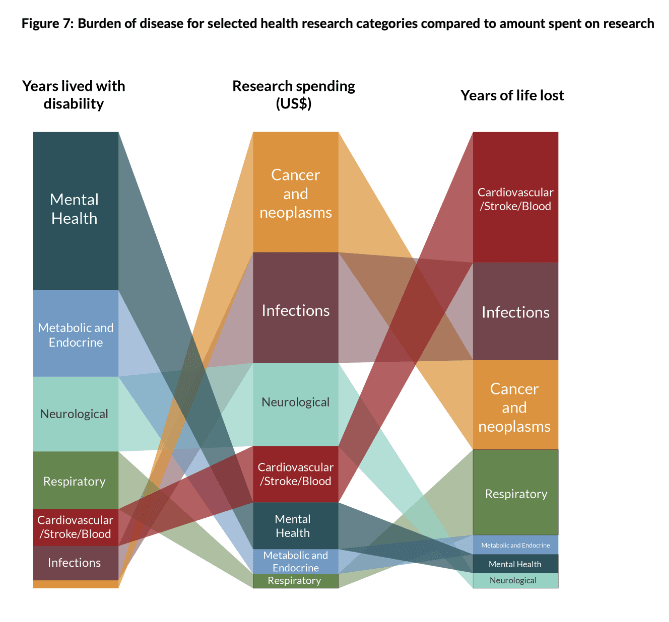
2. Neglectedness While the NIH and large foundations fund mental health, much of that is channeled into "safe" or incremental research. Is there a "neglected" space for high-risk, high-reward neurobiological research that the EA community is uniquely positioned to fund via a hits-based giving model?
3. Tractability Is the lack of funding a result of a belief that SMI is simply too "intractable" given our current understanding of the brain? Or are we reaching a tipping point where new technologies (e.g., neural mapping, deep brain stimulation, or novel compounds) make this research more tractable than it was 10 years ago?
Thanks for taking time to read this! Appreciate it!
Barry Grimes @ 2026-01-09T17:15 (+11)
BD² has committed $105+ million to research on bipolar disorder in recent years. It's funded by the Sergey Brin Family Foundation and three other philanthropic investors. For anyone interested in funding bipolar research, this would be my recommendation.
Mental health is one of Wellcome's three strategic priorities. They've funded a lot of impactful research on SMIs, including AVATAR therapy for psychosis (as highlighted by Kestrel) and the first new drug for schizophrenia in 30 years.
NickLaing @ 2026-01-09T13:58 (+11)
Its an interesting question, but given that no "cure" for these diseases has ever really been found despite enormous pharma spends to find cures for these crippling illnesses which affect the rich almost as much as the poor, I think there's a strong argument that its not super neglected given big pharma has spent a lot already, and tractability here seems low without evidence of previous cures.
Kestrel🔸 @ 2026-01-09T15:49 (+6)
Hello! Great questions. My answers:
- SMI is an illness that is present in high-income countries. Therefore, there is a (comparative) lot of funding available to research it, and the space is not so neglected as to be an EA funding possibility.
- I strongly believe that EA worker time should be spent on improving the treatment of high-income country illnesses like SMI (i.e. it is a high-impact career path that EA should encourage people who are altruistically ambitious to go into, although their salaries should be paid - one way or another - by their country's government and not by EA funds)
- In my opinion SMI research has, on the whole, suffered horribly over the past few decades by an overpropensity towards neurobiological approaches. Quote by NIMH head Thomas Insel: “I spent 13 years at NIMH really pushing on the neuroscience and genetics of mental disorders, and when I look back on that I realize that while I think I succeeded at getting lots of really cool papers published by cool scientists at fairly large costs—I think $20 billion—I don’t think we moved the needle in reducing suicide, reducing hospitalizations, improving recovery for the tens of millions of people who have mental illness.”
- If you're interested in cool recent SMI research, check out AVATAR therapy: https://wellcome.org/insights/articles/avatar-digital-therapy-could-help-people-who-hear-voices
Jamie E @ 2026-01-12T16:08 (+2)
A slight issue here might be something of what I see as a category error - a 'treatment resistant' mental illness is usually not considered a distinct mental illness. For example, treatment resistant depression is depression, against which multiple treatments have been tried and have failed. There is a lot of traditional mental health research funding on severe mental illness, and a lot of funding is also geared towards trying to understand why some treatments don't work for some people (i.e., some people's mental illnesses resist treatment). So in this sense, I just don't think it is neglected.
Barry Grimes @ 2026-01-13T09:03 (+4)
I wouldn't say there's "a lot" of funding. Mental health research is significantly underfunded compared to other health conditions. More info in this report