Flooding in Lagos: Climate Change or Governance Failure?
By aderonke @ 2025-07-08T08:53 (+14)
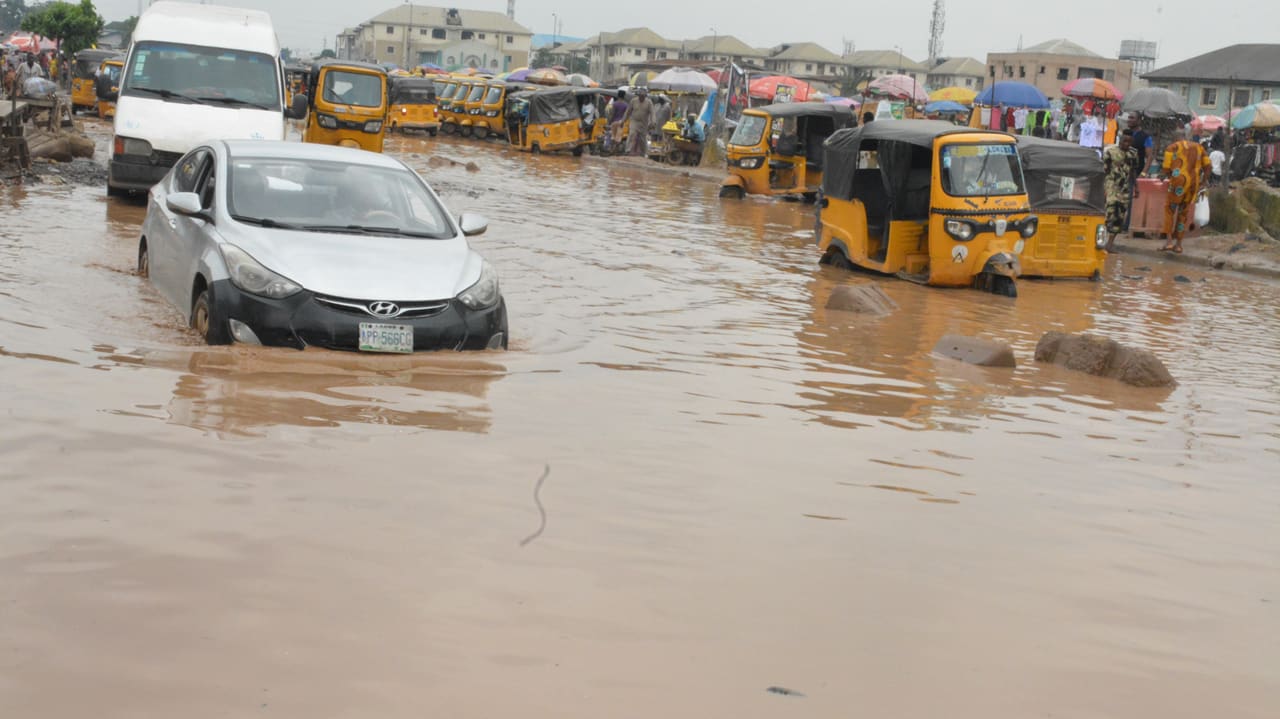
Every rainy season, Lagos drowns. Roads become rivers, homes are inundated, and daily commutes become difficult. Images and videos of submerged vehicles and people wading through waist-deep water circulate on social media, often accompanied by the blame: climate change. But while climate change plays a role, it's not the main culprit. The deeper, more immediate cause lies in the city’s broken systems—infrastructure decay, poor planning, and governance failures.
What Climate Change Is and What It Is Not
Climate change refers to long-term shifts in global temperatures and weather patterns, primarily driven by human activities such as burning fossil fuels and deforestation. It results in sea-level rise, extreme rainfall, droughts, and temperature changes. These global shifts can increase the frequency and intensity of weather-related events, including flooding. However, climate change does not explain why the same streets flood year after year or why entire neighbourhoods sit in waterlogged despair.
Man-Made Vulnerabilities: The Lagos Story
Lagos is not merely a victim of nature. Much of its flooding problem is man-made:
Building on flood plains and wetlands: Successive governments have issued permits for residential and commercial developments on natural water retention areas, like marshes and groves. According to the Nigerian Conservation Foundation, Lagos has lost over 96% of its wetlands, weakening the city’s natural defences.
Check out this video, spoken in Yoruba, of a local explaining how the government sold lands on flood paths to builders and how it leads to flooding. There are countless incidents like this across Lagos.
- Blocked drainage and canals: The city’s drainage systems are poorly maintained or non-existent in many neighbourhoods. The Lagos State Waste Management Authority (LAWMA) regularly reports drainage blockage due to improperly disposed waste. I have witnessed multiple situations where people's only recourse is to wait for rain and dump their waste in the gutters. Much simpler than burning, which many do due to the failed waste collection system. In some cases, private cart-pushing garbage collectors also dump their cargo in the canals due to the trekking distance to the central processor.
Inadequate waste management: Lagos generates over 13,000 metric tonnes of waste daily, but collection systems fail to cover large parts of the city. This leads to a culture of dumping trash in gutters and water channels.
There is a political economy analysis of how waste management in Lagos went from bad to worse. I won't bore you with those details, but here's what life looks like for most Lagosisans.
Unregulated urban sprawl: Lagos has grown rapidly, with an estimated 21 million people, but without coordinated urban planning. Entire estates spring up without flood risk assessments or supporting infrastructure.
An urban planner assessed the situation on the Ideas Untrapped podcast.
These are not natural disasters. They are governance disasters that turn regular rainfall into recurring emergencies.
This is Lagos; we can extrapolate it to the rest of Nigeria. Scenes of entire villages submerged at the tributaries of the Atlantic Ocean or along the Benue River basin can be traced to a lack of infrastructure and government failure at both the federal and state levels. A very good example is the failure to build the Dasin Hausa Dam.
"Initially, Nigeria and Cameroon had an agreement to build two dams: Lagdo in Cameroon and Dasin Hausa in Nigeria. The Dasin Hausa Dam was meant to act as a “shock absorber,” protecting Nigerian communities from floods.
Unfortunately, although construction started in the 1980s, the Dasin Hausa Dam remains unfinished to this day."
"This day" being 2024. Need I say more?
Climate Change + Systemic Failure = Crisis
Climate change does contribute to more intense and unpredictable rainfall. Sea levels are rising. But these global phenomena only become catastrophic when they meet local negligence. In well-managed cities, stronger storms don’t lead to routine urban paralysis. In Lagos, they do.
The truth is that climate change acts as a stress test on existing systems. Where institutions are weak, infrastructure is neglected, and accountability is absent, even mild climate events can spiral into disaster.
Who Is Responsible?
Responsibility is shared, but not equally:
- Government: For issuing permits without environmental consideration, for failing to invest in critical infrastructure, and for allowing urban planning to be driven by short-term political and commercial interests.
- Citizens: For poor environmental habits, like dumping waste in canals and refusing to comply with basic sanitation norms.
- Developers: For prioritising profit over sustainability, ignoring environmental assessments, and building on sensitive ecological zones.
We must stop blaming climate change for everything. Doing so allows those truly responsible to avoid accountability.
FYI, Lagos has chronic housing shortages, hence demand is ever high while supply is low. This can explain the equilibrium that government and developers have found themselves vis-à-vis urban planning. Now, governance in Lagos is not really about the public good; it's about access to the state's resources and how it is shared among the different political stakeholders. Chief of them being the current president of Nigeria.
What Can Be Done
Lagos needs urgent, systemic action:
- Enforce environmental laws and stop development on wetlands and flood paths.
Invest in green infrastructure such as parks, retention ponds, and functional drainage systems. It's a running joke among Lagosians that "Lagos is a naked city". You couldn't find a tree to save your life in the scorching heat. And the gods help you find a local park as you would in any other decent city. Not even in the most Affluent neighbourhood across the states is there a park. I started the EA Lagos Meetup in my living room because there were no public parks, and adequate private venues are expensive.
An ex-governor of the state had an environmental policy that included tree planting. In 4 years, the administration planted 3 million trees and by the 6th year, 4.6 million. When his successor came in, he uprooted the trees for lighting and road construction in a pet project called Light Up Lagos.
Implement a robust waste management system that serves all communities. There was considerable progress here circa 2007-2014. But things got progressively worse with our "Light Up Lagos" governor, who in his infinite wisdom decided to lock horns with the state's PSP operators and swap them for his own waste management company.
By the time the state assembly intervened, it was too little, too late.
- Launch public education campaigns about responsible waste disposal and environmental stewardship.
- Plan for climate adaptation, but ground that plan in good governance and realistic urban management.
Conclusion
Climate change is real and dangerous. But Lagos floods not just because it rains more, Lagos floods because we’ve made it impossible for rain to go anywhere. Until the root causes of our environmental vulnerability are addressed, every rainy season will bring the same destruction, and the blame will keep falling on the wrong target.
References:
- United Nations Climate Change (UNFCCC): https://unfccc.int/
- Nigerian Conservation Foundation (NCF): https://www.ncf-ng.org/
- Lagos State Waste Management Authority (LAWMA): https://lawma.gov.ng/
- World Bank Nigeria Urban Waste Management: https://www.worldbank.org/en/news/feature/2020/09/29/urban-waste-management-nigeria
- UN-Habitat Nigeria: https://unhabitat.org/nigeria
This article was written with the help of ChatGPT.
aderonke @ 2025-07-08T08:58 (+2)
I wrote this to address some misconceptions about climate change and flooding in Nigeria and other developing economies. As a community committed to evidence, reason, root-cause analysis and whatnot, we should always try to look below the headlines and engage with the systemic whys.
I may write a follow-up on practical climate mitigations in Nigeria and ways in which they can impact lives for the better.
jackva @ 2025-07-09T06:52 (+3)
Thanks for writing this! Have you considered sharing this with non-EA audiences?
aderonke @ 2025-07-10T03:34 (+1)
I have. But I'm open to suggestions. Do you have any specific non-EA audience(s) or publication in mind? Thanks!