Make your own model of the AI windfall
By Jack Lewars @ 2026-09-24T08:42 (+20)
This is a linkpost to https://open.substack.com/pub/fundinganthropalypse/p/what-the-coming-wave-of-ai-philanthropy?r=4b7xoz&utm_campaign=post&utm_medium=web
There seems to be a lot of uncertainty, and some cynicism, about how much philanthropy would actually be generated by an Anthropic IPO.
I built a simple model to estimate financial flows to philanthropy. You can make a copy here. Mine is focussed on global health and development, but you could easily change this or add multiple cause areas.
What needs to happen for AI equity to be donated?
In short, there are five stages between people holding private shares and making grants:
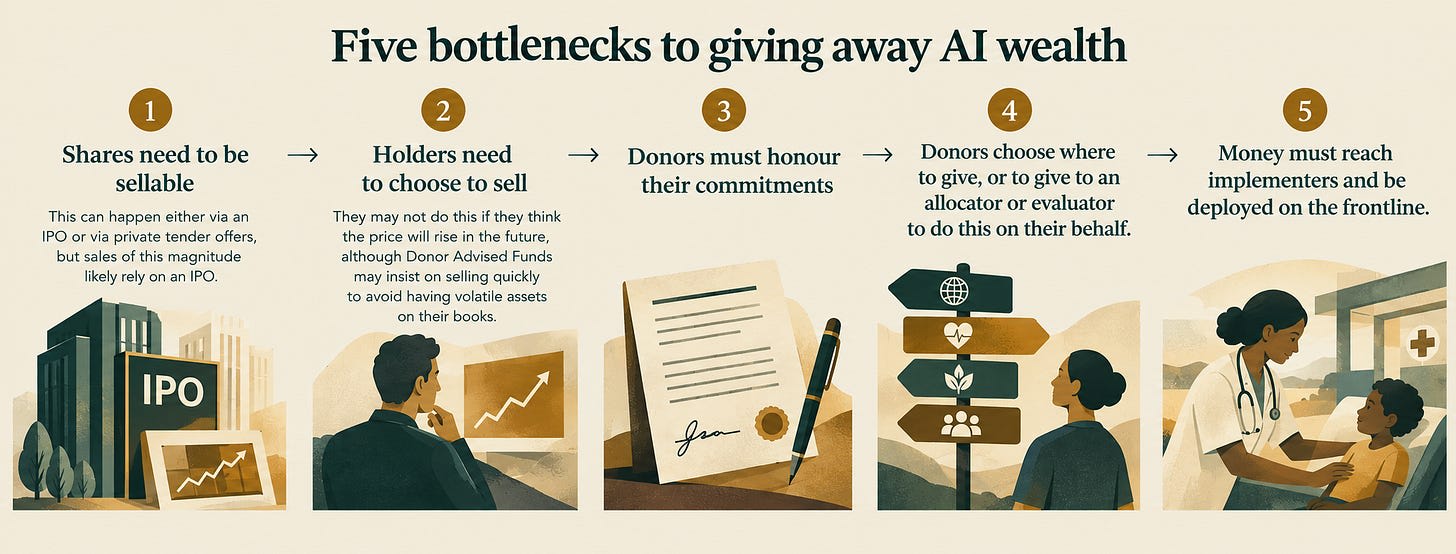
First, the shares need to be sellable. This can happen either via an IPO or via private tender offers, but sales of this magnitude likely rely on an IPO.
Second, the holders of the shares need to choose to sell. They may not do this if they think the price will rise in the future, although Donor Advised Funds may insist on selling quickly to avoid having volatile assets on their books.
Third, donors who have pledged to charity but not put a legal lock on the money must honour their commitments. (Importantly, a lot of employee equity is already in DAFs, and so this money is legally destined either to sit in the DAF indefinitely or be granted, but can't be repurposed to buy a yacht, for example. The pledges from Anthropic's founders are not legally enforced, as far as I know.)
Fourth, they need to choose where to give, or to give the money to an allocator or evaluator to do this on their behalf.
Finally, the money needs to reach implementers and be deployed on the frontline.
Each of these stages will see some attrition, and it’s highly uncertain how much will occur at each stage. The model lets you add your own discount rates at various points, and you could easily add more stages if you wanted a more sophisticated version.
It's going to be a lot of money
Whichever way you cut it, it looks like a lot more money is heading into the ecosystem. My ‘mid-range’ scenario for global health and development is:
- $272bn committed to charity ($139bn from the founders and $133bn from employees);
- Paid out at 10% of the holdings per year;
- 45% of employee contributions and 20% of founder donations going to development;
- Creates $87bn for development, or around $8.8bn per year by 2030.
Assuming only 7-15% of available capital is granted out each year, my ‘bear, central and bullish’ scenarios are:
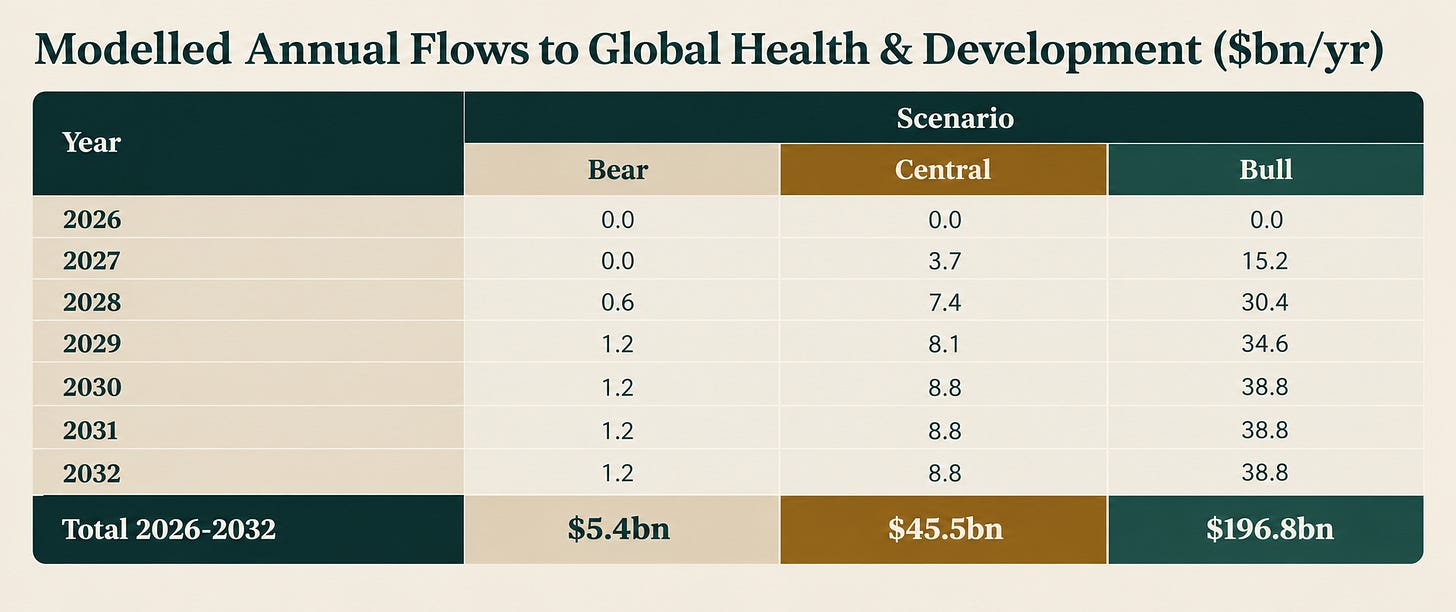
For scale, the Gates Foundation, the largest private funder of global health, pays out around $9bn a year. In the central scenario, these donors would be deploying almost as much every year, just to global health and development, by 2030. In the bull case, on the same timeline, we’d have approximately three more Gates Foundation-equivalent funders in a few years time.
david_reinstein @ 2026-09-24T15:46 (+2)
Hi Jack, hoping to find some time to dig into your work soon. Just wanted to make sure you're aware of the similar project I was doing
https://uj-ai-wealth-philanthropy-steelman.netlify.app/global-development/
https://uj-ai-wealth-philanthropy-steelman.netlify.app/
And maybe doing some comparing and contrasting to see how our independent exercises end up offering. (Feel free to DM me and maybe we do some collab work too).