Not Knowing How This Ends
By Shyn T. @ 2026-08-15T22:02 (+15)
TL;DR
There once was quite an ordinary individual who left a stable career without knowing where she was going next. She knew only that she could no longer remain where she was.
After some contemplation, she applied for jobs. Programs. Opportunities to learn. Opportunities to contribute. Some things looked promising. Many ended in rejection.
After considerably more contemplation, she…
1.
2.
.
.
.
n.
And then __________.
The End.
I’m struggling to finish that story because I’m still in it.
A Less Dramatic Exodus
I left my 20-year aviation career in September 2025 without knowing what came next. Conventional wisdom would say, “Find another job before leaving.” In my case, I didn't have the mental space to even imagine a new destination. That capacity only began returning after I left and had time to decompress.
Looking back, my decision reminds me of an exchange between Frasier and Niles from the sitcom Frasier. Niles tells Frasier that he's finally going to tell Daphne how he feels about her. Frasier has his doubts, but Niles is determined. Eventually, Frasier relents: ‘Yes. Well, as I said to you the time you tried to jump out of the treehouse with an umbrella: “I suppose you know what you're doing.”’ (Frasier, Season 4, Episode 6, “Mixed Doubles”)
I’ve read many transition stories that are told after something has worked out. By then, hindsight has an upbeat way of turning the dizzying wandering into an enlightened path. There may be others somewhere in the unresolved middle whose stories are harder to see precisely because there isn't yet a finished story to tell. There is also the less glamorous undercurrent of loneliness, doubt and fear which makes some days simply so much harder than others. And I’m writing while I genuinely don't know whether this works out.
Where Am I and How Did I Get Here?
I knew long before I left aviation that I wanted to do something meaningful for those whose suffering is easily overlooked (eye-rolling acceptable at how clichéd and grandiose that sounds). I just didn't know how to channel that desire until I stumbled upon Effective Altruism through an unrelated newsletter. As I looked into what made this particular form of altruism “effective,” I started to notice something familiar in the underlying approach: limited resources, uncertain evidence, competing interventions. How do you compare the options and justify choosing the one that might do the most good?
My work in aviation had an “effective” quality to it but operated under very different objectives and constraints. It also required comparing options, working with incomplete information and figuring out the best defensible course of action. I couldn’t help but wonder if my “effective” experience could be useful to Effective Altruism.
That thought gave me a starting point. I began exploring AI safety/governance, animal welfare, global health, operations roles, consulting. So far, I’ve applied for jobs, programs, advising, conferences, RFPs and incubators. There have been occasional positive signals, but they have been largely overshadowed by a steady stream of rejections that offer little information about “why not me?”
I still don't know whether:
☐ I'm moving toward something
☐ I'm moving in the wrong direction
☐ I'm insufficiently legible to the ecosystems I have chosen
☐ I lack necessary expertise
☐ My criteria for choosing opportunities may be flawed
☐ I'm failing to network effectively
☐ I'm simply encountering extremely competitive selection
☐ All/some of the above. Please show your work.
People in Glass Houses…
I would be remiss if I weren’t equally willing to examine myself. I realize my own disposition may make the transition harder than perhaps it needs to be. At this stage in my life, I have become selective about where I expend my dwindling energies. I am not naturally gifted in the enviable art of conventional networking and self-promotion, especially when it involves performing belonging or enthusiasm or optimizing myself for selection. Those characteristics may preserve something important in me, but they may also genuinely reduce my opportunities.
In Holding
Taken together, my actions and my disposition have put me into a psychological holding pattern (thank you, aviation). I’m thinking I might also have an access conundrum: access to the programs, networks and roles that could help me gain relevant experience and become more visible may itself depend on already having some combination of that experience, visibility, networking and self-marketing.
Wait. So to become a stronger candidate, I may need access. To get access, I may need to be a stronger candidate. Stronger candidate. Access. Stronger candidate. Access…
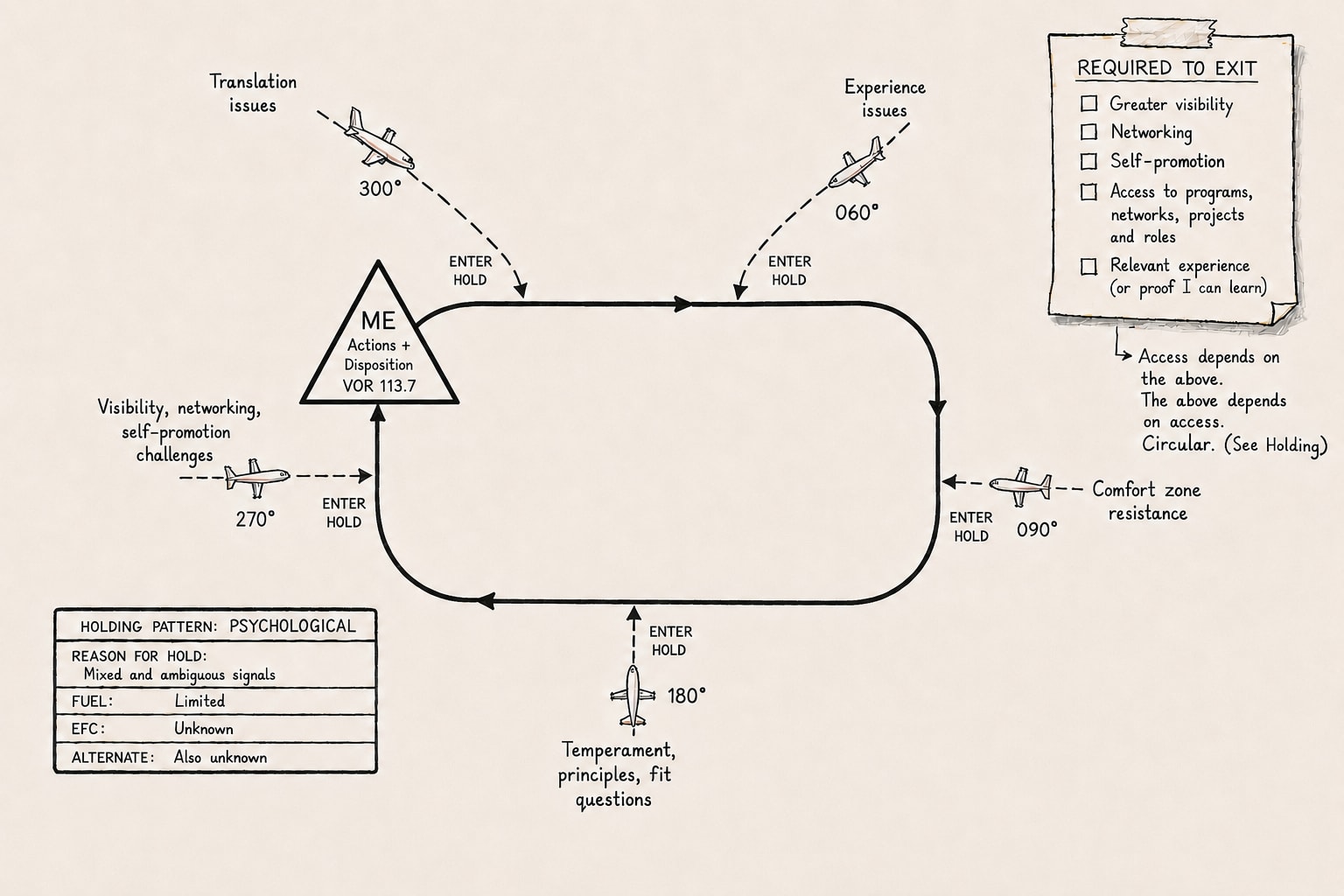
It isn't that I don't enjoy connecting with people. Give a problem or an idea I'm working on center stage and I become blissfully animated, asking questions, disagreeing and perhaps going down a few rabbit holes. I become strangely muted when the thing I am supposed to be presenting is a presentable version of me. But is that resistance something I should push through because I need to “get out of my comfort zone,” or is some of it telling me something real about my temperament, principles or fit?
Tyranny of the Shoulds
Years ago, my spiritual director would smile when I would lament things like “I should be doing better by now,” or “It shouldn't be this hard,” and say, “Ah, the ‘tyranny of the shoulds.’” In her 1950 book Neurosis and Human Growth, psychoanalyst Karen Horney introduced the “tyranny of the shoulds,” akin to a somewhat oppressive internal grading system in which we measure ourselves against expectations, our own and everyone else's, and repeatedly find ourselves falling short.
Given where I find myself now, the “shoulds” are incessant: I should have found another job before leaving; I should know what I want at this age; I should network better; I should be less selective; my experience should be more transferable; if my ideas were valuable, someone should have recognized them by now. But which of those “shoulds” contain useful information and which are just tyrannical judgments about where my life ought to be by now?
What Now?
Upon further reflection (my mind’s current go-to pastime, as you may have noticed by now), I thought I’d try what I most naturally reach for: turn this chapter into an idea I'm working on or a problem I'm trying to solve. Zoom out, take in the big picture, take stock of what I've learned so far about the constraints, the interconnections and the incentives, figure out what I can actually control and tolerably iterate on, and keep going until the signals are strong enough to tell me whether to continue or change course.
After considerably more contemplation, she…
1. Posted her first article on the EA Forum.
2.
.
.
n
And then____________
The End.
NOTE: Chance of declining fuel situation forcing an ending first...
Kestrel🔸 @ 2026-08-17T05:26 (+3)
The fact that you have previously asked for spiritual direction means you're significantly closer than many other people on this Forum to "getting it", I reckon.
Things I'll recommend for keeping your fuel in a job rejection heavy life:
Reading Effective Altruism in the Garden of Ends https://forum.effectivealtruism.org/posts/AjxqsDmhGiW9g8ju6/effective-altruism-in-the-garden-of-ends - in all of that, there's a quote about spiritual nourishment coming from a particular kind of quality of attention.
The Experiment with Light network: www.experiment-with-light.org.uk - the ExL is there as solo meditations, but they really are best done in groups. Done right it'll get you off "should" without getting you off committed motivation.
Looking up the PIN (position-interest-need) model for depolarisation, putting yourself on one P and someone you're trying to understand more on the other P, and going deeper until you find the shared N. Ideally this would be facilitated in a workshop the first few times you do it so you can be corrected on obvious mistakes. But I think you're probably pretty intelligent and would get stuff out of self-attempts.
Befriending someone local who's a singer and getting them to regularly sing you some of their favourite songs. If this sounds real scary, going to Sacred Harp meetups resulted in something similar.
Looking into the Active Hope framework (it's designed around climate doom, it works for EA doom with minimal alterations).
Once you've tried out some, you may gain understanding that interpersonal bonding over shared witnessing of the beautiful unites all these things, and (hopefully) also your spiritual direction, and indeed much of the best parts of EA. Once you've a) got the underlying concept and b) realised beauty is immaterial so it doesn't have to cost much money as long as you know your beauty sense well, you can probably work out how to fill your schedule with more of whatever best does it for you.
--
Things I'll recommend for getting you a job:
Going for a residency at the EA Hotel in Blackpool, UK and using it to in-person network yourself into a job.
Volunteering at something you're good at already and visibly demonstrating altruism and competency in front to other EAs, and then asking them to help review your job applications. You probably do have an ingroup signalling problem rather than a competency problem, and the easiest fix is to demonstrate competency in front of EAs who are able and willing to fix the ingroup signals of competent people, because they understand that's a very high-impact action.
Dialing down the quantity of your job applications and upping the quality of each one. The mental cost (or gain) of job rejection should be taken into account in your calculus - it's fundamentally net negative applying for jobs where you'll be rejected and won't learn anything from the rejection.
I'd recommend the various AI safety bootcamps for gaining context, but honestly I think the EA Hotel would be faster and more convenient around any schedule you have.
Kestrel🔸 @ 2026-08-17T05:29 (+3)
Oh, also - good job posting your first article on the EA Forum!
Shyn T. @ 2026-08-17T17:10 (+1)
I am genuinely touched by the sincerity and depth of your response. That you spent time with what I wrote and reached out to me with ways you think may help means a lot to me.
I also see your point about in-group signaling. My attempts to signal competence have been through RFPs, incubators, and I've received some encouraging feedback. I admit I'm struggling to find the kind of sustained working relationships you're describing. Some of the routes i've tried to access that kind of environment have themselves been very selective, which sort of brings me back to that access conundrum...
Kestrel🔸 @ 2026-08-17T20:29 (+2)
Ah, you won't get sustained working relationships from a bootcamp. The people who attend bootcamps are your competition, and the people who run bootcamps are teaching context rather than facilitating networking, and don't really have the brain space to form sustained relationships with cohort members.
Unfortunately, EA is full of a lot of people who are job hunting for the same jobs, which makes the community around this activity overly transient and, at times, divisive. I've written twice on this forum about the fact that we need to get better at lowering our infrastructure costs, and having less competitive application processes for infrastructure attendance focused around deeper networking and community capital development.
Finding the more stable, more unified parts of EA will help you build long-term relationships, but you'll probably be (directly or indirectly) expected to put in some money or volunteer time to do so.
If you find someone who gives a substantial amount of money to AI safety, they're probably the kind of person who would assist with your job hunting if you convinced them you're competent. But these kinds of people are found at effective giving focused events and spaces.
I'll continue to recommend a residential at the EA hotel in Blackpool UK. It operates as the shadowy centre of a surprising number of things in AI safety, its staff team are good at providing job hunting assistance, and its alumni network is vast and all over EA. The application process is relatively easy, because it selects for commitment by placing itself outside the Loxbridge bubble. And their £30 a night (food included) Patron rate basically removes the application process, they just check you understand what EA is and agree to follow their code of conduct.
https://aisafety.com/hackathon this is coming up and will likely have the "correct" people in attendance.
Posting reports on the EA forum about things you did, that others can usefully learn from, is another way of building the longer-term relationships. So it's good you found your way here!
Best of luck with the job hunt.
Shyn T. @ 2026-08-17T21:21 (+1)
Thank you, really! I found your insights very helpful and you've given me quite a bit to think about.