More AI safety research and project ideas I haven't seen elsewhere
By Lloyd Rhodes-Brandon 🔸 @ 2026-06-25T14:26 (+12)
This is a follow-up to my (now fairly outdated) August 2025 post.
This post contains all the AI safety research and project ideas I've had in the past 10 months which I think could be high impact. I’m sharing them in case any are helpful or generative for others. I don’t plan to pursue most of these myself as there are just too many for me to do them all justice (and I probably lack comparative advantage for many of them).
All of these ideas are at least somewhat novel. Many could be expanded into full essays, policy proposals, or longer-term research programmes. A lot of the questions are fairly macrostrategic in nature. Each section's questions are (very loosely) ordered by expected impactfulness.
Also, a heads up: some of them are a bit weird!
Field infrastructure, mapping, and neglectedness
- There should be a live, regularly-updated and highly visual database of AIS research questions and the latest progress on each of them.
- The nearest existing thing is the EA Midwest list-of-lists. Meanwhile, AISafety.com's map separates listings into categories with an Airtable backend and a graveyard for discontinued projects, plus aisafetyfeed (where AI helps summarise, tag, and rate the novelty of content) and trecursive's tree-maps. But nothing nails "questions + live progress on each".
- Could plausibly be made and maintained mostly with AI scraping and auto-categorisation. I suspect that the majority of updating could also be automated.
- A database like this would allow people to easily see the state of research on a given subtopic, and where there is progress to be made.
- Similarly, there should be a live, regularly-updated and highly visual database of proposed interventions in AI safety, which tracks how many people are working on each intervention, and roughly how much time they're on each intervention.
- This would allow us to more quantitatively assess neglectedness. Landscape maps and 80k problem profiles gesture at neglectedness, but a quantitative time-allocation tracker I couldn't find.
These two projects could even be combined into one comprehensive database:
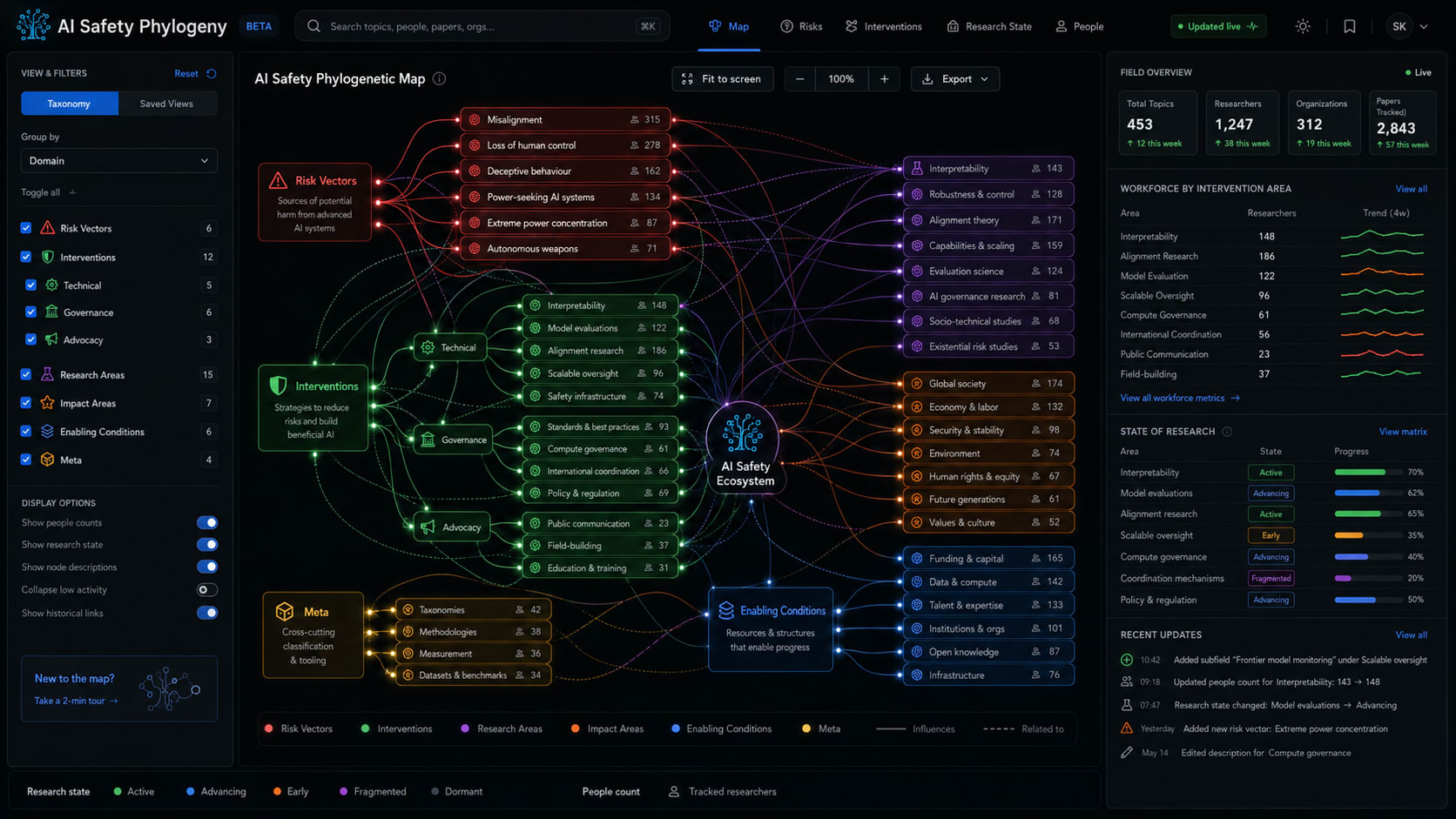
Both of these database ideas are also in my view more needed than ever in 2026. The field of AI (and its surrounding geopolitical context) is evolving so rapidly now as to mean that each week, new developments have emerged from multiple directions. This makes it hard to keep track, making this sort of database quite attractive to me.
A possible issue posed by the databases is that it may make it easier for those who are strategising against the AI safety community. One possible mitigation could be to have some degree of gatedness to these databases, perhaps requiring some kind of authentication to access. That seems tricky and possibly counterproductive, however.
Two more questions on field infrastructure/neglectedness?
- Which disciplines have had the least contact with AI safety, and might they have anything to contribute? See this Claude deep research artefact: https://claude.ai/public/artifacts/55bde7d3-2216-43ea-83f0-9857e1e48750
- Are attractor basins from AI use a risk vector that curtails genuine innovation in AIS itself? One candidate antidote: deliberately spending time in layers of reality that are far from AI (eg spending time in nature) in order to tap into sources of inspiration which lack these attractor basins. Adjacent to model-collapse and LLM-homogenisation-of-thought work, but the specific application to safety-research creativity I haven't seen.
Intervention prioritisation and AI safety strategy
- To whatever extent frontier AI's energy and resource consumption breaks traditional climate forecasts, how should AIS strategy adapt for the likely increased resultant geopolitical and environmental instability?
- Given the high degree of disagreement among experts regarding which AI safety interventions are most promising, would it be helpful for intervention comparisons to factor in interactions between interventions (synergies, clashes) and viability across broad timelines?
- From what I've been able to gather, these factors aren't often taken into account. For example, mechanistic interpretability and evals may be mutually reinforcing, because better interpretability can improve the design of evals while evals can help identify where interpretability work is most urgently needed. By contrast, aggressive public campaigning for a pause might clash with quiet institutional work if it makes policymakers or labs more defensive, though it might also expand the Overton window in ways that make moderate regulation easier.
- Timeline-robustness also matters: some interventions may dominate on short timelines because they can be deployed quickly, while others may only pay off on longer timelines because they require deep scientific or institutional maturation.
- The point would be to figure out which interventions are most synergistic with other interventions, and which remain viable across both short and long timelines. Portfolio/"defence in depth" framing is standard; formal interaction-matrices don't seem to exist.
- Should frontier-AI-company employees strike, with demands of their companies committing to safety?
AI takeoff and civilisational trajectory
- If the world is currently getting worse (a perspective which is of course extremely subject to debate), is there an argument that postponing the singularity makes things worse?
- The "opposite of a long reflection": scale up today's not-completely-terrible values before they degrade.
- In that framing, delaying a singularity lets worse norms, more brittle institutions, and more desperate incentives become the substrate from which superintelligence eventually emerges.
- I'm aware this is kind of counterintuitive and flies in the face of a lot of established AIS thinking, but I think it's a question worth seriously investigating.
- Can recursive self-improvement be (roughly) simulated through an LLM repeatedly improving its system prompt, in order to study alignment implications?
- This would not reproduce full RSI, since the model’s weights, architecture, training data, and capabilities remain fixed while only its instruction context changes. Still, prompt-level self-modification could serve as a useful toy model for studying alignment dynamics, especially how goals, constraints, failure modes, and deceptive or unstable behaviours might shift across iterative improvement cycles.
- Prompt-level self-improvement exists (Promptbreeder, self-refine, self-rewarding LMs); as a deliberate alignment toy-model for RSI dynamics it's less done. Reasonable small project, modest novelty.
Governance, institutions, and political strategy
- If states each had oracle/ASI access and could foresee likely conflict outcomes, might that force negotiation and reduce war? Eg:
- There's no incentive to fight a war which both sides can see will likely lead to mutual ruin. Maybe that will force negotiation?
- There's also no incentive for a state to defend themselves if they can see that they'll lose anyway. Does this increase risk of colonial dynamics?
- Orcale AI likely would not eliminate war entirely, because states may still:
- face commitment problems; even if both sides know what deal should prevent war, one side may not believe the other will stick to it later
- distrust each other’s oracles
- manipulate inputs
- fight for domestic-political reasons rather than national strategic gain. Leaders do not always maximise “national welfare”; they may maximise regime survival, personal power, ideological legitimacy, elite support, or avoidance of humiliation
- What are the implications of evidence and theory on international organisations for the international network of governmental AI safety institutes?
- For example, good leadership is one of the factors which seems to predict robustness of international organisation regardless of particular threatening circumstances-- how good is the leadership of AISIs, and how could we improve it?
- Has political polarisation become so strong as to mean that, contrary to the concern that AI safety should remain unpoliticised, AI safety may in fact only become salient if it becomes a partisan issue? Worth exploring risks and benefits of deliberately allying AIS with one political faction.
Embodiment, robotics, and AI in simulated environments
- Is physical AI / robotics a fundamentally different ballpark from purely digital AI for safety purposes, requiring new theory, interventions etc? (Inspired by Benjamin Alt's SAIGE workshop on physical AGI.)
- We cannot necessarily assume 1:1 transfer of digital-AI safety theory results to embodied systems. We might have to develop good understanding and control from some degree of first principles. It would be good and interesting to think through AIS for robotics carefully, thinking about how each aspect of AIS interacts with robots.
- How important is the conceptual and linguistic gap between AI safety and robotics, and how do we close it? And do we need organisations equivalent to Anthropic, Redwood etc for robotics?
- Is there a risk of AIs escaping online videogames or virtual environments onto the internet?
- Particularly acute for villain characters who use 'evil' LLM persona to shape their dialogue and behaviour.
- This seems like one of the most plausible environments in which ‘evil’ LLM personas may be deliberately designed.
Moral patienthood, digital welfare, and s-risks
- Leading figures in AI think we might need to simulate emotion in order for AI to be truly smart and safe. Is this possible without inducing sentience?
- Two prominent claims from the past year sit oddly well together. In his November 2025 conversation with Dwarkesh Patel, Ilya Sutskever argued that what current models lack, and what blocks human-level generalisation, is something like a value function modulated by emotion: he reached for the textbook case of a patient whose emotional processing was damaged and who consequently became catastrophically bad at ordinary decisions. Separately, since his August 2025 AI4 keynote, Geoffrey Hinton (a 'godfather' of AI) has been arguing that the only stable way to keep a superintelligence safe is to give it something like genuine care for us, because external control of a more capable agent eventually fails.
- Put them next to each other and you get a single design pressure pointing in one direction: build emotion into the system. A question, then, is whether we can get the functional benefits of emotion without the thing that makes emotion morally consequential: sentience. Can a system model affect the way current networks model cognition, reaping the decision-pruning and the motivational grounding, while the lights stay off inside? One really interesting aspect of this is that it seems to really stretch the limits of the concept of a philosophical zombie: it’s one thing to imagine an entity that walks and talks without internal experience, and quite another to imagine one that exhibits cognition without experiencing it, but the idea of an ‘unfeeling feeling machine’ really does challenge our notions of what constitutes sentience.
- Do digital minds research and brain organoid research have anything to learn from each other?
- Eg:
- Can we develop a shared, substrate-neutral framework for assessing when a biological organoid or digital system becomes a possible moral patient?
- How can welfare-relevant states be assessed in systems that cannot verbally report pain, pleasure, distress, boredom, or preference?
- What would count as evidence of negative valence in a brain organoid or a digital system?
- Etc; these are random examples I generated with an LLM (this is the only part of this post for which I did so), and there are probably much higher-impact intersections.
- Eg:
- Do near-future videogames pose uniquely severe s-risks?
- Many (possibly millions) of NPCs in near-future videogames might run on LLMs, which may be sentient, or more advanced architectures which may be even more likely to be sentient. Videogames are possibly the only context in which AI systems might be deliberately tortured (think about how NPCs in games like Grand Theft Auto are treated!). This could suggest that videogames will be an environment particularly susceptible to becoming sites of s-risk.
- Brian Tomasik wrote on suffering in RL agents and video-game characters years ago; the s-risk field (CLR) owns the scale argument. But these concepts together, combined with increasing genuine possibility of sentience in advanced AI now as well as increasing experimentation with use of LLMs in NPCs, poses a novel risk vector.
SummaryBot @ 2026-06-25T18:21 (+2)
Executive summary: This speculative post shares a collection of somewhat novel, mostly unpursued AI safety research and project ideas spanning field infrastructure, intervention prioritisation, recursive self-improvement, governance, robotics, and digital moral patienthood, offered in case they prove helpful or generative for others.
Key points:
- The author proposes a live, regularly-updated, highly visual database of AIS research questions with progress tracking, plus a separate database of proposed interventions tracking how many people work on each and roughly how much time, to more quantitatively assess neglectedness.
- The author asks whether intervention comparisons should factor in interactions between interventions (synergies, clashes) and viability across broad timelines, noting these factors aren't often taken into account, with mechanistic interpretability and evals given as a possibly mutually reinforcing example.
- The author asks whether recursive self-improvement can be roughly simulated through an LLM repeatedly improving its system prompt as a toy model for alignment dynamics, while noting this would not reproduce full RSI since weights, architecture, training data, and capabilities remain fixed.
- The author suggests that if the world is currently getting worse, postponing the singularity may be an active choice to let worse norms and more brittle institutions become the substrate from which superintelligence emerges—framed as the "opposite of a long reflection."
- Drawing on Ilya Sutskever's November 2025 claim that models lack an emotion-modulated value function and Geoffrey Hinton's argument that safe superintelligence requires genuine care for us, the author asks whether emotion's functional benefits can be obtained without sentience—an "unfeeling feeling machine" that stretches the philosophical zombie concept.
- The author argues near-future videogames may pose uniquely severe s-risks because many (possibly millions) of NPCs might run on possibly-sentient LLMs and videogames are possibly the only context where AI systems might be deliberately tortured.
This comment was auto-generated by the EA Forum Team. Feel free to point out issues with this summary by replying to the comment, and contact us if you have feedback.
Grace Roberts @ 2026-07-05T11:31 (+1)
Thanks for sharing these Lloyd! The field mapping including neglectedness is something I've been thinking about for a while and keen to work on. Would you be up for chatting more about this elsewhere (if so, preference of platform)?
Lloyd Rhodes-Brandon 🔸 @ 2026-07-07T17:03 (+1)
Hi grace, sure! My email is lloydrb100@gmail.com
Happy to have a meeting!
Thanks for reaching out.