Hostility Requires a Warrant
By Richard Y Chappell🔸 @ 2026-09-11T20:09 (+9)
This is a linkpost to https://www.goodthoughts.blog/p/hostility-requires-a-warrant
Subtitle: Well-intentioned, reasonable people don't deserve it
We should only express hostility toward targets who truly deserve it—that is, who are blameworthy. (Initiating unwarranted hostility sure seems like a bad thing.)[1] I further claim that someone who is being entirely reasonable in pursuit of good goals cannot be blameworthy for those efforts. Hence my constraint on warranted hostility:
If someone is being both (i) well-intentioned, and (ii) reasonable, then they don’t warrant hostility. To justify hostility, you need to demonstrate ill will and/or unreasonableness on the part of your target. Mere first-order policy disagreement is not enough.
Most online hostility that I observe seems to violate this constraint. People are often hostile to others even when they have no apparent grounds to regard their target as unreasonable or ill-willed. (Do-gooder derogation is perhaps the clearest example of this.) I’m often unsure whether the haters reject the above constraint, or (blinkered by motivated reasoning) don’t realize that they’re violating it. But either way, it seems bad and worth discouraging.
You might be tempted by a view on which we should be hostile to anyone causing (net) objective harm, even if they reasonably regard themselves as helping rather than harming. But there’s a reason why blameworthiness norms track the target’s epistemic situation rather than objective consequences: an agent can only ever be guided by the former, so any attempt to inculcate reliable virtue via social incentives to conform to inaccessible facts is a non-starter. Even if you successfully incentivize more people to conform to your position on a specific issue (without achieving general virtue), using unwarranted social aggression to achieve your goals seems like a deplorable instance of naive instrumentalism. Mistreating people when they don’t actually deserve it is paradigmatically unjust, not something to routinely recommend to fallible humans.
Alternatively, you may just be very confident that the people you dislike must be unreasonable and/or ill-willed. But we know such assumptions are often biased and unreliable. Since people usually believe themselves to be reasonable and well-intentioned, it’s worth taking a moment to check why they might believe that (and assess whether it could be true) before assuming that they’re not. I think that’s the key step that’s too often missing.

(Note: you can be as harsh as you like in your honest assessment of propositions—views, policies, etc.—the chance of making progress on substantive discourse is worth the risk of being wrong. Here I’m rather talking about unreasonably criticizing people.)
As a general rule, we should extend to others the sort of interpretive charity we’d want them to apply to us: don’t assume the worst when there’s a perfectly innocuous alternative explanation available; that sort of thing. Too often, online discourse seems to lack any attempt to check for charitable interpretations. I think discourse would be a lot better if there were more social pressure to abide by this basic norm of charity.
At a minimum, when criticizing others, we should be especially open to correction and be willing to retract our criticism (or at least publicly acknowledge the reasons why it may not be warranted after all) if presented with a reasonable defense. This strikes me as a foundational component of intellectual integrity, yet it’s very rare to see anyone live up to it. To be clear: I very much want to live up to this norm myself, so please let me know—via comments, DMs, or whatever—if you ever think I’m failing to do so. I only want to think badly (let alone speak badly) of people when it’s really warranted![2]
Recent Examples
I may fail to notice lots of warranted criticism, so I don’t really know whether most online hostility is unwarranted. But I sure do come across a lot of unreasonable-seeming hostility even just from philosophers on social media. (It’s easiest to notice, of course, when they’re targeting groups to which I either belong or am sympathetic.) A handful of (fairly minor) recent examples off the top of my head:
- A pseudonymous commenter on Daily Nous called Effective Altruists “philosophically dogmatic”, and upon follow-up it emerged that they had no basis for this charge other than that they happened to be personally dubious of utilitarianism. (They appeared unaware both that EA does not in fact depend on utilitarianism’s most controversial features and that someone could reasonably dispute the objections to utilitarianism without thereby being “dogmatic”.)
- A couple of days later, I saw another philosopher publicly complain about the time an EA organization funded a red-teaming contest to surface new criticisms of EA assumptions and ideas. Apparently this was “self-important” behavior. Suitably humble people, you see, do not encourage public testing of their ideas—especially not before making high-stakes cause prioritization decisions in grant-making.
- After highlighting existential risks from AI, a philosopher in a public FB post concluded: “Why, then, do thoughtful philosophers go out of their way to find ‘use cases’ for AI? It strikes me as quite narcissistic.” I left a brief comment explaining why I think it’s helpful to find helpful uses for things while also supporting regulations to mitigate the risk from bad uses. I don’t think that distinguishing good from bad uses constitutes narcissism, but I got no reply, so don’t know whether the original poster has revised his opinion.
- A philosopher on X conflated a lab employee’s believing that the AI industry has a 10% chance of killing everyone with believing that one’s own alignment work has a 10% chance of killing everyone, and on this basis called the lab employee “reckless, selfish, incredibly arrogant” and “ok to hate”—all because they are trying to reduce AI risk from within the industry.
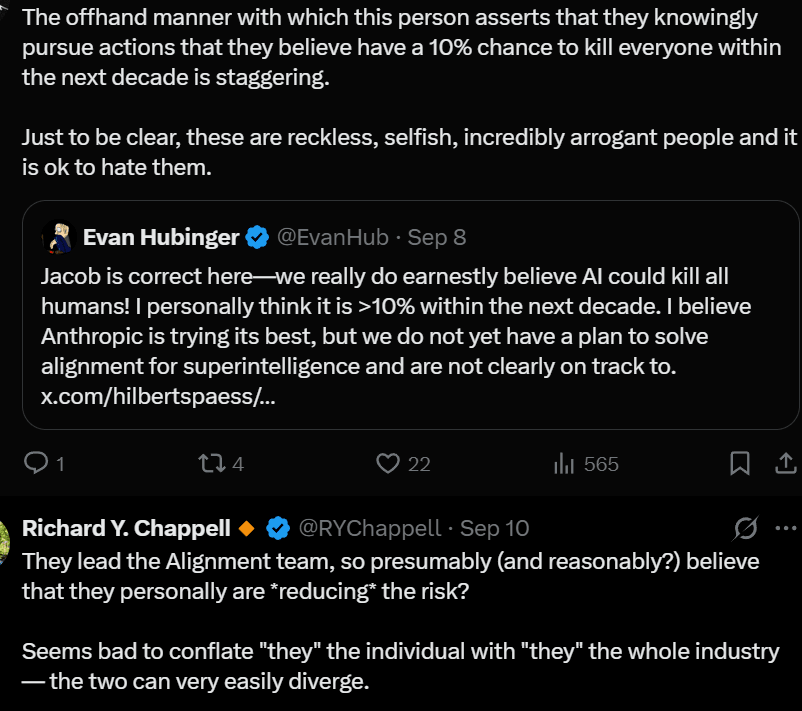
In each case, it’s not difficult to discern that the critic has fallen far short of justifying their insults or establishing their target to be blameworthy. Professional philosophers, of all people, ought to be better at reasoning than this. So I take that to indicate insufficient concern for whether their hostility is actually warranted.
Of course, “Internet denizen angry, reasons poorly” is not exactly a newsworthy headline. I don’t think any of the above examples are particularly unusual or involve worse behavior than the typical internet user indulges in.[3] Transparently bad reasoning is, alas, commonplace. But I do find it especially disappointing to see philosophers indulging in it, and would like to encourage better norms if possible. If anyone has ideas for how to achieve that goal (besides simply highlighting its desirability as this post does), I’m all ears.
- ^
On the distinction between warrant and value, see Consequentialism Beyond Action. While it’s possible for the two to come apart, taking them to be more likely correlated seems like a reasonable default assumption.
- ^
I think I’m usually pretty careful to criticize ideas rather than people, though I have made deliberate exceptions for Alice Crary and Leif Wenar, both of whom have expressed striking hostility towards effective altruists and explicitly discouraged the general public from donating to effective charities for reasons that I’ve argued are deeply unreasonable and callously indifferent to the lives that could be lost as a result of their actions. Readers are, of course, welcome to dispute my arguments if they think my targets are more reasonable than I’ve made out.
- ^
This is part of why I’ve anonymized my presentation of the examples.