55% of the US public is now aware of AI xrisk
By Otto @ 2026-09-16T17:34 (+5)
(This post is a crosspost from LessWrong and an update from a previous one here.)
The Existential Risk Observatory has been interested in public awareness of AI existential risk since its inception over five years ago. We started surveying public awareness in December 2022, including by asking the following open question:
"Please list three events, in order of probability (from most to least probable), that you believe could potentially cause human extinction within the next 100 years."
If respondents would include AI or similar terms in their top-3 extinction risks ("robots" or "computers" count, "technology" doesn't), we counted them as aware, if not, as unaware. The aim of this methodology was to see how many people would spontaneously, without getting led by the question, connect the concepts of human extinction and AI. We used Prolific to find participants, n=300, and we only included US inhabitants over eightteen years old and fluent in English.
In the four surveys we ran, we obtained 7% (Dec '22), 12% (Apr '23), 15% (Apr '24), 24% (Dec '25), 34% (Aug '26), and, today, 55%. In a graph, that looks like this.
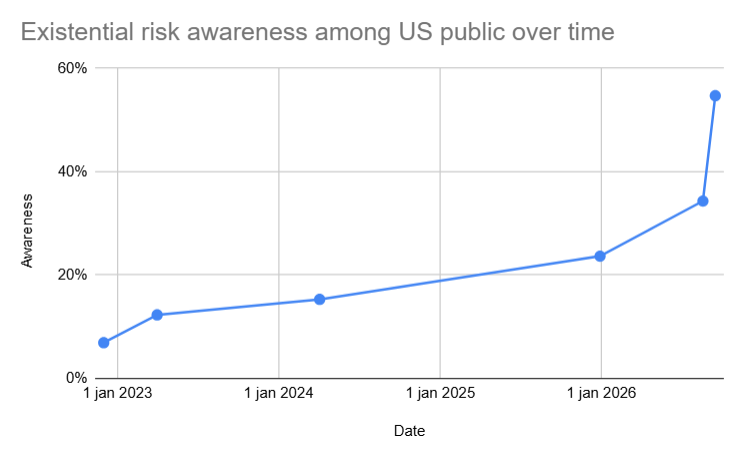
The usual caveats apply: ours is a rough measurement method, and from participants' answers to our open questions, we see that not every participant takes all our questions seriously, and that some answers are obviously self-inconsistent. Therefore, I don't think the 55% by itself is a very meaningful number.
However, I do think we can draw the conclusions:
- We clearly reached a tipping point: the speed of awareness increase was a lot faster the last four weeks on average, than it has ever been before. This seems clearly driven by the resignation of Jacob Coxon from Anthropic, and the preparatory work that the Hugging Face incident did before that (we did not research this).
- Policy is driven by awareness: the serious discussions we are now seeing about global AI slowdowns and even the pause are not coincidentally happening at the exact same time when public awareness is reaching its tipping point. Therefore, if we want this regulation to be implemented, increasing awareness even further ('saturating the awareness benchmark') seems a sensible strategy.
We would expect the S-curve to continue rising until we are close to saturation, although the speed may depend on AI technical progress, proliferation, warning shots, and other incidents.
If one is interested in the data, do reach out.