Vegans are down... animals are up...?
By Taj Uppal @ 2025-12-09T21:36 (+5)
How the animal rights movement is gaining, even though everyone still eats meat
Introduction
Veganism has weathered its fair share of hit pieces this year. The Atlantic reported that “plant-based eating has lost its appeal”; the Financial Times declared “the vegans lost”; and even the environmentally-conscious The Guardian acknowledged that “vegan burgers are losing the US culture war.”
Unfortunately, the hit pieces are right… veganism is failing. Despite the proliferation of vegan-options, vegan-ism has never cracked more than 3 % of the U.S. population. On a per person basis, Americans are eating more animals than ever before.
The average American ingests a disturbing, 260 pounds of meat—more than 100 individual animals—per year. This number has steadily risen since the ‘60s.
This really sucks for the animals who are being eaten, but there is a silver lining. While the hit pieces are correct in assessing veganism, they fail to see that its underlying belief system—animal rights—is more popular than at any time in American history.
I know that might sound crazy. “If animal rights is so popular,” you might ask, “then why is everyone still eating meat?” In short, these split trajectories are possible because buying is not believing.
Allow me to explain…
I. Buying is not believing
Consider your last trip to the grocery store. Did you calculate the carbon emissions of your milk carton? Did you make sure your bananas were ethically sourced? Did you research your eggs’ animal welfare standards?
If you’re like most consumers, the answer is a resounding NO! Our food choices, and our consumer choices more broadly, are rarely a function of carefully reasoned, moral preferences. Rather, they are a reflection of simpler concerns such as, “Hmm… I could really go for some beef jerky right now.” Or, perhaps, “Soy beans are gay.” In other words, immediate concerns such as taste, price, convenience, and culture do far more to determine our food choices than far-off concerns like morality.[1] Thus, it would be a mistake to infer that meat-eaters never support animal rights. To the contrary, the omnivore’s purchase of boneless chicken breasts has far more to do with his circumstances than his moral preferences. Indeed, buying is not believing. Purchasing chicken is no more an endorsement of animal cruelty than purchasing Nike’s is an endorsement of sweatshops.
II. Animals are up
Once we acknowledge this disconnect between buying and believing, it is easier to see how veganism (a consumer boycott) might diverge from animal rights (a moral worldview). Indeed, this divergence describes our world today—a world where animal rights is measurably rising in popularity. Below, I share evidence from three key domains—political ballot initiatives, public opinion polling, and elite endorsement of animal rights—to show that this is so.
(A) Political Ballot Initiatives.
Political ballot initiatives are a great way to observe the buying-believing gap. By transforming what is typically an individual, consumer decision (“Should I buy cage-free eggs?”) into a collective, moral decision (“Should we ban caged eggs?”), ballot initiatives expose the gap between consumer behaviors and moral beliefs. Through two decades of these pro-animal ballot initiatives, it is clear that people are sometimes willing to collectively ban the products they individually buy.
Take California’s Proposition 12, for example. Perhaps the strongest animal welfare law of this century, Prop 12 banned the caged confinement of egg-laying hens, passing with a strong, 62 % majority. Now, take a guess… prior to California’s vote on Prop 12, did a corresponding 62 % of consumers actually buy cage-free eggs? NO! In fact, cage-free eggs only made up about 14 % of California’s egg market. That means roughly 48 % of consumers approved the ban of a product they once bought!
Similar stories can be told of pro-animal initiatives in Arizona, Florida, and Massachusetts. In fact, state bans on the intensive confinement of farmed animals are now an undefeated, 5-0 when presented to voters at the ballot box. These successes reveal a much larger base than the ~5 % vegetarian population, and they provide a launching pad for more ambitious reforms in the future.[2]
(B) Public Opinion Polling.
We don’t have a lot of polling to measure the public’s support of animal rights over time. But, conveniently, Gallup has been asking one, animal rights-related question for 25 years! In its survey on “Acceptance of Moral and Values Behaviors” Gallup asks a bunch of questions about polarized moral issues like abortion, assisted suicide, and, yes, animal testing.
The question pertaining to animal testing asks, straightforwardly, whether medical testing on animals is “morally acceptable or morally wrong.” In 2001, 65 % of Americans said animal testing was morally acceptable. But by 2025, that number has steadily dropped to 47 %.
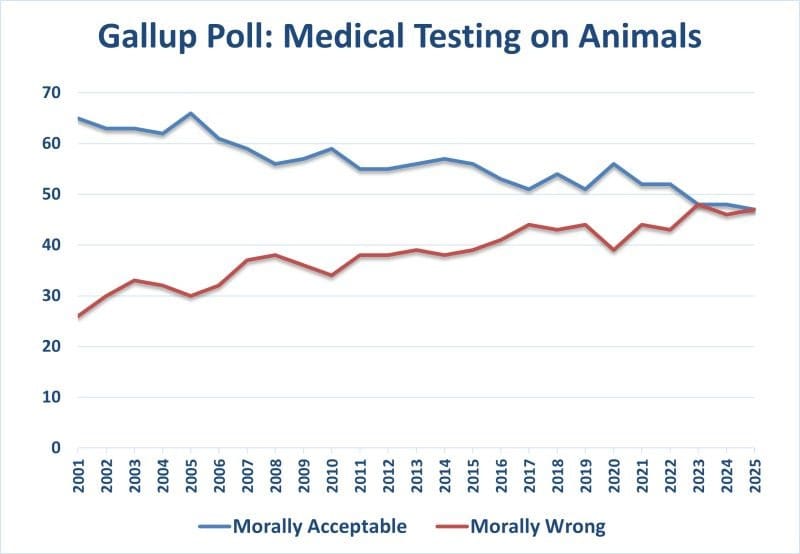
Admittedly, this is just one poll, and it pertains to animals in research, not food. (Unfortunately, we don’t have this kind of polling in the food context.)[3] Still, the poll demonstrates that it is possible to increasingly devour animals in one context WHILE increasingly respecting them in another.
(C) Elite Endorsement.
Onto the last category of evidence: elite endorsement. When we look to the “elite” sectors of society—public intellectuals, academia, politics—it is clear that the moral validity of animal rights (or, at least, the moral atrocity of factory farming) is increasingly recognized.
Here are a few prominent intellectuals who have endorsed animal rights (or condemned factory farming). For philosopher kings and queens we have Peter Singer, Richard Dawkins, Martha Nussbaum, and Yuval Noah Harari. For lefty intellectuals we have Angela Davis, Ta-Nehisi Coates, Ezra Klein, and Jane Goodall. And, for prominent conservatives, we have RFK Jr., Vivek Ramaswamy, and Mr. Joe Rogan himself. Basically, anyone who seriously thinks about factory farming comes to the conclusion that it is very, very wrong.
This increased recognition is also found within academic institutions. For example, in the legal field, animal law was only offered at nine law schools in the year 2000. Today, however, it has expanded to over 150 law schools, including 13 of the 14 top-ranked law schools. Similarly, philosophy departments have seen an explosion in animal ethics courses since the 1980s.
Finally, within the realm of state politics, there has been a significant increase in the number of farmed animal welfare laws. In the year 2000, zero such laws existed. But today, there are 44 of these laws across 18 states.[4]
III. My prediction: The sprouts will surface
Dr. King once compared injustice to a boil. Like a boil, injustice will persist so long as it remains covered. It is only when injustice is exposed “with all its ugliness to the natural medicines of air and light” that it can be cured.
I’m not sure this analogy is medically accurate, so let’s imagine some vegan sprouts instead. Like a sprout, the animal rights movement slowly germinates beneath the surface, extending its roots, yet remaining invisible to observers. It is only when the sprout breaks the surface that its full force is suddenly unleashed, visible to the world.
The sprout represents our world today. While our movement’s progress is obscured by carnivorous, consumer patterns, its roots continue to unravel across the moral landscape. Soon enough, these roots will break the surface of complacency and cognitive dissonance, and animal agriculture will fall alongside it. Institutionalized animal abuse is simply untenable in a world that increasingly recognizes its evil.
Like other social issues, our ultimate policy victories—factory farm bans, slaughterhouse phase-outs, legal rights for animals—will lag behind the shift in public opinion. Specifically, I predict that the trajectory will look something like this:[5]
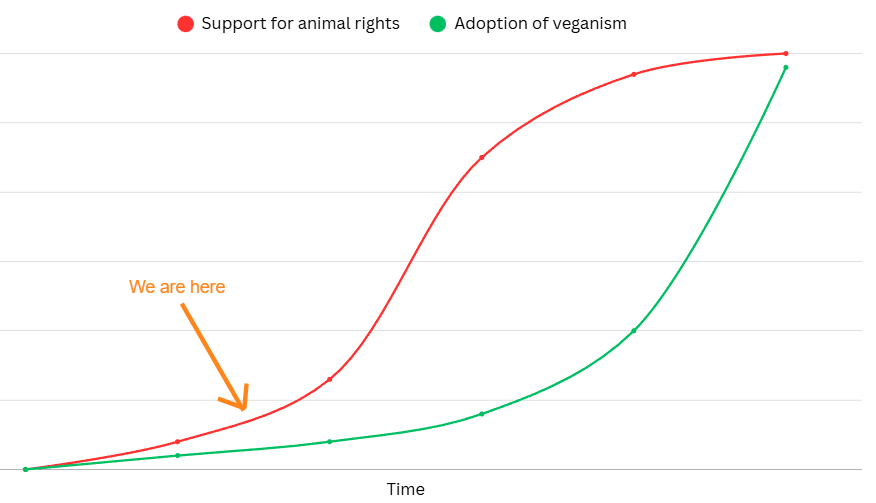
The million-dollar question is, of course, where are we on the timeline? This is, candidly, just a vibes-check at this point, but I’ve marked on the graph where I believe we are at this point in time—a position where animal rights is gradually rising in prominence, one to two decades prior to the explosion of our social movement.
If I’m wrong, well, there’s only trillions of animals, and an unfathomable scale of suffering on the line. So, let’s make sure it comes true, I guess!
- ^
Unless, of course, you’re one of those self-righteous vegans.
- ^
Unfortunately, however, the more ambitious (and more disruptive) reforms have not yet received the same success. In Sonoma County, California, a proposed factory farm ban received only 15 % of the vote. And, in Denver, Colorado, a proposed slaughterhouse ban received 36 % of the vote. These results show that America is not ready to embrace animal rights in its entirety.
Still, the buying-believing gaps remain cause for hope. In Denver, for example, about 1 in 3 omnivores voted to ban slaughterhouses within the city limits!
- ^
None of the farmed animal polling spans decades like Gallup’s. The best we have is probably an ASPCA poll that found 74 % of Americans support a ban on new factory farms; a Sentience Institute poll that found 53 % of Americans support a ban on all factory farms; and a Rethink Priorities poll that found 16 % of Americans support a ban on slaughterhouses.
- ^
Unfortunately, these laws are seldom enforced.
- ^
Importantly, the veganization of our food system will not be driven by consumers going vegan, one by one. Instead, veganization will be a collective transition driven by social movements and government policy.