The Infrastructure Gap: A Better Model – Trust-Based Philanthropy with VC Standards (Part 3 of 3)
By Deena Englander, Freddy from Germany 🔸 ✳️ @ 2026-05-27T20:57 (+5)
Where we are in the series
In Part 1, we made the case that operational infrastructure is the variable that determines whether nonprofit funding produces real impact, and that closing the infrastructure gap is a shared responsibility between funders and nonprofits. In Part 2, we looked at how the two dominant funding models leave impact on the table and what philanthropy could learn from venture capital's approach to operational achievement.
Now we get to the question that matters most: what does a better model look like, and how do we build it?
VI. The Partnership Model – Combining the Best of Both Worlds
So, what does a better model look like?
Not solely restricted to grantmaking, with its rigid controls and starvation-level overhead. And not trust-based philanthropy taken to the extreme, where funders step back so far that they stop engaging with whether their investment is succeeding. The truth is that trust-based philanthropy has the right instincts: respect for nonprofit expertise, flexibility, decreased administrative burden, and partnership. It’s the direction the sector should be heading. But trust without structure leaves too much to chance, and the organizations that need support the most are the ones least equipped to succeed without it.
The better model is simple to name, even if it’s harder to build: trust-based philanthropy with venture capital standards. Take the values of trust-based philanthropy – the respect, the flexibility, the partnership – and pair them with the operational rigor that makes venture capital such an effective investment model. Trust the leaders. Respect their expertise. Give them flexibility. And then do what any serious investor does: make sure they have what they need to succeed, stay engaged throughout the relationship, and treat their success as your responsibility too.
That means operating on trust, but earning that trust. It means delivering flexibility within a structure that ensures organizations have what they need to use it well. It means respecting nonprofit expertise while recognizing that mission expertise doesn’t automatically translate into running an organization.
What a healthy funding partnership looks like
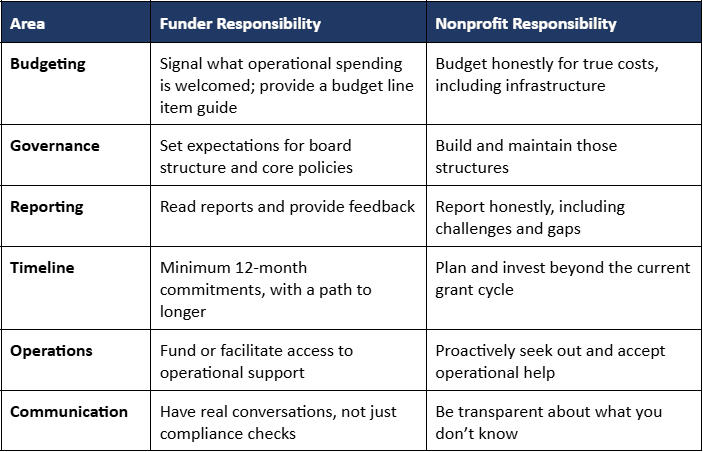
The table below outlines baseline expectations for a strong funding partnership. This is a starting point for both sides to understand what they’re responsible for and what they should expect from each other.
For funders: specific, implementable steps
- Provide a budget expectations guide. Give applicants a clear picture of what you want to see in their budgets: staff compensation at competitive rates; professional services (bookkeeping, legal, HR); technology and training; insurance; compliance costs; and overhead in the 25-30% range. When you name these things specifically, you give nonprofits permission to include them.
- Commit to a minimum of 12-month funding cycles. Most project grants run 6 months or less, which forces organizations into constant survival mode. A 12-month minimum gives organizations enough runway to plan, execute, and hire well. For grantees with a track record, extend it to 24 months or longer as trust is established.
- Be specific about what operational spending is welcome. Don’t just say “we fund overhead.” Tell applicants exactly what you want to see. Training. Professional services. Technology implementation. Succession planning. Fractional operational expertise. The more detailed you are, the more confident your grantees will be about including these items in their budgets.
- Read the reports you require. If you’re going to ask for reporting, commit to interacting with it. Flag concerns early. Ask follow-up questions. Connect the organization with resources when you see a gap. Reporting should build the relationship.
- Consider funding shared service providers or a capacity-building fund. Funding one service provider who supports ten organizations is often a better investment than giving each of those organizations a slightly larger grant and hoping they figure out operations on their own. A dedicated capacity-building fund that grantees can access as needed is the philanthropic equivalent of a VC platform team, and it's the highest-leverage addition most funders can make. Fiscal sponsorship programs that pair financial infrastructure with operational coaching are another high-leverage option, particularly for funders investing in early-stage organizations that need more than money to establish their footing. WorkStream is launching one such program in September.
For nonprofits: specific, implementable steps
- Have your budget reviewed by someone with operational experience before submitting it. Specifically examine commonly missed line items: payroll taxes and benefits beyond base salary (typically 15-25% on top of salary); multi-state compliance costs if you have remote employees; fiscal sponsorship fees if applicable; professional services (bookkeeping, legal, financial review or audit); technology costs including implementation and training, not just licenses; insurance (D&O, general liability, workers comp); and a realistic line item for unexpected costs. Budget Template
- Build a basic strategic plan. Even a one-page version with your top 3 priorities, measurable goals, and a 12-month roadmap is far better than operating reactively. Without this, every new dollar is spent on whatever feels most urgent, not on what will have the greatest impact.
- Write down your core policies. At minimum: fiscal management, conflict of interest, and basic HR policies. These aren’t bureaucratic exercises. They protect your organization, your team, and your mission when things get hard.
- Identify your biggest operational bottleneck and address it prior to scaling programs. If you grow your programs without building the operational capacity to support them, you'll break what's working. Fix the bottleneck first. If you don't know where to start, an outside assessment can surface the constraints you can't see from inside the day-to-day. WorkStream's GRIP program uses 10 Growth Readiness Indicators to identify the three highest-impact changes your organization needs prior to scaling.
- Be transparent with funders about what you don’t know. Telling a funder, “We don’t have a succession plan, and we need help building one,” builds more trust than showing only what you do know. Funders who are serious about partnership will respond with support.
What they build together
The strongest funding relationships aren’t transactional, but ongoing partnerships where both sides are invested in the same outcome. That looks like:
- Regular conversations, not just reports. Continuous dialogue about what’s working, what isn’t, and what the organization needs. These need to feel like a strategic partnership rather than performance reviews.
- Shared accountability for outcomes. Both parties invested in the same goal, and both are taking responsibility for creating the conditions that produce results.
- Access to a capacity-building ecosystem. Fractional expertise, peer learning cohorts, shared service providers, and dedicated capacity-building funds that organizations can draw on as needed.
- Graduated trust over time. Organizations that demonstrate operational maturity earn lighter reporting, lengthier timelines, and greater flexibility. This creates a positive cycle – the opposite of the starvation cycle – where investment in operations leads to better results, which in turn build trust, permitting more flexible funding, which in turn supports more operational investment.
On the question of burden
Yes, this model asks more of funders than writing a check and walking away. But it doesn’t ask as much as it might sound. A budget checklist is a one-time creation that can be reused across an entire portfolio. Connecting grantees to service providers is a relationship. A dedicated capacity-building fund is a structural decision, not an ongoing administrative burden.
And the return on that investment, more stable grantees, better outcomes, less wasted funding, lower risk, far exceeds the cost.
The VC world figured this out a long time ago. Investing in portfolio support isn’t an expense. It’s a multiplier.
VII. The Payoff – Return on Impact
Let’s come back to where we started: every funder wants maximum return on impact. Every nonprofit leader wants to deliver it. The gap between those two desires and the existing reality is the space this series has been trying to name and close.
Here’s what it looks like when the partnership works.
For nonprofits:
- Operating from stability instead of survival
- Leaders focused on maximizing mission impact instead of patching operational holes.
- Programs that scale because the infrastructure beneath them is strong enough to support growth
- Staff are paid competitively, staying longer, and building institutional knowledge.
- Financial systems that catch problems early, before they become crises
- Strategic judgments made proactively with data, not reactively in the dark
For funders:
- Dollars are going further because funded programs actually deliver on their promise.
- Less wasted investment and fewer organizations collapsing from preventable failures
- Lower risk exposure from compliance gaps and governance blind spots
- Grantees who improve with each funding cycle instead of running in place
For the mission:
The animals rescued, the communities strengthened, the movements advanced, the research completed – all of it happens at a higher level because the organizations doing the work have what they need to do it well. None of this requires more money in the sector, but it does require smarter investment of the money that’s already there.
- We’re not asking funders to become program officers in a hundred different cause areas. We’re asking them to recognize that operational capacity is the lever that determines how far every other investment goes and to treat it accordingly.
- We’re not asking nonprofit leaders to become operations experts. We’re asking them to budget honestly, seek out support before a crisis hits, and stop treating infrastructure as something to apologize for.
- We’re asking everyone in the sector to stop pretending that trustworthiness and accountability stand as opposites. They’re not. The strongest funding partnerships have both, and are built on honest conversation, realistic expectations, and mutual investment in the conditions that produce impact.
We’re not handing out cars to people without driver’s ed. We’re giving them the keys, the training, and the road map they need to make the journey well. Because we all want them to arrive.
Closing thoughts
The infrastructure gap isn’t a permanent feature of the philanthropic sector. It’s a pattern, and patterns can change. The funders who recognize this and build operational support into their grantmaking will see their dollars go further. The nonprofits that recognize this and invest in their own operational foundations will deliver greater impact, weather more storms, and build organizations that last.
This series has been a long argument for a simple idea: operational capacity is the lever. It determines how far every other investment goes. And it’s the one lever that almost nobody is pulling hard enough.
If you’re a funder reading this, the question isn’t whether to make operational support part of your grantmaking. It’s how. Start small if you need to: a budget guide, a service-provider relationship, or a conversation with one grantee about what they need. But start.
If you’re a nonprofit leader reading this, the question isn’t whether to invest in your own operational foundations. It’s where to start. Pick the biggest bottleneck. Find one piece of infrastructure to strengthen this quarter. Have one honest conversation with a funder about what you need.
The infrastructure gap closes one decision at a time. Both sides have decisions to make.
About WorkStream Nonprofit
WorkStream Nonprofit exists to bridge the gap between what funders provide and what organizations need to turn that funding into sustainable impact. Through our Growth Readiness Improvement Program (GRIP), operations accelerator, fractional operations services, and free educational resources, we help small and grassroots nonprofits build the operational infrastructure that makes their missions possible – and we work with funders who want to pair their grantmaking with the capacity-building support their grantees need to succeed.