Is Gradual Disempowerment on the radar of the Abrahamic religions?
By David Leech, Alexandra Cheung @ 2026-09-23T14:14 (+6)
Summary
Christian, Jewish and Muslim leaders and institutions have started to make authoritative religious statements about advanced AI threats. However, it remains unclear whether they recognize the catastrophic risk scenario of Gradual Disempowerment (GD), where AI slowly erodes human agency, decision-making, and control (Kulveit et al., 2025). Exploring the current positions of religious institutions reveals potential gaps in their understanding of catastrophic risks, carrying important implications for AI policy, governance, and coalition building. Religious traditions are very significant shapers of cultural norms and could be powerful agents in reducing AI risk.
Why care about religious leaders and AI governance?
The institutional positions of religious leaders have historically exercised cultural and political influence that goes beyond their own religious communities and affects policy and governance, for instance:
● Demanding state intervention: Pope Leo XIII’s 1891 encyclical Rerum Novarum established a theological defense of worker rights, directly calling for state action to protect workers, including through laws enforcing maximum working hours and mandatory rest days.
● Setting limits to the application of new technologies: Within months of Dolly the Sheep’s cloning in 1997, Catholic and Islamic authorities established moral limits against human cloning alongside wider international moves to establish restrictions.
● Shaping medical practice: In 1986 the OIC Fiqh Academy and Israel’s Chief Rabbinate determined that brain death constitutes death. These rulings have informed practice around organ transplantation.
● Guiding economic decisions: When the OIC Islamic Fiqh Academy ruled in 1985 that modern bank interest is forbidden under Islamic law, it gave powerful authority to the turn away from interest-based banking in favour of the Islamic finance sector.
To what extent are global religious leaders aware of Gradual Disempowerment, and where does it currently feature in their risk perception?
We have carried out a first pass survey of how authoritative religious statements from within the Abrahamic religions engage (or not) with the Gradual Disempowerment (GD) threat.
We have read the most authoritative religious statements we could find, and have asked the following question: to what extent does one specific AI-related concern, gradual human disempowerment (GD) in the sense defined by Kulveit et al. (2025), show up in them?
Kulveit et al. define GD as an impersonal drift-like process, distinct from the power concentration, deliberate misuse, and autonomous misalignment scenarios, by which the three key societal systems of the economy, culture, and states could become gradually misaligned with human interests. GD is not driven by bad actors or the result of autonomous AI misalignment, but instead represents a ‘boiling the frog’ scenario which may result in a range of negative outcomes on a par with those which could result from the more familiar threat models.
In short, we did not find evidence that GD shows up strongly in these statements. Sometimes this is because the statements were more narrowly focussed on other threats and we should therefore not expect discussion of GD. Where it does show up – and it was most pronounced in the Orthodox and Catholic sources – we rarely find discussion of mechanisms by which GD may occur. Again, this should probably be unsurprising, given the purposes of the statements. That said, the concept of GD seems to be present, at least in several of the sources, even where it is not explicitly articulated, and we predict that future statements of the Abrahamic religions on advanced AI threats will likely address the GD threat more explicitly.
GD passages were difficult to identify with confidence. This was mostly due to the fact that mentions of harmful developments rarely disambiguated between when these were driven by bad actors – this would make them a case of power concentration or deliberate misuse – and when they represent impersonal drift (GD developments in the proper sense). (Autonomous misalignment was much more rarely discussed.) This meant that many passages were open to multiple readings. On a final manual check, we also excluded a fairly large set of passages from the Catholic sources concerning critiques of trans-/post-humanism which seemed to assume human steerage rather than drift. After this final check, GD extracts comprised only ~0.7% of the ~1790 passages we coded if we counted only those extracts which were unambiguously GD, and this rose to ~5% when we counted extracts which were plausibly interpreted as GD but also admitted of other readings. Either way, concern with GD appears fairly marginal in this set of authoritative religious statements overall compared to power concentration and AI misuse threat models.
Note: we have restricted our analysis to the major Abrahamic religions (Judaism, Christianity, Islam), but it could also be extended to the other major world religious traditions.
Methodology
To evaluate how religious statements engage with AI risks, we adopted a sequential qualitative-to-quantitative mixed-methods design across primary authoritative texts spanning Catholic, Protestant, Islamic, Jewish, and Eastern Orthodox traditions. Non-Abrahamic traditions were excluded due to structural differences in institutional authority.
- Extraction & Unitization (N = 1790): Texts were segmented into standardized data extracts using explicit word limits and rhetorical-shift rules to isolate individual arguments, claims, and justifications.
- Coding Schema: Claims were mapped using a multi-level taxonomy adapting secular AI safety frameworks (Kulveit et al.) to religious discourse. The schema spans 5 Macro-Domains (D1–D5), 6 Argumentative Moves (M1–M6), 5 Risk-Vector categories (including Gradual Disempowerment), 22 Policy sub-codes across 5 domains, and structural flags capturing mechanism presence, religious authority level and target stakeholders.
- Two-Phase Human-in-the-Loop Verification: Initial broad-recall extraction and classification were assisted by an LLM prompted with a frozen codebook. To ensure high precision and eliminate false positives, every extract underwent a complete manual verification pass by the research team.
We used a sequential mixed-methods design, analyzing 15 primary institutional statements across 5 major Abrahamic traditions (N = 1790 extracts). To ensure analytical rigor without relying solely on unvalidated LLM outputs, we implemented a hybrid human-in-the-loop pipeline:
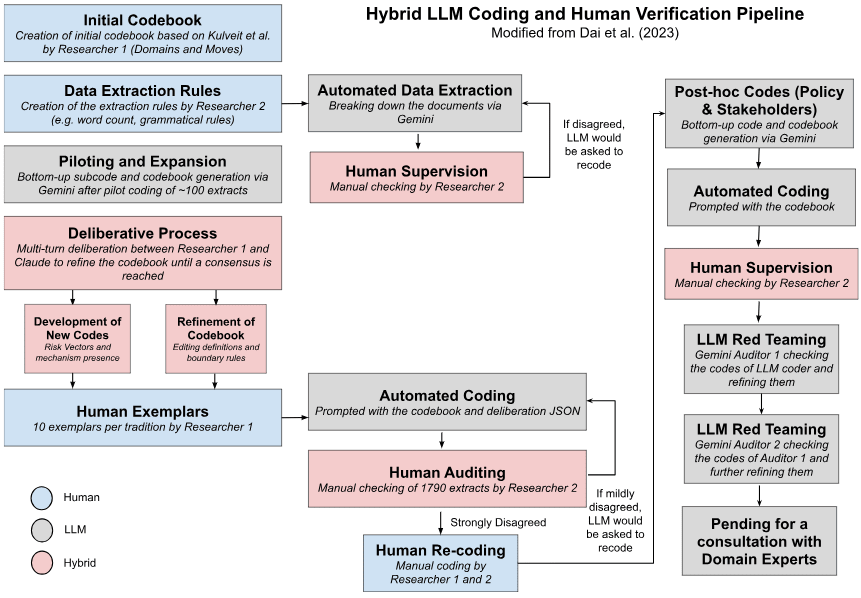
Note: The post-hoc codes (including stakeholders and policies) were excluded from the analysis while waiting for consulting policy experts
The full methodology, document authority metadata, variable taxonomy, and key deliberative decisions are available on [Link].
Findings
Judaism
Around 19.0% of Jewish extracts discuss AI risks. Among the extracts that address AI risks, the primary topics break down as follows:
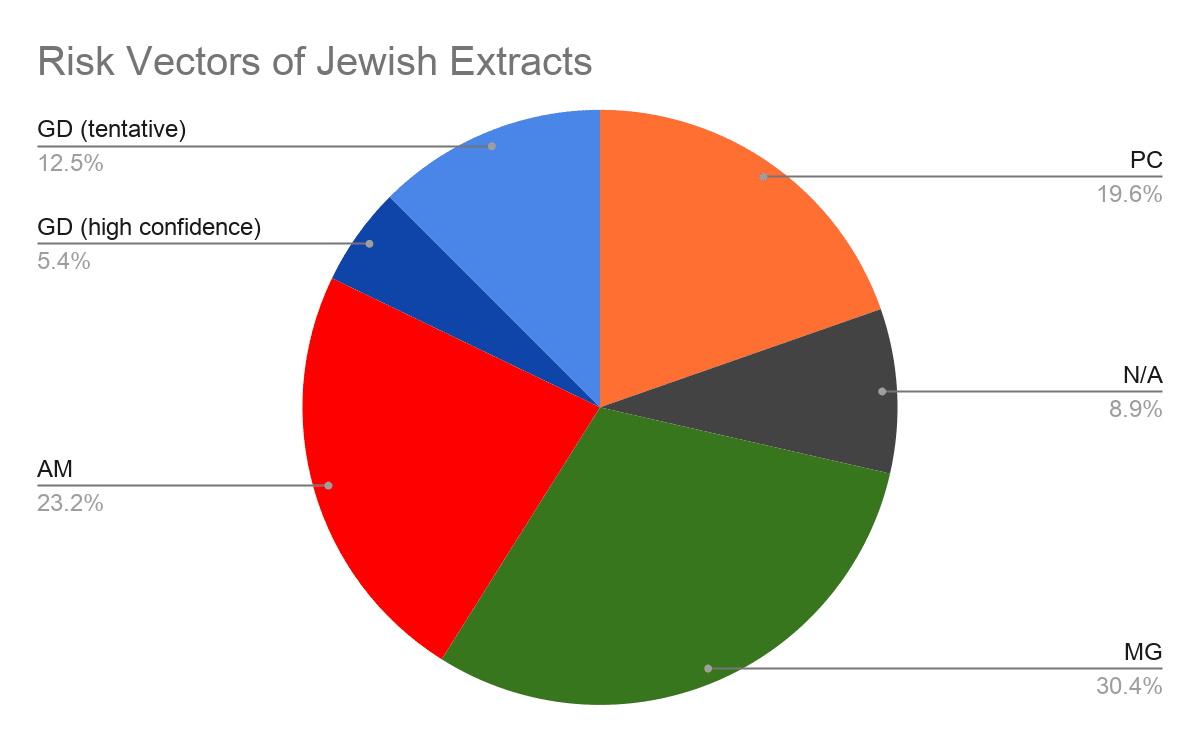
Note: GD = Gradual Disempowerment; PC = Power Concentration; AM = Autonomous Misalignment; MG = Misuse/General Ethics; N/A = No AI threat asserted
Within the Jewish extracts coded as GD - high confidence or GD - tentative[1], 90.0% contained no causal mechanisms, 10.0% mentioned causal mechanisms, while 0.0% were not assessed.
The two authoritative sources we read for Judaism are juridical responsa, one representing Conservative Judaism, Daniel Nevins’ ‘Halakhic Responses to Artificial Intelligence and Autonomous Machines’ (2019), issued by the Committee on Jewish Law and Standards (CJLS); the other a Reform Jewish Responsum 5784.2, "Artificial Intelligence and Authorship" (2025) on legitimate use of AI in authorship, issued by the Central Conference of American Rabbis (CCAR).
Jewish authority structures are decentralised. As Kalman (2024) observes, anybody with a strong understanding of Jewish law can seek to speak with authority on the topic (they do not need to be recognised as a religious leader).[2]
The limited existing literature on Judaism and AI emphasises that the debate has not yet matured, or has barely even started, and it is difficult to predict how it will develop. Kalman notes that ‘neither Jews or Jewish thought really know what they think about AI just yet [and] ‘the’ AI conversation is in fact non-existent’ (p.70).
The register of existing Jewish authoritative engagements with advanced AI is juridical, and is expressed in terms of Jewish law (halakhah). The two authoritative sources we read are focused on Jews and Jewish obligations in particular rather than humans in general – for instance, whether a Jew can use an agential AI to do work for them on Shabbat (this is similar to the Islam sources too, see below). Jewish law is almost entirely concerned with the moral intentions and actions of individuals rather than with states and corporations. This also sets limits to the extent to which we can expect Jewish legal sources to take positions on what should be done at the level of states and corporations to mitigate GD (p.76).
The sources also look for Jewish legal precedents concerning erstwhile new technologies (for instance, the acceptable use of waterwheels on Shabbat, as there is no scriptural precedent). They mostly display a concern with whether Jews are responsible for, and can be held liable for, the actions of AIs; and the moral limits of delegation of human work to AI, e.g. in the case of autonomously driving cars or the use of lethal weapons. In fact there are few passages in these two authoritative Jewish sources which engage GD in an unambiguous way.
CCAR is engaged very specifically with the question of whether a rabbi may take direct credit for AI-generated work (poetry as part of minyan). This falls under AI ethics and unsurprisingly, no GD passages were identified.
CJLS contains some passages which are tangentially GD related, but again, concern with GD is quite indirect. Nevins expresses the concern that ‘the border between “natural” and “artificial” intelligence is eroding...[h]umans depend upon artificial intelligence for a bewildering array of activities’ (p.3). This can be interpreted as an instance of GD; however, it is discussed in the context of a need to integrate moral reasoning into AIs rather than of a concern that humans will become disempowered in a gradual boiling-a-frog way.
The following passage is more GD adjacent, even if it is not identified in GD terms explicitly: ‘Given that computers can process some data sets far faster than humans can, the temptation is great to move people out of the decision‐making loop…This would lead to a fully autonomous system, even if humans continue to set goals and review results.’ (p.5). Similarly, Nevins refers with concern to ‘trends in advanced economies to rely on such systems in place of humans, whose assistance may be costlier, less readily available, and perhaps less reliable.’
Islam
Around 40.6% of Islamic extracts discuss AI risks. Among the extracts that address AI risks, the primary topics break down as follows:
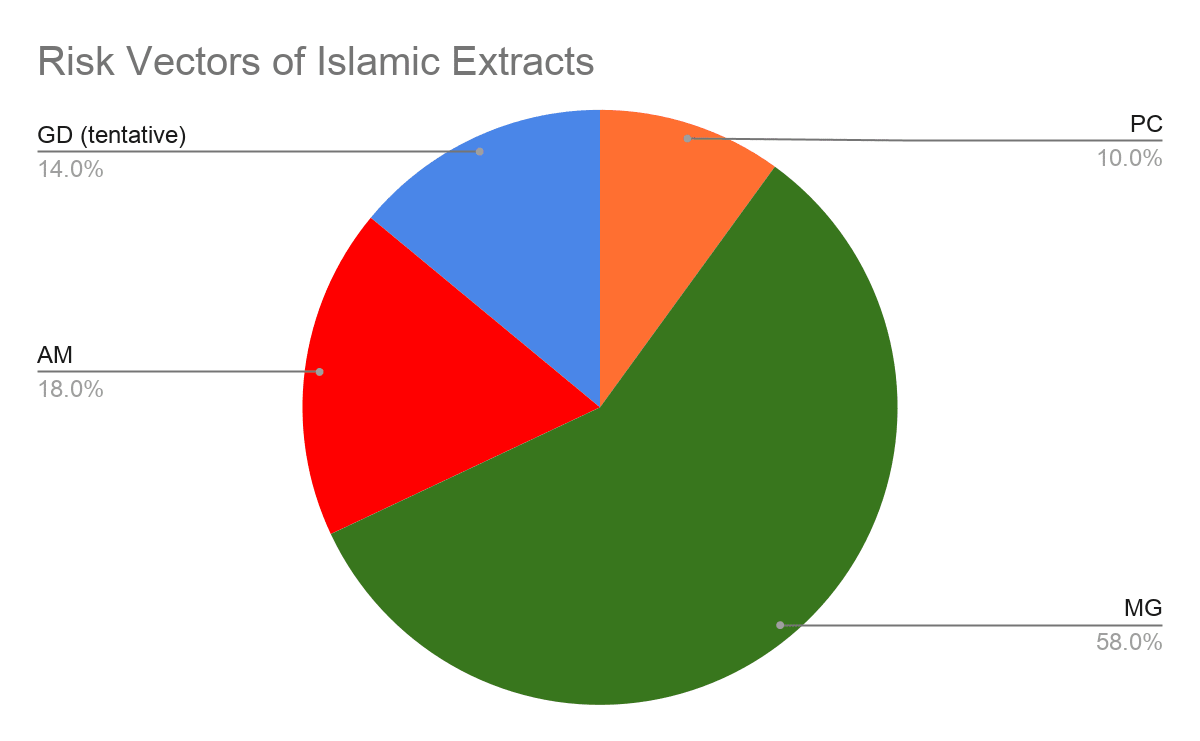
Note: GD = Gradual Disempowerment; PC = Power Concentration; AM = Autonomous Misalignment; MG = Misuse/General Ethics; N/A = No AI threat asserted
Within the Islamic extracts coded as GD - high confidence or GD - tentative, 85.7% contained no causal mechanisms, 14.3% mentioned causal mechanisms, while 0.0% were not assessed.
Islamic religious authority structures are also quite decentralised compared to e.g Catholic Christianity. The two genuinely authoritative sources we read are juridical: a Dar al-Ifta fatwa (2025) and an International Islamic Fiqh Academy resolution (2025). Like the Jewish responsa, they are narrowly focussed on specific issues, and neither engages GD directly.
The Dar al-Ifta fatwa states that it is impermissible in Islamic law to rely on AIs to obtain a fatwa, noting only that no current AIs have achieved the relevant competences for issuing fatwas, and do not have a mufti’s qualifications for doing so. The fatwa rules that only humans, not AIs, can issue fatwas, but on competence grounds rather than out of concern for gradual disempowerment. The Fiqh Academy resolution rules in general terms that AI use is permissible provided it is used for good ends, but does not address GD.
Given the absence of references to GD in these, we also read the Riyadh Charter, an Islamic-world intergovernmental charter issued in 2024 by the Islamic World Educational, Scientific and Cultural Organisation (ICESCO) and the Saudi Data and Artificial Intelligence Authority (SDAIA). This is not a religiously authoritative source itself but it is widely recognised and was a source for the Fiqh Academy 2025 ruling.
The Riyadh Charter implicitly expresses concern about GD; for instance, it signals concern about the increasing reliance on AI from a young age, plausibly stunting a range of human capabilities and leading to diminished human agency. The charter also states that AI solutions should only be used when they are ‘relevant and … cannot be achieved by human or low tech means’, or when human involvement is not ‘essential to the task’ (III,1, p. 20). This, in the form of a prohibition, implicitly expresses a concern about gradual replacement of human labour. The charter furthermore insists that AI must not replace human authority or ‘reduc[e] the ability of humans to determine their own lives and collective destinies’ (II, 2, p.16); and it should always ‘collaborate with humans rather than replace them on socially important tasks’ (II, 4, p.17). It also issues this warning:
‘[w]e should be careful that the development of AI systems does not undermine the capacity of the preservation of essential social relations providing the context of human flourishing, the political institutions providing its stability, the traditions and cultural heritage defining its identity’ (I, 2, p.14).
Given the lack of reference to bad actors, it seems more natural to read this as a GD warning.
Nevertheless, the presence of concern about GD is more implicit than explicit in the charter as a whole, and cannot always be cleanly distinguished from adjacent AI threat categories. Also, the charter does not discuss possible GD mechanisms.
Orthodox Christianity
Around 48.0% of Orthodox extracts discuss AI risks. Among the extracts that address AI risks, the primary topics break down as follows:
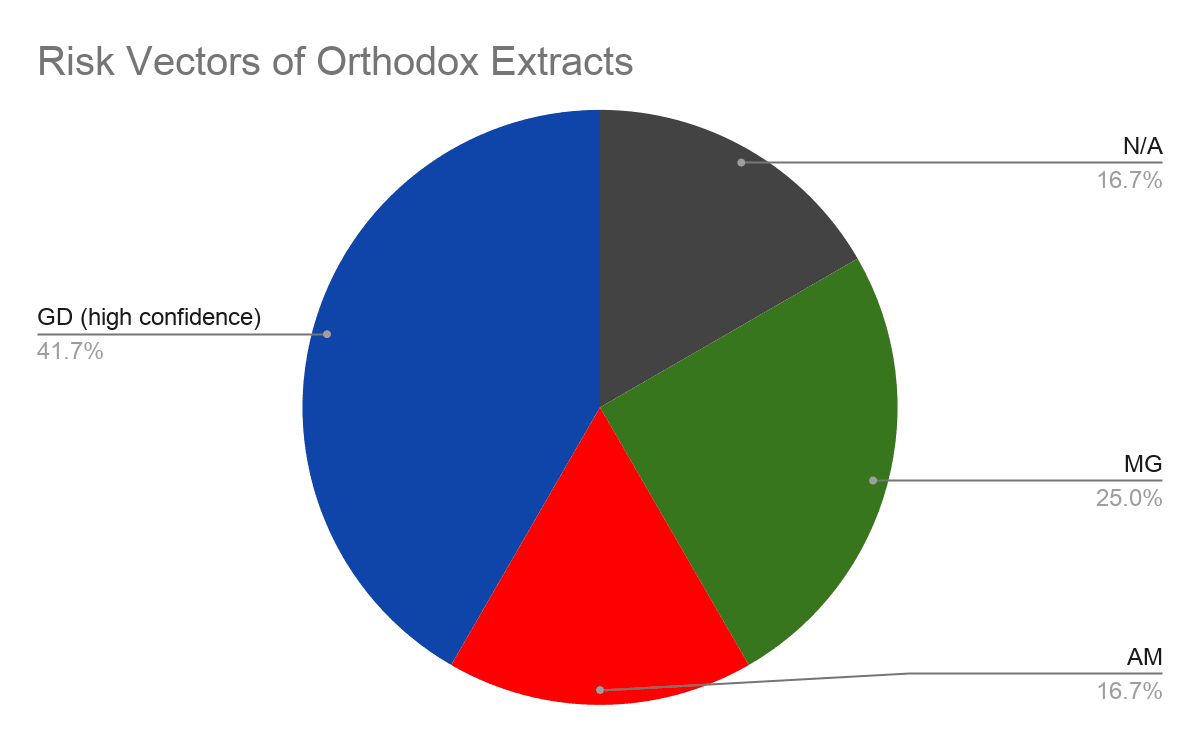
Note: GD = Gradual Disempowerment; PC = Power Concentration; AM = Autonomous Misalignment; MG = Misuse/General Ethics; N/A = No AI threat asserted
Within the Orthodox extracts coded as GD - high confidence or GD - tentative, 80.0% contained no causal mechanisms, 20.0% mentioned causal mechanisms, while 0.0% were not assessed.
We read two sources, both primatial addresses – a keynote to a meeting of the World Council of Religions for Peace (2025), and an address to the Parliamentary Assembly of the Council of Europe (2025) by the Ecumenical Patriarch Bartholomew I of Constantinople, the highest ranking primate of Eastern Orthodox Christianity. It should be noted, however, that both sources are speeches rather than synodal or conciliar doctrine, so they do not have the equivalent authority of publications such as the papal encyclical Magnifica Humanitas (see below) in the Catholic Christian tradition. The Eastern Orthodox Church has not yet articulated its position(s) on Artificial Intelligence at the authoritative level of the Catholic Church.
The Council of Europe address does not touch on GD. By contrast, the keynote to the World Council of Religions for Peace is unusually explicit about GD threats among the authoritative religious sources we have read. Bartholomew refers to ‘erosion of human agency’ among his concerns about the development of AI. In the context of expressing concern about algorithms which can reinforce existing injustices, Bartholomew speaks about advanced AI instituting an ‘invisible, but omnipotent, web of control’; a concern that human judgment could be replaced by AI; and that persons will ‘shrink[] into a set of data’. Most directly, he warns that humans are ‘in danger of losing not only the control of [their] tools, but the very sense of what it means to be human’.
While these passages could be interpreted as a concern about power concentration, no bad actors are identified and the concern reads more naturally as about an impersonal GD threat.
Protestant Christianity
Around 38.8% of Protestant extracts discuss AI risks. Among the extracts that address AI risks, the primary topics break down as follows:
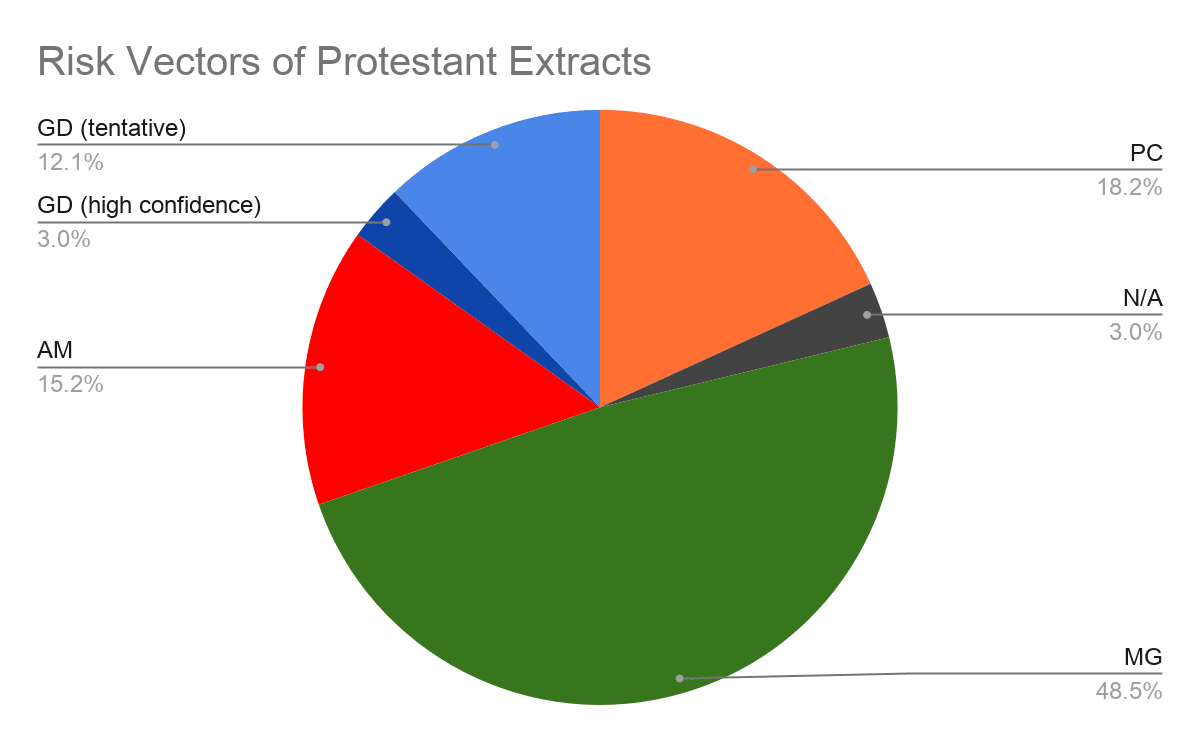
Note: GD = Gradual Disempowerment; PC = Power Concentration; AM = Autonomous Misalignment; MG = Misuse/General Ethics; N/A = No AI threat asserted
Within the Protestant extracts coded as GD - high confidence or GD - tentative, 40.0% contained no causal mechanisms, 40.0% were not assessed, while 20.0% mentioned causal mechanisms.
The sources we read for Protestant Christianity are denominational statements, including the Southern Baptist Convention’s Ethics & Religious Liberty Commission statement ‘Artificial Intelligence: An Evangelical Statement of Principles’ (2019); the Southern Baptist Convention resolution on On Artificial Intelligence and Emerging Technologies (2023); and the Church of England’s General Synod affirmation on work, dignity and AI (2024).
The most direct expression of a GD concern is the Ethics & Religious Liberty Commission’s insistence that humans should not ‘use AI...as a reason to move toward lives of pure leisure’ (Article 7: Work). While this is not a catastrophic GD scenario, it is a ‘human zoo’ variety of GD scenario where humans are materially provided for but stripped of meaningful participation in society. However, this threat may be framed here as something which results from the sinful tendencies of humans – i.e. they are tempted by a life of pure leisure - rather than from an impersonal set of processes which happen to them without their awareness or control. In this sense, it is not a ‘pure’ expression of GD. We did not find any GD-relevant passages in the Southern Baptist Convention resolution (2023). The 2024 Church of England Synod noted the absence of safeguards for ‘human purpose and dignity in work’ in the face of AI replacement, and the lack of a plan about how to compensate those who lose out.
Catholic Christianity
Around 22.58% of Catholic extracts discuss AI risks. Among the extracts that address AI risks, the primary topics break down as follow
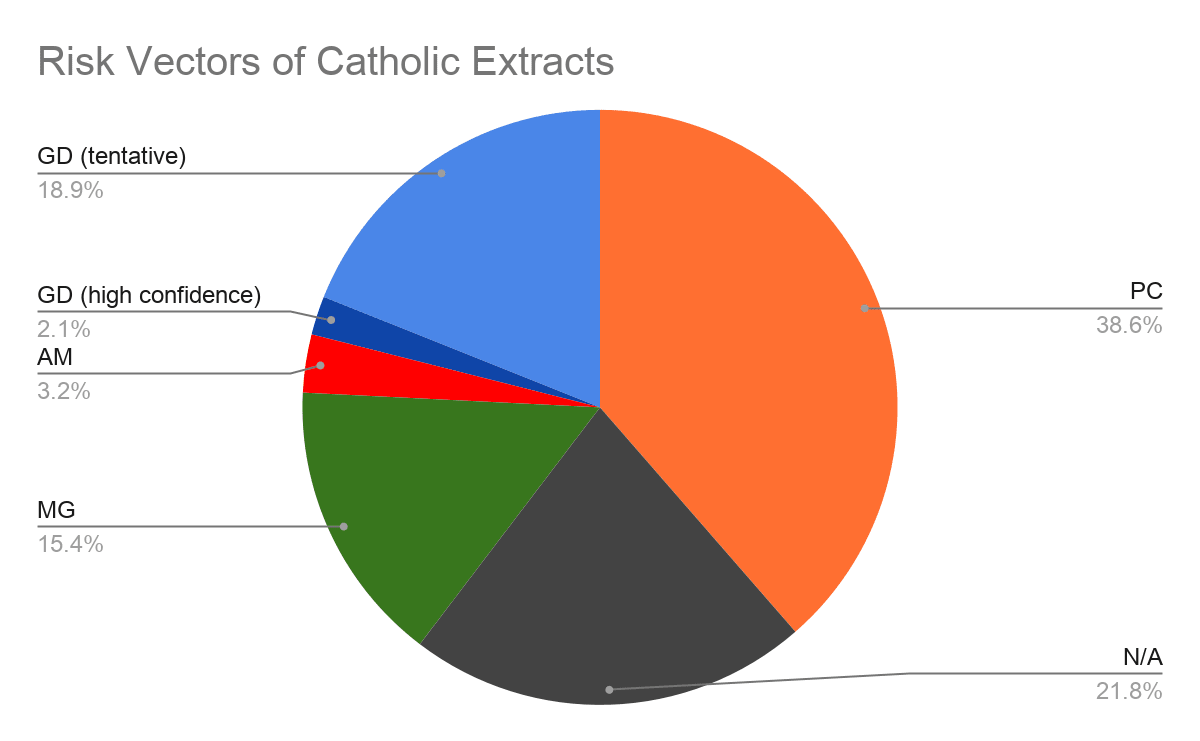
Note: GD = Gradual Disempowerment; PC = Power Concentration; AM = Autonomous Misalignment; MG = Misuse/General Ethics; N/A = No AI threat asserted
Within the Catholic extracts coded as GD - high confidence or GD - tentative, 57.4% mentioned causal mechanisms, 41.0% were not assessed, while 1.6% contained no causal mechanisms.
The Catholic Church has produced by far the largest and in-depth set of statements on threats from Artificial Intelligence, in the form of the papal encyclical Magnifica Humanitas (2026); the dicastery note Antiqua et Nova (2025); and the International Theological Commission’s Quo Vadis, Humanitas? (2026).
Antiqua et Nova has a well-developed defence of the dignity of human work, and warns that AI may replace rather than complement human labour. Alongside a concern about the role of ethics in guiding the development and use of AI, there are indications of GD-type concerns. For instance, the text notes that ‘as AI models become increasingly capable of independent learning, the ability to maintain control over them to ensure that such applications serve human purposes may effectively diminish’ (§45). It also refers to the church’s moral and social teaching as resources to ‘help ensure that AI is used in a way that preserves human agency’ (§47). It registers the concern that AI improves efficiency by replacing human work, but at the cost of ‘forc[ing] workers to adapt to the speed and demands of machines rather than machines being designed to support those who work [which can] deskill workers, subject them to automated surveillance, and relegate them to rigid and repetitive tasks’ (§67). It also flags what looks like a GD adjacent concern where it reports that AI-generated fake media can ‘gradually undermine the foundations of society’, as this is not explicitly attributed to bad actors but can happen ‘unintentionally’ (§88).
In perhaps the most GD focussed passage in the text, the authors mention that as AI becomes more embedded in the main societal systems, there is a risk that ‘human labor may lose its value in the economic realm. This is the logical consequence of the technocratic paradigm: a world of humanity enslaved to efficiency, where, ultimately, the cost of humanity must be cut’ (§68). This text - as well as the papal encyclical, embeds this within the broader technocratic paradigm threat model, which identifies the alienating potential of technological development more generally - not restricted to AI - where it is not steered by an adequate human vision of the good. The text appeals to the general principle - which has wider application than only to AI - that ‘the order of things must be subordinate to the order of persons, and not the other way around’ (§69).
Finally, the authors flag the concern that humanity may become ‘enslaved to its own work’ (§105) as a result of treating AI as a substitute for God, and that human labour ‘may lose its value in the economic realm’ and become ‘enslaved to efficiency’ (§68). Again, the text does not imply that these developments are necessarily driven by bad actors, so these claims can also be read as expressing GD concerns.
Quo Vadis, Humanitas expresses concern about technological change that ‘seems to be spiralling out of control’ in a GD sense (§27). However, the concern about AI is embedded within a broader concern about the development of technology in general (such as the alienating features of megacities etc). The document discusses the ‘uncontrollable evolution of machines ... which could lead to the creation of autonomous entities capable of determining the future and dominating the planet’ (§52), although this is probably best read as a mixed GD-and-autonomous-misaligment concern. More broadly, the text expresses concern about trans- and post-humanisms, but as human-directed developments rather than as impersonal ones (although there is a warning that transhumanism may lead to negative rather than positive consequences, where ‘the idea of overcoming implies the replacement or suppression of the human’ (§23). The text is more typically concerned with power concentration such as the possibility of technocratic oligarchy and new ways in which the weak could be exploited.
Nevertheless, there are some clear statements of GD concerns. The authors note that ‘advances in artificial intelligence offer a process of data management…and the development of effective solutions…which are not always controllable by individuals, and sometimes not even by companies or states (the algorithms of some systems have not been disclosed to any public authority)’ (§36). More explicitly still, the authors note that ‘[w]here specific aspects of human intelligence are consciously weakened or abandoned, AGI could have profound consequences that risk escaping human control. Some therefore hypothesise that AI will be asked to manage the problems it has created, according to a dynamic that would become irreversible’ (§38). While this could be construed as an autonomous misalignment concern, it seems more natural to read it as a GD one.
The papal encyclical Magnifica Humanitas – the highest authority source we consulted – generally frames AI concerns in terms of power concentration and AI misuse, especially concerning ways in which already powerful actors could exploit the powerless, and it opposes trans-/post-humanism. However, it also expresses AI-led GD concerns in terms of the technocratic paradigm referred to in the other Catholic sources, for instance, noting that in the domain of education, AI can ‘encourage excessive reliance and the search for ready-made answers, and weaken personal creativity and judgment’ (§100), with the result that humans may gradually lose the desire to form human connections, that important decisions may be ‘fully delegated to automated systems’, and that due to algorithmic biases, injustices can ‘go[] unnoticed, and compassion, mercy and forgiveness...gradually disappear from view’ (§102-103).
Again, perhaps the most prominent way in which GD concerns surface is in relation to the domain of work, where the encyclical refers to how AI, which supposedly makes work more efficient, ends up subordinating workers to the ‘speed and demands of machines’, resulting in deskilling and ‘erod[ing] workers’ sense of agency’ (§105). It also speaks about a ‘legitimate fear of a significant and rapid contraction in available jobs that would create a chain reaction deeply impacting families, young people and local economies’ (§151). This displacement of human labour ’risks exposing many to forced inactivity, a lack of responsibility and the absence of daily tasks and stimuli, resulting in human and cultural impoverishment’ (§154). While this could be construed in terms of power concentration, it seems more natural to read these concerns as GD-related, seeing as they don’t explicitly identify bad actors.
Ecumenical Christian responses
Finally, we looked at an ecumenical source, the World Council of Churches’ Statement on the Unregulated Development of Artificial Intelligence (2023). The pie chart was excluded here due to sample size constraints (N=1). This document may express a specifically religious-domain GD concern where it states that the human interactions which make up the ‘work of the churches’ may be displaced by AI ‘facsimiles’, but it is otherwise more focussed on other advanced AI threats.
Note: the Catholic Church is not a member of the World Council of Churches, although it engages with the World Council via a Joint Working Group.
Conclusion
The sources we read across the three major Abrahamic traditions suggest that the GD threat currently is not as strongly attested compared to the threats of power concentration and AI misuse, or it is only implicit, although it is more explicit in the Catholic and Orthodox Christian sources. This should not be surprising, given that GD is a concept with fuzzy boundaries, it is identified as a neglected AI threat by Kulveit et al., and it does not yet have much currency.
This is also a first pass at a moving target – while we make no claim to have been exhaustive in our identification of authoritative religious statements on advanced AI, we are not aware of having missed any significant ones to date. However, we expect that the Abrahamic religions will continue to publish authoritative religious statements on AI, and the picture may well change as this happens. We’d value pushback on the passages we have interpreted as GD, as some of these could admit of other interpretations.
Next steps for AI Governance and coalition building
1. If religious leaders are largely unaware of Gradual Disempowerment (GD) as a threat model, the AI safety community can explore tailored outreach to help these institutions recognize GD alongside standard ethics concerns.
2. Religious institutions represent massive, trusted global networks. Establishing shared understanding around AI risk could lay the groundwork for broad societal coalitions that reduce AI risks through shaping cultural norms and other more direct interventions.
3. Future engagement can frame catastrophic risks using concepts tailored to specific religious traditions and concerns, including understanding human loss of agency in theological terms.
4. Further work is needed to test the robustness of this human-in-the-loop coding approach in comparison with independent human readings of the relevant religious statements and how it may potentially help policymakers, AI governance researchers, and religious leaders get an orientation to emerging norms concerning this threat.
- ^
The GD splices in the pie charts are split by coder confidence: high confidence = unambiguously GD; tentative = plausibly GD but also open to other readings.
- ^
‘the decentralisation of Jewish communal authority means that these discussions tend to adjudicate based on existing texts rather than legislate based on personal authority, which means that anyone with a sufficiently high degree of Jewish legal knowledge can try their hand at this work (many do; it is not an accident that many long-form treatments of new technologies are written by people with no religious leadership position at all).’ David Zvi Kalman, ‘Artificial Intelligence and Jewish Thought’, in The Cambridge Companion to Religion and Artificial Intelligence, ed. Beth Singler and Fraser Watts (Cambridge: Cambridge University Press, 2024), p.72.