How to Properly Reject AI Safety Fellowship Applicants: Lessons from Rejection Letters from Top Organizations
By CalEA @ 2026-08-26T15:17 (+38)
This post was written while participating in Gen Stream in London and done based on inspiration and with some advice from Roman Ross based on his work on helping rejected applicants upskill.
Update: This post was updated on September 9th, 2026 to include additional rejection letters and info. I've created two templates which I have posted here based on the insights gained from these rejection letters. I think every organization should at the bare minimum be using one that helps redirect and upskill rejected applicants.
Introduction
There are way more applicants for AI safety fellowships, courses and projects than organizations have the capacity to accept. That means that for every fellowship that runs, hundreds and sometimes thousands of people will receive rejection letters. There is probably a better way that we could formulate rejections to make sure they have the proper resources to upskill and be ready for the next round, or redirect them to a fellowship that would be a better fit for them. This would expand the talent pool of people working in AI safety and reduce drop-out.
As someone who has faced my own share of rejection letters, this can be extremely discouraging, lead to demotivation and potentially dropping out of AI safety entirely if you can’t find the right fit. If you have sought out and applied for an AI safety fellowship, there is a good chance that you are motivated to work in the field and have at least something to contribute. We want to be able to capture all of these potential contributions. Resources are limited and so organizations understandably have to make difficult decisions about who to include and who to reject.
Many organizations put all rejected applicants into the same bucket regardless of how close they were to making it in and therefore everyone receives the same rejection letter. However, there are actually different categories of rejected applicants:
- Near Misses: These people would actually have been a good fit but capacity constraints mean you can’t take everyone.
- Need Upskilling: These people should be redirected to a lower tier fellowship or course to get more context.
- Long-shots: Probably generally unskilled or not highly intelligent individuals who might not be a good fit even with more training.
- Wrong Stream: They should be in a governance track but they are applying for a technical fellowship, or might be overqualified and therefore would be better suited to a direct role.
Rejection letters should be tailored to the individual needs of the applicants to make sure that those who are actually a good fit have something to look forward to and a clear path to success.
Note: One group not included here is Logistical Issues meaning people who could not get the visa, are in the wrong geographic location and funding or timing does not permit them to come. This is a group worth considering although they don’t fall as clearly into the grid framework I’ll introduce below because their fit is unrelated to their actual talent but more about bureaucracy or logistics instead.
One intuition I gathered from colleagues and friends, and also from analysis of rejection letters (see below) is that there is a ladder of fellowships, from most introductory to highest level. This makes sense, but lacks a dimension which is the particular stream. Instead, I think a grid is a more useful framework. One axis represents the stage of readiness the applicant should be before applying, the other represents the track (technical, policy and governance, generalist). I populated the grid using Claude to find as many top fellowships as possible. This is somewhat vibes based so the placement of any fellowship can be argued against but generally I think the placements make sense.
The Readiness Grid
| Technical research | Policy & governance | Generalist / ops / comms | |
Stage 3 — Frontier (competitive, usually full-time) | MATS (+ Neel Nanda stream) Anthropic Fellows OpenAI Safety Fellowship Astra (Constellation) CHAI Fellowship PIBBSS Iliad Fellowship | Horizon (DC placements) RAND TASP IAPS Institute for Law & AI TechCongress Navigators Incubator | Real jobs / founding / grantmaking Catalyze Impact (incubator) Seldon Lab Constellation Incubator BlueDot Incubator Week |
Stage 2 — Mentored / first research (some context; a real project) | SPAR (Kairos) ARENA LASR Labs ERA:AI Pivotal CBAI Summer Global AI Safety Fellowship MARS AI Safety Camp | GovAI Fellowship Talos (EU) FAS Policy Entrepreneurship Arcadia Impact Taskforce ERA:AI (gov track) CAIS AI & Society MATS (policy track) SE-Asia gov fellowship | Generator Residency Tarbell (journalism) Frame (comms) Pathfinder (Kairos — univ organizing) Gen Stream |
Stage 1 — Foundations (structured intro, low bar) | BlueDot AISF — Alignment ML4Good (technical) Iliad Intensive BASE (technical track) | BlueDot AISF — Governance AI Safety Collab (gov) ML4Good (governance) BASE (governance track) | BlueDot Context Week Lens Academy (AI Risk / AI Futures) Intro to Cooperative AI Global Challenges Project (Kairos) Lateral Workshop |
Stage 0 — Do something now (no gate; start this week) | Apart hackathons Self-study (AI Safety Atlas, ARENA materials) Join a local university group | Reading groups Respond to a real policy consultation Policy sprints | Write in public (Substack) Run a local event 80,000 Hours / Probably Good / Successif / HIP advising |
I’ve been told that the grid itself could be an EA Forum post, so I’ll probably follow up with one in which I expand on it more, but I’d be happy to hear advice on how it can be improved and whether orgs have their own internal model similar to this. I think this could serve as a good framework for a recommendation algorithm for those who either were rejected or completed a fellowship.
Rejection Letters
I gathered rejection letters from 20 top organizations that myself and my colleagues have received, and reached out to different organizations to see what their rejection letters looked like. I used Claude to analyze the letters and find common traits between them.
The rejection letters are from the following organizations: Constellation, Talos, MARS (Initial rejection and follow-up), ARBOx (OAISI), BlueDot, Frame, Pivotal Research, SPAR, Future Impact Group (FIG), Generator Residency, MATS (Winter 2024, Summer 2026 and Summer 2026 Stage 3), GovAI, Intro to ML Safety (Center for AI Safety), Lateral Workshop, Kairos Pathfinder, Claude Corps, Gen Stream (generic rejection and waitlist), Arcadia Impact, ACS Research Group, Future of Life Foundation, AISCU
Updated to include: ML4Good, 80,000 Hours Career Advising, SPAR (Top 10% Rejection), Horizon Career Accelerator, Global Challenges Project, Safe AI Netherlands, European Seminar for Frontier AI and Law
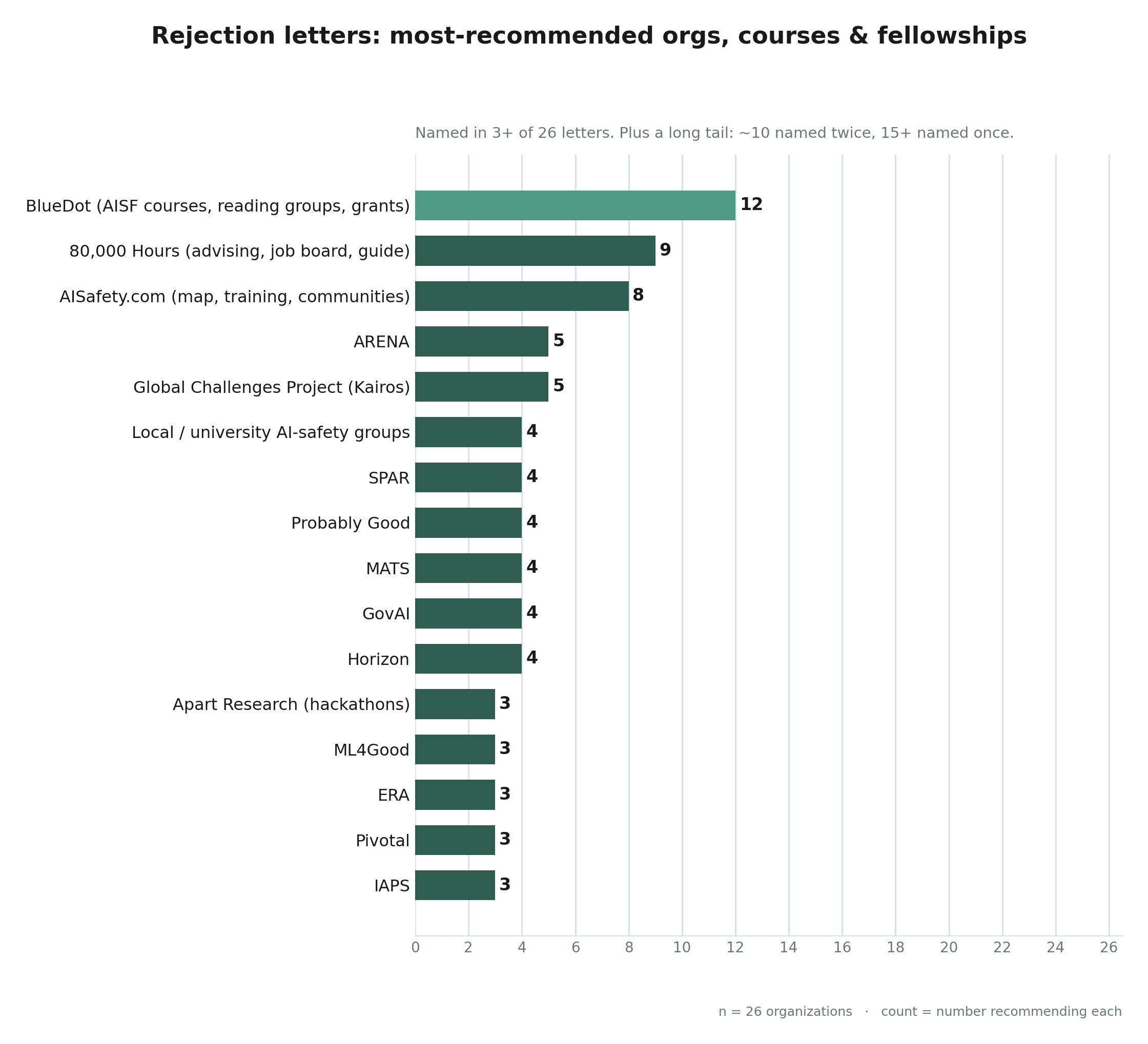
Organizations named once: CBAI, Condor, Impact Academy, CHAI, PIBBSS, BASIS, AI Safety Camp, Talos, Legal Priorities, Successif/SteadRise/HIP, BlueDot Incubator Week, AI Security Bootcamp, CAMBRIA, Effective Thesis, Blue Book, CNAS/CSET
Analysis
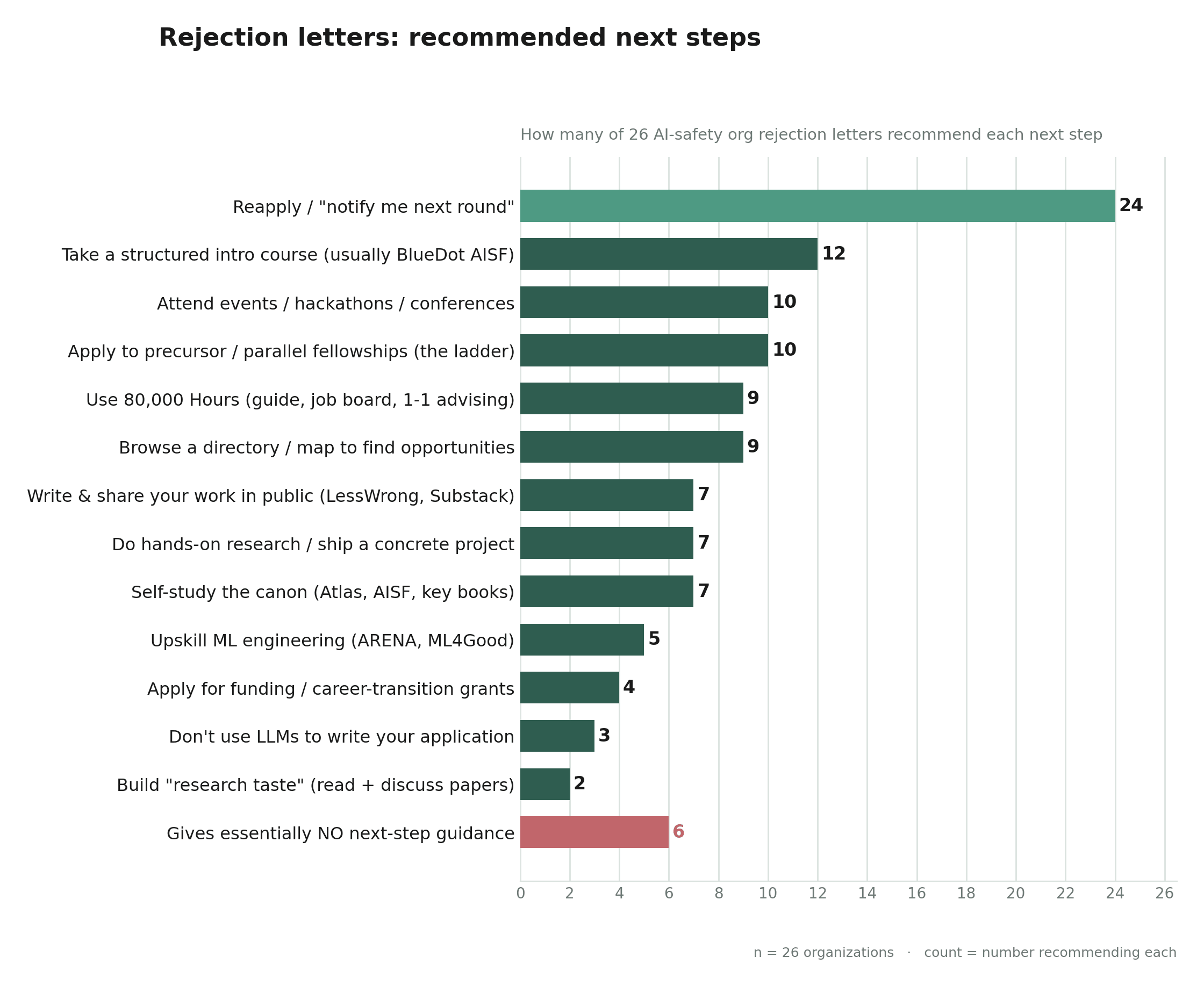
Almost everyone says “reapply next time”. This is standard boiler plate advice but actually doesn’t work for everyone. If you are a highly technically minded individual who wants to work on mechanistic interpretability research then you most likely aren’t going to be a good fit for a comms or operations fellowship, so reapplying might not be your best bet. If you want to transition to that area, you probably need more context and to start from a lower row on the grid to get the basics before moving on to the higher context fellowship.
BlueDot is by far the most recommended organization, with almost half of all rejection letters mentioning them specifically. 80,000 Hours is another resource that gets mentioned quite frequently. I am somewhat unsure how useful these recommendations are. It’s likely that anyone applying for higher level fellowships has heard of BlueDot and 80,000 Hours, but there is at least a small percentage of people applying who haven’t so it could still be useful. A helpful nudge is also potentially useful for some people. If you are a person who has already done all of the BlueDot courses or has been rejected from a lot of fellowships and keeps getting the advice of “just do BlueDot”, this can be quite frustrating and make you feel like you’re stuck at the starting gate without any clear path of progression.
One of the most recommended things to do is publish work or do work in public, such as writing on Substack or Github, doing some kind of research, posting on the EA Forum or LessWrong, and other types of visible signalling. This makes sense because if others cannot see it, they can’t be sure you have done anything or have the proper context to participate in their fellowship. Many people might view doing work in public as simply building a resumé and question whether they have anything meaningful to contribute yet. Nonetheless, I think it’s relatively useful advice and people need to practice contributing if they want to make meaningful contributions, and they may actually be able to produce something more meaningful than they think.
A few organizations gave almost no feedback or resources for upskilling. Instead, they just gave a generic rejection letter in a few sentences. This indicates that there is room for a standardized rejection letter that includes a list of helpful resources that organizations can plug in to their automated rejection emails. This would at least be better than nothing at all.
The Best Rejections
I want to give special mention to MATS, Constellation, MARS, ML4Good, and Lateral Workshop. The actual rejection letters will not be reproduced here to preserve their proprietary work, but I would encourage the orgs to publish them themselves here on the forum in the best interest of the community. All of these organizations went above and beyond with their rejection letters, sending a long list of resources to rejected applicants.
- Constellation gave very clear signals about what their org is looking for and what past applicants did that stood out. They also identified the difference between readiness and track which is present in the grid above. Their advice was tailored to individuals at different stages and in different tracks.
- MARS followed up around a month later with more information and encouragement. This seems like a good practice that can be easily reproduced and automated by other organizations.
- MATS had different rejection letters for different stages of the application process. One of my colleagues made it to the third round and received very long and personalized feedback based on their specific work test along with resources curated for their specific project (much of the feedback was generated with LLMs).
- Lateral Workshop had a different email for top applicants (i.e. Near Misses) which included more information and gave a clear signal to the applicants that they were a top candidate, which can encourage more motivation and reapplication.
- ML4Good has 7 VERSIONS of their rejection letter, which was by far the most of any organization. Their rejection letters are curated for different types of people and different reasons for being rejected including being too young or in the wrong career stage, overqualified, Near Miss (and waitlisted), Wrong Stream, and Long-shots. Importantly, ML4Good's rejection letters aim to help people pivot into relevant alternatives rather than severing the relationship right then. Overqualified individuals are encouraged to apply as teachers for their programs, Near Misses are waitlisted and given the potential to join if space permits, and Wrong Stream individuals are encouraged to participate in the stream that would fit them better. Generally, the structure of all the rejection letters is the same, but the details are changed. This type of rejection template system takes significantly more initial set-up but once created is a more effective system to help rejected applicants.
One particularly unique case is Horizon Accelerator. Those who were in the top percentile of applicants are invited to an all-expenses DC workshop with named keynotes, offers $400 in application-review credit, and puts them on talent lists. Their rejection letter, although unique to a small number of highly qualified applicants, makes sure to maintain the relationship in a very strong way and gives very clear and tangible ways to upskill and remain in the field. Not every organization will have the resources to do this, but it could be worth dedicating more resources to having programs and events specifically for high-quality rejects to make sure they remain interested and engaged.
Ideas for Improvement
There are probably ways we could increase retention and reapplication by improving the rejection and redirection process. This is a non-exhaustive list of some of the ideas I’ve come up with by analyzing the rejection letters I received and talking with colleagues:
- A standardized rejection letter that can be co-opted by different organizations. It will have a variety of different resources for people at different stages and in different tracks. Those who wrote the rejection letters for the highlighted orgs above would be well suited to creating an open-source public document of this type that new organizations can use. This would be especially well suited for the orgs that sent no feedback whatsoever. This type of generic rejection letter is best for Needs Upskilling and Long-Shot categories of applicants.
- Doubts: A lot of organizations might not find it that useful or may question whether it’s applicable to their organization.
- Encouraging and facilitating more direct hand-off between organizations. If an applicant is rejected from your fellowship because you lack capacity or you think they would be a better fit for another fellowship, you can send them directly to that other org. This is good for Near Misses and Wrong Stream applicants. The theory is that orgs should trust each other's judgement. If you would trust their graduates, then you should also trust their application process and that their Near Misses are actually good candidates. This takes away a lot of the legwork of looking through applications and doing interviews.
- Doubts: I don’t know whether orgs would really trust each other enough to accept Near Misses based on the recommendation of others.
- I also question whether this is practical because of the same kind of capacity constraints. It would take a lot of work and cognitive bandwidth for hiring managers to do this.
- It’s not always obvious from people’s applications which other fellowship they would be a good fit for. People game applications by altering the information to suit different fellowships and make it appear that they are a good fit. It would take a highly sophisticated hiring manager or perhaps some LLM to accurately relay people to the right fellowship.
- A shared database that orgs have access to with information about different applicants and what category of reject they were. This can be referred to when applicants apply for their fellowship.
- Doubts: Already being worked on (although not publicly available yet).
- I am not entirely sure it is consistent with data protection and sharing laws, although I am not an expert on this subject.
- A platform where applicants can build their profile, apply for fellowships and receive specific recommendations based on what they were rejected from in the past and what they need to do to upskill or what fellowships would be better suited to them. Ideally, fellowship organizations would also use the platform to host the applications themselves. This way, they can simply tick a box at the end that says whether the candidate was a Near Miss, Wrong Stream, etc. This will give direct feedback to the candidate and shape the recommendations they receive while also offloading the work of the orgs finding the right fellowship for their rejected candidates. A basic mock-up of this kind of website is here which I made with Lovable based on the theory in this post.
- Doubts: Does it fit with the database idea? Can the two be combined?
- Is it better than just using LinkedIn, which still serves as the standard for this type of thing?
- Can we get enough buy-in to make it a meaningful platform?
- Reject Con (?): This could very well be a dumb idea but I want to put it out there anyway because I was inspired by Horizon Accelerator's effort to help their top rejected applicants. Perhaps a convention for all of the very best rejected applicants could be held for them to network and talk with other organizations that might be interested in having them as a paricipant. Those who are extremely close but just miss the cut-off for a fellowship or program could be invited to an in-person or online event in which top organizations also participate. It could be hosted at Constellation or LISA rather than renting a new space, or be a regularly held online event in which people can go to break-out rooms to talk with one or two members of an organization.
- Doubts: Would organizations want to participate in something like this? Would rejected participants?
- Is it a meaningful use of limited resources?
Conclusion
Rejections are a necessary part of the fellowship application process and there will always be people left disappointed. However, we still need to consider strongly all of the rejected applicants and how they could still contribute to AI safety. There is probably a more optimal and streamlined way that we could reject and reorient applicants so that they can upskill and make meaningful contributions to the field.
If you have any rejection letters that I didn’t include here and want to improve the data, I would be happy to receive them. Either your own rejection letters you received or if you work for an organization that rejects candidates. You can email them to me at calebeliprice@gmail.com.
Special thanks to everyone who sent me their rejection letters and thanks to all the organizations that rejected them (just kidding): Julien Sireau, Grace Roberts, Zuzanna Topolska, Carl Scheffler, Shahil Goodka, Zahra Farzanekhoo, Jian Xin Lim.
jdw-1 @ 2026-08-27T18:00 (+3)
I'm the lead author of Constellation's rejection email. I very much welcome further suggestions and further feedback on how this email can be better (across the myriad possible axes of "better"). I'll check back on this post occasionally to read folks ideas, and reply to them if it makes sense!
Thank you for this post - I learned from it, and am taking away some improvements I can apply in my work.
Mark Aiken @ 2026-08-27T13:21 (+3)
Great writeup. This is also a really positive example of the kind of work that Gen Stream can produce by getting someone to focus on a specific issue for a short sprint, and publish the analysis. So kudos to you and to Gen Stream for this initiative.
I want to acknowledge that managing a recruitment process is a huge amount of work, and giving detailed feedback is an additional workload on top of this. Not all organisations will have capacity to do give targeted feedback, even if they wanted to. There are also some risks of giving targeted feedback in some jurisdictions - eg if your feedback indicates that the employer has unlawfully discriminated against the candidate.
However, the further candidates advance and invest in a selection process, the more they would benefit from getting targeted feedback. Feedback can be provided by stage as you've explained (candidates who reach the final round might get individual feedback, candidates who do not pass the first screening might only get general feedback). I also agree that feedback can be misplaced - if a candidate reaches a late round, they are probably well beyond the stage of BlueDot and 80,000 hours and referring these candidates to resources that they have already advanced beyond doesnt seem very helpful.
I'd be interested to see examples of good feedback if the organisations you've chosen decide to post them. From previous high volume experience, I've seen some organisations give effective feedback by describing what strong candidates did vs weaker candidates - eg strong candidates could clearly describe A,B and C and apply this knowledge to the scenario to identify risks, impacts, sequencing. Weaker candidates identified 2 or less of the key issues; did not link the issues to an impact and / or did not clearly describe a viable sequence. By showing candidates what good and bad look like, you invite them to find their own opportunities for improvement.
I also think there are more opportunities for common recruitment processes and recruitment for shared rosters across organisations. I know this is not easy to organise, but it's common practice in some industries. Often organisations are recruiting for very similar competencies (rightly or wrongly), and it's a significant workload on both hiring organisations and applicants to repeatedly have full hiring processes for common roles.
Marta Kosmyna @ 2026-09-09T04:58 (+2)
The Art of the Rejection Email 🤌🏽
Readiness grid is super useful 💯
I'm curious about the role orgs like Impact Ops can/do play in data sharing and funneling candidates since a lot of AI Safety orgs used them for hiring processes. I've definitely checked all the share my data with other orgs boxes and been invited to apply to roles based on this
Tamkeen Nawab @ 2026-08-28T07:05 (+2)
This is a great resource!