The AI Windfall
By LewisBollard @ 2026-08-05T20:03 (+81)
This is a linkpost to https://farmanimalwelfare.substack.com/p/the-ai-windfall
Note: This post was crossposted from the Coefficient Giving Farm Animal Welfare Research Newsletter by the Forum team, with the author's permission. The author may not see or respond to comments on this post.
The third wave of American philanthropy is finally coming. It could usher in a Golden Age of Animal Welfare. If you don’t know what I’m talking about, I recommend reading the linked pieces by Nan Ransohoff and Itsi Weinstock. If you do, read on.
Newly-minted AI millionaires have already donated tens of millions this year to help factory-farmed animals. Many plan to give much more. We don’t yet know how much, but this could be a step-change for our movement.
It’s about time. Our movement has long punched above its weight, winning change for billions of animals on a global budget smaller than what Americans spend on Halloween costumes for their pets. If we spend the new funds well, we could help many billions more.
How? Here are some initial thoughts on what the new money could enable our movement to do.
1. Raise our ambitions
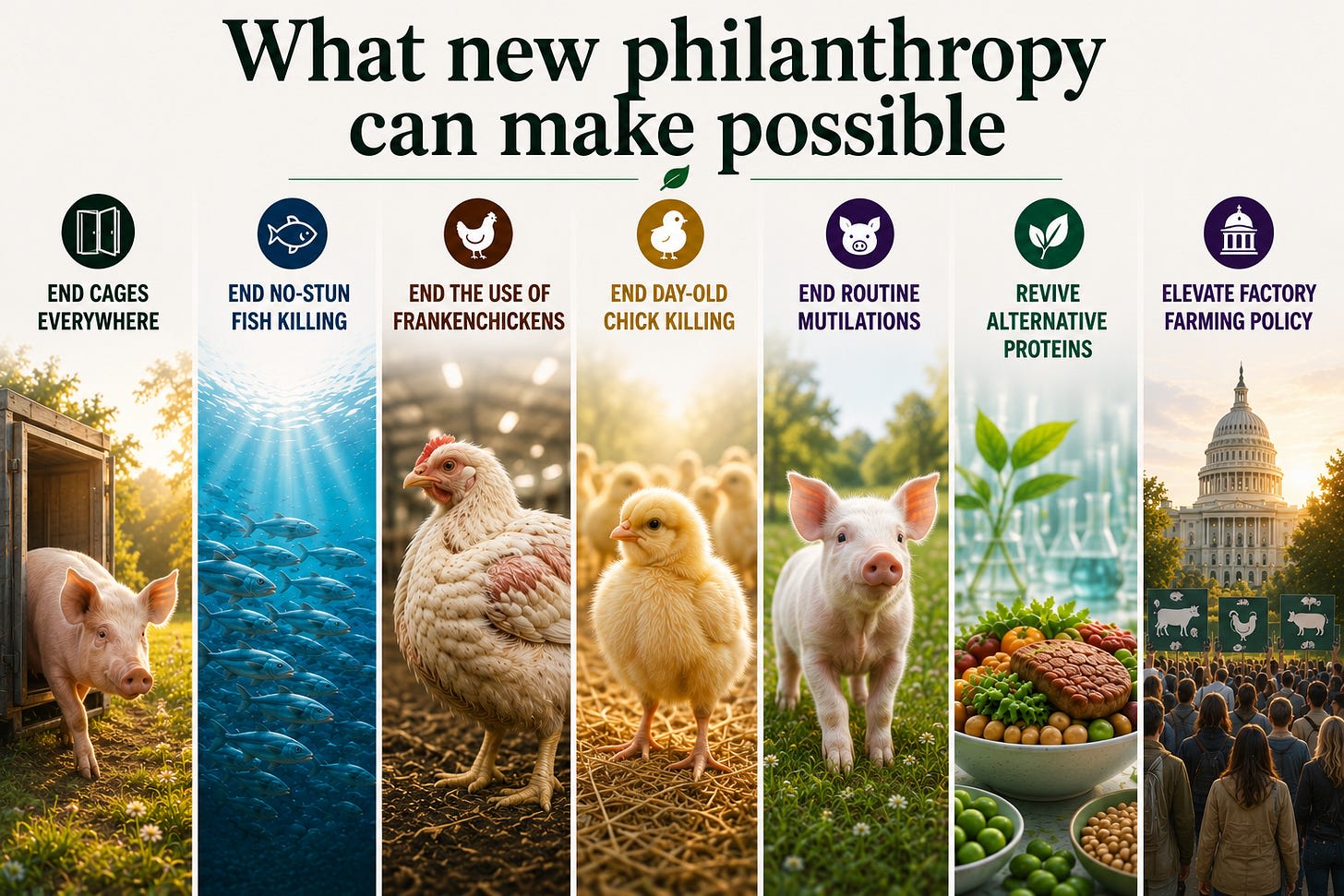
We’ve long played triage: with limited resources, we could only pick the biggest fights we could win. Now we can pick more and bigger fights — and drive key issues toward tipping points. Spent well, I think the new funds could:
- End cages and crates across Europe and the Americas, and put them on a path to global extinction. That would spare about 10 billion animals alive at any time from one of the worst tortures ever invented — immobilization for life.
- End the no-stun killing of farmed fish and shrimp, and start to end it for wild-caught fish. That would spare over 100 billion animals annually — ultimately trillions — from slowly suffocating to death.
- End the use of Frankenchickens — birds bred to grow so fast their legs and hearts can’t keep up — first in Europe, then globally. That would spare about 70 billion animals annually from chronic pain built into their genes.
- End the killing of day-old chicks through in-ovo sexing. That would spare seven billion animals annually from being gassed, macerated, or boiled alive on their first day in the world.
- End the routine mutilation of farm animals, by scaling humane technologies like immunocastration. That would spare billions of animals annually from being castrated, debeaked, and tail-docked — usually without pain relief.
- Revive alternative proteins, by accelerating AI-driven innovation and defending them from vindictive regulations. That could reverse factory farming’s default path of indefinite growth.
- Elevate factory farming into a major political issue, with politicians and nations vying to solve it. That would make governments part of the solution instead of part of the problem.
2. Solve new problems
We tend to treat factory farming as one problem. That framing leads some to minimize it — as just one issue among many — and others to despair, seeing a single monolith too vast to topple.
In reality, factory farming is more like “human disease”: a broad label for many problems that collectively cause most human-inflicted suffering in the world. Dozens of industries farm hundreds of species, each with its own catalog of cruelties.
Consider three you’ve likely never heard of. The feed industry raises 160 million to 2.1 billion mice and other animals annually to feed to snakes. The frog and turtle industries confine 400 million to 5 billion animals. And the Mandarin fish industry raises 170 to 700 billion fish annually just to feed to other fish. (These estimates are so wide because no one has ever bothered to accurately count these animals.)
In a world with less cruelty, each of these would count as a moral atrocity in its own right. In ours, they count as rounding errors.
How to tackle so many problems? I like Nan Ransohoff’s proposal: general managers for the world’s most important problems. Each problem gets its own manager, who obsessively pulls every lever to solve it. We already have many such managers. I’d love to see more: one for each neglected atrocity we inflict on animals.
3. Globalize
I’d also love to see our movement become a truly global one. It’s traditionally been mostly American and European. But most factory-farmed animals are not — about 80% of vertebrate farm animals are confined in Asia alone.
Asian, African, and Latin American advocates are already winning real progress. Japanese advocates just secured the first animal welfare policy from the country’s largest retailer, Aeon. Brazilian advocates just won a nationwide ban on the production and sale of foie gras.
They could use more support. One model I like is the Open Wing Alliance, incubated by The Humane League, which unites over 80 groups across 70+ countries to end the worst abuses of chickens. The Alliance coordinates, trains, and funds its members, who execute their own strategies locally.
Another promising model is Welfare Matters, a fellowship and incubator building the next generation of advocates across Indonesia, Vietnam, Thailand, Malaysia, the Philippines, and Singapore — countries with seven times more factory-farmed animals than the US, and a fraction of the attention.
4. Innovate
As these models suggest, some of the most exciting work in our movement comes from new projects. We need more of them. Sofia Balderson has a great map of the growing list of incubators in our movement.
One immediate opportunity is Ambitious Impact’s first-ever animal-only incubation round, which just opened for applications this week. AIM has incubated some of our movement’s most exciting new charities — from Animal Advocacy Careers to the Shrimp Welfare Project. If you’re at all entrepreneurial, consider applying.
I’m especially keen on new initiatives applying AI itself to help animals — a fitting use of the windfall. New AI tools can accelerate corporate and legislative campaigns, improve alternative protein products, and develop humane technologies.
5. Recruit and retain top talent
To staff these projects, we’ll need more talent. Our movement is already talent-dense. But we need to do better at retaining our most talented advocates — and attracting more like them.
One lever is to pay more. I hesitated to include this recommendation. I’ve long avoided pushing groups to raise salaries. I think groups should set salaries based on their own needs — not based on funders acting like Soviet central planners. So this is not me saying “every group should raise salaries.”
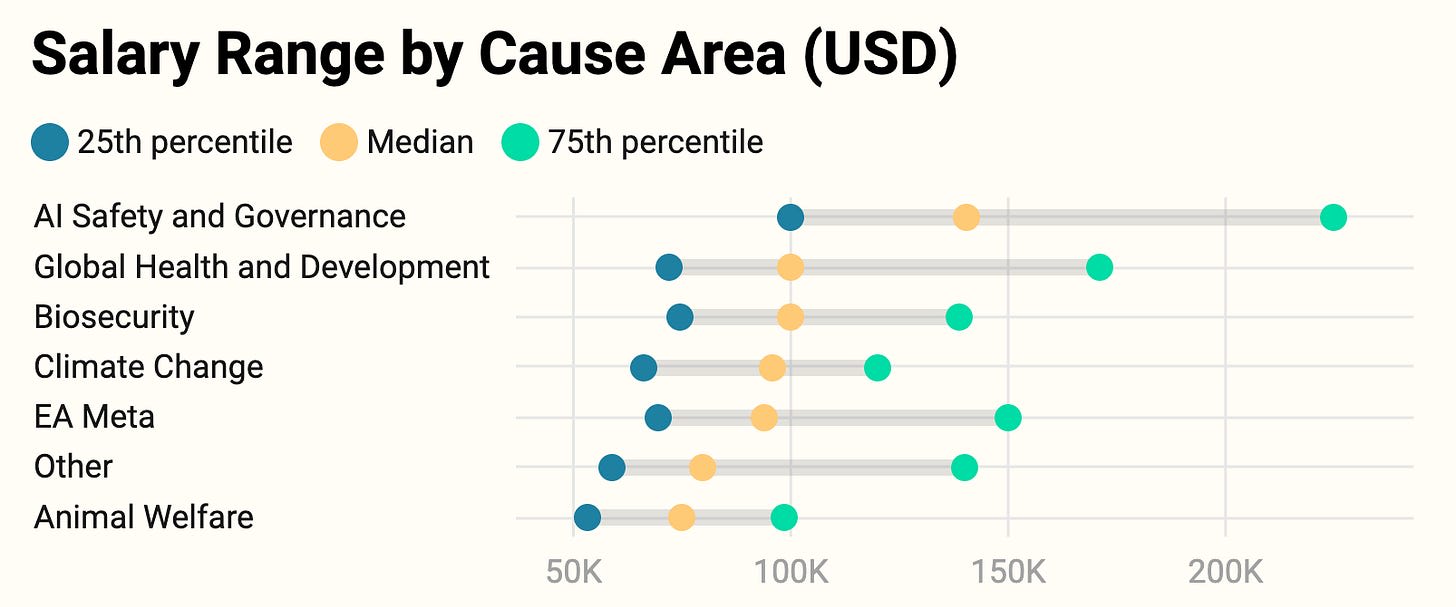
But I do think salaries in our space are mostly too low. When I left law school 12 years ago, I had two offers: $160,000 a year at a big law firm, or $42,000 at an animal welfare group. Thankfully I liked animals a lot more than corporate lawyers. Salaries have improved since then, but still lag those in comparable sectors (see chart below).
New funding will naturally raise salaries as groups compete for talent. This is how it should be. So I include this mostly for the curmudgeons, who may resist this trend with the logic that “in my day, activists earned a fraction as much.” To which I reply: I’m glad we’re not in your day anymore.
6. Maintain our standards and culture
We also need to preserve what makes our movement special. I love hanging out with animal advocates: few people are as altruistic, compassionate, and strategic. We have a culture that rewards collaboration, truth-seeking, and most importantly, achieving big wins for animals.
More money will test that. I’m not worried about money corrupting advocates — many advocates’ idea of luxury is still a hotel room to themselves. (When we started funding groups in 2016, many movement leaders still couch-surfed to save money.)
But I do worry about money altering movement dynamics. A sudden influx of new talent will test our shared values. Some groups receiving more than others will test our collaboration.
Above all, more funding will test our discipline: whether we can keep spending every dollar as effectively as possible to reduce animal suffering. As Neil Dullaghan puts it: we need more scalable cost-effective interventions, not “plans to absorb trillions of dollars to buy Tyson Foods and build cultivated meat on the Moon.”
7. Get involved
If you’ve always wanted to work on this issue — or just started wanting to — now is a great time. I expect many new jobs to come online over the next year. Keep an eye on the Animal Advocacy Careers job board, or reach out to them or High Impact Professionals for career coaching.
And if you’re a donor now wondering whether your funding still matters: we need you! Non-AI donors can add unique value by making longer-term commitments, helping groups weather the unpredictability of future AI giving. (And maybe don’t invest all your wealth in AI stocks — your dollars will be most valuable in the worlds where they crash and this new funding stream dries up.)
This is an exciting, promising, nerve-racking time. For years, our biggest constraint was money. Soon, it may be everything else: the talent, strategies, and discipline to spend it well. Those are better problems. Let’s go solve them.
NickLaing @ 2026-08-06T16:36 (+10)
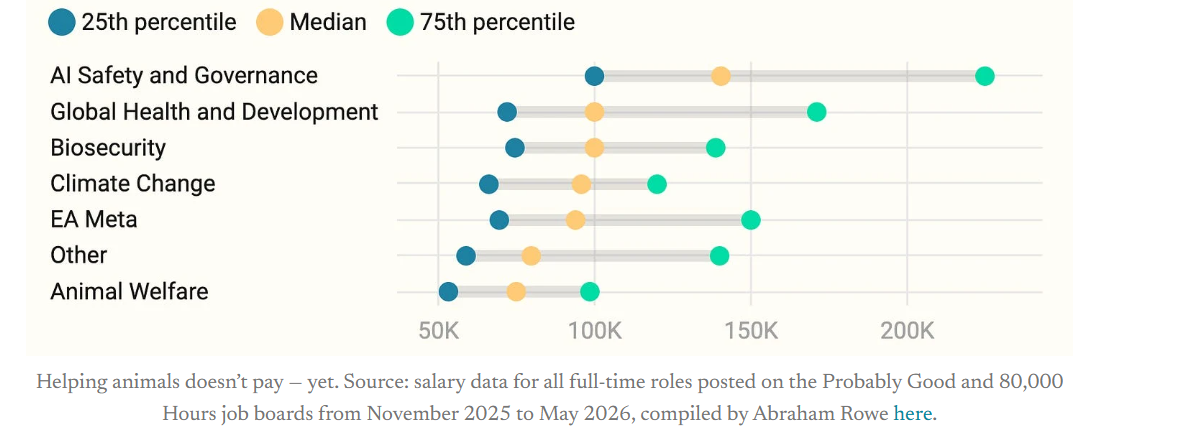
A small point on this - the 80,000 hours and probably good jobs board post EA paygrade jobs. The median GHD development worker salary would be WAAAAAAAY below 100k. Of perhaps 30 people I know well working in GHD (not including the majority of jobs which are in-country and way lower) maybe 3 of them have salaries over 100k US. These salaries are kind of wildly high IMO (disagree votes incoming) - apart from the Animal Welfare range of course which from my perspective seems reasonable stand-alone but definitely unreasonably lower than the rest!
LewisBollard @ 2026-08-06T17:12 (+5)
Good clarification, thanks for adding that Nick!
NickLaing @ 2026-08-10T14:33 (+3)
Thanks and I should clarify this EXCLUDES people I know pretty well working in GHD grantmaking jobs outside EA, where salaries are often much higher.
David_R 🔸 @ 2026-08-10T14:27 (+1)
Great data, thanks for sharing!
CB🔸 @ 2026-08-07T06:39 (+2)
Great post, very inspiring, thanks for making it!