Unit economics vs. the singularity
By Thomaaas @ 2026-07-14T16:06 (+5)
This is a linkpost to https://thomaaaskirk.substack.com/p/unit-economics-vs-the-singularity
This is a condensed version of the essay linked above.
Not long ago, it was fashionable to ask “how would the AI labs ever turn a profit?” In theory, ever-increasing training costs would swallow all revenue, as labs compete to stay at the frontier. If a lab stopped training better models, their competitors would catch up, undercut them and take their market share. A lose-lose.
Anthropic is poised to prove a lab can be profitable. However, if progress slows, low switching costs and distillation could mean labs eventually compete on price, not capability. If intelligence actually becomes a commodity, it will be cheap.
Why SaaS margins are high
SaaS companies have high margins (typically 20-30% operating profit) because they benefit from high switching costs: it is often impractical, and therefore expensive, for customers to change providers, or adopt new products. This means SaaS companies can charge higher prices. Anthropic has similar margins.[1]
But AI labs do not benefit from high switching costs.
To retain market share, if frontier labs can’t provide the cheapest models, they must continue to provide the best models. Distillation makes this hard.
Commodities are cheap
The price of a commodity approaches the marginal cost of production. The MC of AI is the inference cost. If distilled models achieve comparable performance, competition will reduce prices to the cost of compute. Labs will not have SaaS margins.
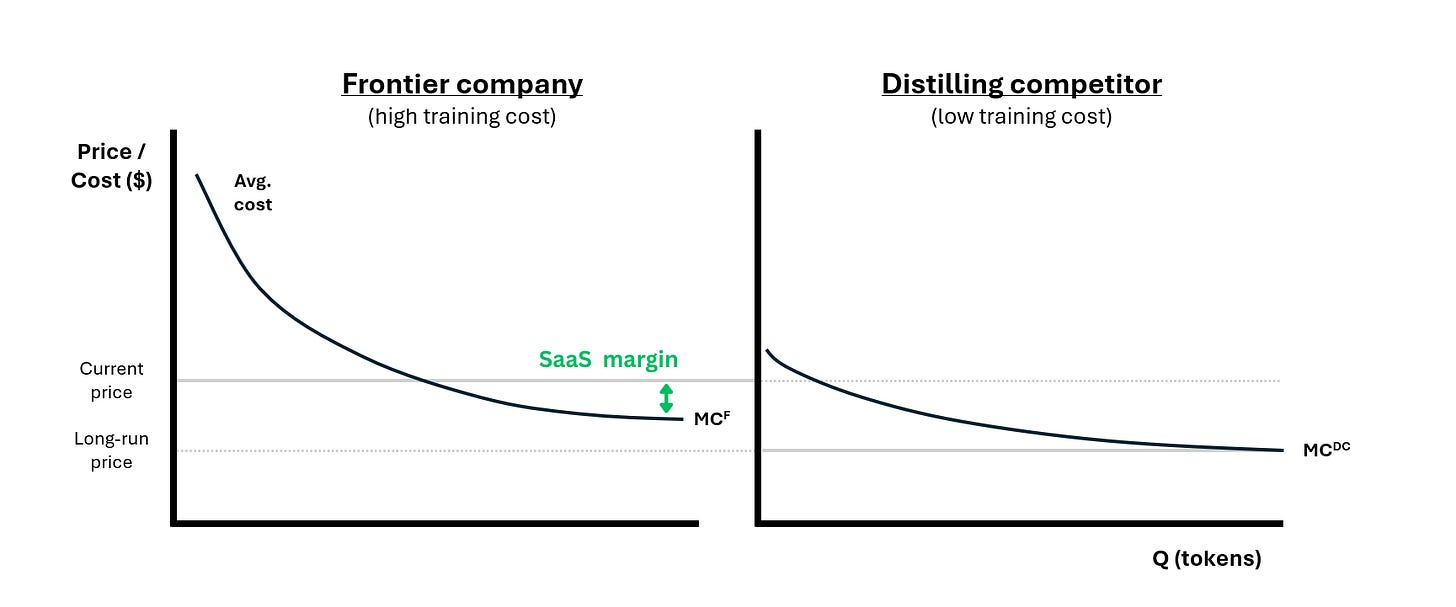
For the current labs to stay ahead, they need to make constant progress, so can retain the market share thanks to model performance.
Slow progress & token-hungry models increase cost pressure
Slower progress increases the pressure labs face from low-cost competitors: they have more time to catch up. Hungrier models increase pressure on the cost of AI.[2] These two facts compound, increasing likelihood that labs will compete on price, not capability.
The upper limit on model performance may be set by economics, not physics. If intelligence is priced like a commodity it will not be very profitable, but that does not mean it won’t be transformative. The Fortune 500 is littered with companies you have never heard of selling electricity and oil and gas and making 3% profits.