Electrical stunning does not yet ensure prolonged insensibility in several European finfish species
By Rethink Priorities, samaramendez, Sagar K Shah @ 2026-03-12T16:40 (+59)
This post is a summary of our literature review of seabream, seabass, and small rainbow trout electrical stunning studies, which you can find on RP’s website. It was cross-posted from our Substack.
Rainbow trout, gilthead seabream, and European seabass are the top three most farmed fish species in Europe, by number of individual fish. We estimate that ~400 million gilthead seabream, ~200 million European seabass, and ~200 million small rainbow trout were slaughtered for European consumption in 2021. Current standard slaughter methods for these Mediterranean species, mainly asphyxia in air or ice slurry, are widely considered inhumane due to the prolonged suffering they induce.
Major retailers and producers (1, 2) have made commitments to transition to electrical stunning methods by 2027–2028. Additionally, leading aquaculture certification bodies are updating their standards to mandate these practices, encouraging industry-wide adoption within the next few years.
The problem
While electrical stunning has gained rapid policy and commercial acceptance with reported operational benefits, the scientific evidence for whether it actually achieves humane outcomes for these species is surprisingly sparse.
Humane stunning means rendering fish immediately insensible and keeping them that way until death. In practice, achieving this standard - and confirming that achievement - presents several challenges:
- For electrical stunning, the current must be strong enough to cause genuine insensibility (not just paralysis, where fishes appear immobile but can still feel pain). At the same time, it can't be so strong that it damages the meat and makes it unsellable.
- Electrical stunning efficiency varies widely based on a range of factors like fish size, species, water conditions, and how operators set the equipment.
- Measuring whether fish are actually insensible is difficult. Practical indicators, such as loss of balance, are easy to observe but can be misleading, as a paralyzed fish might still be conscious. The gold standard uses neurological measures that directly assess whether the brain is processing stimuli, but these tests are expensive and require specialized expertise.
- Most studies happen in carefully controlled labs, where conditions are idealized. Real commercial settings, with space constraints, power limitations, maintenance issues, and variable conditions, likely produce worse welfare outcomes than what research shows is possible.
What we did
To better understand the scientific consensus on electrical stunning, we conducted an AI-accelerated review of peer-reviewed academic journal publications and conference proceedings. The search focused on three species: small rainbow trout, gilthead seabream, and European seabass. We identified 19 papers that included 76 experiments attempting to measure the duration of insensibility or stress levels, and we extracted and summarized data using AI tools.
This project is part of the broader work of Rethink Priorities (RP) with advocates, researchers, and funders to co-develop species-specific, cost-effective interventions that improve fish welfare.
Our results
Our results showed a lack of evidence for quick and persistent insensibility after electrical stunning in gilthead seabream and European seabass, but more promising results for small rainbow trout.
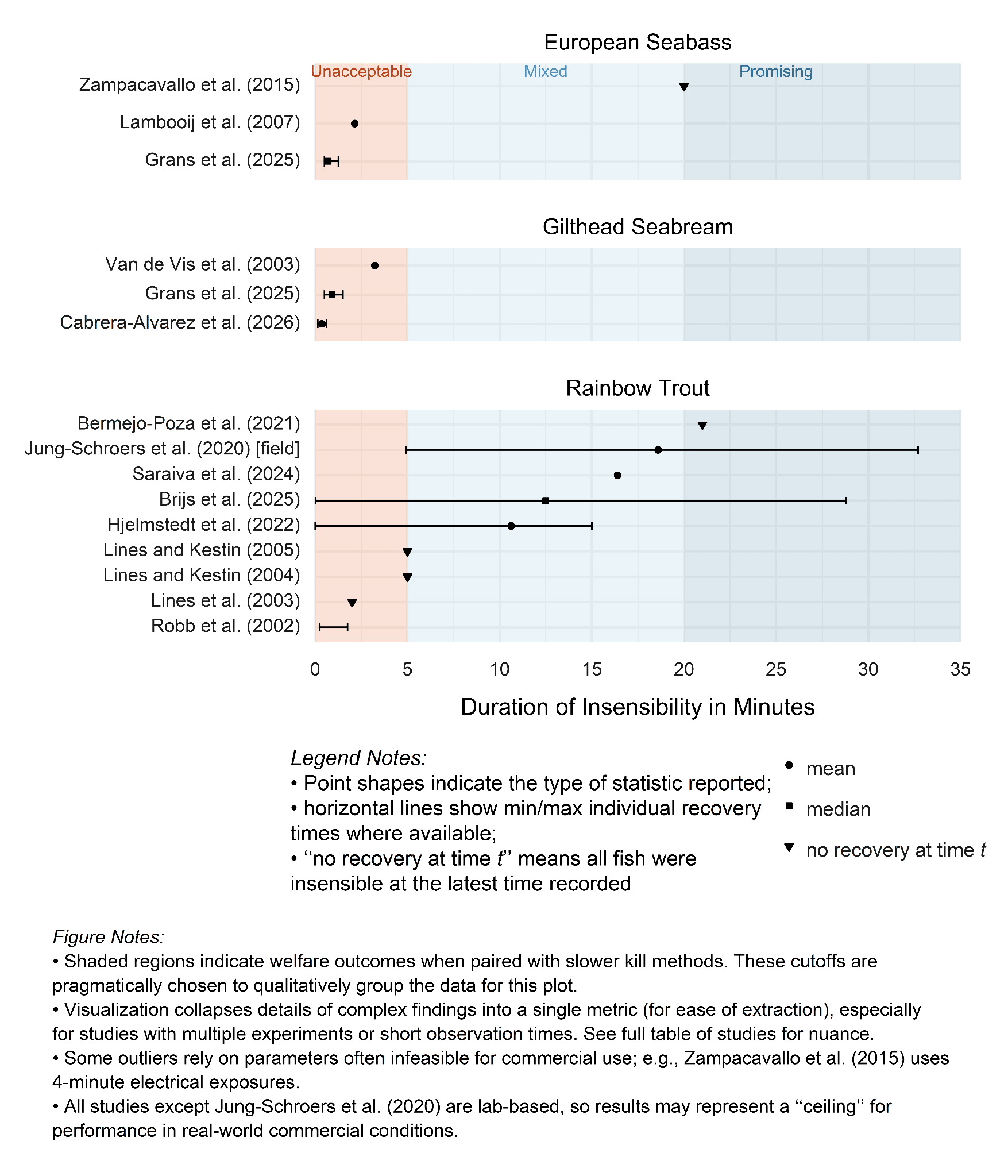
Figure 1 below shows a study-level summary of insensibility durations that includes both fish who recover sensibility as well as those that never recover (so we use the phrase “insensibility duration” instead of “recovery time”). For seabream and seabass, the plot shows how few studies have measured insensibility duration, with most of those pointing to very rapid recovery times. However, for rainbow trout, the plot looks more optimistic: several averages, including promising results from a field trial, cross the ten-minute mark. More details on these points below.
Note that summarizing results from each study into a single data point will omit important details, especially for studies with multiple experiments or complex findings. We feel reasonably confident that our plot provides a visual summary of the amount of evidence and the degree of optimism about electrical stunning for each species, but we recommend reading Tables 1, 2 ,3 in the full report for a more detailed summary of findings and nuances.
Figure 1: Duration of insensibility after electric stunning in peer-reviewed literature.
Finding 1: Electrical stunning remains unproven for seabream and seabass
- While studies are few, the most reliable evidence suggests seabream and seabass recover sensibility far more quickly than the time needed to complete the entire follow-on slaughter process (2 min to recover compared to 5–50 min to die by current methods). Some studies reported longer durations, but study-specific limitations led us to trust these results less.
- Our review leads us to conclude that electrical stunning remains unproven for seabream and seabass. We will need more evidence demonstrating commercial stunners can realistically deliver longer-lasting insensibility before electrical stunning can be endorsed as a humane stun method for these species.
Finding 2: Electric stunning may be more promising for rainbow trout
- The evidence we reviewed was consistent with electrical stunning having the potential to offer welfare benefits for the majority of small-sized rainbow trout. Several high-quality lab studies pointed to machine settings where more than 70% of fishes appeared insensible for at least 15 minutes. And the field study found similarly promising results on German trout farms.
- But the results are not yet perfect, and likely highly sensitive to maintenance and calibration. Most studies pointed to a material proportion of fishes that recovered sensibility quickly after electrical exposure. These fishes are unlikely to benefit as much from electrical stunning, and they might even experience net harms. The studies also suggested performance is highly sensitive to machine settings, which means that on-farm stunning machines would need to be both well-maintained and calibrated appropriately.
Finding 3: Thin evidence means our findings are more speculative than we would like
- To feel confident that electrical stunning works for each species, we’d ideally have lab studies demonstrating the technology works in optimal conditions, followed by field trials validating the lab results on farms. These field trials would ideally use the highest quality indicators, test all commonly-used commercial stunning machines, and cover the full breadth of settings where each species is farmed.
- Unfortunately, the body of evidence we reviewed falls well short of these ideals. The conclusions we draw are therefore far more speculative than we would like.
- For seabream and seabass, we found only a handful of lab studies for each species and no field studies. Some lab studies were so old that we did not feel confident that the stunning machines used reflected the types of machines used on commercial farms today.
- For rainbow trout, we had more evidence to evaluate, but it was still thinner than ideal. We found over 10 lab studies, some of which used higher quality indicators and commercial machines with manufacturer-recommended settings. But unfortunately, there was only one field study. While that study was particularly useful, we are uncertain whether we can use one country’s results to draw conclusions about the efficacy of electrical stunning in other countries.
Implications of our findings
Electrical stunners could improve rainbow trout welfare
Currently available electrical stunners plausibly offer counterfactual welfare improvements for rainbow trout, but the case is much weaker for seabream and seabass.
The best commercial stunners, if properly maintained and calibrated, could still improve welfare outcomes for small rainbow trout overall even if not all fish are effectively stunned. The key trade-off is between the welfare gain for fish that are permanently stunned, and the potential harm to the minority that recover quickly and may suffer as a result. But since current slaughter practices already cause significant pain, even an imperfect switch to electrical stunning likely leaves most small rainbow trout better off.
The limited evidence makes us less confident in the same claim for seabream and seabass. This counterfactual improvement hypothesis feels risky to explore for these species before lab studies demonstrate commercially available machines are realistically able to deliver long-lasting insensibility for the majority of fish.
More research is needed on stunner performance in commercial settings
Our review is limited to published peer-reviewed studies in academic journals, mostly conducted in laboratory settings with a limited range of machines, and some studies are over 20 years old. Advancements in stunning technology have occurred, but we expect much of the relevant data resides in grey literature or manufacturer documentation, or remains unpublished for commercial reasons. This limitation may cause us to be overly pessimistic about electric stunning.
Greater availability of real-world performance data would help. More validation studies across diverse contexts would enable informed, species-specific recommendations to improve fish welfare at slaughter. Although high-quality scientific evidence requires time and resources, we recommend that stakeholders collaborate to find cost-effective ways to reduce critical information gaps.
Our recommendations on how to advance fish welfare at the time of slaughter
- More academic validation studies
- For seabream and seabass, verification that current stunner machines can deliver humane outcomes under ideal conditions should precede field validation studies, unless field studies are quicker to provide better evidence at the same cost.
- For rainbow trout, field validation of promising lab results to ensure commercial implementation delivers humane outcomes.
- Focusing on the most critical research gaps per species is a cost-effective approach to research; we further recommend that stakeholders collaborate to find other cost-effective ways to reduce information gaps.
- Developing quicker and cheaper validation approaches. Interested stakeholders could look to develop quicker, cheaper ways to validate on-farm stunner performance.
- Advancements in video technology may enable the development of a protocol to remotely measure the recovery of operational indicators of sensibility.
- Alternatively, it may be possible to train a much wider set of people to collect such data.
- Incentivising disclosure of commercial performance data. There may be creative opportunities to make unpublished performance data more widely available in a way that supports transparency and competition to improve welfare outcomes. This goal could be achieved through an anonymized dataset, benchmarking exercises, or a new type of peer-reviewed publication with different acceptance criteria than traditional journals.
- Incentivising innovation. Innovation prizes or market commitments could incentivize technology developers to demonstrate their best-performing stunners meet necessary welfare criteria, and also incentivize innovation to improve welfare outcomes.
- Developing and testing faster follow-up kill methods. If it seems technologically infeasible to extend the duration of insensibility for some species, faster kill methods (for example, bleeding or automated percussion) might offer a way to improve welfare.
Such methods would need to be tested for commercial viability and consumer acceptance.
This substack is based on a literature review, and we hope more research will follow to resolve the most pressing questions and reduce some of our uncertainty around a potentially promising welfare improvement.
Acknowledgements
This research summary was written by Samara Mendez and Sagar Shah. Thank you to Urszula Zarosa and Elisa Autric for helpful feedback, and to Siobhan Ballan for copyediting.
SummaryBot @ 2026-03-12T18:27 (+2)
Executive summary: Based on an AI-accelerated review of 19 papers covering 76 experiments, the authors conclude that electrical stunning is not yet proven to ensure prolonged insensibility in gilthead seabream and European seabass, while it appears more promising but still uncertain for small rainbow trout, warranting further validation studies before strong welfare endorsements.
Key points:
- The authors estimate that ~400 million gilthead seabream, ~200 million European seabass, and ~200 million small rainbow trout were slaughtered for European consumption in 2021, and note that current standard methods like asphyxia in air or ice slurry are widely considered inhumane.
- Humane stunning requires immediate and persistent insensibility until death, but electrical stunning outcomes vary by species, machine settings, and conditions, and practical indicators of insensibility can be misleading compared to neurological “gold standard” measures.
- Across 19 papers and 76 experiments, the authors found little reliable evidence that electrical stunning produces insensibility lasting long enough for seabream and seabass, with some studies suggesting recovery in about 2 minutes compared to 5–50 minutes to die under current methods.
- For small rainbow trout, several high-quality lab studies found machine settings where more than 70% of fishes appeared insensible for at least 15 minutes, and one field study on German farms reported similarly promising results.
- The overall evidence base is thin and more speculative than ideal, with few lab studies for seabream and seabass, no field studies for those species, and only one field study for rainbow trout.
- The authors recommend species-specific academic validation studies, more field trials, improved and cheaper validation methods, greater disclosure of commercial performance data, and potential innovation incentives or faster follow-up kill methods to close critical evidence gaps.
This comment was auto-generated by the EA Forum Team. Feel free to point out issues with this summary by replying to the comment, and contact us if you have feedback.