AIM's new charity taxonomy
By Aidan Alexander, Morgan Fairless, Ambitious Impact @ 2026-05-04T16:07 (+112)
This is a linkpost to https://open.substack.com/pub/ambitiousimpact/p/aims-new-charity-taxonomy
0. I don't work at AIM.. why care about this?
This taxonomy is written from AIM's perspective, but it may be helpful more broadly:
- If you're starting a new charity, incubating others, or doing charity idea research: The taxonomy gives you a structured way to think about which ideas to pursue, what founder profile fits, and what research and support each idea needs. This is the audience the rest of the post is most directly written for.
- If you're at an established org: You can use the taxonomy two ways: (1) To categorize new programs, interventions or strategic pivots (which can be thought of like new charities) with implications for research, staffing and timelines; (2) To map your existing portfolio of interventions to different parts of the taxonomy, with implications for how to think about and manage each intervention.
- If you're a funder or grantmaker: The taxonomy may help you think and communicate about how different kinds of organizations will have different journeys to impact (different timelines, milestones and risk profiles), and why holding them to the same standards can sometimes be counterproductive.
1. Why a Taxonomy Matters
- Ambitious Impact (AIM)'s incubated charities works across many fields and delivery models -- spanning malnutrition treatment clinics in Northern Nigeria, the United Kingdom’s animal product import policy, and charity fundraising platforms.
- Categories structure our thinking. They allow us to identify key differences between different non-profit ideas and what those differences imply for our operations (e.g., research, recruitment, program training, and incubation support).
- We have tended to default to overly simplistic categories ("human vs. animal ideas" or "direct delivery vs. policy") leading to poor decisions. For instance:
- Pairing a new founder with an alumni mentor because both work on animal welfare, when the founder is running a corporate campaign and the mentor ran a direct service provision charity. Often the type of intervention, not the cause, determines what advice is most relevant
- Applying the same research template to every idea, when the main uncertainty for some ideas is whether the intervention works when executed (e.g. deworming) and for others it's whether you can convince government to prioritise the issue (e.g. banning lead paint)
- Investing a similar amount of effort on the CEA for a replication of a global health direct delivery intervention and something far more speculative and harder to quantify ex ante
- A better taxonomy will help each of our teams in different ways:
For the research team, it will guide which research areas[1] to prioritize, or what to focus on when evaluating a charity idea
- For the recruitment team, it will tell us us what founder profiles to look for
- For the program team, what content and support to provide during the incubation program and beyond, depending on the type of organization
- For future founders, it will help assess whether they are a good fit for an idea, what to focus on in strategic planning, and what their timeline to impact may look like.
Our new taxonomy:
- Our taxonomy has three components (the latter two are the more interesting and new bits):
- A two-by-two classification of ideas by target outcome and mechanism
- A spectrum of how much of a track record there is for the charity idea vs. how exploratory it is (explore vs. exploit)
- A spectrum of whether the core challenge is executing vs. persuading
- This taxonomy isn't perfect — the categories aren't mutually exclusive or collectively exhaustive, and many ideas sit across boundaries. All models are wrong, but some are useful. The value is in having a shared language and forcing more structured strategic thinking.
- We recommend using this as a big-picture framework, rather than getting bogged down in the details of how categories are defined and which category a given charity idea falls into. Use it to the extent its helpful. Ignore it where it isn't.
2. Target Outcome × Mechanism
2.1. The dimensions
2.1.1. Target outcome
The target outcome is the impact the charity aims to achieve. Some of our categories refer to aspects of wellbeing directly (health, mental health), while others refer to intermediate outcomes that drive wellbeing (education, economic development). In animal welfare, it might be a subset of animals (chickens vs. fishes, farmed vs. wild).
In our two-by-two, target outcomes include physical health, mental health, livelihoods, climate change, farmed animal welfare, wild animal welfare, biorisk, artificial intelligence, democracy and governance, and meta-science. There are many different defensible ways one could divide these up. We also have a category for organizations that work towards a number of these outcomes (e.g. effective giving organizations that raise money for a number of orgs).
These groupings aren't clean-cut (for instance family planning could sit under physical health, mental health or livelihoods depending on preferred framing), but they're useful because they map roughly to how funders, evaluators and academic literature organize themselves.
2.1.2. Mechanism
The mechanism is how the charity achieves that impact or the type of work it does. We group interventions by their theory of change: a direct delivery charity provides goods or services to beneficiaries; a policy charity works with regulators to change rules; a market shaping charity corrects market failures through incentives; and so on. Two charities targeting the same outcome can use very different mechanisms.
We have ten broad mechanisms, grouped into four broad buckets:
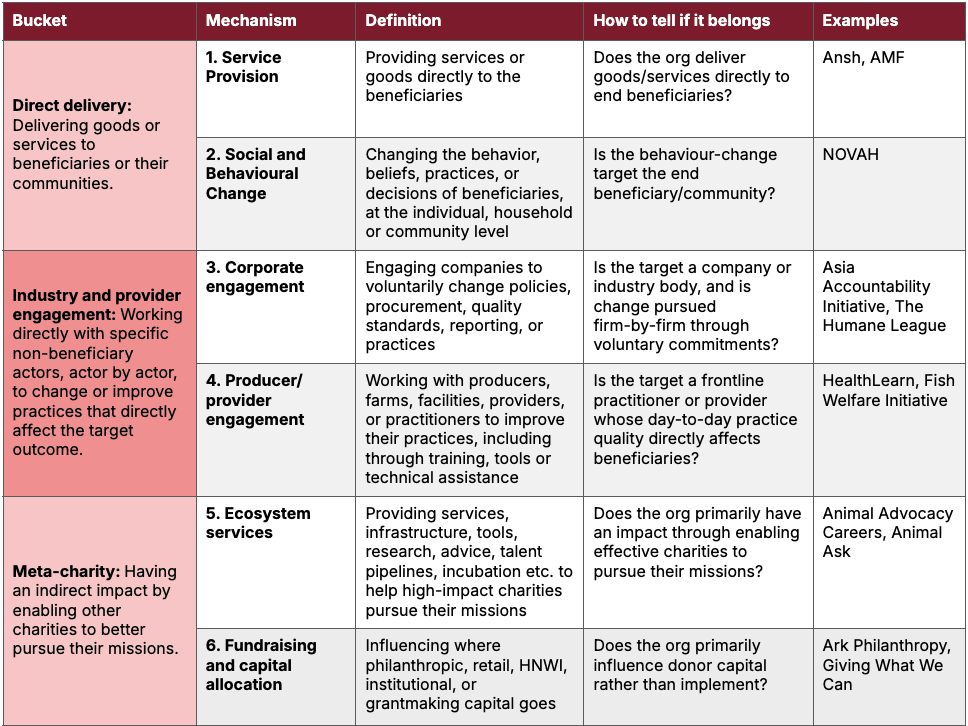
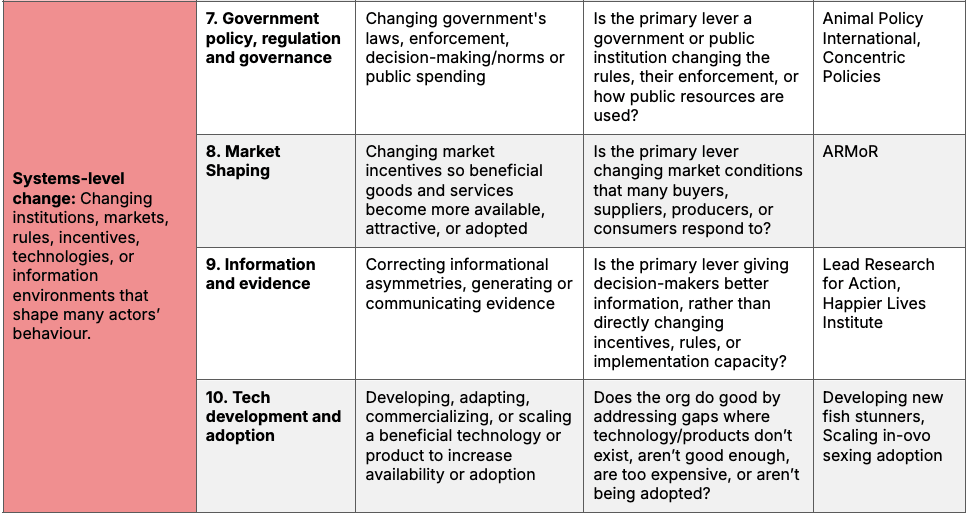
These buckets are far from clean. For example, technical assistance can fall under provider engagement, meta-charity, or system-level change depending on whether the recipient is a clinic, a charity, or a government ministry. Our aim is not to force every idea into a perfect box, but to identify the most useful reference class for research, recruitment, founder fit, and support. Meanwhile, organizations can sit across multiple categories at once or change over their lifespan. We suspect many example orgs may disagree with where they’ve been placed.
2.2. Implications
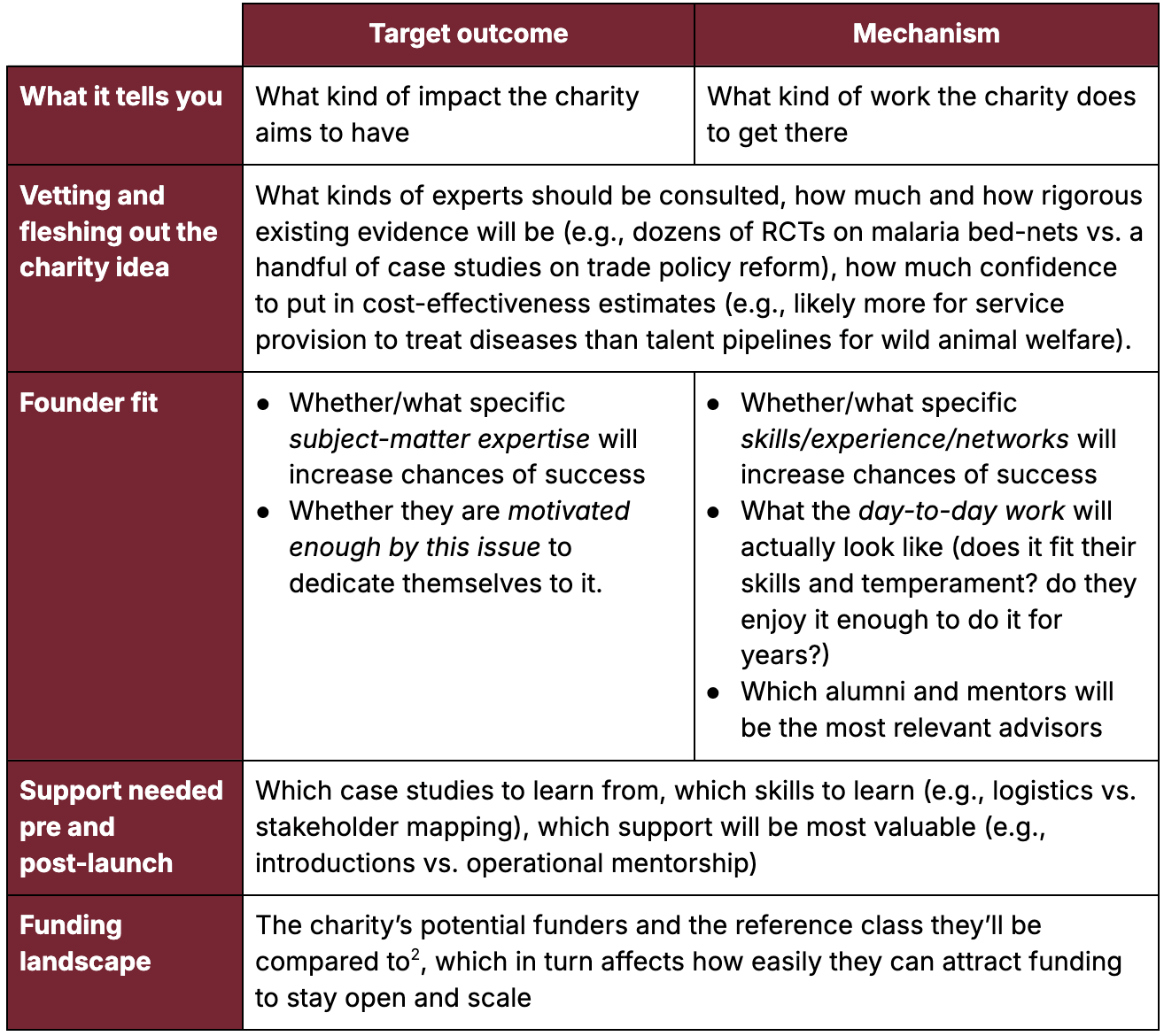
3. The Execute-Persuade Spectrum
3.1. The spectrum
Target outcome and mechanism are descriptively useful (telling us what a charity does and how) but they don't always capture the most important differences between ideas or organizations.
One of the most significant dimensions on which charity ideas differ is the degree of control the organizations have over steps along the theory of change. Rather than classifying ideas by the type of work they do, the execute–persuade spectrum assesses the degree to which success depends on the charity's own operational execution versus influencing external actors to change their activities. The key diagnostic question is: who needs to act for impact to occur, and what's preventing them?
Consider two health policy charity ideas:
- One aims to secure bans on leaded paint (e.g., LEEP). They work with regulators, who face informational and technical barriers, but have the motivation to act. They provide evidence and technical assistance that make taking action possible.
- Another charity aims to increase taxes on tobacco products (e.g., Concentric Policies). They face organised industry opposition, must build coalitions and persuade policymakers to shift policy in spite of entrenched interests.
- Both are health policy charity ideas, but the first is closer to a logistics challenge, and the second to a political campaign. These charity ideas each require different priorities when it comes to research focus, founder profile and support pre and post-launch.
3.1.1. Detour: Even execution-dominant ideas involve persuasion
It's worth clarifying that even execution-dominant ideas involve persuasion. This is usually targeted at individuals or entities with operational, rather than political portfolios. For instance, a charity may need to persuade beneficiaries to take up a service, or acquire permission to operate in a hospital from an administrator. This type of persuasion looks more like behaviour change than advocacy. Shrimp Welfare Project needs farmers to operate shrimp stunners correctly; Ansh needs kangaroo mother care nurses to follow treatment protocols; Notify Health needs parents to respond to notifications. This kind of persuasion is qualitatively different from convincing a regulator to prioritise your issue or overcoming organised industry opposition. The key crux is about adoption and compliance within a system the charity has direct access to, not about shifting the priorities or behaviour of powerful external actors.
Meanwhile, execution-dominant charities often eventually need to move toward the persuasion end as they seek truly massive scale, for instance by pursuing government adoption of their intervention.
..back to defining the spectrum:
We’ve divided the spectrum into four archetypical positions. These are not rigid categories – many charity ideas will have defining features of more than one position, and may move along the spectrum as they change strategy.
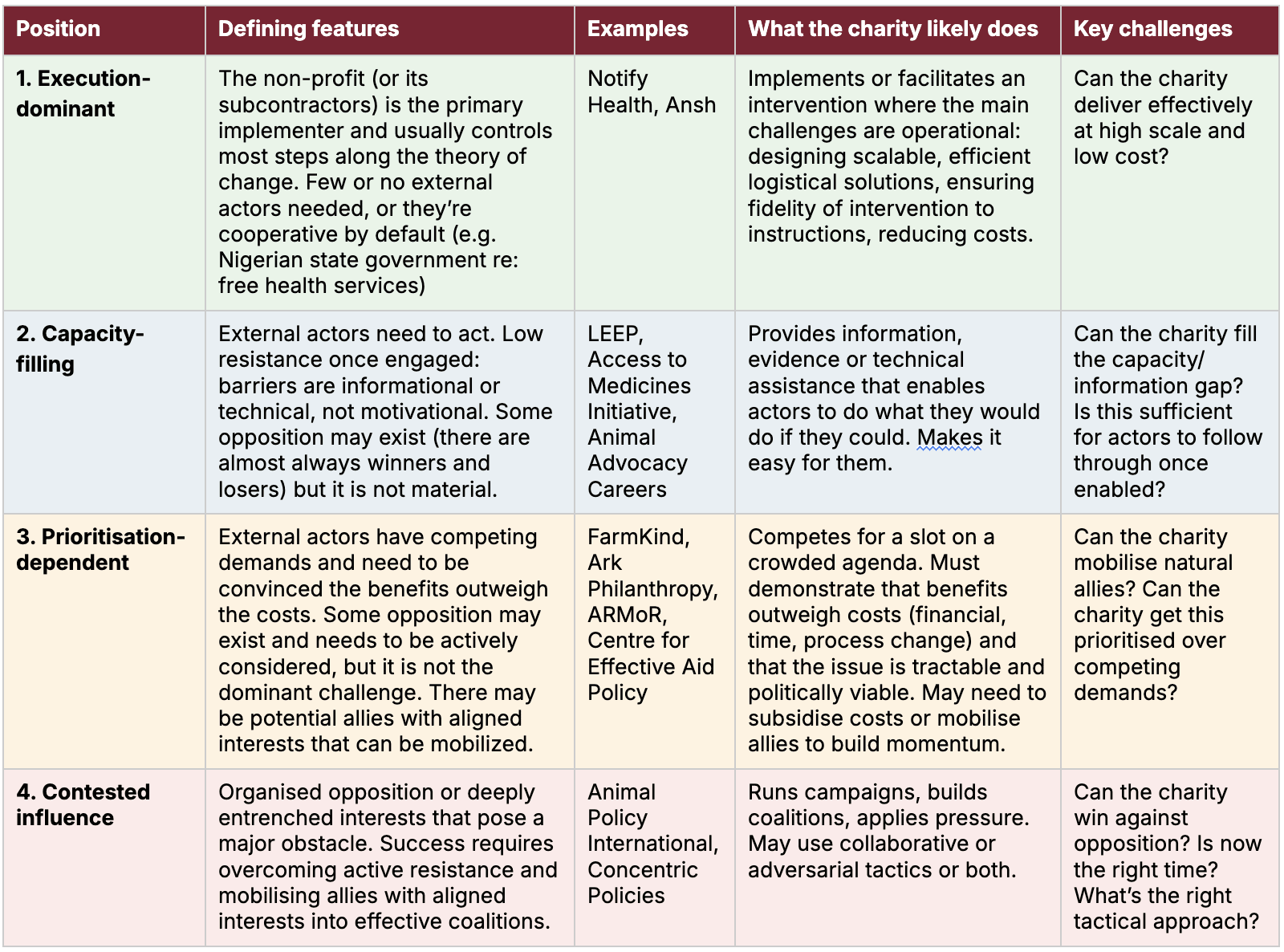
3.2. Collaborative vs. adversarial persuasion
As charities’ move towards the persuade end of the spectrum they’re more likely to encounter stronger opposition/gatekeepers[3]. When they face significant opposition, a key strategic question arises: should the charity take a collaborative approach or an adversarial one?
A collaborative approach calls for relationship-builders who can earn trust and find common ground with reluctant actors (e.g. ARMoR). An adversarial approach calls for campaigners comfortable with confrontation and public pressure (e.g. ICAW).
Collaborative and adversarial charities operating in the same space can be powerfully complementary – the "good cop, bad cop" dynamic. An outside campaigner applying pressure can make an inside collaborator's job easier, and vice versa (e.g. Global Food Partners and Asia Accountability Initiative when it comes to the transition to cage-free eggs).
3.3 Implications
- Vetting and fleshing out the charity idea: For execution-dominant ideas, the key question is how significant the effect size is per beneficiary and whether the charity can solve the operational hurdles to reaching beneficiaries cheaply and at scale. For persuasion-dominant ideas, more energy will be spent on assessing tractability, by mapping the goals, priorities, incentives and resources of relevant stakeholders and institutions. In the persuade end of the spectrum, understanding how decisions are made and what formal and informal rules govern decision-making is important.
- Scoping the charity's focus: For persuasion-dominant ideas, the high fixed cost of building a stakeholder network and the unpredictable timing of policy windows often favour specializing in a single jurisdiction (e.g. UK government) and becoming the go-to expert on a topic there (e.g. farmed animal welfare policy) who can pick from a range of sensible reforms to advocate for as opportunities arise (e.g. policy windows), as opposed to pursuing a narrow ask (e.g. banning low-welfare imports) across a wide range of jurisdictions. This means that charity idea researchers and founders should likely focus more on picking the right jurisdiction where there are multiple highly impactful and realistic policy asks, instead of picking the right policy ask to push for internationally.
- Founder fit: As ideas move from the execution end to the persuasion end of the spectrum, the founder profile shifts from operational to relational. At the execution end, founders need to be operators: skilled at logistics, driven to continuously and iteratively improve a repetitive process, able to identify which part of the intervention delivers most of the value and double down on that while cutting the fat. As you move toward the persuasion end, you instead may require persuasive communication skills, social and emotional intelligence or charisma (depending on the idea), and a relevant existing network may be very valuable. Where the landscape is contested and the approach is adversarial, founders will likely need to be comfortable with confrontation and resilient under opposition.
- Support and mentorship: At the execution end, the most valuable support is operational: case studies, pilot design, and cost modelling. At the persuasion end, it's stakeholder mapping, campaign strategy, and media skills. The most helpful mentors will have experience overcoming your dominant constraint, even if in a completely different domain.
- Branding and positioning: At the execution end, org name, website and public profile often matter less. In some cases beneficiaries may never interact with the org’s brand directly (e.g. if they engage only with an implementation partner). At the persuasion end, they matter a great deal: charities are asking powerful actors to trust them and take them seriously, first impressions are hard to undo, and public-facing communications can be weaponised by opponents (in some cases, organizations may need to keep their plans and true intentions private).
- Charity journey to impact: Persuasion-dominant ideas may require an upfront phase of credibility-building – earning brand recognition and trust, and building relationships and coalitions with key stakeholders – before they’ll gain traction. This often takes years, with long periods of apparent stagnation before a window of opportunity opens. Pushing for early traction as you would with an execution-dominant charity idea can sometimes be actively harmful, when it leads to rushed, low-quality engagements that burn bridges with the actors the charity needs to influence. Founders and funders need to be comfortable with long-term bets and harder-to-measure progress.
A charity's position on the spectrum need not be not fixed. Many execution-dominant charities that achieve proof of concept will eventually need to move toward the persuasion end as they seek truly massive scale, for instance by pursuing government adoption of their intervention. Founders and funders should anticipate this shift and the change in skills and strategy it demands.
4. The Explore–Exploit Spectrum
4.1. The spectrum
The second spectrum addresses a different question: how much of the model is already proven versus how much still needs to be figured out? Accordingly, ideas can be characterised along a spectrum between exploration and exploitation.[4]
At the exploit end of the spectrum:
- Well-developed, concrete intervention with a strong track record / evidence base
- The charity's job is primarily localization, implementation precision, and careful expansion: taking something that works and scaling it, or bringing it to a new context
- Narrower confidence intervals: we're relatively sure it can work and know roughly how cost-effective it can be
- Examples: Clear Solutions, Notify Health (a replication of Suvita, in Nigeria), First Embrace (a replication of Ansh, in Nigeria)
At the explore end of the spectrum:
- Requires significant research and design before a viable model emerges
- Wider confidence intervals (“big if true”): High upside if successful, but lower probability that it will (and low certainty in our estimates of upside and probability of success)
- In practice, the charity is more likely to deviate significantly from how it was originally envisaged
- Examples: Fish Welfare Initiative, ARMoR, Centre for Effective Aid Policy
4.2 Implications
- Vetting and fleshing out the charity idea: For exploit ideas, research emphasis is on validating the evidence, track-record and cost-effectiveness of previous work, and figuring out whether the target context is sufficiently similar to where the intervention has been proven. For exploratory ideas, research emphasis is on whether there is good reason to believe this could work, what key assumptions and known-unknowns the organisation will need to test early and identifying promising paths to consider exploring first. When researching exploratory ideas, people will hit the limits of what can be achieved through desk research sooner. Because animal welfare is a less mature field than global health and development, ideas in this space will be more exploratory on average.
- Founder fit.
- Exploit ideas need founders who are good at (and excited by)..
- Figuring out what made something work so they can replicate the ‘secret sauce’ and cut the least valuable ingredients (i.e. 80:20 it). Which parts of the process don’t add value? Which steps can you safely cut to get to scale faster?
- Building systems, processes and teams that can deliver consistently at high volume
- Not just copy-pasting, but adapting: paying close attention to the cultural, institutional and logistical differences between contexts, and mitigating what could prevent the model from working and tapping into the new setting’s comparative advantages
- Finding step changes: not just incremental improvement but reimagining how the intervention is delivered
- Explore ideas need founders who are good at (and excited by):
- Navigating ambiguity and charting a path where no playbook exists
- Balancing the tension between research and action, i.e. spending enough time learning and validating without getting stuck in analysis paralysis
- Being willing to pivot when evidence demands it, but sufficiently disciplined to test tactics properly before moving on
- Persisting for years without major wins or even identifying a promising intervention (while being disciplined enough to shut down when the search stops looking promising or it becomes clear you're not the right team to crack it)
- Spending significant time on the ground (if the charity directly serves beneficiaries there) – early exploratory work is messy and hard to delegate
- Both ends of the spectrum require creativity and innovation, but the scope is different.
- Founders who are less risk tolerant tend to find exploit ideas more appealing and vice versa.
- As explore ideas mature into proven interventions, the job shifts from discovery to implementation. Founders cannot know at the outset whether they will be a good fit for the eventual intervention, and so may end up hiring someone better suited to execute it, and may move on themselves.
- Exploit ideas need founders who are good at (and excited by)..
Information value: Opportunities and obligations. Exploratory ideas can generate impact beyond the charity's direct work: positive updates on tractability attract implementers and funders (e.g. FWI/SWP normalizing aquatic animal work, LEEP’s success and the subsequent ~$100M directed toward lead) while negative updates can redirect future investment away from dead ends. This means the information value alone can make pursuing an uncertain idea worthwhile – and sometimes, the currency of early success is understanding, not direct impact. It also means exploratory charities may have obligations beyond trying to build an impactful charity: They may need to invest in M&E to resolve specific key open questions raised when they first launched and they will need to put in the work to share what they learn with the ecosystem[5]
- Charity journey to impact: Exploit ideas often lend themselves to quicker early progress against clear milestones: pilot planning, pilot launch and monitoring, iterating to improve quality, scaling to reduce costs. Exploratory ideas can easily need 2-5 years to find a model that works at all. Sometimes, the reason a charity idea doesn’t have an existing track record to exploit is that it is harder to measure or has long feedback loops. This makes it harder for founders to know whether they're on the right track and harder to make the case for continued funding. It may be helpful for exploratory charities to have larger seed grants so they don’t face unhelpful pressure to move from explore to exploit prematurely.
5. Conclusion
Taken together, the three elements in this taxonomy give a richer picture of what any given charity idea actually requires. A charity idea's position on each of these three dimensions has implications for how it should be researched, who should lead it, what support will be most valuable, and what success looks like on what timeline.
This taxonomy is imperfect and will need refinement over time, but having a shared language for the differences that matter most enables more structured thinking and reduces the risk of defaulting to overly simplistic categories that lead to poor decisions.
- ^
A research area is a way of delineating research priorities through a defined scope. We think of research areas as an interplay of mechanisms of action and outcomes of interest. Ambitious’ Impact mostly focuses on within-cause prioritization, organized by research area. To decide which research areas to focus on, we carry out a small amount of targeted cause prioritization research.
- ^
Funders/evaluators often define their scope by target outcome and mechanism. For example, Africa Jobs Fund focuses on livelihoods (more specifically, migration and industrial development) as target outcome; GiveWell generally doesn't publish evaluations for charities with policy mechanisms; Navigation Fund don’t fund charities with individual diet change as their mechanism for helping farmed animals.
- ^
At the execution end, the change the charity is trying to make may be win-win, or have ‘winners’ and ‘losers’ but the losses may be minimal enough that no resistance materialises. As you move to the right, there may be more significant losses but which can be easily compensated (e.g. banning leaded paint means paint manufacturers need to change their formulation, but you can provide technical assistance to make this easier).
- ^
To be clear, all organizations do some amount of both exploiting what works and exploring new options, and the balance between both activities will likely change as their strategy and circumstances evolve.
- ^
In some cases the key uncertainty won’t require specific M&E, e.g. for Lead Research For Action a key uncertainty was whether finding new lead exposure sources would be sufficient to influence other actors to address those sources. In other cases, specific M&E needs may be requested during the ideation phase, e.g. for NOVAH we expect a quasi-experimental study to (a) measure IPV itself instead of upstream proxies, and (b) determine whether the existing studies generalize.
Suma @ 2026-05-07T10:46 (+2)
This seems very useful for the EA ecosystem, particularly in bringing a more nuanced language for distinguishing between different kinds of interventions and pathways to impact.
But broadly speaking, many of these categories have existed for decades in traditional public health and international development. For e.g. distinctions between service delivery vs systems strengthening, implementation vs advocacy, pilot vs scale-up, technical assistance vs movement-building, etc.
I’d love to see more more EA engagement with the existing literature and practitioner experience from global health and international development. There’s a huge amount of accumulated learning, including around public sector capacity, political economy, implementation failure, market shaping, coalition-building, and institutional incentives, that could strengthen overall thinking in this space.
In that sense, the primary value of this taxonomy may not be its novelty, but its role as a "translator”, i.e. adapting long-standing development thinking into a structure that is legible and actionable for the EA community.
SummaryBot @ 2026-05-05T18:43 (+2)
Executive summary: AIM proposes a three-part taxonomy (outcome × mechanism, execute–persuade, explore–exploit) to better distinguish charity ideas and guide decisions about research, founder fit, support, and timelines.
Key points:
- The author argues that overly simple categories (e.g., cause area or policy vs. direct) often obscure important differences between charity ideas and can lead to poor decisions.
- The taxonomy’s first component classifies ideas by target outcome and mechanism to better capture differences in theory of change, while remaining an imperfect, flexible framework.
- The execute–persuade spectrum assesses whether impact depends more on internal execution or influencing external actors, which the author claims is often a more decision-relevant distinction.
- As ideas move toward persuasion, they tend to face greater opposition and require different strategies, founder skills, support, and longer, less predictable timelines to impact.
- The explore–exploit spectrum distinguishes between proven, scalable interventions and more speculative ideas requiring significant research, with corresponding differences in risk, evidence, and founder tasks.
- The author argues that a charity’s position across these dimensions shapes how it should be researched, staffed, supported, and evaluated, and that ideas may shift along these spectra over time.
This comment was auto-generated by the EA Forum Team. Feel free to point out issues with this summary by replying to the comment, and contact us if you have feedback.
AïdaLahlou @ 2026-05-28T09:12 (+1)
This is really useful both from an idea generation point of view and also from the point of view of prospective applicants to Ambitious Impact, wanting to demonstrate how their prior experience might be relevant to a particular charity model. This belongs in the next edition of the Ambitious Impact book! :D