A reply to Austin Chen on his “keen debt” to FTX when hiring Caroline Ellison at Manifund
By Bland Garlic @ 2026-09-30T20:55 (+34)
New account here, created by an irate outsider to EA.
I started typing this as a response to a comment by Austin, in the discussion of his recent shocking announcement that his organization Manifund has hired Caroline Ellison. My reply to him ballooned to a size that merits its own post.
Please bear with me as I attempt to somewhat match this forum’s style. I will be consolidating some of the points that I and others have made less charitably on X and other sites.
--
General context:
Caroline Ellison, the former CEO of Alameda Research, was one of the convicted perpetrators of the FTX cryptocurrency fraud, along with her boss Sam Bankman-Fried (SBF) and two complicit software engineers. Together, these four EAs stole billions of dollars from FTX’s customers.
Austin Chen co-founded the Manifold prediction market, which received money from FTX, and he subsequently moved on to create a non-profit called Manifund (formally, Manifold For Charity), where Caroline Ellison now works for him.
--
Austin, I'm going to respond to this bluntly, even though I believe you meant well. This action creates an unacceptable flow of funds and benefits, starting with the FTX victims and ending with one of the people who defrauded them.
Nothing that follows is directed personally against Caroline Ellison, whom I happen to have known many years ago and don't resent. She did her time. Her contrition seemed to be on the genuine side. She is smarter and more self-assertive than she was made out to be, both by the press and by her own defense strategy. It’s my opinion that EAs – who sit somewhere on the long list of people she harmed with her crimes – may forgive her if they so choose. No pressure. The quality of mercy is not strained.
More generally, I believe that FTX was not primarily about the criminals themselves. EA's main failure at FTX is not that they let four bad people into their good people club. EA’s main failure is that the philosophy, as it turns out, can accidentally inspire big crimes, and EAs needed to reflect on that. Some have, rarely enough. But that's a separate discussion.
Caroline is not an ogre, and Austin, if you can convince Manifund’s stakeholders of your plan for governance in this highly irregular situation, then as far as I care, you can go ahead and employ her...
Except:
First, you need to give back the $500,000 grant. All of it.
This repayment will correspond to the July/August 2022 grant of $500k from FTX to Manifold, where you were a co-founder. Maybe the claim is more like $508k, as stated in the court filings, apparently to cover some additional prize payouts in October, shortly before FTX's collapse that November. Pay the whole bill.
There's also the separate matter of the "seed funding", apparently around $1 million, that Manifold received earlier in 2022 from FTX/Alameda’s venture arm. I can’t tell whether this stake is still held by the FTX bankruptcy estate, or whether the estate is treating it as another donation and lumping it in together with the $500k claim. Clearly you and your Manifold friends need to resolve this equity obligation too; however, it sounds like the sort of gnarly thing that will take time, given the multiple parties involved. I expect it will happen according to an acceptable process, so I am leaving it out of this post.[1]
But as for the $500k grant, you should find a way to pay it back independently, out of your own end. The need to repay it is obvious to me as an outsider, but I'm going to lay out the case to you here with the full verbosity for which this forum and its elder counterpart are famous.
A quick note about alternative facts
As an aside: I am also concerned by your past statements defending SBF’s actions, both in your contrarian post three days after the bankruptcy when any sensible observer could already see that fraud had been committed, and in the years since.
I am tempted to ask you whether have ever accepted the plain reality of these infamous events: that FTX was a real crime, not just a mistake; that the crimes started within months of the exchange’s founding in 2019, and escalated thereafter; that FTX was not a bank and so the subsequent performance of any investments has no bearing on the criminality; that the depositors have not been fully repaid in a true economic sense; that SBF took risks that were not his to take; that Michael Lewis got taken for a ride; that CZ’s role was incidental to Sam’s self-inflicted downfall; and that it is only through quirks of the legal process that EA and rationalist orgs have been able to keep so much of the money.[2]
But it doesn't seem productive to insist that you affirm these facts when you may or may not believe them, and moreover, you say you’ve been legally advised not to discuss your opinions in detail. So I will give you the benefit of the doubt and just assume that by now, your professed admiration of FTX is mainly directed at certain innovations by the giving arm, and I will return my focus to the more tangible request here, which is that you repay the money.
Actions speak louder than words, after all.
The chain of obligation
Let’s start by reviewing the history of how all these assets got mixed together. I am not speaking in a technical legal sense of “commingled” or whatever, but rather in a functional, moral sense, which is probably more stringent.
- In July/August of 2019, Nishad Singh wrote the backdoor loophole code. Thereafter, all money leaving either FTX or Alameda was functionally indistinguishable from FTX user funds. (There was theoretically a limit to the loophole, but SBF and Gary Wang could and did increase that limit at will, so the borrowing from FTX users was functionally unlimited.)[3]
- By June 2022 at the latest, it was clear to SBF and Caroline Ellison that there was an $8 billion hole in their balance sheet.
- In July/August of 2022, FTX’s philanthropy team paid $500k of these FTX user funds to Manifold, the prediction exchange where Austin Chen was a co-founder. As phrased, this grant was largely intended for regifting, but from another perspective, it was a perk and an inducement for the power-users on your growing exchange platform. It was also free publicity. Under the circumstances, we must take the least favorable perspective.
- Anything that Manifold paid Austin in salary or equity, up to $500k, was functionally FTX user funds.
- Anything that Austin took (or will take) with him to Manifund was FTX user funds, up to $500k. This may include the opportunity cost of switching from a for-profit role to a new non-profit.
- Anything that Manifund is paying Caroline – whether it’s salary, or in-kind as work experience and rehabilitation, up to $500k – is FTX user funds.
Again, we are not in a civil court here, and I’m not opining on the ongoing litigation. Rather, we are in this unprecedented instance where a fraudster is being welcomed back into her old clique with warm expressions of gratitude. We need to look at each step in this chain through the least charitable lens. We should count the intangibles against you. In the broadest possible way, we must acknowledge here that money is fungible.
Note that in Step (3) above, Caroline does not seem to have personally directed the grant money to Manifold. Rather, it was Will MacAskill and Leopold Aschenbrenner, working at the FTX Future Fund, who signed off on it. If we asked them, I doubt that they would say that their intent was to provide for a future soft landing after prison for FTX/Alameda executives in a scenario where SBF turned out to be running a big fraud. They didn’t know!
But we’re not talking about an explicit deal; we’re talking about a general spirit of reciprocation. When the fraudsters were spreading all this money around the EA ecosystem, even turning up the firehose in some cases as they realized the size of the Alameda balance sheet hole, their motives were surely mixed. I have high confidence that SBF and his comrades really believed in the EA causes they sponsored, but it’s reasonable to speculate that they were also hoping to cultivate a store of goodwill among EAs, which could be called upon in the increasingly likely event that their scheme fell apart. Regardless of their exact mix of motives, it would be highly improper to reward this behavior by the four fraudsters.
You, Austin – and by extension EA, for all an outsider might care – need to be totally, thoroughly beyond conflict of interest, before you even try to rehabilitate a friend who is a party to an $11 billion fraud. You – and by extension, EA – need to be totally, thoroughly beyond the hint of an implicit quid pro quo.
One could probably go even further. As described in your announcement, you received other benefits as well – a conference, a retreat, opportunities, and so forth. One could assess the cash value of your Bahamas trip. One could also investigate whether any other donor money that will flow through Caroline’s hands at Manifund is partially downstream of other FTX grants, as is inevitable when handling EA money.[4] But I think that’s all probably de minimis, in the grand scheme. If you err on the side of overpaying by returning the full $500k, I believe it would easily cover these other conflicts, too.
Your good intentions
As I said at the outset, it’s clear to me that you truly believe you’re doing the right thing by giving Caroline a second chance. I have met you a few times, and you came across as kind and humble. You have done things that I thought were neat. [5] What I know of your work has often involved you standing by your stated principles. And in making this unconventional hiring decision, I think you’re trying to live by principles such as gratitude, loyalty, reciprocity, fairness, and forgiveness. This is respectable, except that here, the principles are grossly misapplied.
If someone does you a favor, it is natural to want to pay it back. If someone does you a favor using stolen money, then it is no longer correct to pay her back, at least not until you’ve done your best to make the primary victims whole. It is certainly not okay to pay her back with the money that she stole.
As you cling to the bulk of this $500k that was given to Manifold, maybe your stubborn attitude comes partly from a sense of fairness. Maybe it’s not “fair” that you were on the verge of getting to some settlement that would let you and your former colleagues at Manifold off the hook for most of the $500k. If the judicial process is definitionally “fair”, then paying anything extra must feel unjust.
Maybe it doesn’t seem “fair” that the bankruptcy team has tried for years to pierce through the dual nature of the FTX regranting landscape. On the one hand, it was a creative way to distribute funds through a network of trusted deciders – a technique which Manifund, incidentally, has copied and iterated upon, with what I’m told are promising results. On the other hand, it had the effect of splitting up the stolen money among thousands of little entities, behind several layers of proxy, making repayment arduous, and letting an entity like Manifold shrug and say they don’t have the money anymore. It might not seem “fair” to you that the cleanest recourse for the creditors is to just sue the first recipient for the full sum. But sadly, that’s a peril of doing regranting for a reckless and duplicitous guy like Sam.
From the outside, to be frank, it’s quite infuriating that in the good times, whenever all of the EAs and rationalists are trying to save the world, it’s one big team with everyone largely supporting each other, but then as soon as someone does a crime or owes money, suddenly none of these orgs have ever heard of one another.
Anyhow, Austin, let me bring up your explanatory comment that I began typing this post in response to. In it, you lay out the stats of Lightcone Infrastructure’s settlement with the FTX bankruptcy team. You offer up their stats “[f]or reference”, as if it’s some sort of relevant benchmark. By your numbers, it seems that Lightcone returned around 40% of what they got from FTX, and kept the rest.[6]
Maybe it doesn't feel “fair” to you that Lightcone got away with over half of their haul, and you're being asked to pay your whole bill. But Lightcone is not employing Caroline. Lightcone's share of the loot is not flowing brazenly into the hands of one of the perpetrators. Lightcone did not write a forum post that basically says "QUID PRO QUO" in giant bold letters for all the world to see, rubbing it in the face of any FTX depositor who reads it. I suppose we should applaud your honesty about your motives, but if this flow of funds weren’t already damning on its own, your shameless rationale would seal the deal.[7]
The point is, what’s fair for Lightcone and other orgs is not what’s fair for you. The bar is higher for you now, if you want to pay Caroline even one dollar.
Lastly, in hiring Caroline, I do think that you’re sincerely trying to demonstrate some virtue like Christian mercy and forgiveness. I can honestly see the case for that, in isolation.
But in the complexity of our lives, context matters. Under the current circumstances, it is not your place to dispense mercy. You are sitting, in your own words, upon a “keen debt” to FTX. While I imagine the turmoil of the FTX bankruptcy has been rough on you, you are not a primary victim of the fraud. You do not have the standing to forgive her in this manner.
Buy yourself that standing, Austin, if you like. If you truly believe in this grand gesture of yours, then pay up, more than may be legalistically required of you.
Those are the main principles that I think are being misapplied.[8] Now, let’s turn now to the future. You have three options at this juncture, as I see it.
Option 1: Dismiss Caroline
Bow to the pressure and amicably part ways with her.
As I understand your motives, I doubt this is what you wish to do. There are plenty of people in these comment sections who want to see her head on a figurative pike, and maybe yours as well. Their reasons are quite robust. But I sense that you've dug your heels deeply into what you see as a principled stand.
Again, I can respect your intransigence. It would be in character for you! Consider the controversies around your platforming choices at the Manifest conference, which people have dredged up in their reactions to this hiring announcement. As much as I disagree with those radioactive personalities whom you allowed to attend and speak, I can appreciate the principle at play: Free exchange of ideas has always been a rationalist value.
Of course, the attempt to “cancel” your conference over questions of speech was quite a different beast from people’s desire to dissociate from you now based on your intolerable actions. And of course, your attempt to divert the current discussion into that well-trod territory of Manifest speakers was squirrelly and obvious. You’re better than that. Repairing trust will take more than just thanking people for their criticism and then deflecting.
But anyway, I think there is a narrow parallel here. With Caroline as with the Manifest speakers, you seem to be determined to take an unpopular course of action no matter if it’s costly.
So why not pay the cost?
Option 2: Pay back the $500k to the FTX creditors
Work with Manifold to get this grant money back to the FTX bankruptcy entity – not as a drawn-out settlement, but as a unilateral concession. It should come from yourself, as the one who is passing on this improper flow to Caroline, rather than from anyone else on the Manifold cap table. I hope that the various parties can find a way to minimize the disruption to your other legal wranglings as you do this.[9]
As someone who has run an exchange and understands markets, you surely know that the creditors have not been fully repaid in a true economic sense, because FTX itself caused the artificially low dollar value marks at the moment that Sam admitted defeat. I’d be happy to elaborate if it’s unclear.
Perhaps your attempt to keep some of the Manifold grant money feels like yet another principled stand to you, similar to hiring Caroline. I could probably steelman each of these two defiant stances independently. But when the two actions are put together in the full context of your entanglement with FTX, your stance against full repayment has far less merit.
Incidentally, I would argue that repaying the depositors is a worthy act on its own merits. Indeed, if repaying the victims of EA – beyond what is exacted legally – is never an EA cause area, why would any normal person trust EAs to align a lawnmower, much less an AGI?
Perhaps restitution doesn’t strike an EA as the most “effective” cause. Perhaps you know how to spend this money better than the FTX creditors. But we should be skeptical of any belief that even faintly echoes SBF’s apparent attitude, whereby it is justified for EAs to take and invest other people’s money because EAs will use it in smarter and more altruistic ways.
(If it helps to ease your mind, please know that this is not some sort of shakedown. I am not an FTX creditor. I am writing this out of an outsider’s sense of justice. Also, I feel some cultural affinity toward EAs despite my many disagreements, and I hate to see you shoot yourselves in the foot.)
Further concerns in the case of Option 2
Repaying the money won’t put you completely in the clear, as you can tell by glancing at the comments. You’ll still need to win people over, and it will be an uphill battle in many cases. Nobody is obligated to forgive a criminal for the harm she caused in the past, and there are also some practical questions going forward.
Manifund’s donors and other stakeholders should still ask diligent questions about Caroline’s role(s) and your plans for supervising her, above and beyond the baseline transparency that Manifund espouses. They can ask if there’s a competent, independent board; a CFO checking the books, even if they’re part-time; and the other standard structures that would make the governance look better at Manifund than at Alameda and FTX. It’s a low bar!
Trusting a white-collar criminal with money-related duties is quite weird. As always, you should be deliberate about spending your “weirdness points”. That admonition is less for the sake of optics than for efficacy. Best practices exist for good reasons.
And of course, if there’s any further malfeasance from Caroline, you’re on the hook, reputationally! I personally don’t see her as an especially high recidivism risk, given the right structures; nonetheless, you’re the one closest to the question who is making the call.
But really, these are all internal questions for EA, and they might be surmountable. Outsiders like me have less reason to care about whom EA decides to entrust with which responsibilities, than we do about basic justice for the victims. The FTX fraud must not continue.
Option 3: Throw your entire contacts list into disrepute
Your third option is the default outcome, if you are too stubborn to do either 1 or 2.
In this scenario, EA is no longer saddled with just the FTX fraud that happened years in the past. EA is saddled with an ongoing FTX fraud, where the loot cycles back to one of the perpetrators.
I appreciate the many EA and rationalist voices condemning Austin’s actions, but at the end of the day, words and upvotes don’t count for much to the outside world. The public is well aware that EAs’ actions and outcomes can diverge wildly from their professed beliefs, as seen famously at FTX and Alameda. We will look at what EAs do, not what you say.
The newsreel here is something like, “EA is still doing the FTX fraud”, and it would take a visible, durable schism to separate Austin from EA at this point. Basically, we would need to see a whole lot more of this:
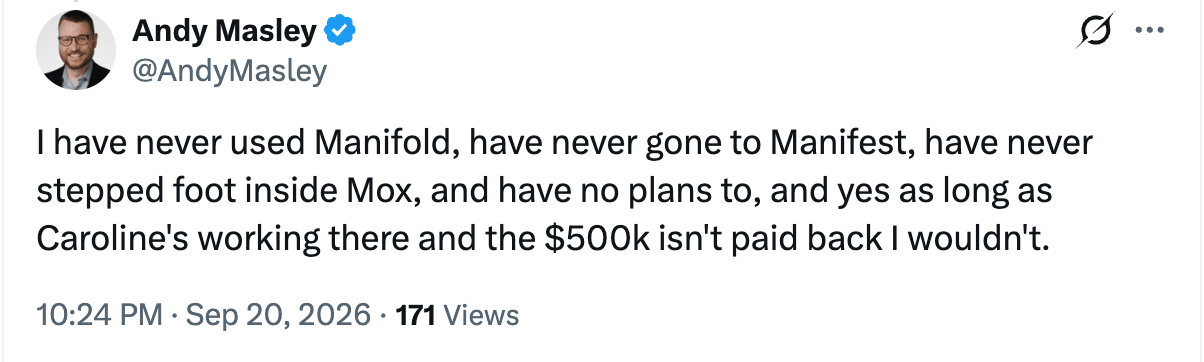
Well said, Andy.
Austin, you may be within your legal rights to choose Option #3. I wouldn’t know; IANAL. But if you do, the condemnation that you bring upon yourself and your endeavors will be far more righteous than you saw for a more debatable issue like the Manifest speaker list.
That’s how I see your current set of options. Caroline is not eternally contaminated as a human being. What’s contaminated here is the money you’re paying her.
- ^
If, in your own honest estimation of the opaque $1M seed funding situation, you have received additional windfalls from FTX that won’t be recouped via the legal process, you should probably repay that, too, at a time when it’s feasible. But VC is hard to analyze from the outside, and again, the equity is not my focus here.
- ^
Of course, there are also plenty of non-EA beneficiaries of SBF’s wild largesse, such as celebrities and politicians, who have managed to hold onto some of the money, too.
- ^
Wang was the CTO of FTX, and Singh was the Director of Engineering. These are the “two complicit software engineers” I mentioned at the outset.
Based on the legal filings, it appears that Nishad Singh worked for Manifund at some point, creating a similar conflict to the one presented by hiring Caroline Ellison. To my mind, this conflict is all the more reason for Manifold to voluntarily pay back the $500,000 grant.
For completeness: There was a fifth FTX culprit, Ryan Salame, who was charged only with the campaign finance crimes. As a non-EA, he was outside the core conspiracy, and thus did not have much useful testimony to offer the prosecutors. His plea deal was therefore far harsher than the treatment given to Ellison, Wang, or Singh, and he was sentenced to 7 years.
This struck many people as deeply unfair: His crimes were less serious, yet he was sentenced to more time. Too bad – that’s how the system works. Plea deals are how the feds convict a kingpin. I think there may be a game theory puzzle about this.
- ^
We’re talking about trace amounts here, I’d guess, since donors and recipients are generally two distinct groups. But they do blur together occasionally, creating strange cycles.
- ^
For example, you retroactively funded VaccinateCA for their excellent work during covid. In that case, it was a reward for good behavior!
- ^
Minus legal fees
- ^
In this later tweet, you rephrased this quid pro quo language in a slightly less galling way, centered around the FTX Future Fund and not the seed funding from the venture arm or other early opportunities you received.
However, there was little meaningful distinction between the Future Fund and the entities doing the fraud. As described by David Thorstad in his write-up of the present scandal: "By all appearances, there was no such entity as the FTX Future Fund. The fund was not a separately incorporated legal entity, but rather a project of FTX through which the company distributed funds, including misappropriated customer assets, to primarily longtermist projects."
- ^
Here is one more principle that may or may not be at play: a contrarian sort of honesty.
As I said at the outset, your current stance on the basic facts of FTX is hard to discern, given that you’re under legal advice to stay mum. I do want to give you the benefit of the doubt. But it’s possible that you privately disagree with the outside world and do not believe that this money was stolen from FTX users. It’s possible that you’re trying to act in a way that’s truthful to your dissenting version of events.
If that’s the case, please consider that you are not just acting for yourself here. I would expect that many stakeholders of Manifund and of your other undertakings have accepted the consensus reality. If you take them this dubious ethical road, you are enlisting them in your revisionist history against their assent. You are tying their reputations to your hot take.
But again, I want to assume you’ve come around to accepting the facts. If Caroline’s apology is truly genuine, as has been claimed, then it encompasses an understanding of what happened. Hopefully she can clarify the essential facts for you.
- ^
To elaborate: I’m cognizant that this voluntary repayment may set back a negotiation that’s been in progress for years, forcing the parties to lose some hard work and re-do some steps, with more legal fees all around. I hope that such side-effects can be limited. I know it’s already a sore point for some people that SBF, with his crimes, gave so many lawyers a generous payday. I'm also aware that the FTX estate is playing hardball, and they've made at least one filing relevant to Manifold that seems quite spurious and was thrown out by the court.
I’d be willing to hear more offline about realistic ways to repay a satisfactory amount while working within a legal reality that you can’t discuss publicly.
Austin @ 2026-09-30T22:29 (+29)
Hi! Thank you very much for writing this. It's clear that you've spent a lot of time thinking about this subject, are well-informed, and care about doing the right thing. I will aim for a quick response now in the interest of having you & the public understand the current state of things; I might like to do a more thorough/thoughtful response in the future, but will have to balance that against ongoing bandwidth and legal counsel. (I also have a private letter I've been circulating about this situation which I'm happy to DM you, provided you don't share without checking in.)
I am considering a range of options for what to do about the lawsuit. As I've previously written, and no doubt you've seen:
The $500k was a grant (not investment) from the Future Fund, to fund a program where successful Manifold traders could choose which charities would receive donations: https://forum.effectivealtruism.org/posts/mbBfFHKEDBTwTSSJX/predicting-for-good-charity-prediction-markets
Manifund ran this program for ~2 years and distributed most of this funding to charities & charitable projects, with the top 3 being Givewell (~$61k), LTFF (~$38k), Rethink Priorities (~$27k). We offered to return remaining funds to the estate; we are still in litigation. This case has been going on for years, and may continue for months at least; litigation takes a while. I do hope to write a retro on this overall program someday.
And then, some context on Manifund's finances: we're not an especially rich organization. We've never received a grant from CG, or most other philanthropic funders; we're primarily bootstrapped off of a 5% ops fee when we match projects and donors. As of earlier this month, we held an estimated $6-8m of assets, depending on how you count, but most of it is assigned to various Manifund donor accounts, or subprojects like Frame Fellowship. See https://manifund.org/finances. We estimated our net unrestricted assets at about $400k, which is something like 3-6 months of runway across all of our ongoing projects (primarily due to ongoing burn from operating Mox).
So, I am mostly considering whether I should make a large personal donation to Manifund to help resolve the lawsuit. I do have some money personally, mostly from having worked at Google for a couple years, and then through public stock investments; but, not that much money. Between me and my wife, we have ~$1.6m in liquid assets. (On paper, my Manifold stock might be worth another $1-2m, but for various reasons I think it's correct to sharply discount that number; for example, the original 3 founders have all left Manifold.) Sometimes, $1.6m feels like a lot, and sometimes, given our 2 kids and the cost of SF, it doesn't feel like very much. (FWIW, I've never taken a salary at Manifund, and at Manifold the founders drew a salary of $80k-$100k, as we were trying to conserve runway.)
Anyhow, I honestly would be pretty open to picking option 2, if it meant that Manifund could work with Caroline in a capacity that is endorsed by the community and the world. (It does depend a bit on Caroline's own plans too.)
I appreciate your writeup for laying out these considerations. Some of my worry is that even if we return the full amount, most people will continue thinking that they don't wish to collaborate with Manifund; your post (and, Andy's?) provide some evidence to the contrary. I think I'll set up a quick EA Forum poll for others to weigh in on this matter.
Austin @ 2026-09-30T22:49 (+5)
I've set up a poll now on Manifold:
(I first tried an EA Forum poll, but 1. it error'd and wouldn't create, and 2. it doesn't support multiple choice, just a spectrum agree/disagree, and I couldn't figure out how to express these options correctly.)
Bland Garlic @ 2026-10-01T00:23 (+1)
Thank you for the forthcoming response. I would be interested in seeing the private letter you mentioned at an appropriate time. Let me register a few more thoughts here before I see it.
I don’t have a good sense of how the wider community would react, and obviously you’re not going to please everybody. But from my perspective, if you return $500k and you assuage some of the governance concerns that I mentioned here under “Further concerns in the case of Option 2”, it would go a long way.
Something I can’t predict is whether you would see holdouts who insist that you should return some or all of the $1M seed funding, too. If it helps, I could spell out in more detail why I decided not to push that point:
- It has something to do with the complexity of equity, as I said in the post, as well as the number of parties who have a stake. The negotiations are still in-progress, and even without seeing the private letter I can guess that it’s thorny.
- It probably also counts for something that the seed investment was made in early 2022 before the culprits necessarily knew how much user money they had stolen.
- Even from the inside view, you won’t actually know for sure how much you have cleared from Manifold equity until some sort of liquidity event, and you would also have trouble personally repaying anything so large before that time.
All of this has been pretty messy to dig into, but as I attempt to reason through what is being under- or over-counted in the various interpretations of this story, I think $500k is a decent ballpark of your own excess “moral” debt to FTX beyond what will be legally reclaimed.
Moreover, I would say that on a practical level, the goal is to see you repay a meaningful amount of what FTX bestowed on you, to show that you recognize the conflict and want to fix it. By this approach, a reasonable amount would be a tangible hardship without ruining you – I’m aware that you have a young family and that some of your investments are illiquid. I think the $500k would meet that bar.
Austin @ 2026-10-01T05:17 (+3)
Okay, unfortunately the EA Forum DM functionality is also broken for me, atm. Could you post a reply with an anonymous email address for me to email the letter to? I'll email from austin@manifund.org.
Separately, you seem to think the $500k figure is particularly important. Does that mean that, even if we reached a settlement with the FTX estate to return some lower amount, you believe that we ought to return $500k anyways? This is how I interpret your original post, but this seems somewhat unintuitive to me and I'd appreciate you explaining more.
Bland Garlic @ 2026-10-01T18:14 (+1)
I will be in touch with you.
Yes, I think that money should be returned beyond the amount that you would settle upon. As I wrote in the post:
it is only through quirks of the legal process that EA and rationalist orgs have been able to keep so much of the money.
In most cases, the outcomes of that legal process seem acceptable, but not in this case of Manifold:
The point is, what’s fair for Lightcone and other orgs is not what’s fair for you. The bar is higher for you now, if you want to pay Caroline even one dollar.
Basically, I believe that there is a legal debt and a functional debt. The legal debt, by definition, is whatever settlement competent lawyers arrive at. The functional debt is generally greater. For most EA orgs, it would feel fine to write off the functional debt in exchange for some gratitude toward the system and some soberness around the facts and lessons of FTX. But in your case, it would be best for you to settle the difference, lest you end up paying Caroline with what is functionally FTX money.
So for example, if Manifold/Manifund were to return $200k of the $500 through a legal settlement, then it would make sense to pay an extra $300k voluntarily if you want to employ Caroline (and retroactively, Nishad). This would resolve the conflict of interest, in my mind.
(I do see Nishad named in one of the FTX estate's filings, and perhaps they will also press the issue of Caroline when they find out. This may move the needle towards a fuller recovery, but still seems unlikely to hit the full $500k, and I think you should make up the functional difference.)
Mechanically, I do not know whether your eventual settlement will itemize the breakdown of the $508k separately from the $1m, but you get the general idea.
Separately, there are other mechanical steps I do not understand here, e.g. when you write
I am mostly considering whether I should make a large personal donation to Manifund to help resolve the lawsuit.
that seems like it's the first of two steps. First, your money goes into Manifund, and second, the money somehow goes from Manifund to the FTX estate. I do see that Manifund has been added as a defendant alongside Manifold. But are you imagining that this money gets held in some designated account at Manifund until the case is settled and you have clearer instructions on payment?
There are other technical points that are not clear to me, but I'm sure there's a way for these details to all make sense.
Czynski @ 2026-10-01T01:25 (+2)
The accounting of "the chain of obligation" seems inflammatory to me. Exaggerated beyond the point where it is plausible. I don't think it's morally correct or reasonable.
Also, in a practical sense: If we had taken that perspective closer to the time, rather than use the legal process... there pretty much wouldn't be an EA funding ecosystem left. Not because there was no other source of money, but because every funder would have had to give back money they didn't have, all at once, money that had been donated through them but not to them, and which they'd have been held accountable for anyway. Cut the heart out of everyone but GiveWell and probably OpenPhil/Coefficient, and the ecosystem's gone.
Bland Garlic @ 2026-10-01T01:57 (+4)
I wouldn't approach it the same way in most cases. The majority of orgs in the ecosystem are not paying forward money to one of the same culprits who stole it. My logic in that section is also more stringent than what was applied to the politicians, celebrities, and other non-EA outflows from FTX.
From the outside, I really don't mind it that most EA orgs followed the legal process to its conclusion, as is their right. You can count it in the column of EAs acting like normal people for once, which is always welcome. If everybody in all the different outflow categories (both EA and not) pushes back in court, and everybody ends up repaying some but not all of what they got from FTX, then that's the system at work and there's a certain justice to it.
(The politicians didn't pay anything back, if my memory serves me. They just made some small payments to generic charities. But what are you gonna do.)
So yeah, the only reason I'm calling for a voluntary repayment beyond the legal process in this case is because of the highly nonstandard hiring of Caroline (and Nishad) at Manifund and the quid pro quo it implies.
Does that help clarify at all?