Forum feature update: n-dimensional debate sliders
By Toby Tremlett🔹 @ 2026-04-01T06:42 (+110)
Also on my substack.
A piece of feedback we've had a few times on our debate weeks is that the debate slider shouldn't be single-dimensional.
When you agree or disagree with something, you also want to be able to signal your confidence in your belief. It's time-consuming to do so by explaining yourself in a comment, and percentage agreement isn't necessarily the same thing as confidence in your agreement.
So, not to worry, we're now introducing a second axis, like so:
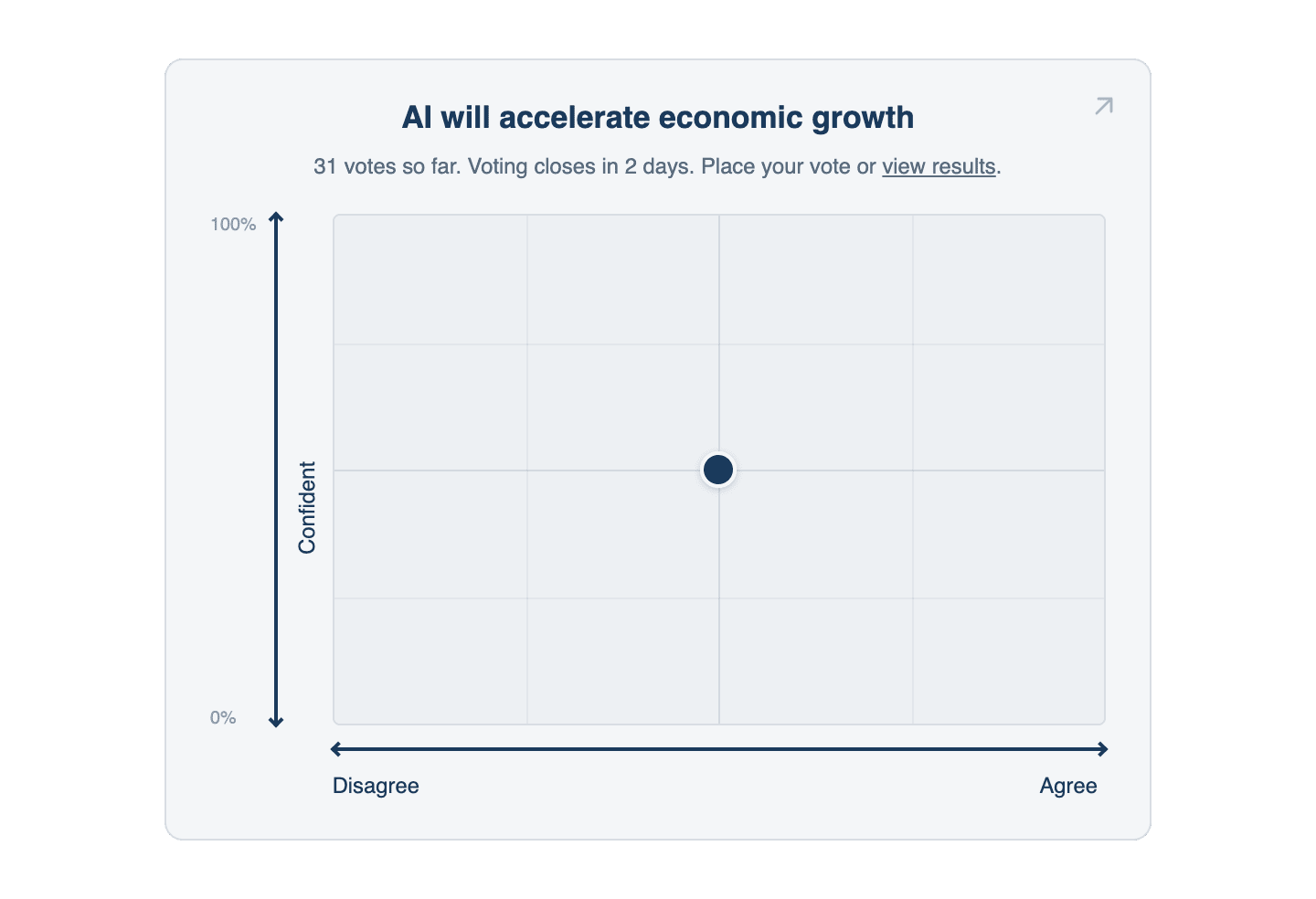
…or, we were going to. However, once I finished designing this and we tested it internally, I realised that I was still pretty frustrated.
I always wanted to express, especially with more controversial questions: how related is this belief of mine to the rest of the beliefs that I hold? Should people who come across this, in a year or two years, think of this as representing what I think? Should they use this in their model of me? Is this belief more like a leaf, which a tree can lose and remain itself, a branch, or the trunk? I'm adding one more axis which runs from correlated (with my web of beliefs) to anti-correlated with my web of beliefs:
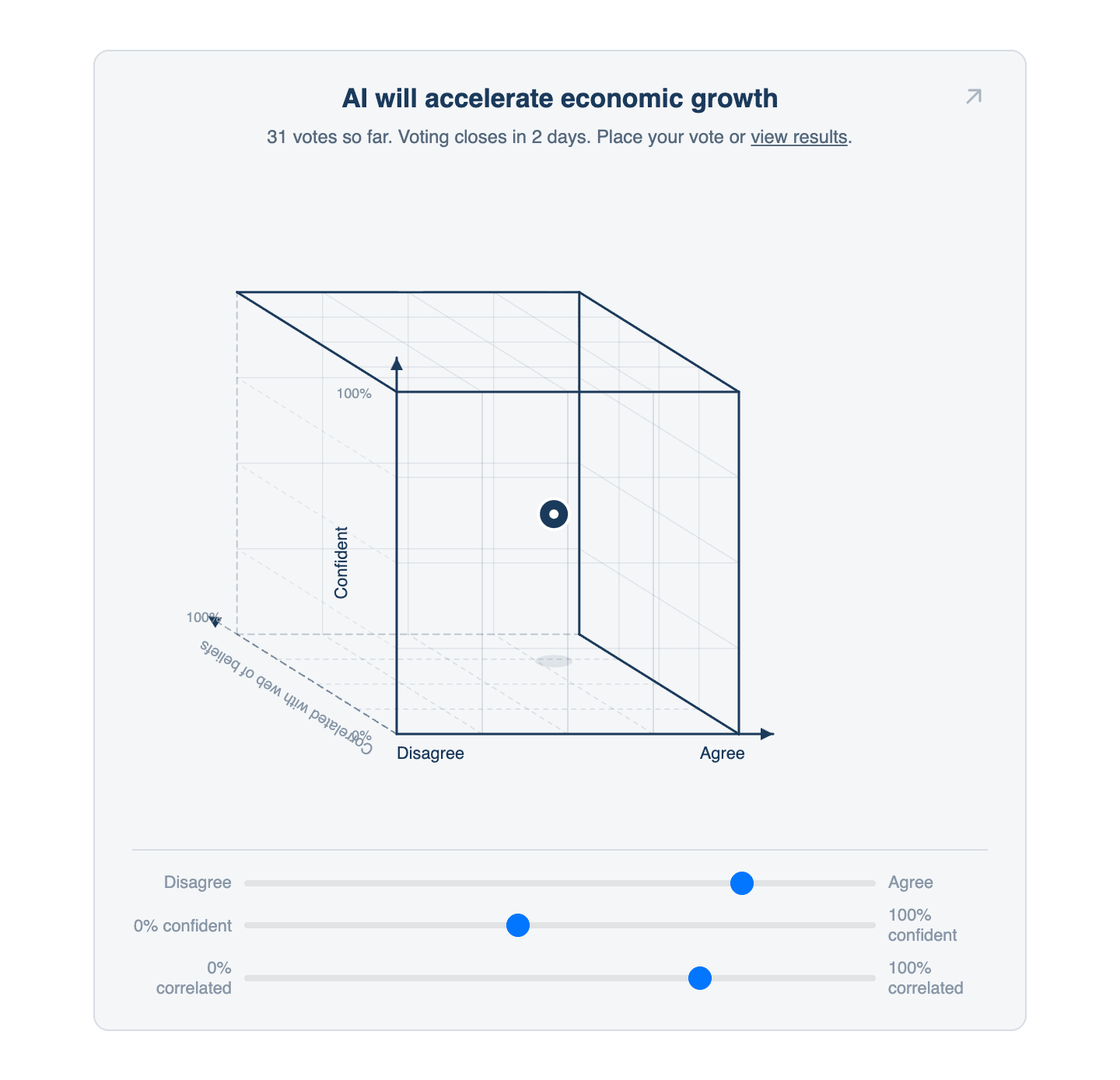
Once I was done with this, I felt, I'm not afraid to say, pretty smug and proud of myself. I decided I'd take the rest of the day off as a treat.
As I do with all the spare time I have, I revisited some classic Effective Altruist thought. To my shock, halfway through Bostrom's seminal paper "Existential Risk Prevention as Global Priority", I saw the below graph:
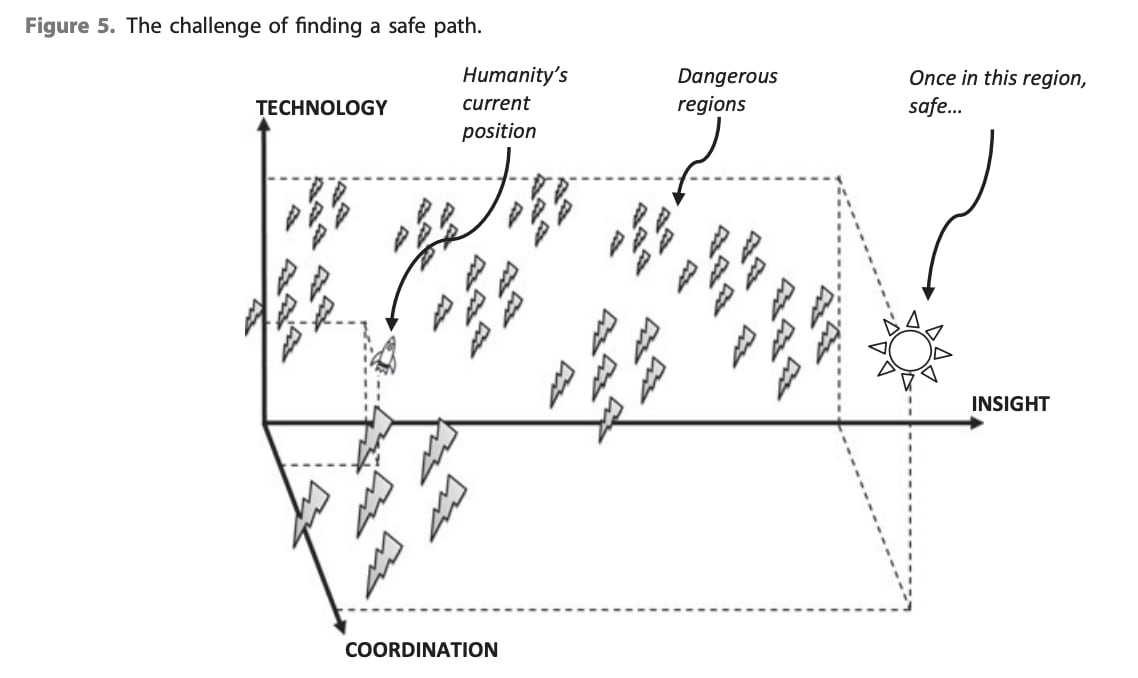
My oh my, I thought, that's one hell of a graph.
They say a picture speaks a thousand words, but what about multiple clip art pictures, labelled for even more detail? Bostrom’s work had dwarfed my achievements. I couldn't let this stand. I returned to work…
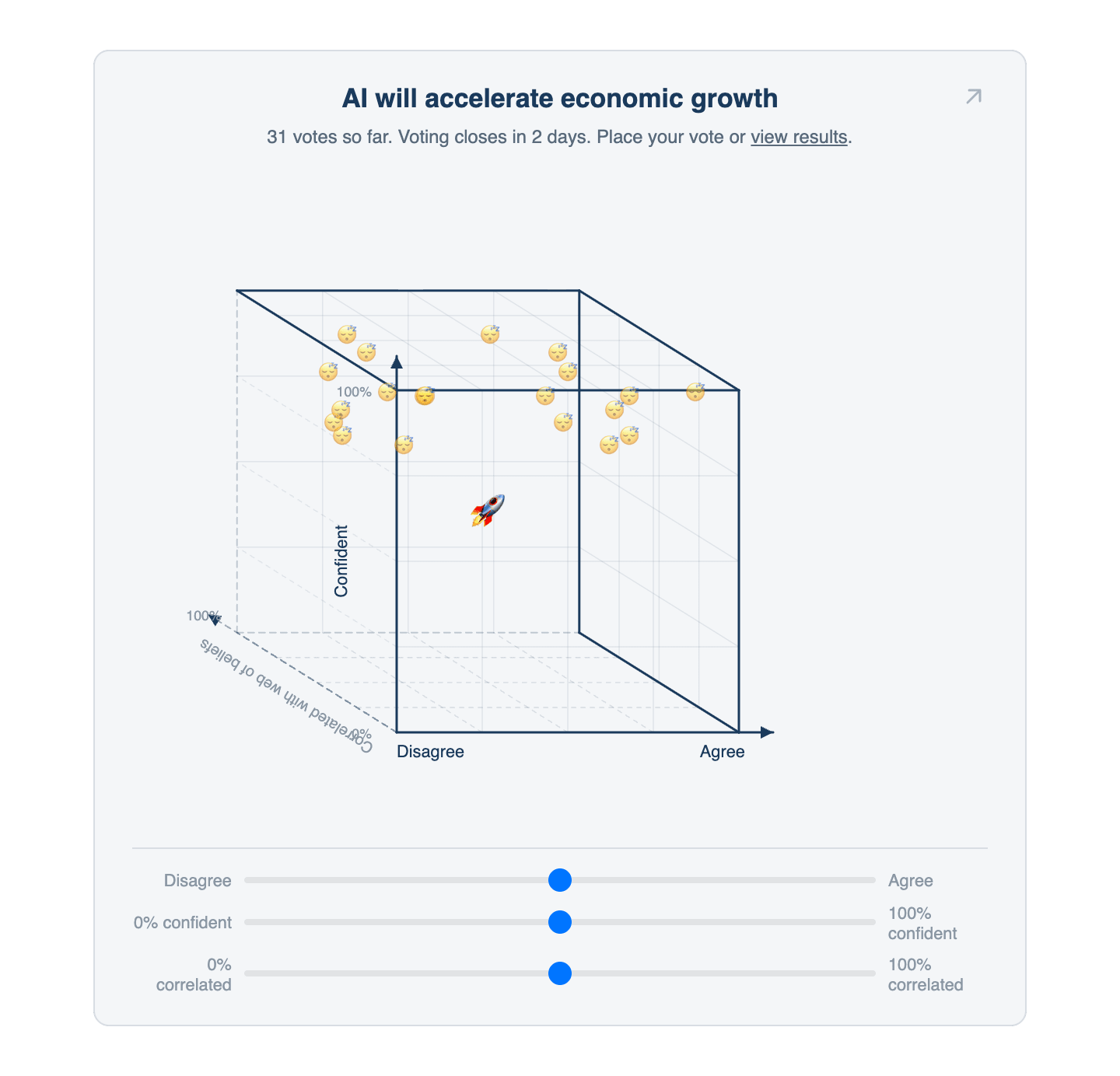
Returning to my home, I hate to admit, I threw away my well-thumbed Bostrom papers in disgust. I couldn't be outsmarted in that way again.
To relax, I turned to the work of an emphatically non-effective-altruist philosopher who I nonetheless admire, Iris Murdoch.
To my dismay, the first line of the second essay of her book The Sovereignty of Good scuppered my confidence. In it, she writes, "To do philosophy is to explore one's own temperament, and yet at the same time to attempt to discover the truth."
“Oh Shi–[1]” I thought “She's right”. There is no objective philosophising, or, by extension, even opinion having, without emotion of some kind. How am I to understand the opinion of someone else if I'm not aware of their emotional state when having said opinion?
Once more, I headed into the office. It was almost 3 p.m. by now. I was growing tired.
With the help of Claude Code and two cans of Diet Coke — which I drank while waiting for Claude Code to do it for me — I hand-coded a heart rate detector that uses a forum author's webcam to detect their heart rate at time of voting.
Claude, when I asked it without double-checking, told me that polygraphs are almost 80–90% accurate if administered correctly. Polygraphs use a heart rate monitor, I thought wisely, and 80–90% is pretty good, so I figured this would be enough for us to tell how truthful our authors are being.
The only natural way to represent this is, of course, as a tesseract.
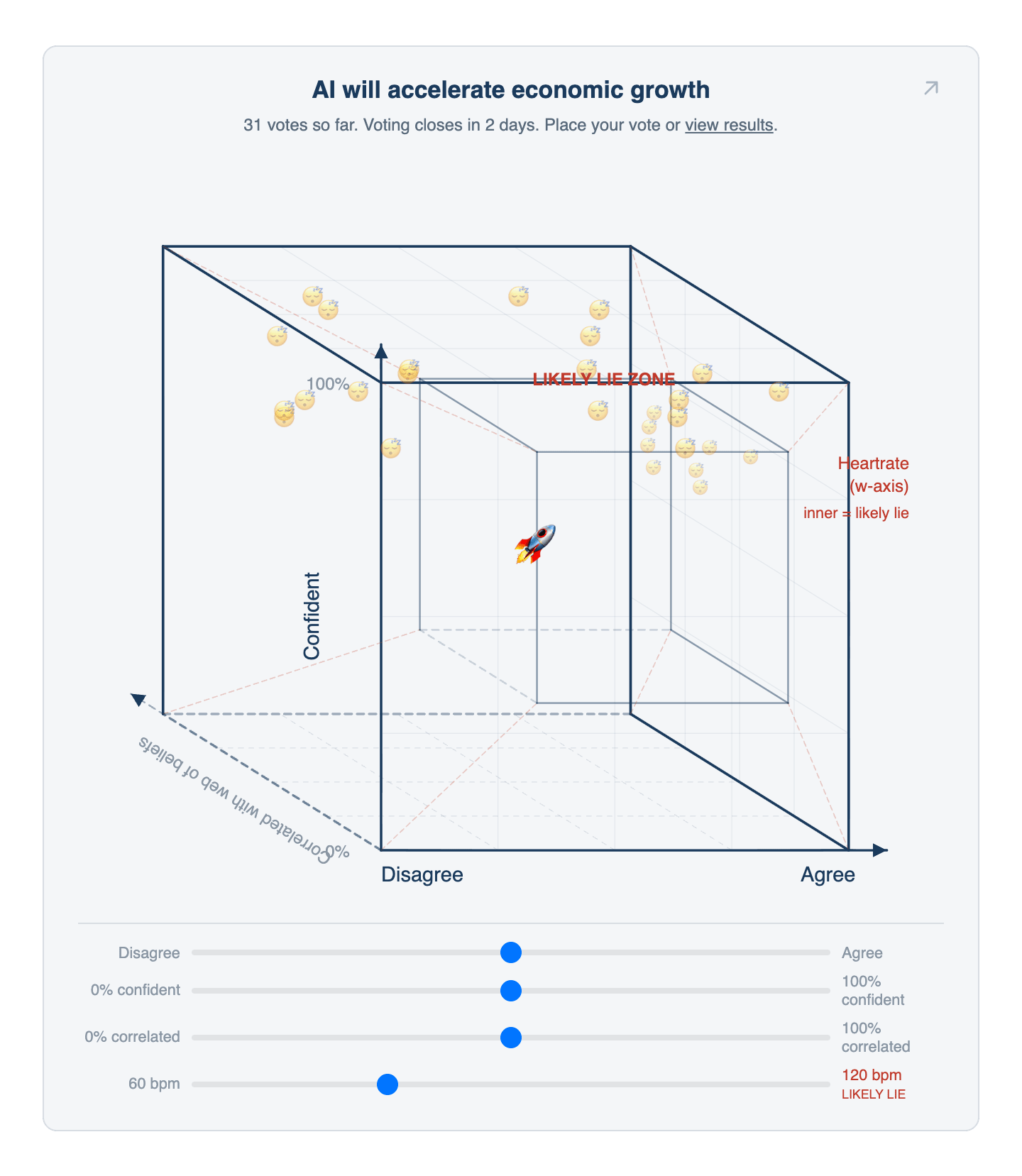
I was transfixed. My eyes dried out staring into the screen, into the depths of the cube within the cube within the… I must have blacked out. By the time one of my colleagues thought to wake me with a third can of diet coke, this one missing my mouth somewhat, my computer was almost red hot.
What was on my screen was now far more complex than the image above, in fact, all too complex for me to share here. Suffice to say that there were enough dimensions that one single vote, one click of the mouse, could have represented the full web of an individual's opinions, experiences, aspirations, perspirations, memories, bank account passwords, secrets and joys.
Buzzing with pride, I rushed to find a user interviewee to test this new product out on. I ran up to the first person I found sitting alone in the office cafeteria, laptop proffered like a relay baton.
As I explained the concept to them and asked for their vote, I saw, rippling across their face like ripples rippling across a lake, the cosmic horror associated with our first brushes with the truly sublime.
As they seemed a little indisposed, I guided their hand to the webcam to take a heart rate reading. To my great disappointment, they were well within the "likely lie zone". "Tsk tsk," I said, as they slipped into what I would later discover was cardiac arrest.
After having similar experiences with the next few people, I paused.
As a good effective altruist, I know that if my beliefs don't survive contact with the world (or the world doesn't survive contact with them), I may be wrong.
I decided, for now, to discontinue the product, until either it can be proven safe and efficacious or the forum users are replaced by digital minds who can handle the complexity of my multi-dimensional polling tools.
Let me know if you have any questions or feedback about this feature update.
- ^
-stosomiasis
akash 🔸 @ 2026-04-01T20:41 (+11)
Ok but I unironically think that a 2D debate slider could be useful!
Marta Strzyga 🔸 @ 2026-04-02T10:01 (+3)
Polish speakers use 'cholera' (the illness) as an expletive, so I love to see 'shistosomiasis' joining this category, rolls right off the tongue too! I love this concept and look forward to toying around with tesseract sliders while I play 5D Chess with Multiverse Time Travel, thanks Toby!
Elliot Billingsley 🔸 @ 2026-07-29T07:40 (+1)
this is funny as hell, thank you Toby
AïdaLahlou @ 2026-07-05T20:56 (+1)
😁🤣