CEA is growing again: 25% more people engaged with our programs in 2025
By Angelina Li, Jessica McCurdy🔸, Alex Dial, Joris 🔸 @ 2026-02-11T23:02 (+130)
TLDR: In 2025, we grew engagement with CEA’s programs by 20–25% across every tier of engagement, reversing two years of moderate declines in engagement. We did so without disproportionately increasing costs or lowering the quality or bar for our programs.
This post reviews CEA’s work on growing the EA community, which is only one of our strategic goals. See more on our other strategic goals here. We plan to accelerate our growth even further, and we're hiring across multiple teams to make that happen. Join us!
Summary
- The Centre for Effective Altruism’s 2025 and 2026 strategy is focused on building sustainable momentum for EA, and growing the EA community is the cornerstone of building that momentum.
- In our first year of executing this strategy, we grew by 20–25% year-over-year across each tier of our engagement funnel, beating our targets of 7.5–10% year-on-year growth, and reversing the moderate decreases in engagement with our programs throughout 2023-2024. Our results include:
- Hosting the biggest EA Global ever without lowering the admissions bar (with the highest satisfaction score and lowest cost-per-attendee in the last 4 years)
- Launching a new 4-day online bootcamp to help participants make a high-impact career pivot
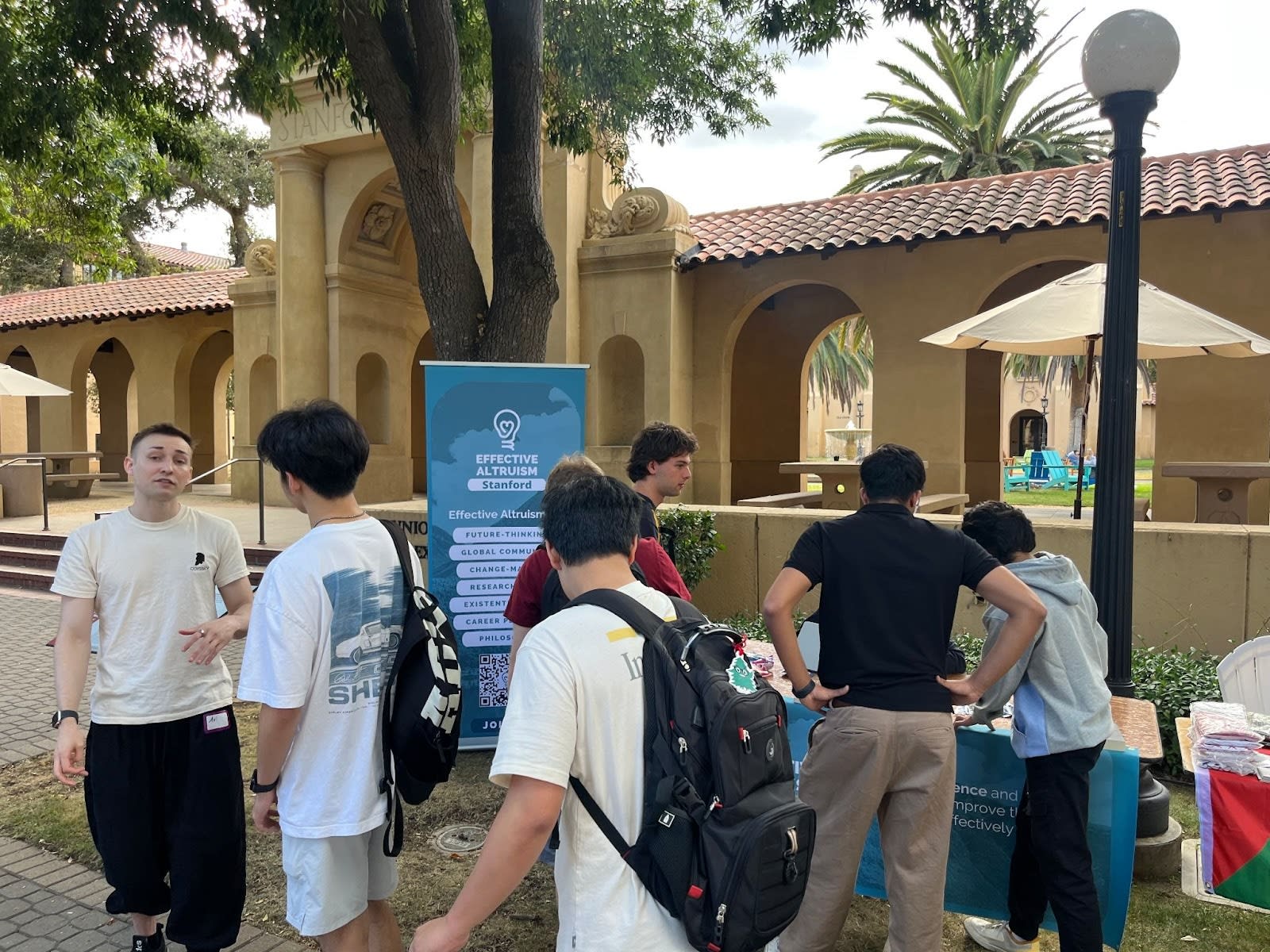
- Reviving several groups at pilot universities (including Stanford EA)
- Increasing the conversion rate from EffectiveAltruism.org to the EA Newsletter by 3.3x (0.6% → 2.6%), and
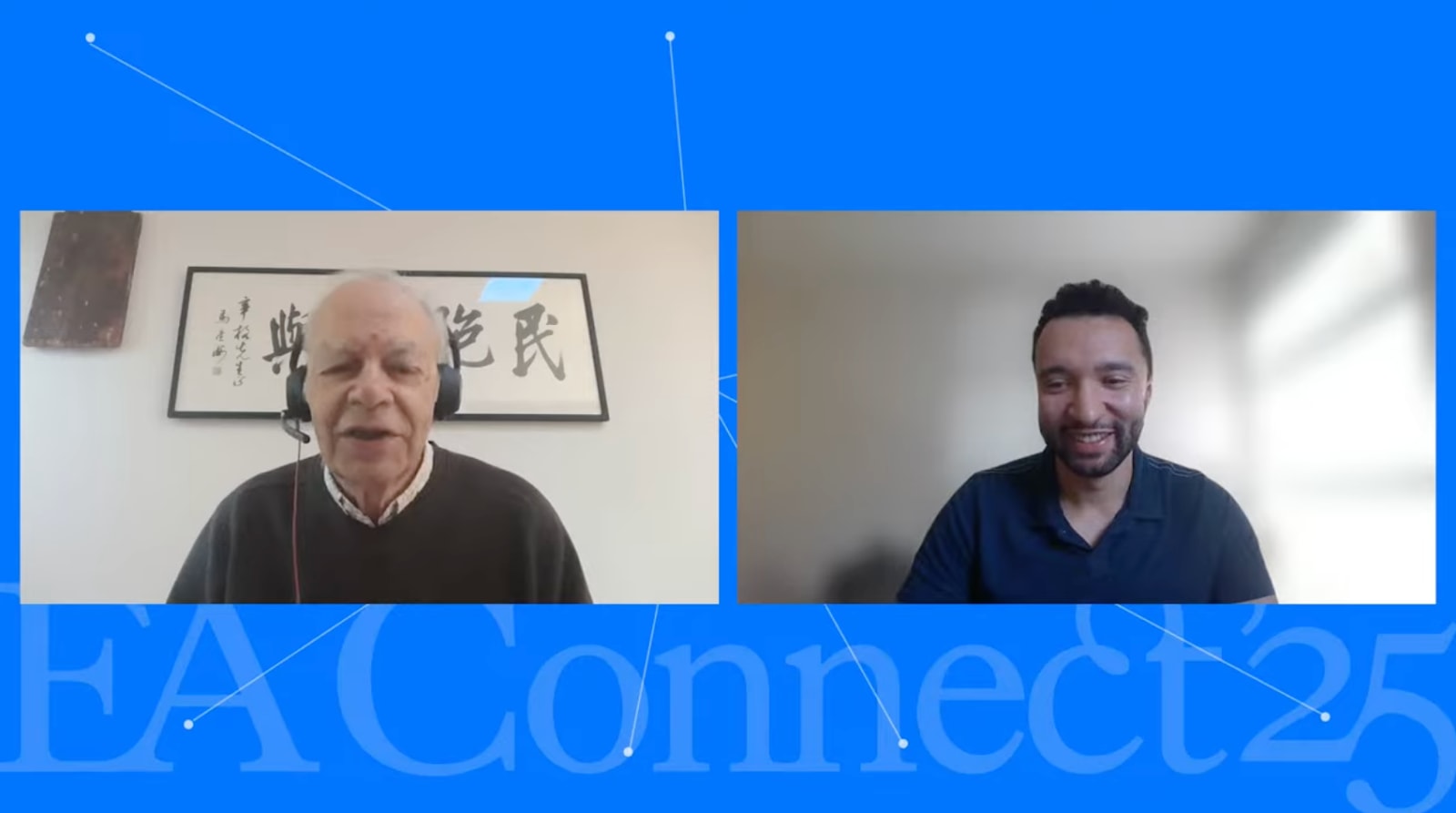
- Hosting a new virtual outreach event (EA Connect) which was the largest event we’ve ever run.
- Our growth strategy has centered around building sustainable momentum in EA growth, while not leaving behind our focus on cost-effectiveness or program quality.
- We achieved our growth without disproportionately increasing costs. Overall CEA spending increased by 0.4% on a like-for-like basis in 2025[1], whereas our tiers have grown 20–25%. When we looked at cost growth for each of the tiers, we broadly found that we did not disproportionately increase our spending.
- Our growth came from many sources, for instance:
- Expanding existing program offerings (e.g. expanding from 3 → 9 EA Summits)
- Launching new ones (e.g. our new career bootcamp course)
- Investing in outreach (e.g. ramping up our email marketing for EA Global)
- Improving the quality of programming (e.g. improving the onboarding emails for the EA Newsletter increased our click rate from 10.6% → 17.5%)
- Picking up programs that otherwise wouldn’t exist (e.g. the EA Opportunities Board).
- We also maintained focus on quality. We deliberately held back on scaling programs we judged unready; these results don’t reflect us maximally pushing. In some areas, we prioritized talent-dense programs (like our pilot university program) even when they contributed a low number of users to our headline metrics.
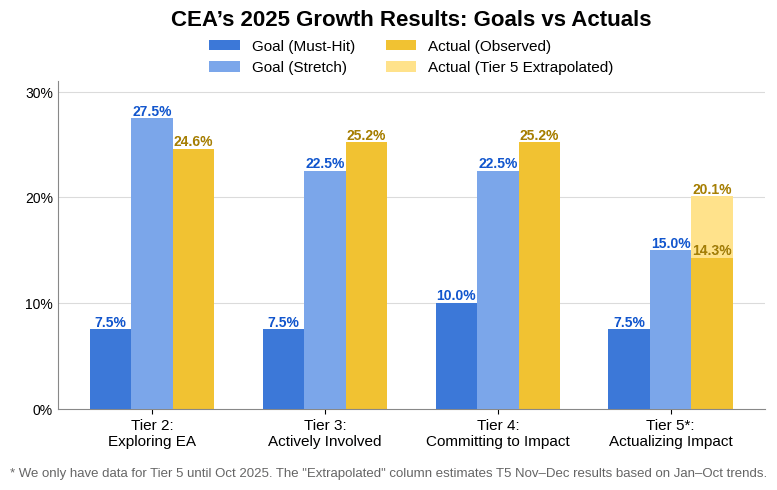
After one year of executing on our sustainable momentum strategy, we have exceeded our own growth targets by a significant margin, and now have much more confidence that growing the EA community is tractable. There are real challenges that remain: our modelling has gaps, growth carries risks, some of our products need significantly stronger foundations before scaling, and we can’t do this work alone. We are excited to tackle these challenges and see sustainable momentum as an important goal worth pursuing.
In 2026, we will (1) set the foundations to deliver an ambitious step-change in EA’s growth trajectory in 2027+ and (2) continue delivering year-on-year growth for CEA programs.
We believe the world’s most pressing problems need more talented people aimed at solving them. We are motivated to grow EA, and to do it right.
Why grow?
CEA’s 2025 and 2026 strategy is focused on building sustainable momentum for EA, and growing the EA community is a key aspect of achieving that momentum.
There are several reasons why we are prioritizing growth: Most directly, there’s the impact people have through their careers or donations when they put EA principles into practice. Indirectly, achieving this type of growth is a clear signal to the world that EA is worth taking seriously and applying to big life choices.
Our goal is to build and sustain momentum, not to boom and bust. Some other things this growth strategy is not:
- It’s not growth at all costs. We aren’t leaving behind our focus on quality, cost-effectiveness, or marginal returns. Our targets are not pushing for maximally aggressive growth.
- It’s not ignoring trade-offs or downside risks. We are considering and trying to minimize downsides related to growth, e.g., increased risk associated with bad actors, changes in culture or epistemics that reduce EA’s impact, and introducing people to EA who end up having a bad experience.
- It’s not our only goal. CEA’s other strategic priorities help make this growth sustainable: we’re simultaneously working to improve the EA brand, and diversify EA funding.
- It’s not CEA acting alone. Building momentum by growing EA will require a concerted effort not only across CEA teams but across organizations. We won’t be able to drive this exclusively via our own programming, and we expect CEA’s programs often won’t be the best bets to double down on.
2025 review
Our focus in 2025 was on measuring and growing engagement with CEA programs. While our ultimate goal remains focused on growing the EA community as a whole, we wanted to start with where we have the most influence.
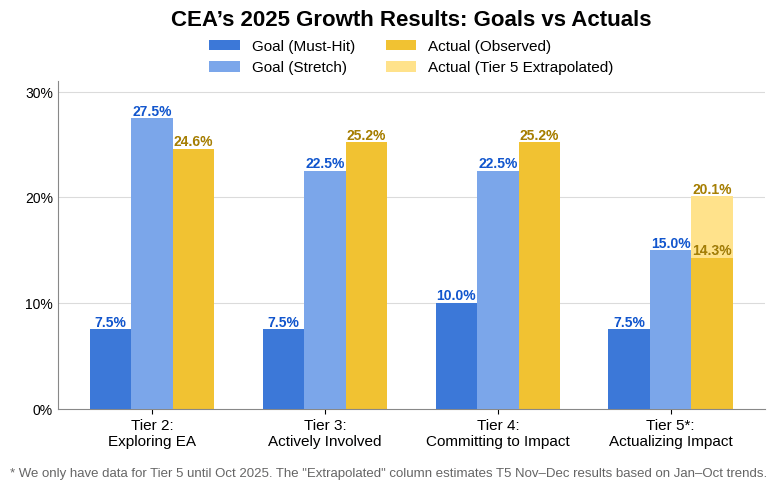
At the start of the year, we built a model to measure the growth in the number of people who engage with CEA programs at different tiers of engagement (from “Exploring EA” to “Actualizing Impact”). Using this model, we set targets of 7.5–10% growth across all tiers in 2025.
We are glad to say that we ended up growing by 20-25% across our tiers. We exceeded all our growth targets by a large margin and hit the majority of our stretch goals, reversing our previous two-year trajectory of moderate decreases in engagement with most of our programs.
Our growth model and 2025 targets
To measure and set goals for EA growth, we built a model that tracks the number of people who have engaged with CEA programming at different tiers of engagement.
At the start of the year, we set the following goals for 2025:
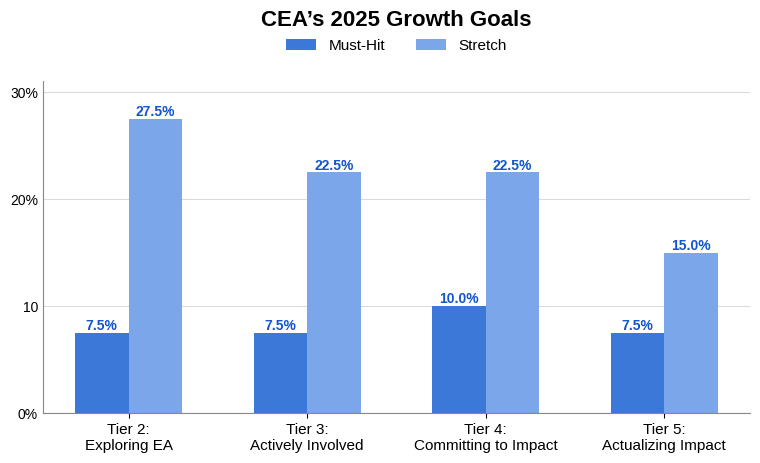
We go into more detail on how we built this model and set our 2025 goals in the appendix, and describe each tier more in the next section.
Our results
In 2025, we grew by 20-25% year-over-year across each tier of our engagement funnel[2], beating our 7.5-10% growth target and reversing the moderate declines in our programs’ growth throughout 2023-2024.
Tier 2: Exploring EA
| 🔎 Persona: This person is curious about EA and takes an active, possibly one-off action to learn more or “try it out”. |
Summary: Grew from 47K people in 2024 to 58K in 2025 (25% growth)[3]
We have invested in improving the quality and reach of introductory programming this year. Some of our work here has included:
- Redesigning the EffectiveAltruism.org website to improve understanding and perception of effective altruism, and make it easier to take action (you can read more about the redesign here).
- Improving the onboarding emails new EA Newsletter subscribers get, to improve how helpful they are to people new to EA.
- Stabilizing engagement with the EA Forum after two years of continuous declines, while more than halving staff hours on the program.
- Launching new online outreach initiatives such as EA Connect (the largest event CEA has ever held), and EA Stories (a campaign featuring short profiles of EA spokespeople).
- Expanding our in-person EA Summit program from 3 to 9 events, while maintaining the same cost-per-attendance.
| Metric (all unique counts)[4] | 2024 | 2025 | Growth |
| EffectiveAltruism.org visitors who view 3+ pages | 31,000 | 40,208 | +30% |
| EA Newsletter subscribers who click on at least one link this year | 12,354 | 14,535 | +18% |
| EA Forum users who log in | 11,318 | 11,419 | +1% |
| Attendees at virtual events | 1,230 | 2,630 | +114% |
| Attendees at EA Summit events | 409 | 1,095 | +168% |
| Attendees to introductory events at groups in our scalable support program | ~1,000 | ~1,500 | +50% |
| Attendees to introductory events at groups in our pilot university program | 205 | 638 | +211% |
Tier 3: Actively Involved with EA
| 📚 Persona: This person is actively engaged with EA in more than a one-off way. They are leveraging some mechanism for repeated interactions, and are starting to think about how EA could affect their life. |
Summary: Grew from 8K people in 2024 to 10K in 2025 (25% growth)[3]
We have been continuing to build on the work we do to support people in deepening their engagement with EA after they have first encountered these ideas. Some of our work here has included:
- Continuing to run EAGx events across the world. We hosted 10 EAGx events (including first-time EAGx events in Nigeria and São Paulo).
- Hosting events on the EA Forum aimed at engaging users more deeply with EA ideas and supporting newcomers in their EA journeys (e.g. Career Conversations Week).
- Taking over and lightly redesigning the EA Opportunities Board in January 2025 after this project was otherwise going to be dropped.
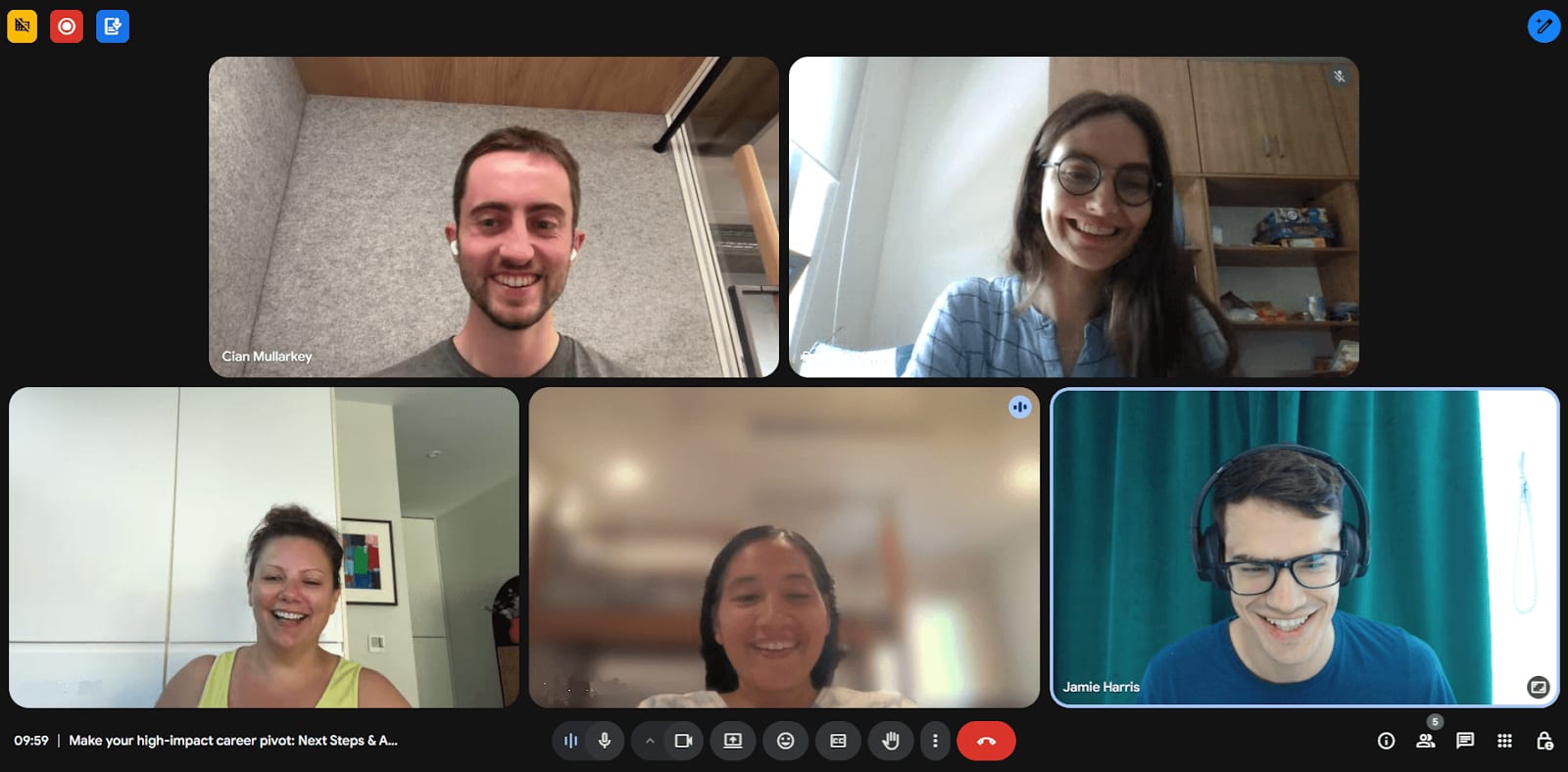
- Launching a new 4-day online bootcamp to help participants make a high-impact career pivot.
| Metric (all unique counts) | 2024 | 2025 | Growth |
| Attendees at EAGx (or EAGx-like) events[5] | 2,866 | 3,238 | +20% |
| EA Forum users who read 20+ posts and make a post/comment | 1,809 | 1,798 | +0% |
| EA Opportunities Board visitors who click on 3+ opportunities | 504 | 1,273 | +153% |
| Graduates from online Courses | 561 | 769 | +37% |
| Graduates of introductory fellowships at groups in our scalable support program | ~650 | ~700 | +9% |
| Graduates of introductory fellowships at groups in our pilot university program | 113 | 235 | +209% |
Tier 4: Committing to Impact
| 🎯Persona: This person is starting to pursue substantial actions on the basis of EA principles, although they may not yet have made a significant impactful contribution. |
Summary: Grew from 3.9K people in 2024 to 4.9K in 2025 (+25% YoY growth)[3]
The main program we track in this tier is EA Global, which is one of the most established resources we have to offer people who are starting to pursue substantial actions on the basis of EA principles. Our work here has included:
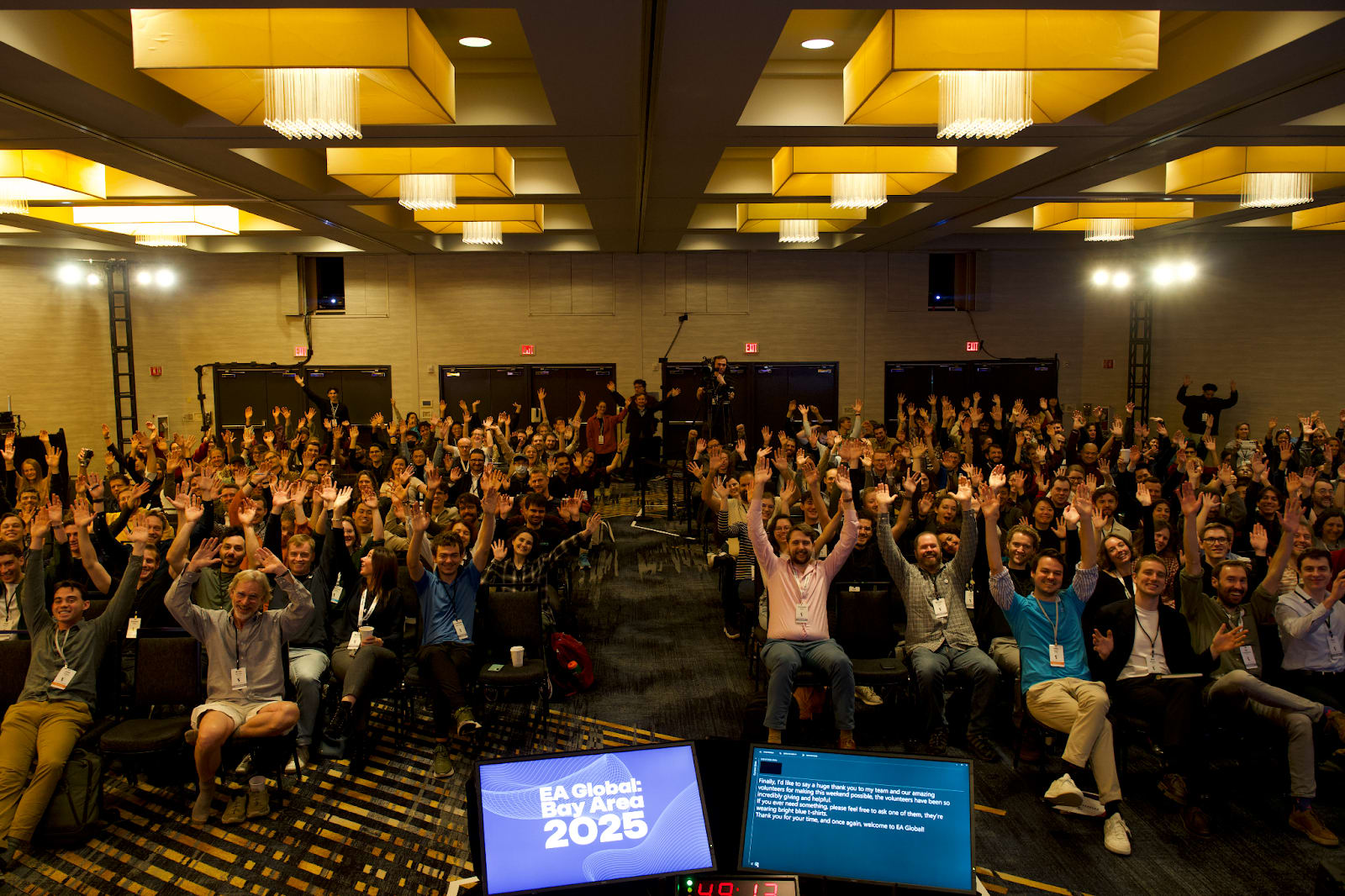
- Welcoming more attendees to EA Global.[6] This program has had a standout year: total unique attendees are up 28% from last year, all three of our annual events saw higher average satisfaction scores and lower average CEA costs per attendee, and EA Global: London 2025 was the largest in-person event we’ve ever held.
- We didn’t change the admissions bar for this program. Two of the most successful actions we took to increase attendance were (A) relocating our East Coast event to NYC, and (B) increasing our email outreach to encourage signups.
- We also continued to increase the number of groups we support, via our Scalable Support and Pilot University programs.
| Metric (all unique counts) | 2024 | 2025 | Growth |
| Attendees at EA Global events | 2,294 | 2,943 | +28% |
| Highly engaged EA members at groups in our scalable support program | ~200 | ~275 | +135% |
| Highly engaged EA members at groups in our pilot university program | 36 | 84 | +233% |
Tier 5: Actualizing Impact
| 💼 Persona: This person is making significant impactful contributions based on EA principles. |
Summary: Grew from ~2,250 users in 2024 to ~2,700 in 2025 (20% YoY growth)[2]
Alongside the three above tiers which track engagement with CEA programs, we also monitor a laggier indicator to track how many recent alumni of CEA programs go on to take significant impactful actions.
How we measure this tier: We classify someone as “Tier 5” if they meet both these criteria:
- (1) Engaged with CEA programs at Tier 2-4 in the prior 3 calendar years, and
- (2) Held a high-impact job this year, which we classify using public LinkedIn data
How to interpret growth in this tier:
- This growth is primarily driven by new job conversions. The primary reason this metric has gone up in 2025 (accounting for a significant majority of the growth) is that people who previously engaged with CEA programs have landed new high-impact roles. The remaining ~30% comes from professionals already in high-impact positions engaging with CEA for the first time.
- Growth here likely lags our current efforts. Because of the lag time between when people first engage with EA and when they land a high-impact role, we think this metric more closely tracks the impact of CEA’s programming from 2023–2024. Our best guess is that in 2024, this tier grew at a similar rate to in 2025 (about ~20%).
- This metric does not account for attribution. It's a proxy for impact, not a causal analysis. We are explicitly not claiming that all these career changes were counterfactually attributed to CEA’s programming (for instance, there are many other programs in the ecosystem that support people in making career changes). We use this as a lightweight metric and supplement this with other ways of measuring our impact across programs.
- We use this metric to think about broad trends. We designed our growth model as a whole to help us track how our programs are growing, but we know it will be wrong on the individual level in many cases.
This tier is still in development. It captures one major way people make significant contributions based on EA principles (legibly high-impact roles), but misses out on others (e.g. donations, or roles that are less legibly high-impact). We are working to develop a fuller picture over time.
Changes in our spending
One question readers may have is: how has the corresponding spending on CEA programs has changed over time? We conducted a rough-and-ready analysis to evaluate the question: “Have we achieved our growth results by disproportionately increasing our spending?”
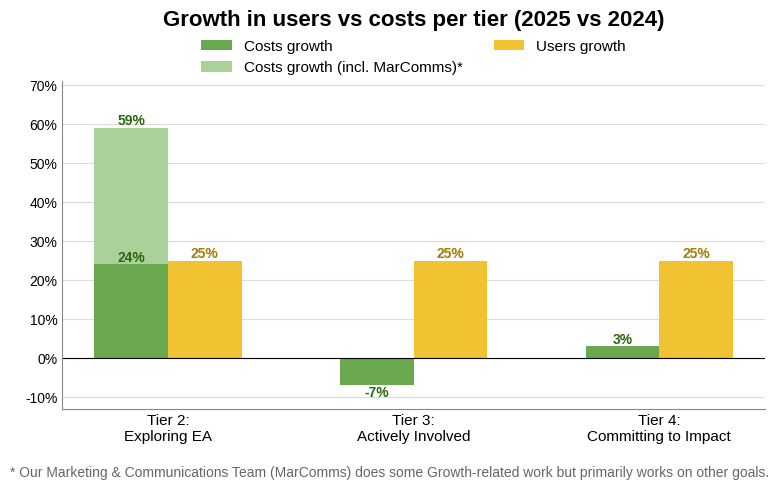
The following graph summarizes how the costs of our growth generating projects have changed over time, as compared to our growth results:
Some interpretation notes:
- Across our mid tiers (3 and 4), our growth-relevant costs changed by -7% and +3% while engagement increased by 25%.
- Costs for our early tier increased by more (somewhere between 24% and 59%) but much of this increase is driven by increased investments in brand understanding and sentiment (coming off of a low historical base) rather than increased investments in growth specifically.[7]
- As a sense check: Overall CEA spending increased by 0.4% on a like-for-like basis in 2025.[1]
While there is some ambiguity with regards to how to classify our marketing and communication costs, our overall takeaway is: No, we don't think CEA achieved our growth results by disproportionately increasing our spending. We think our results came primarily from greater strategic focus and the growth generating tactics we used.
We discuss why we think this (and give more context on our Tier 2 work) in the appendix.
Maintaining the quality of our programs while we scale
While our numeric modelling and growth targets are useful tools to keep us accountable for our goals, we don’t just steer blindly via numbers. Internally, we introduced G.R.O.W. principles to keep us oriented towards impact as our north-star:
- Greater than Numbers (prioritizing cost-effective real-world impact over numerical targets)
- Reach and Progress (sustained outreach and progression through the funnel)
- Out-of-the-Box Thinking (embracing innovation)
- Work Across (C)EA (collective responsibility for EA's growth trajectory).
Here are some other ways we think about maintaining the quality of our programs:
- We track quality metrics alongside our numeric outcome targets, to establish clear guardrails against growing in unendorsed ways. For example, we monitor the impactful actions attendees at our events report taking, to make sure that additional attendees are gaining value.
- We do not lower important program standards to meet targets,[8] stretch mentors unreasonably thin, or dilute EA ideas to increase participation.
- We prioritize investing in some high talent density programs (such as our pilot university program), even when they don’t contribute as much numerically to our headline metrics.
We describe our G.R.O.W. principles in more depth in the appendix.
2026 plans
In 2026, we have two main growth-related objectives:
- Set the foundations for a trajectory change in our ambition
- We plan to set more ambitious growth goals for 2027 and onwards. Within our Growth strategic pillar, our primary focus will be on growing the number of people making significant impactful contributions (e.g. on the level of a career change), as that best reflects realized impact (as opposed to growth earlier in the funnel, which represents potential impact).
- In 2026, our primary focus will be on getting ready to deliver on that increase in our ambition. We will focus on substantially improving the foundations of our programming, both to improve the scale-readiness of our existing programs, and to launch new scalable programs.
- Continue to sustain EA’s momentum by delivering year on year growth via CEA’s programs
- While our primary focus will be on building foundations with urgency, we still want to maintain a steady pace of sustainable growth across CEA programs.
- In 2026, our goal is to grow by 10–15% across our tiers.[9] This is purposefully lower than the growth rates we achieved in 2025 as we want to reemphasize the need to build foundations for accelerated future growth.
What does this all mean?
After one year of executing on our growth strategy, we exceeded our own targets by a significant margin. This result was not a foregone conclusion—we set goals we thought were achievable but ambitious, and we beat them across every tier. We have much more confidence now that growing the EA community is tractable.
That said, we hold these results with appropriate humility:
- Our modelling intentionally has gaps. We're tracking engagement with CEA programs as a proxy for someone's exposure to EA, which will miss a lot at the individual level. We explicitly aren't yet modeling counterfactual impact or optimizing naively for these metrics. We think of this model as one major input to keep us on track, used alongside qualitative judgment—not a substitute for it.
- Growth comes with real risks. Scaling too fast or in the wrong ways could increase risk from bad actors, dilute culture and epistemics, or strain the ability of the community to support the people we're bringing in. We're actively tracking these risks, but avoiding the pitfalls of growth will take continuous effort from all of us.
- We care about growing EA, not just CEA. Building momentum will require effort across many organizations. We're starting to coordinate with partners on how to collectively steward EA's growth: many others are doing valuable work here. CEA can’t do this work alone.
Ultimately, we invest in building the EA community because we think that the world’s most pressing problems need more resources directed at them. More talented people in high-impact careers, more donations, more people thinking carefully about these values and how to help.
We’ve seen EA be a powerful lever for saving lives, reducing suffering, and safeguarding the future. We want to see it work at a much larger scale.

Acknowledgements
This post was authored by Angelina Li. Jessica McCurdy leads CEA’s Growth work, and is supported by Alex Dial, Joris Pijpers, Angelina, and others. Many colleagues at CEA reviewed this post, and many more contributed to this work.
Finally, all of this work is aimed at better supporting people who engage with our programs, including all of the readers of this post, and especially the ones who made it all the way to the end. Thank you for showing up, and for all of the impactful work you do!
Join us
If you're excited about growing the EA community, consider joining us! We're hiring across many teams this year—you can find our open roles at centreforeffectivealtruism.org/careers.
Appendices
Our model and targets
Building the model
To measure and set goals for EA growth, we built a model that tracks the number of people who have engaged with CEA programming at different tiers of engagement.
Here is an idealised description of what our current approach is trying to capture:
We’d like to measure and set targets for growth in the number of people who have engaged with a CEA program at each tier of the funnel.
We took four steps to measure this growth:
- Defining tiers: We defined “EA engagement tiers” and identified qualifying engagement criteria corresponding to each tier.
- As a proxy for engagement, we categorized specific actions within CEA programs by where they typically meet people in their EA journey. For instance, we categorize clicking on a link in the EA Newsletter as early exploration (Tier 2), and attending an in-person EAGx event as more active involvement (Tier 3).
- Bucketing users: We used the tiers from step 1 to categorize users for each year based on their observed engagement data. In general:
- If you qualify for a later tier one year, we automatically count you as being in all earlier tiers for that year (e.g. qualifying for ‘Committed to Impact’ means you also qualify for the first two tiers).
- We only use engagement data from a particular year when categorizing users, so if someone was in the “Committed to Impact” tier last year, but based on this year’s engagement, they only qualify for the “Exploring EA” tier, they only get counted in the “Exploring EA” tier this year.
- Add uncaptured users: We added in our estimates for the number of additional unique people in each tier contributed by program metrics that weren’t captured by our CEA-wide CRM.
- For instance, we don’t systematically capture personally identifying data (e.g. names and emails) for visitors to the EffectiveAltruism.org website, or attendees at introductory events hosted by groups we support. We have some educated guesses for the duplication rates here that we apply.
Setting the goals
Using the above model, we then took the following steps to set growth targets for 2025:
- Forecast program-level growth: We worked with program leads at CEA to forecast 2026 growth for each of our growth metrics, in two different worlds: (1) Must-Hit growth (what we’d aim to achieve in an ambitious but readily tractable world), and (2) Stretch growth (what an outstanding year of growth would look like).
- Populate tier-level targets: We then used the program-level forecasts to generate tier-level forecasts for each growth scenario.
- Round targets: We then rounded the overall growth rate of each tier to the nearest 2.5%, to avoid false precision.
Some interpretation notes:
- The specific growth rates we chose were mostly based on what growth was tractable given where our programming was at the time, rather than a top-down endorsement of what ideal growth rates would be at each tier of the funnel.
- These targets were meant to be CEA-wide, not program-specific—we retained flexibility to reallocate resources toward what was working.
- For 2025, we did not set targets for Tier 1 (because we started the year with very low marketing and communications capacity) or Tier 6 (we prioritized developing Tier 5 methodology). We have set goals for both tiers in 2026.
- Note that we excluded the Community Building Grants (CBG) program from our growth model this year. The main reasons: (A) We did not deliberately aim to grow this program in 2025, and (B) the annualized data we have on this program is of low quality, as grants are staggered throughout the year with reported performance reflecting prior-year activity. As such, we excluded CBG from both our growth model and our spending analysis. Overall, if it we had accurate historical data and added this program our best bet is that our growth numbers would go somewhat down, but costs would also drop significantly (our CBG costs decreased by 22% in 2025).
Changes in our spending
We conducted a rough-and-ready analysis to evaluate the question: “Have we achieved our growth results by disproportionately increasing our spending?”
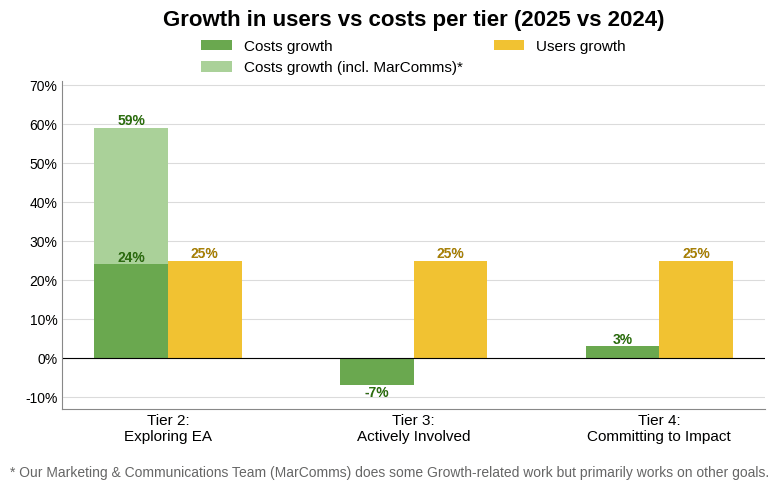
The following graph summarizes how the costs of our growth generating projects have changed over time, as compared to our growth results:[10]
Here’s a brief description of how we generated the above results:
- User growth: This reflects our projected growth results for 2025, as described above.
- Cost growth: For each growth-generating program (e.g. the EA Newsletter, EAGx events), we estimate how much the program cost in 2025 vs 2024, in some cases making simplifying assumptions. We then apportion the costs for each program to the tier(s) this program contributes to (e.g. EA Newsletter costs are allocated to Tier 2).
High level takeaways:
- For Tiers 3 and 4, the story is straightforward: No, we did not achieve our growth results by disproportionately increasing our spending. Growth in users (25%) substantially outpaced growth in costs (-7% and +3%).
- Tier 2 has a more complicated cost story, depending on how you categorize our increased spending on marketing and communications. Excluding these, Tier 2 costs increased 24%, about the same as user growth. Including these, costs increased 59%.
- Beyond growing the EA community, another major goal CEA has is to improve the EA brand. As part of that, we have invested substantially in growing our Marketing and Communications work (from a relatively low historical base).
- Improving the brand is partly motivated by growth, because it’s such an important part of increasing awareness and understanding of EA among potential recruits. But it’s also about sustainability, because investing in the brand and communications can not only improve our reputation but make it more stable over time. The contrast with a purely growth maximizing lens is that we aren’t just looking at factors like brand awareness, but also at factors like brand sentiment.
- While our Marketing and Communications Team does support growth (e.g., supporting marketing for our virtual conference, making improvements to the EffectiveAltruism.org website), much of their 2024–2025 work targeted brand sentiment and resilience rather than reach, e.g. working with journalists to improve how accurately effective altruism is described in the media.
- There's no clean way to cleanly separate out the Growth portion of our Marketing and Communications work from the Brand portion, and so we present our cost increases with and without this team.
- Our current takeaway: While the Tier 2 cost story is more complicated, much of our cost increase is driven by investments in brand understanding and sentiment rather than growth specifically, although we’re less confident in our conclusions here.
- We also expect the cost effectiveness of this work to increase over time as we onboard our new team members and build experience.
- Beyond growing the EA community, another major goal CEA has is to improve the EA brand. As part of that, we have invested substantially in growing our Marketing and Communications work (from a relatively low historical base).
- As a sense check: Overall CEA spending increased by 0.4% on a like-for-like basis in 2025.[1]
Bottom line: We don't think CEA achieved our growth results by disproportionately increasing our spending. We think our results came primarily from greater strategic focus and the tactics described in the main post.
G.R.O.W. principles
To keep impact at the forefront, we introduced four G.R.O.W. principles internally to govern our prioritisation. While these were originally written for internal publication, we are sharing them to add more color on how we think about growth:
| Principle #1: Greater than Numbers |
Our metrics can’t capture all impact. We prioritize cost-effective real-world impact over hitting numerical targets – especially when the two are in tension. Our focus remains on the ultimate beneficiaries of our work: not just those who engage with our programs, but the lives they go on to help. Being Greater than Numbers means focusing on increasing our actual impact, not just what’s easiest to measure. In action: We deliberately hold back on scaling programs we judge as unready, even if this would help us hit our growth targets. For instance, we deprioritized marketing the EA Opportunities Board last year because we weren’t confident in the program’s scale-readiness. We are now actively working on improving this service. If you’ve benefitted from the Opportunity Board, we’d love to talk to you! |
| Principle #2: Reach and Progress |
We grow the EA community by reaching new people who haven’t yet encountered these ideas and helping those who are interested to progress in their engagement. Instead of chasing short-term or one-off growth spikes, we bring talented people in through sustained outreach and guide them to impactful opportunities. Reach and Progress means expanding to new audiences and feeling responsible for both conversions into and out of our programs. In action: We encourage groups we mentor to send committed group members to EA Global and EAGx events: for instance, via hosting events for group members to apply to conferences together, and having mentors emphasize this as a valuable next step. |
| Principle #3: Out-of-the-Box Thinking |
We push boundaries and explore creative solutions, seeing “EA or CEA has never done this before” as a reason to try, not to hesitate. Achieving ambitious goals requires taking calibrated risks, testing new ideas, and learning from failures. Out-of-the-Box Thinking means embracing innovation and continuously finding better ways to make an impact, while remaining principled and responsible with our ambition. In action: In building on our Courses program, we considered building on top of our typical 8-week fellowship format. However, after conducting a product discovery process, we landed on a 4 day intensive bootcamp which has been showing signs of promise. |
| Principle #4: Work Across (C)EA |
We win and lose as a team — to be effective stewards for EA’s trajectory, we’ll need to make sure that programs across CEA and EA have what they need to succeed. Work Across (C)EA means achieving more together than we ever could alone. In action: We have started coordinating with other community building organisations to help advance our collective growth goals, and aim to build on this partnerships work in the future. |
- ^
Our spending on CEA-wide operational costs in 2025 was $21.8M, a 7% increase compared to 2024.
Our 2025 operational costs include the costs of operating Trajan House and EA Funds (and exclude EA Funds grantmaking), which were not part of CEA previously. Excluding Trajan and EA Funds, we spent $20.5M, a like-for-like increase of 0.4%.
- ^
Disclaimer: We stopped being able to gather the data we needed to calculate Tier 5 in November 2025, due to an issue affecting our data vendor. If we had been able to collect a whole year’s worth of data, our best guess is we would have ended the year at around ~20% growth based on extrapolating the trend from previous months (this tier was growing by a very steady percentage throughout the year). We report both figures for transparency’s sake.
- ^
We count someone as part of a tier if they take any actions in that tier, or qualify for a higher tier. As such, the sum of metrics in the above chart will not equal the total number of people in this tier (e.g. because some people take multiple actions).
- ^
For instance, if someone attended multiple EA Summit events in 2025, we still count them as “1 attendee” under the EA Summit row.
- ^
For modelling purposes, we considered the London EA Student Summit an “EAGx-like” event.
- ^
A note on methodology: attending EA Global doesn't constitute “committing to impact” by itself. We include it in this tier because the admissions bar for EA Global is similar to how we think of users in this tier. As a general note, this model is designed to give us useful trend lines for how different audience segments within CEA are growing, but it will be wrong at the individual level in many cases—some of our users might be deeply committed to impact without attending EAG, or might skip a year and still be highly engaged.
- ^
Note that while we did increase our Marketing and Communications costs significantly from a low starting point (and so they account for a substantial portion of our cost increase), they still account for only 4% of our overall spending.
- ^
Although we may update programs for unrelated reasons, such as to serve more users or improve our product-market-fit.
- ^
Specifically, we set the following growth goals:
- Tiers 2 (Exploring EA) through 5 (Actualizing Impact) by 10%
- Tier 1 (Hearing of EA), a new tier we are adding, by 15%
- Tier 6 (Leading within EA) at the lower of: 10% or our measured 2025 growth rate.
- As we’re still designing our Tier 6 definition and methodology, we don’t yet have a measured growth rate for 2025 (though we expect it to be similar to, and correlate with, our Tier 5 metric). Accounting for this uncertainty, our goal for 2026 is to grow at the lower of a) a 10% growth rate and b) 2025’s measured growth rate.
- ^
Note that we don’t include Tier 5 in our analysis: we did not dedicate resources to directly increasing this tier in 2025, and we measure Tier 5 differently from our other engagement tiers.
Vasco Grilo🔸 @ 2026-02-12T11:47 (+13)
Thanks for the update.
Have you considered assessing your impact in terms of changing careers and increasing funding?
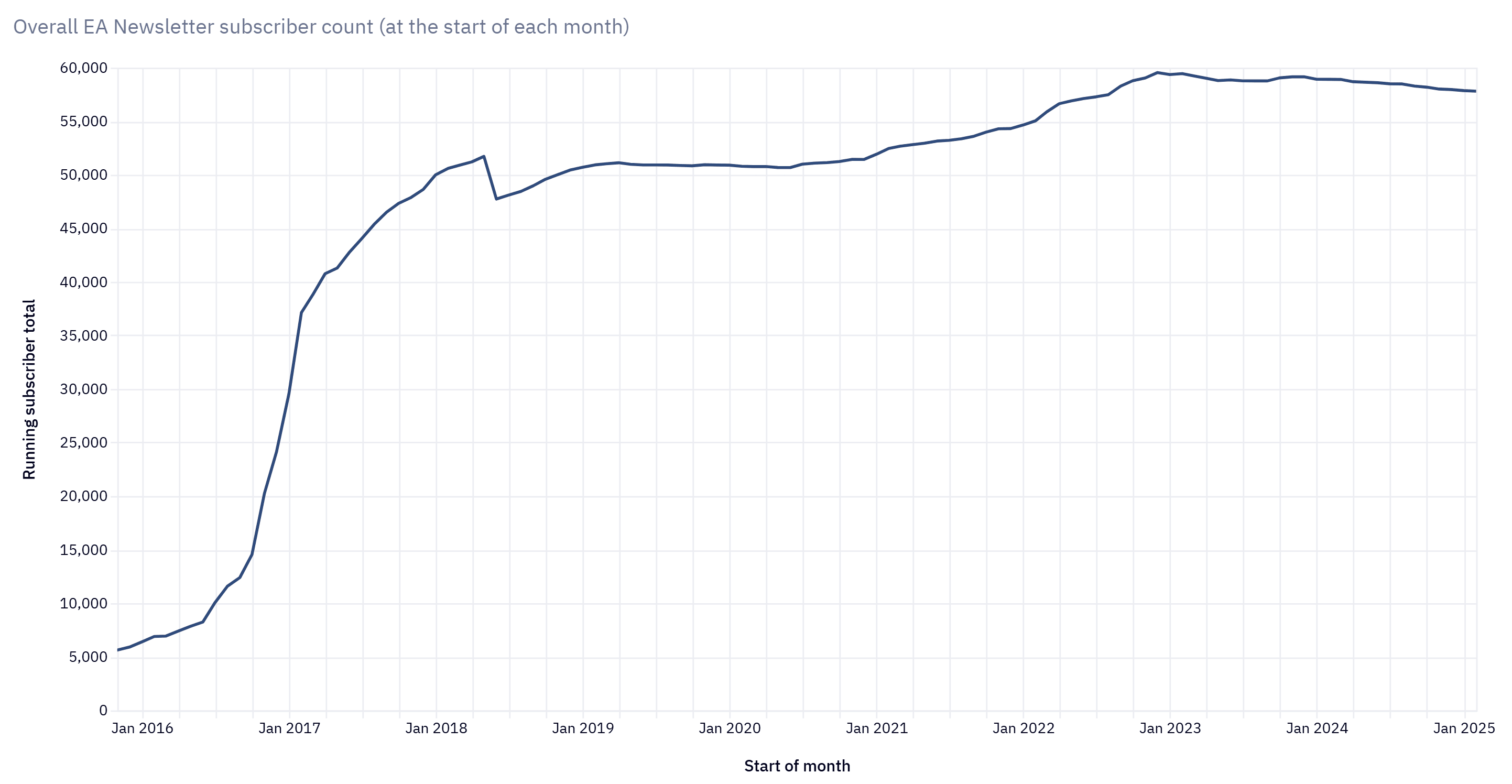
How did the number of subscribers of the EA newsletter change over 2025? CEA's dashboard only shows data up to February 2025.
Rory Fenton @ 2026-02-12T14:38 (+12)
Hey Vasco, I just joined CEA last month to start building out an internal monitoring and evaluation function. Getting into our impact in terms of things like career changes + donations is a top priority. For now, I'm still in learning mode, but I hope to have some defensible ideas on this soon!
Vasco Grilo🔸 @ 2026-02-12T16:21 (+3)
Hi Rory. That is great to know. I am looking forward to what you come up with.
Angelina Li @ 2026-02-12T18:16 (+9)
Thanks Vasco! Here’s the graph of EA Newsletter subscribers over time. We’re about to hit 64K subscribers :)
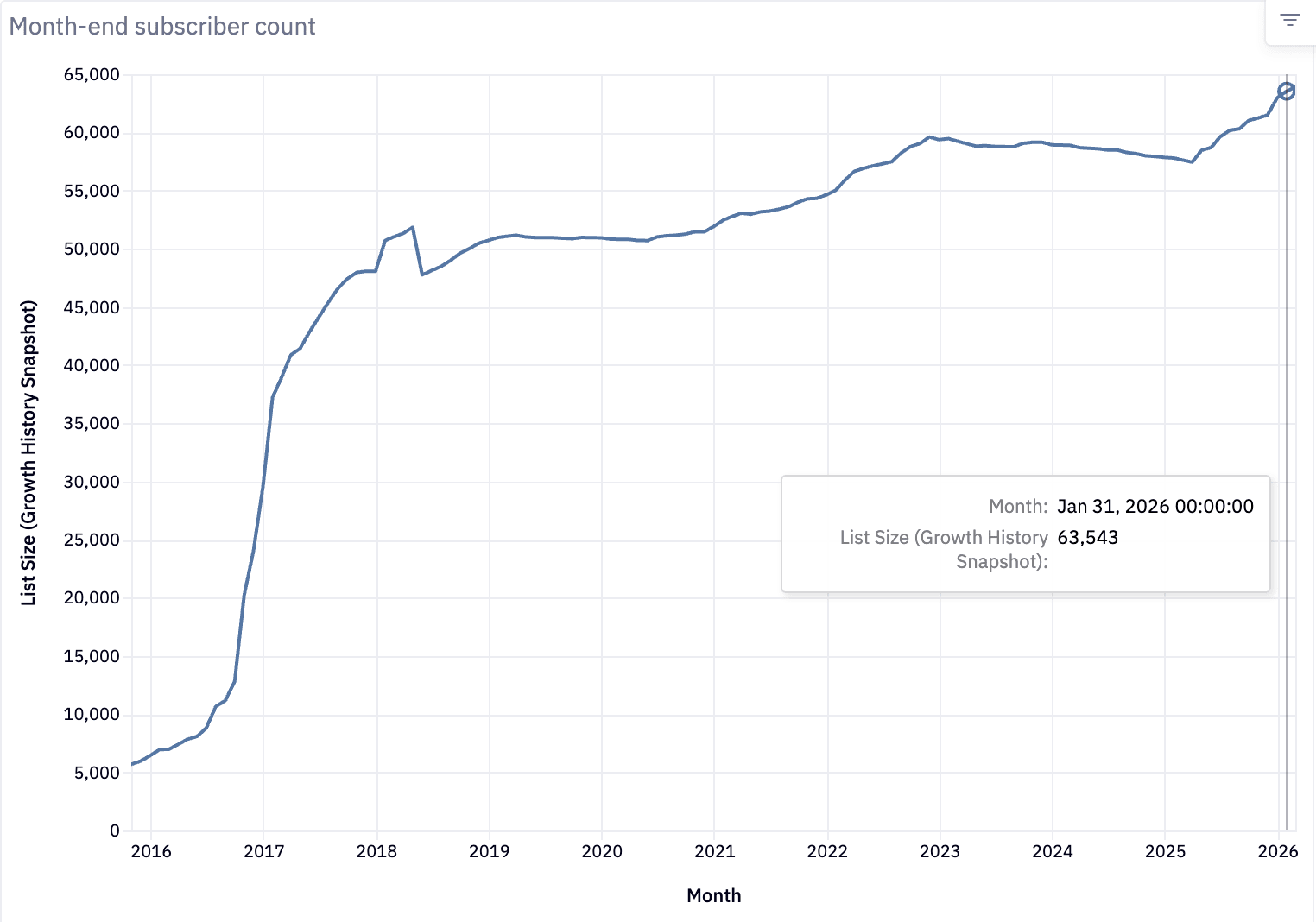
(Edit: replaced the tooltip to show our end-of-January totals, the last full month of data we have)
As a side note, the reason why we track actively engaged subscribers as our central growth metric is because many people who are subscribed never open the newsletter, and therefore we don’t think they get value from it. In general, we think “flow” metrics (like active engagement, attendance in a given year) are a better proxy for our present-day impact than “stock” metrics (like the number of people who have ever come to an EAG).
I’m glad the dashboard has been useful for you! Hearing about user demand is definitely valuable data for us. Unfortunately we’ve had to deprioritize maintenance on this for a while, due to higher priority M&E and engineering projects taking precedence over the last few quarters.
Relatedly, we will soon be hiring for a software engineer to join the Online Team and work on engineering projects across CEA. I’m really excited that we are building out our technical and analytical capacity (hi @Rory Fenton!). If any software engineers reading want CEA to have more capacity to execute on projects like this, I encourage you to apply!
Vasco Grilo🔸 @ 2026-02-12T18:35 (+4)
Thanks for sharing, Angelina.
It is nice to see significant growth of the number of subscribers over 2025, especially considering the downwards trend over 2023 and 2024.
I agree "flow" metrics are a better proxy for current impact, and that the number of actively engaged subscribers is a better metric than the number of subscribers.
Vasco Grilo🔸 @ 2026-03-02T09:31 (+2)
I’m glad the dashboard has been useful for you! Hearing about user demand is definitely valuable data for us. Unfortunately we’ve had to deprioritize maintenance on this for a while, due to higher priority M&E and engineering projects taking precedence over the last few quarters.
To clarify, I do not know whether keeping an updated dashboard is a good use of time relative to other activities you could be doing. My overarching point is just that I personally find valuable the reporting of some clear metrics that seem reasonably correlated with impact, like the number of active subscribers to the EA Newsletter.
MHR🔸 @ 2026-02-12T12:51 (+5)
I second Vasco's desire for the dashboard to be maintained again!
Vasco Grilo🔸 @ 2026-02-12T13:15 (+2)
I like the dashboard because it is a way of quickly getting a rough sense of the impact of CEA's programs. The number of people engaging in each tier may well track progress better, but they cannot be so easily interpreted as concrete metrics like the number of subscribers of the EA newsletter.
I think it would also be helpful to see the number of people engaging in each tier across time. There are numbers in the post for 2024 and 2025, and the numbers for 2025 were better than for 2023 ("reversing the moderate decreases in engagement with our programs throughout 2023-2024"). However, the meaning of this depends on the stability of past trends. Many past annual changes in engagement up or down of 10 % to 20 % would make a 25 % increase from 2024 to 2025 less impressive relative to a past downwards trend of a few years.
Angelina Li @ 2026-02-12T18:29 (+4)
Responded on the dashboard above, but wanted to quickly say thanks @MHR🔸 and @Vasco Grilo🔸 for letting us know you are invested in this project, that kind of feedback is useful for us.
I think it would also be helpful to see the number of people engaging in each tier across time. [...] Many past annual changes in engagement up or down of 10 % to 20 % would make a 25 % increase from 2024 to 2025 less impressive relative to a past downwards trend of a few years.
Thank you for the feedback, Vasco. As you have noted, we have some older data on growth trends (although not cost trends) in the dashboard. This is of course not formatted the same way, and plus how we think about growth (i.e. our funnel approach) has changed over time.
The team is presently busy preparing with EAG SF, but I'll make a note of your feedback so we don't lose it.
Vasco Grilo🔸 @ 2026-02-12T18:37 (+2)
Thanks, Angelina. Happy preparation of EAG SF.
John Salter @ 2026-02-12T11:00 (+13)
What a turnaround. Well done!!!
James Herbert @ 2026-02-12T11:42 (+7)
Great work and great post! Thanks for sharing.
Re the 'Changes in our spending' appendix and the challenge of separating 'performance' marketing from 'awareness' or 'brand' marketing, we've also been thinking about this at EA Netherlands. My tentative solution is to split CAC into an ‘activation CAC’ (only direct conversion costs) and a ‘blended CAC’ (total spend including brand/awareness). Apparently this is quite standard in the commercial world.
If blended CAC holds steady or falls even as we scale up awareness activities, that’s evidence the broader work is expanding the top of the funnel and making our conversion efforts more efficient downstream. If blended CAC rises while activation CAC stays flat, it could be an early signal that our awareness spending is not translating into engagement.
So for EA Netherlands, using intro programme completions (87) as the denominator:
- Activation CAC: ~€149 (intro programme delivery + performance ads)
- Blended CAC: ~€471 (adding brand agency + staff time on awareness)
For context, Claude tells me the average B2B SaaS blended CAC is ~€500
Bella @ 2026-03-24T14:17 (+4)
Thanks for writing this James, interesting / potentially helpful idea! :D
Angelina Li @ 2026-02-12T18:38 (+4)
That's really interesting, thanks for sharing! I'll pass it on :)
Nathan Young @ 2026-08-07T15:48 (+5)
Hey, elsewhere someone pointed out that the community seems more interested in engaging with criticism than I previously thought so here are some thoughts:
- Here growth seems to be about more people engaging with CEA. I am unsure that is the main component of impact regarding EA. I prefer 80k's notion of trajectory changes and going back over time and updating those. Surely CEA succeeds when EA does a lot of what we think of as good.
- Commmunity healthiness is also a key part of this. Does the community feel able to take on struggles, does it have integrity? I guess all this feels a bit divorced from what is discussed in this piece.
- Personally, I have found CEA's recent output pretty uninspiring and corporate. And I think maybe that lines up with a real focus on growth metrics, like when a company has been sold from it's previous owners and is run by a conglomerate. Numbers are easy to track so they get tracked. Is EA well? And perhaps my model of CEA takes a lot of flack in return and so just wants to get on with the job, but that isn't gonna fix the relationship between us (and maybe that's fine)
- I don't particularly like being on the forum these days so I am rarely here. I guess I think if the community felt more alive/capable of disagreement/self-assured etc then I would be, but the whole place just smells of things that can't be said and there are far too many topics without a shared knoweldge base so its hard to engage with the factual stuff.
As I've said elsewhere I imagine most people at CEA work hard and really want to help. I am sure the authors of this piece do. And I know posting on the forum can be a gruelling experience. But maybe there is a reason for this. A fundamental thing about this community that isn't well such that this is the case. And maybe it's worth focusing more on that rather than just ever more members.