AI, Animals, & Digital Minds 2025: Retrospective
By Alistair Stewart, Johannes Pichler 🔸, Constance Li, Sentient Futures @ 2025-07-12T02:28 (+64)
Key takeaway
We need less breadth and more depth. Much of the early growth and success of the movement at the intersection of AI, animals and digital minds has come from exchanging ideas, people and resources across these fields. We think we are now approaching a point where more specialisation and a greater focus on action will lead to the most valuable outcomes.
Rather not read? Watch a short highlight video instead.
Aim
The aim of AI, Animals, & Digital Minds (AIADM) 2025 was to bring together leaders in AI and non-human ethics to share ideas, resources and opportunities; and to collaborate on two goals:
- Using AI to help animals now
- Making powerful AI go better for all sentient beings, regardless of species or substrate
Did we achieve our aim? Yes, we think so!
Event overview
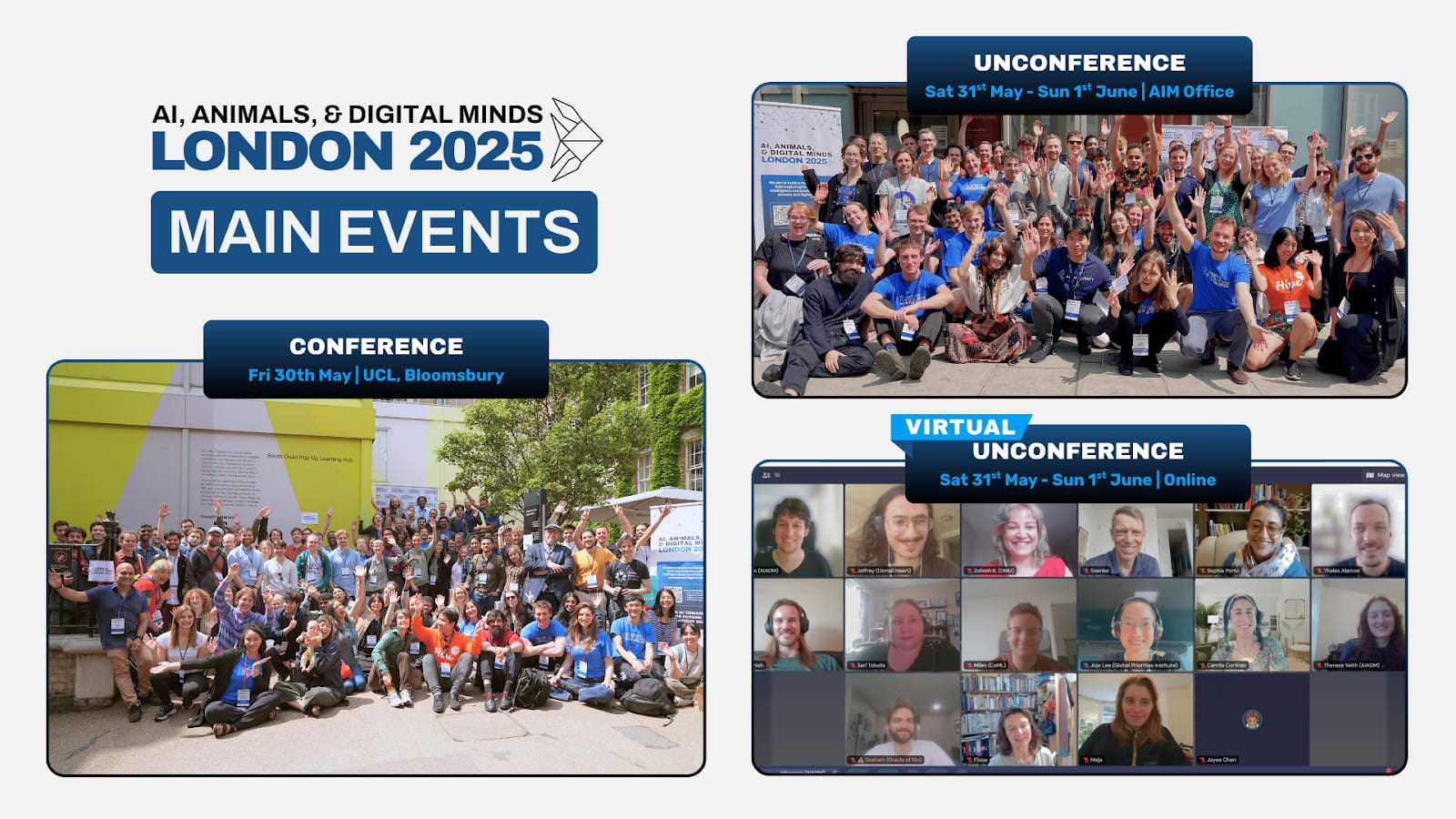
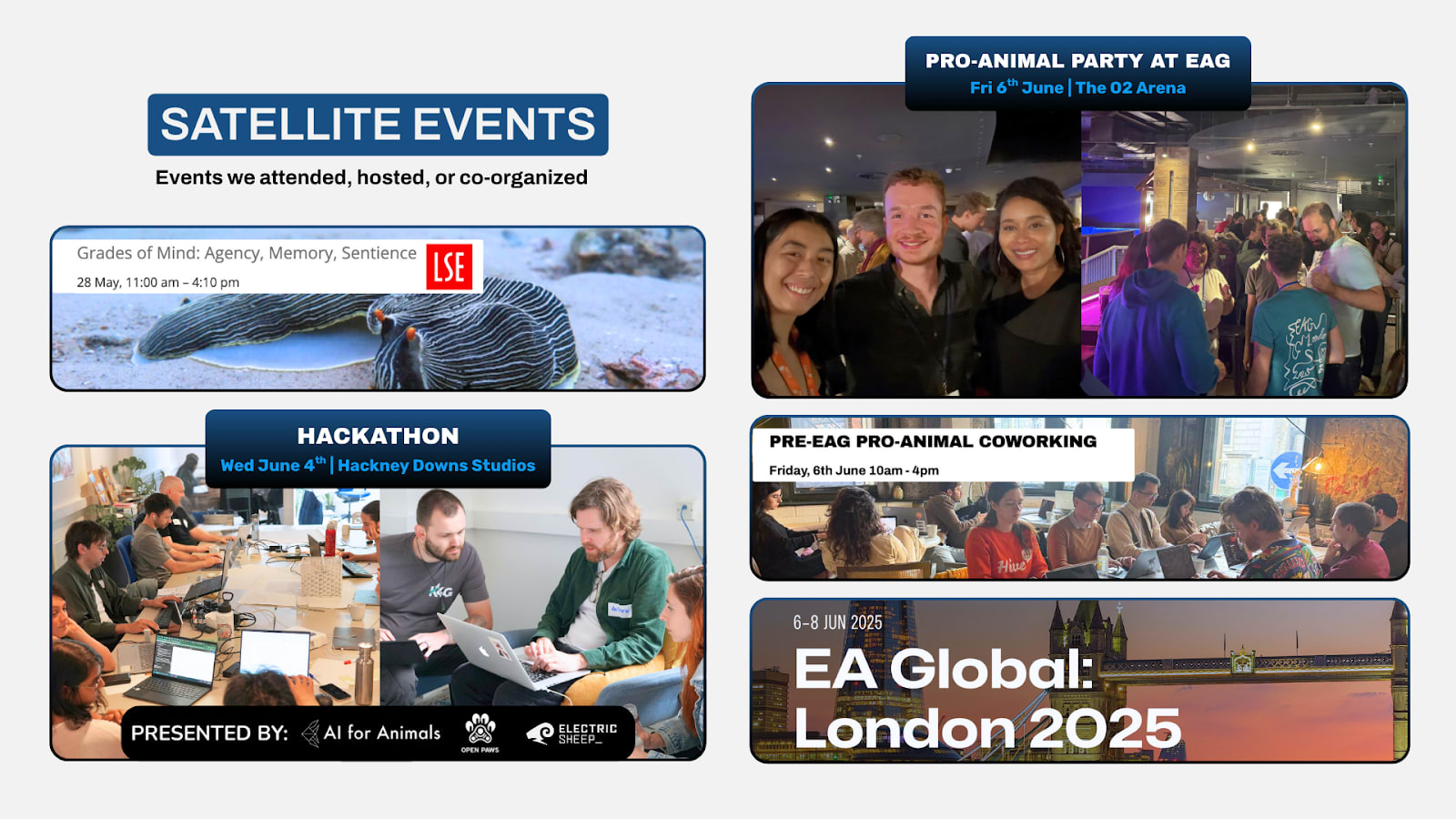
Organised by AI for Animals (now Sentient Futures), AIADM 2025 brought together almost 900 people in person and virtually across three days in May/June:
- Roughly 115 people at our in-person conference on Friday 30th May at University College London – including organisers, volunteers and speakers.
- Over 750 views of our virtual conference, which was a free livestream of most talks in the largest room of the Friday conference on YouTube.
- Up to 60 people at our in-person unconference on Saturday 31st May and Sunday 1st June at the Ambitious Impact office in east London – including organisers, volunteers and speakers.
- Over 20 participants at our virtual unconference, which took place at 4-7pm UTC on Saturday 31st May and Sunday 1st June in the EA coworking and lounge virtual space on GatherTown.
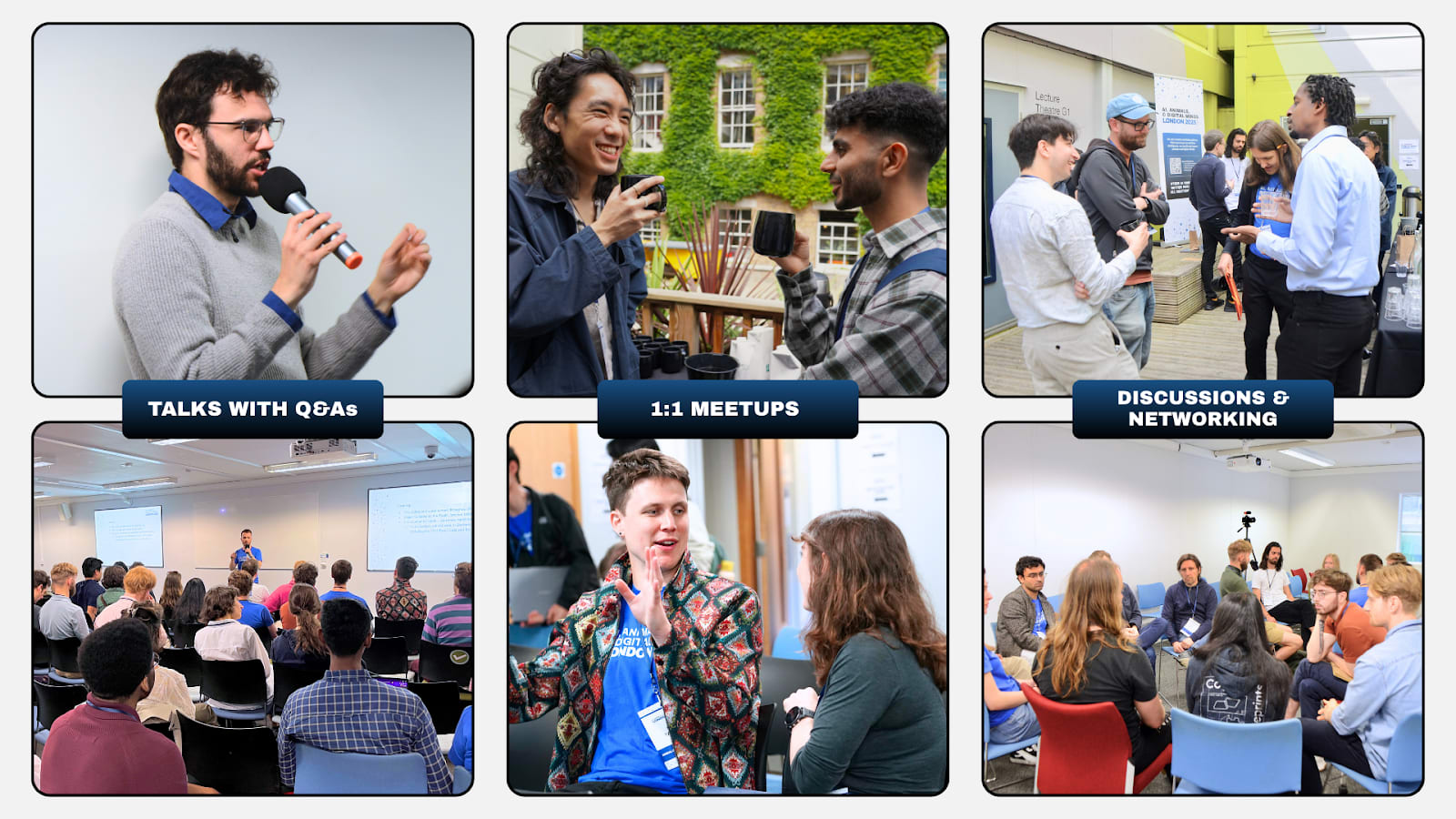
At the Friday conference we had three rooms in use for talks, panels, workshops and meet-ups throughout the day:
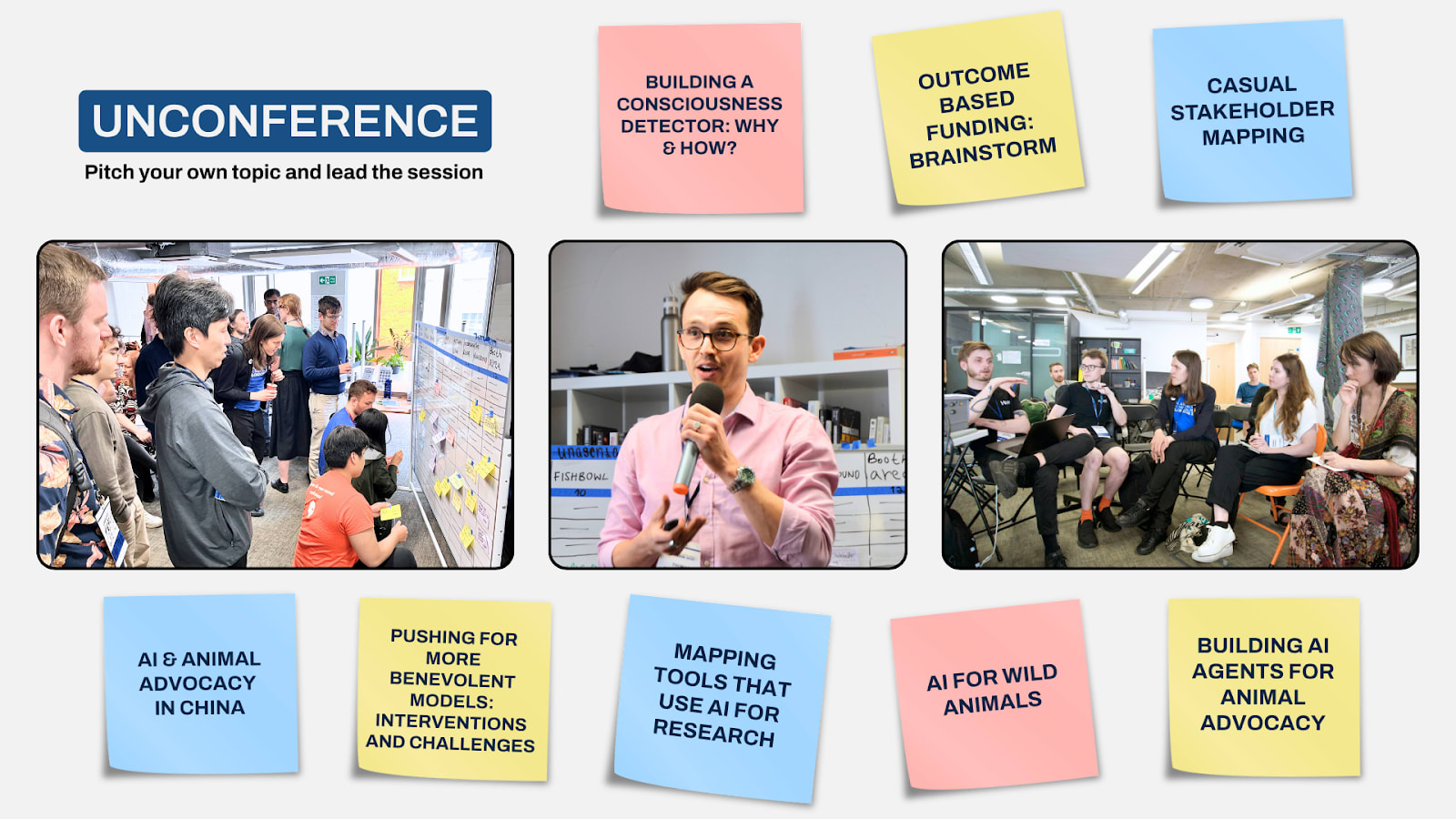
At the weekend in-person unconference, we had free use of almost the entire Ambitious Impact office with over nine rooms and other areas for participants to meet in. Participants pitched their own sessions – discussions, debates, workshops, talks – and then, based on interest, Constance and Alistair assigned these sessions to the rooms.
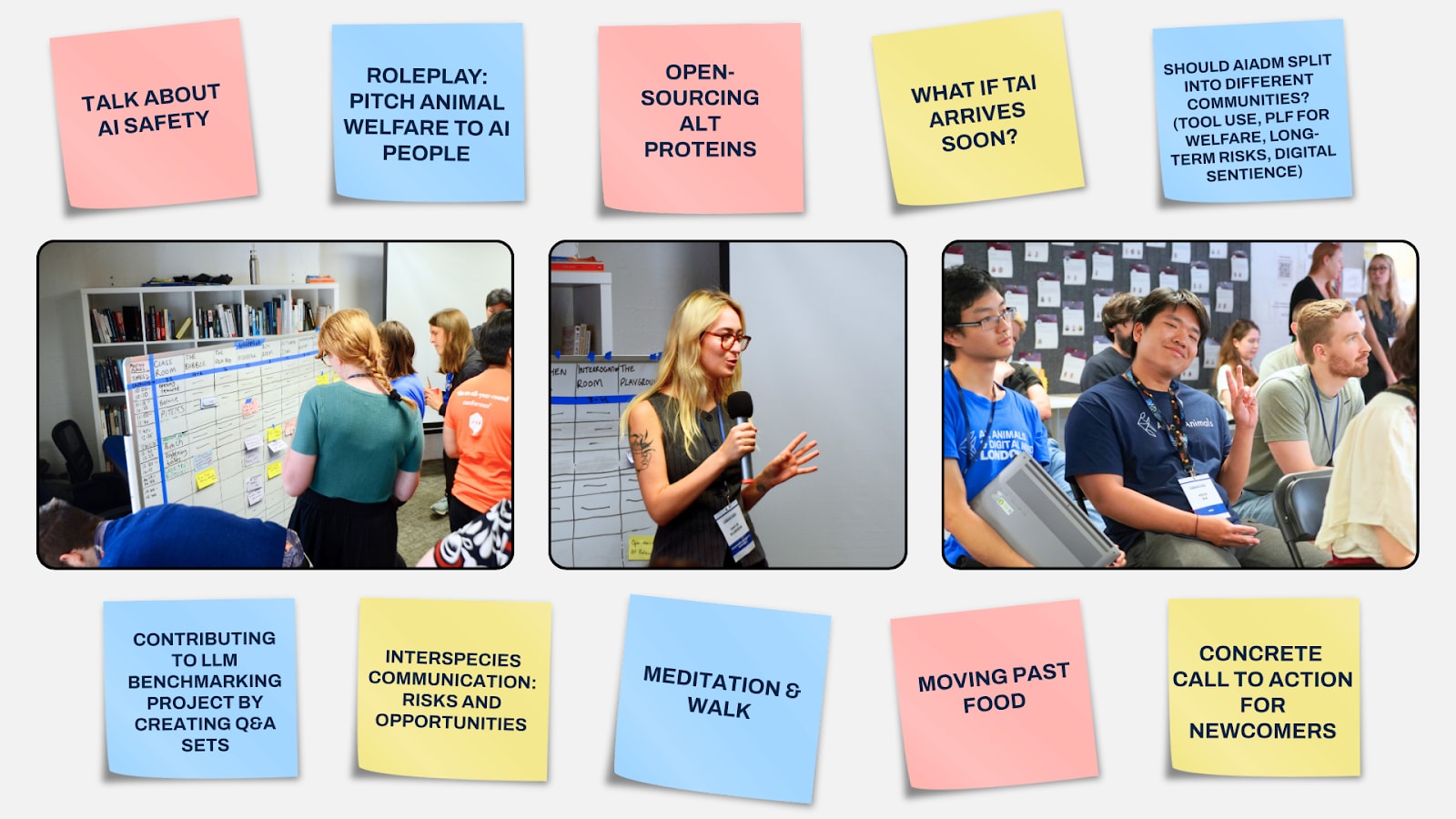
The weekend virtual unconference was planned and delivered by Johannes, almost entirely separately from the other events that made up AIADM.
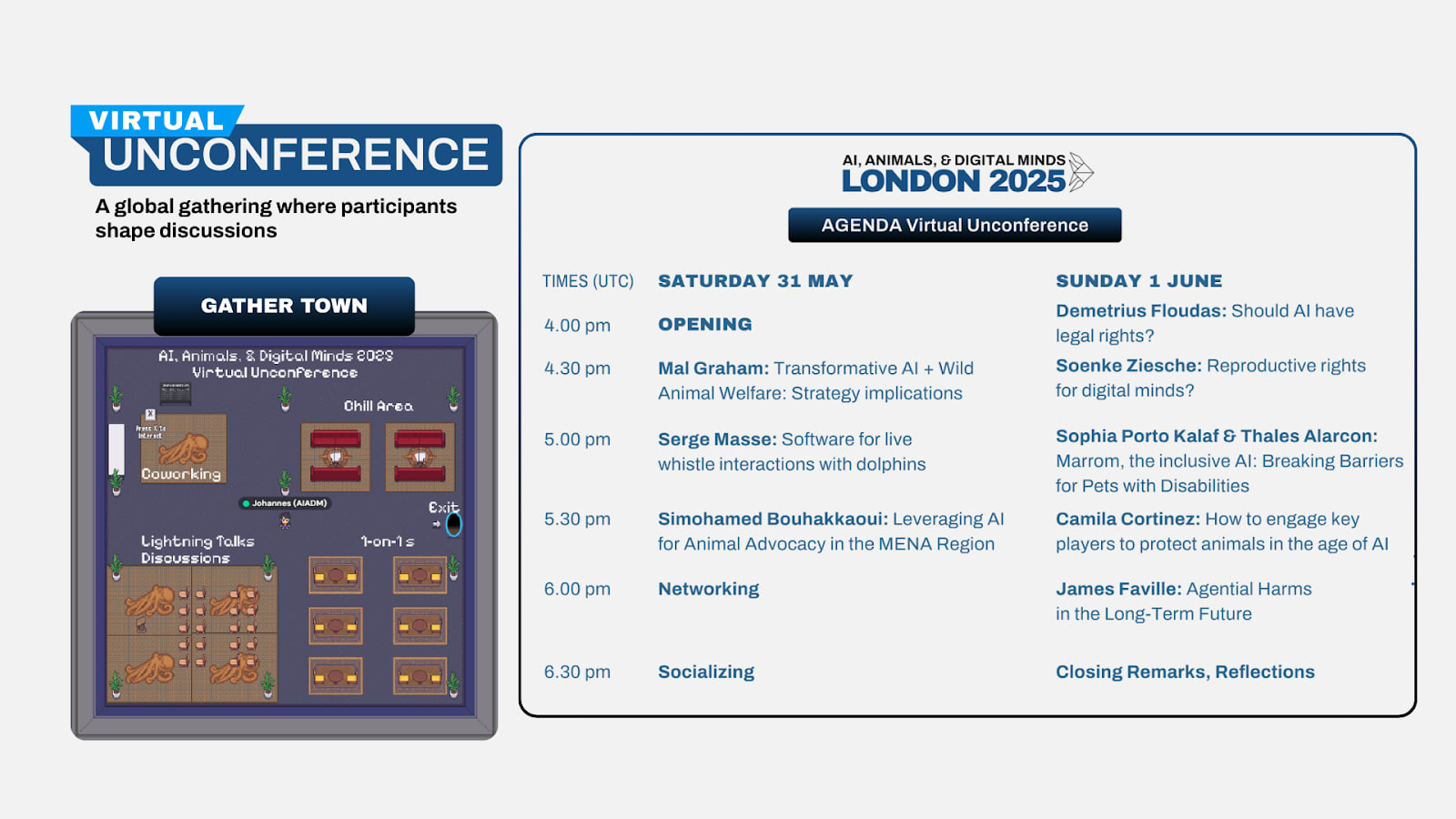
The primary part of the virtual unconference was a track of eight talks and workshops, but thanks to the online Gather platform we used, there were also opportunities for collaborating, coworking, one-on-one meetings and casual connections.
Event takeaways
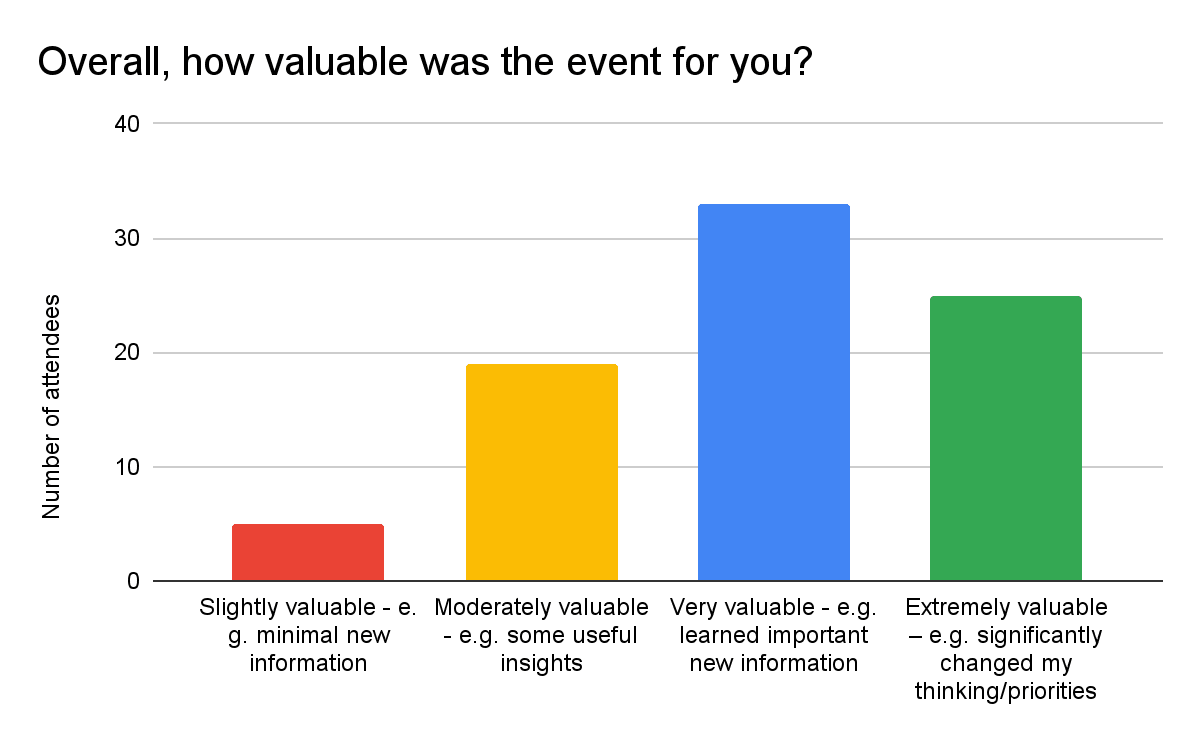
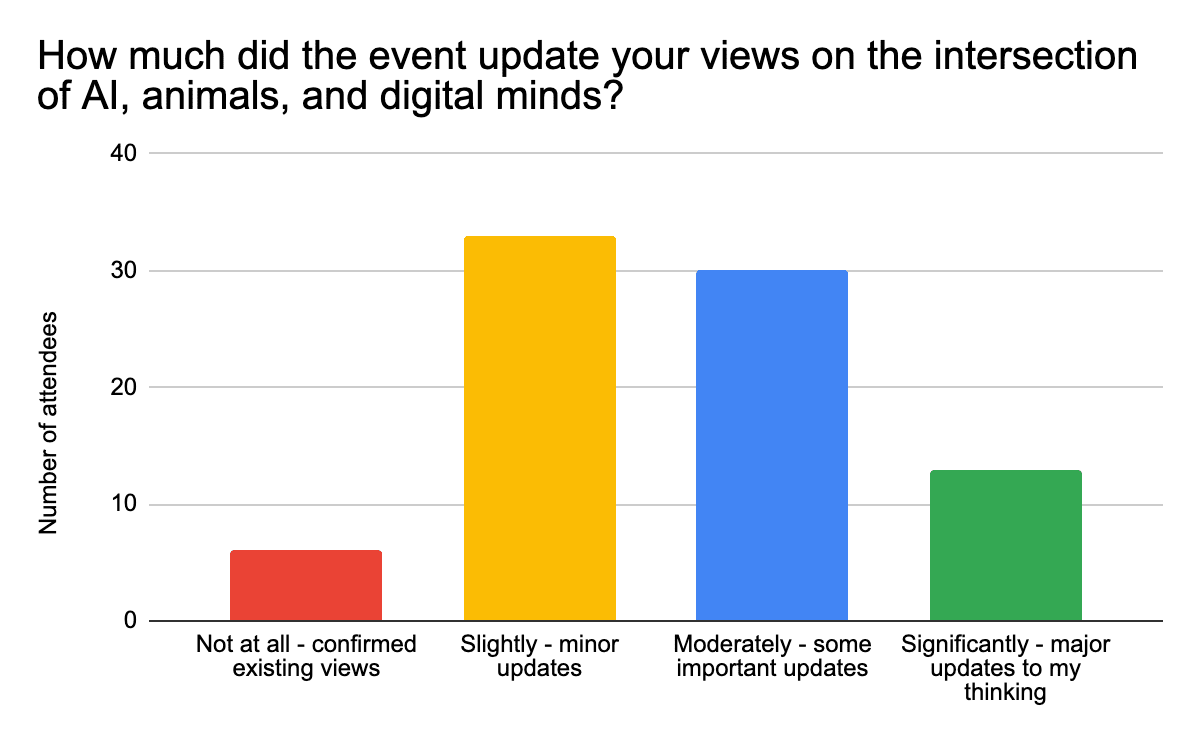
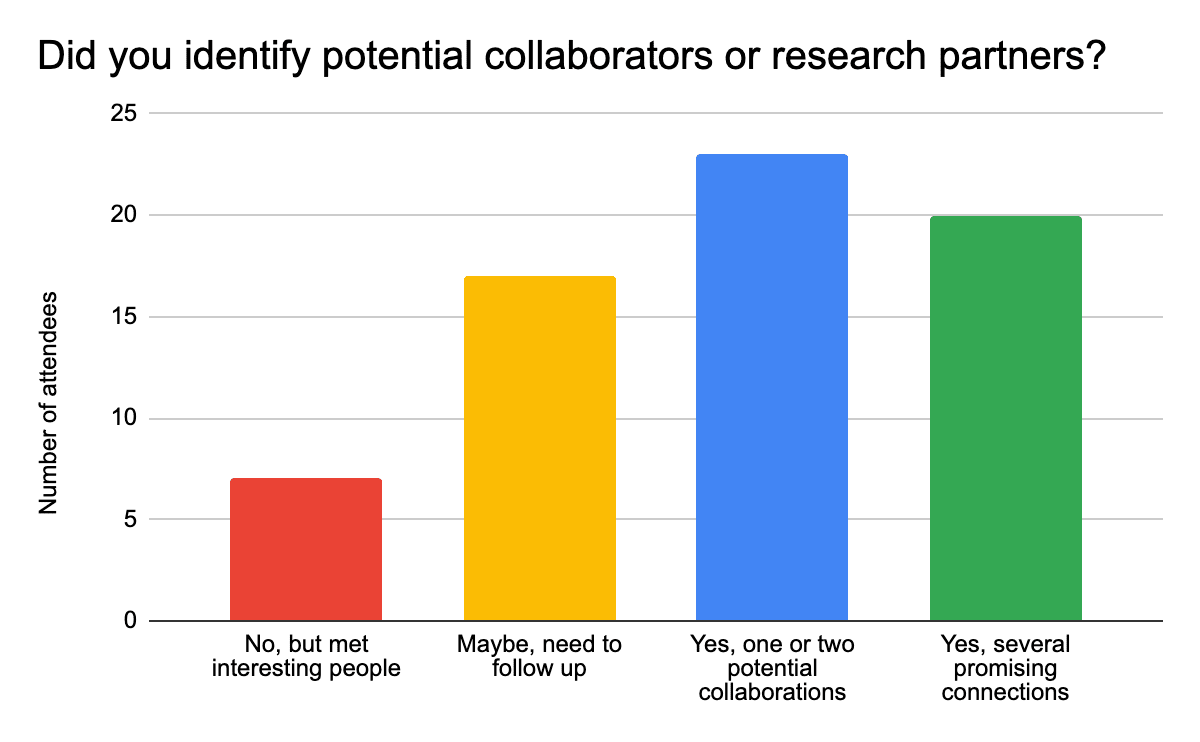
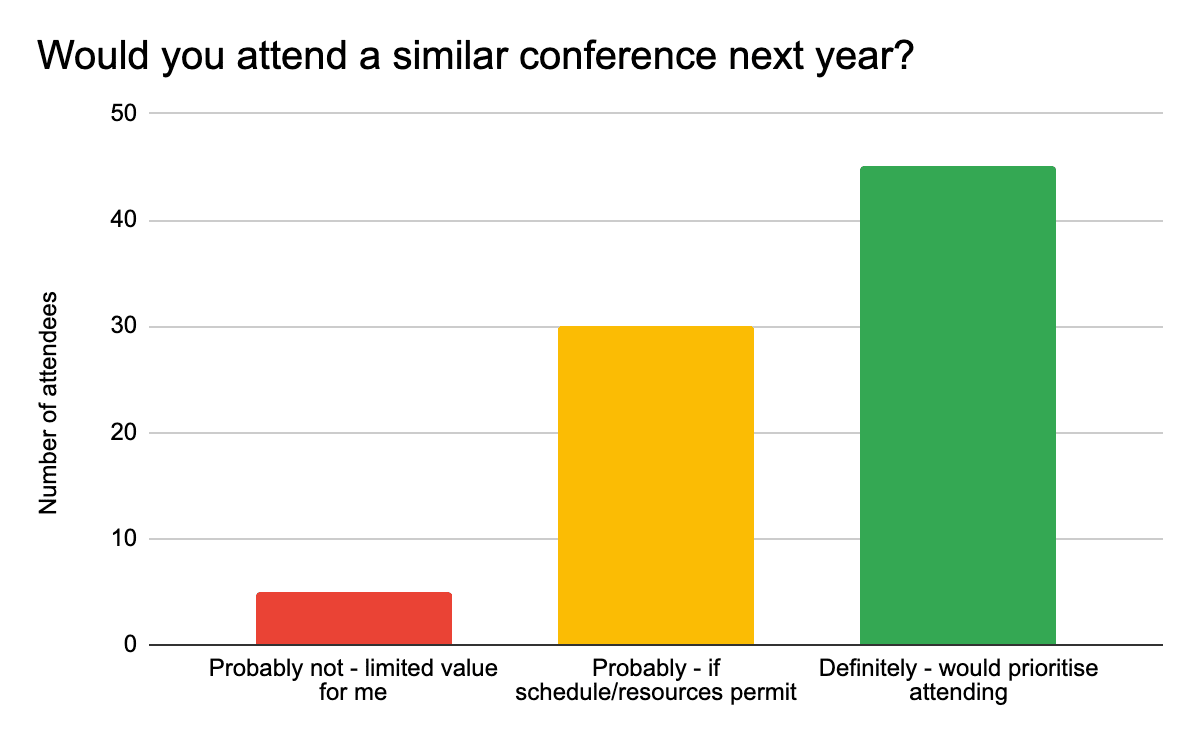
These four graphs represent collective feedback from the three events that made up AI, Animals, & Digital Minds 2025: the conference, the in-person unconference and the virtual unconference.
High impact and value
- Strong evidence of knowledge transfer: participants gained insights on AI consciousness, precision livestock farming, digital minds welfare, moral alignment, and practical AI applications for animal advocacy.
- The event effectively connected a diverse, growing community working at the intersection of AI, animals, and digital minds at a critical moment for the field's development.
- The virtual unconference was a successful experiment in creating a separate dedicated space online, with several participants wanting to follow up new ideas and work with specific organisations.
- Comment from an attendee: “This is honestly the best conference / summit I've attended yet in terms of content density, action-guiding insights, and motivation of the average attendee. Unforgettable and so useful!”
Networking and collaboration
- Exceptional networking outcomes: most attendees made valuable connections, with many identifying "several promising connections" for future collaboration.
- The event successfully brought together interdisciplinary expertise (AI researchers, animal advocates, philosophers, policymakers, industry representatives).
- Among those who filled out the feedback form and attended both, the participant-driven unconference format was consistently rated as more valuable than the structured conference sessions – 25 preferred the unconference, 4 preferred the conference.
- The virtual unconference reached participants without access to cities like London and the Bay Area who hadn’t previously had the chance to connect with others.
Movement momentum and direction
- Evidence of the field's maturation: participants identified concrete next steps, research directions, and collaborative opportunities.
- The event capitalised on a critical window where the field/community/movement at the intersection of AI, animals and digital minds field is rapidly growing and can still be meaningfully shaped.
Event comparison
The in-person unconference received the most positive feedback of the three events, with a striking 51% of survey replies describing it as “extremely valuable” (as opposed to “very valuable”, “moderately valuable”, “slightly valuable” or “not valuable”). 75% of responses described the Friday conference as “very” or “moderately valuable”, and six out of seven described the virtual unconference as the same. This creates an argument for deprioritising the conference in favour of the lower-effort, lower-cost and more valuable in-person unconference. However, we suspect the conference has an important effect in attracting attendees to listen to high-profile speakers, which in turn makes the in-person conference more valuable.
We think the networking value of the in-person unconference was the main reason why it received such positive feedback in comparison with the conference. Almost 80% of replies described the in-person conference as “extremely” or “very valuable” for networking, as opposed to around 50% for the conference. As such, we believe that explicitly encouraging and facilitating more networking at conferences and virtual events should be a priority in the future.
The knowledge impact of the three events was roughly similar, with around 80% of replies for the conference and in-person unconference reporting “moderate” or “slight” updates to thinking. Only 15% reported “major” updates. We suspect it’s hard to change people’s minds in general, though these numbers are lower than we would expect considering the AI x animals x digital minds field is young!
Content deep dive
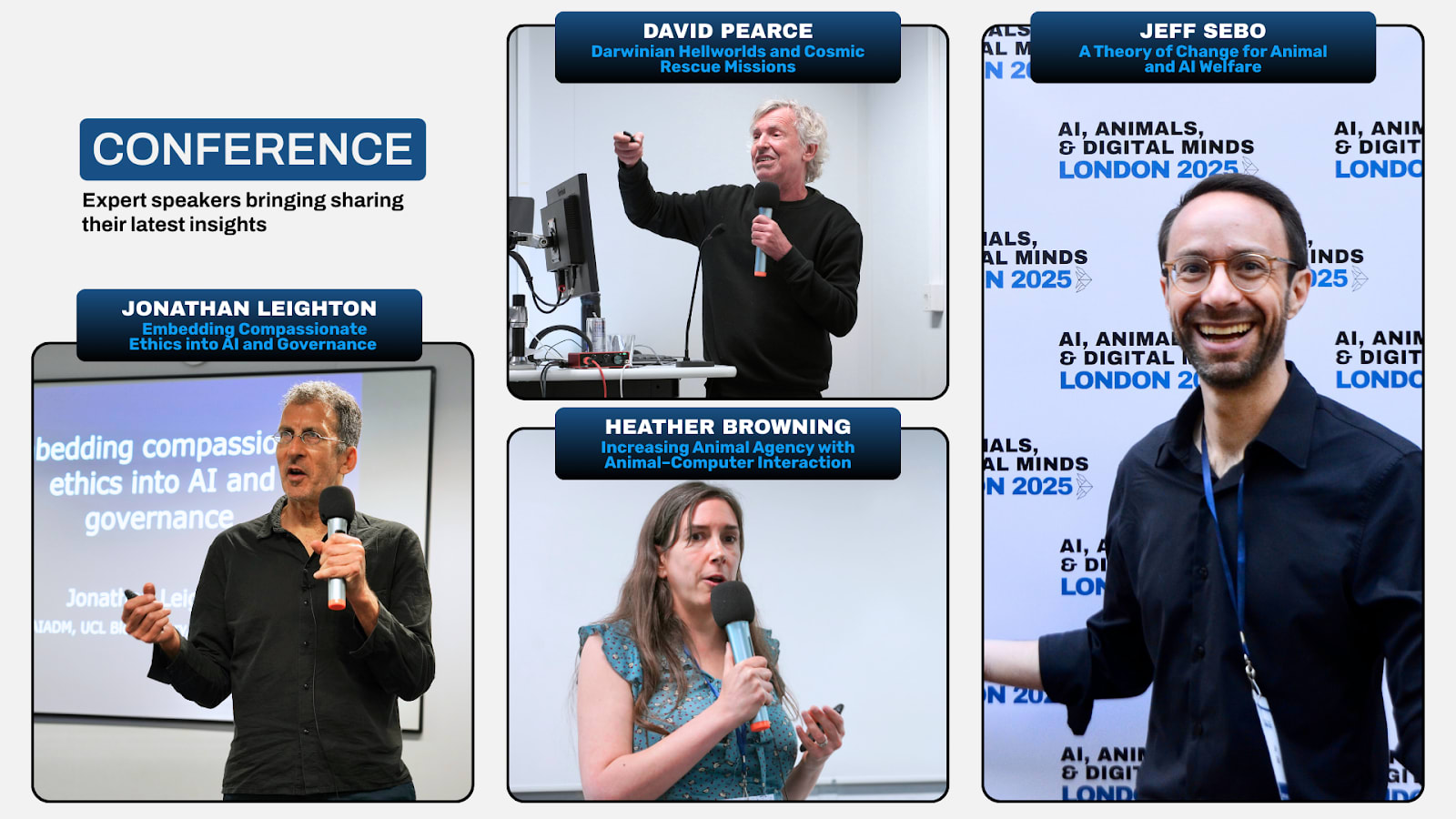
Consistently highlighted talks/workshops:
- Marian Dawkins (precision livestock farming) - repeatedly cited as "extremely valuable," generated concrete insights about farmer incentives and welfare metrics.
- David Pearce (abolition of suffering using technology) - "significantly changed thinking" for multiple attendees.
- Jeff Sebo (theory of change) - praised for broad strategic framework balancing pragmatism with idealism.
- Joey Savoie (adaptive movements) - influenced thinking on flexibility vs. commitment in strategy.
- Thomas Manandhar-Richardson (deep research workshop) - provided practical tools attendees plan to implement.
Core tensions
Consciousness or capabilities for moral patienthood? Nick Bostrom warned consciousness-based alignment may enable corporate gaming (“AI isn't conscious when it would be inconvenient"). Sessions struggled with whether consciousness or sentience is necessary and/or sufficient for moral status, while David Pearce argued that the phenomenal binding problem means digital sentience is unlikely in the near term.
Conventional AI safety vs AI welfare. Adrià Moret identified the key tension: techniques making AI safe for humans (behavioral restriction, RL training) may harm AI systems if they are welfare subjects. Risk of "large-scale, unintentional harm" without course correction.
Present vs future moral priorities. Bradford Saad focused on near-term AI moral patients being treated as tools. The spectrum game revealed disagreement on whether AI moral patienthood is the most pressing issue. Trade-off between addressing factory farming now vs. preventing digital suffering later.
Rigour vs gaming in consciousness detection. Daria Zakharova proposed behavioural approaches beyond self-report, while multiple sessions noted single consciousness tests are vulnerable to gaming. Need for "clusters of evidence" creates complexity vs. practical implementation challenges.
Terminology matters. "Digital minds" may not be the optimal term for the field; "artificial sentience" could be more accurate and inclusive of non-digital artificial beings.
Strategic insights
Critical timing window
- Multiple sessions emphasised embedding the importance of moral consideration of non-human sentience before our present values become (possibly irreversibly) entrenched in societal structures.
- Nick Bostrom issued a rallying cry, saying that we have an opportunity to act with purpose and make a positive difference to the world now. “We have our work cut out for us!”
Coordination and funding gaps. One session revealed lack of coordination, and a need for more funders in the space. Attendees updated on movement complexity and need for better coordination mechanisms.
Measurement challenges. Marian Dawkins focused on demonstrating animals are "healthy and have what they want." Alistair Bugg presented inferentialist vs direct perception approaches. Core challenge: developing reliable welfare metrics without false positives.
Adaptation strategy. Joey Savoie's framework: loyal to goals, flexible in methods. "Care about animals" > "go vegan" for broader coalition building. Emphasis on transferable skills over specialisation in rapidly changing contexts.
Emerging priorities
Meta-work over direct intervention. Ronen Bar advocated meta-work "encouraging others to fill gaps effectively." Oscar Horta noted most funding goes to research; need more policy/outreach investment. Recognition that influence on AI development may be more tractable than direct animal interventions.
Multi-stakeholder complexity. Moyinoluwa Oladoye outlined the need for interdisciplinary collaboration on zoonotic surveillance. Marian Dawkins noted farmer skepticism about financial returns on welfare-positive PLF. Challenges around aligning incentives across diverse stakeholder groups.
Methodological evolution. Movement toward portfolio approaches for consciousness testing, scenario planning for uncertainty, and robust frameworks that avoid both anthropomorphism and dismissal of non-human interests.
Talks, panels & workshops
Movement-Building, Strategy & Meta-Questions
- How to Build a Movement That Can Adapt to Rapid Changes - Joey Savoie
- A Theory of Change for Animal and AI Welfare - Jeff Sebo (▶️)
- How to Make Worldviews More Sentientist (workshop) - Jamie Woodhouse (slides)
- Building the Moral Alignment Space: Interventions, Challenges, and Its Importance - Ronen Bar (▶️ & ▶️)
- Building an AI macro culture for the animal movement - Thomas Manandhar-Richardson (unconference lightning talk) (▶️)
- The case for and against pivoting to AI x animals work - Joseph Ancion (unconference lightning talk) (▶️)
- How to engage key players to protect animals in the age of AI - Camila Cortinez (virtual unconference)
- Darwinian Hellworlds and Cosmic Rescue Missions - David Pearce (▶️)
- The nematode in the room: what will happen on earth after human extinction? - Joseph Ancion (unconference lightning talk) (▶️)
- Game: Where Do You Stand? Agree–Disagree Spectrum
- Meeting: Connecting Funders and Grantees
- Next steps: Actions, Projects, Collaborations, Opportunities
- Meet-ups: First-timers, Moral Alignment
Governance, Ethics & AI
- Embedding Compassionate Ethics into AI and Governance - Jonathan Leighton (▶️)
- Meet-ups: Policy & law for non-humans, AI safety & ethics
Digital Minds
- AI Creation and the Cosmic Host (virtual fireside chat) - Nick Bostrom (▶️)
- AI the Moral Agent, AI the Moral Patient (panel) - Winnie Street, Geoff Keeling, Henry Shevlin (▶️)
- Status Quo Treatment of AI Moral Patients as a Large-Scale Catastrophic Risk - Bradford Saad (▶️)
- Is AI conscious? Early Results from the Digital Consciousness Model - Arvo Munoz Moran (▶️)
- AI Welfare Risks: Four Tentative AI Welfare Policies - Adria Moret (▶️)
- Advancing behavioural approaches for the study of possible conscious states in LLMs - Daria Zakharova (lightning talk) (▶️)
- Different types of artificial minds: Digital, analogue, and hybrid - Chris Percy (lightning talk) (▶️)
- Reproductive rights for digital minds? - Soenke Ziesche (virtual unconference)
- Agential Harms in the Long-Term Future - James Faville (virtual unconference)
- Meet-up: Digital minds
AI, Agriculture & Food
- AI in Farming: Helping or Harming Animal Welfare? - Marian Dawkins (▶️)
- Meet-ups: Precision livestock farming, Alt proteins
AI, Wild Animals & Conservation
- The Future of Wild Animals - Oscar Horta (▶️)
- Transformative AI + Wild Animal Welfare: Strategy implications - Mal Graham (virtual unconference)
- The Synergy between AI and Biotechnology for Conservation: an Epistemic Justice Problem - Bernice Bovenkerk (unconference)
- Meet-up: Wild animal welfare
Animal Welfare & Health
- Increasing Animal Agency with Animal–Computer Interaction - Heather Browning (▶️)
- Reading (Animal) Minds - Alistair Bugg (lightning talk)
- One Health, AI and Zoonotic Surveillance: Bridging the Gap Between Animal Disease and Public Health - Moyinoluwa Oladoye (lightning talk) (▶️)
Animal Testing
- Rethinking Toxicology: Challenging Animal Testing Status Quo with Ethical, Explainable AI - Alexandra Hammond
- Meet-up: Alternatives to animal testing
Interspecies Communication
- Software for live whistle interactions with dolphins - Serge Masse (virtual unconference)
- Marrom, the inclusive AI: Breaking Barriers for Pets with Disabilities - Sophia Porto Kalaf & Thales Alarcon (virtual unconference)
- Meet-up: Interspecies communication
AI Tools
- The Deep Research Revolution (workshop) - Thomas Manandhar-Richardson (▶️)
- Smarter, Faster Research: AI-Powered Data Collection for Strategy Decisions - Jah Ying Chung
- Leveraging AI for Animal Advocacy in the MENA Region - Simohamed Bouhakkaoui (virtual unconference)
- Meet-up: AI tools for advocates
Miscellaneous
- Ideation – Using a Technique to Generate Participant-Relevant Ideas (workshop) - Ronen Bar
- The implications of illusionism on the distribution of consciousness - José Luis-Curbera (unconference lightning talk) (▶️)
- Opening & Closing Remarks: Alistair Stewart, Constance Li, Jonathan Birch (opening only)
What went well
Content
- There were high-quality talks, workshops and discussions throughout the event.
- The event successfully balanced discussions of current AI applications (farming, research) with future considerations (digital minds, moral alignment).
- There was effective cross-pollination between a wide range of perspectives, including animal advocacy, AI research, philosophy, and policy perspectives.
- The spectrum game and workshop sessions were well-received for encouraging participation.
Community and networking
- The Swapcard platform facilitated valuable one-on-one connections.
- Volunteer screening and management was highly effective.
- The planning team worked well together with mostly clear division of responsibilities.
- We successfully created space for both newcomers and experts to contribute.
Logistics and organisation
- There were no major / show-stopping logistical hiccups (though several minor ones on the Friday at UCL, including problems with some of the projectors and one of the key bathrooms being closed).
- The space at UCL worked well, thanks in part to the good weather; the AIM office was an excellent space, especially for providing a variety of meeting areas.
- The virtual Gather platform was very well-received by virtual unconference participants.
What could be improved for next time
Planning
- Find a location with greater capacity for the conference in particular, as there was more interest than we had space for!
- Secure high-profile speakers (much) earlier in advance.
- Activate Swapcard more than two days in advance of the conference earlier for proper meeting planning.
- Promote the virtual unconference more widely in advance – including to academic networks and AI companies.
Technical and logistical
- Invest in a more experienced and professional AV company for recording.
- Improve signage to make it easier to find toilets and the canteen.
- For the virtual unconference, ask speakers to share their slides with the organisers in advance in case of technical issues. Also, save the discussion chat in Gathertown and record the talks (if speakers agree).
Content
- Invite more policymakers/implementers, more people with connections to industry, and above all people with expertise in AI, people who are AI-first – whether that’s AI safety, governance, ethics, capabilities.
- Have more of a focus on specific actionable outcomes.
- Label talks and sessions more clearly by topic and level of knowledge needed to benefit from attending it.
- For the virtual unconference, consider reducing the length of some of the 30-minute talks.
Format
- Put aside more time for Q&A, longer events.
- Create more time and space for one-on-one meetings in particular.
Follow-up
- Establish working groups, shared repositories, and better coordination after the event.
Budget
We budgeted about £23.5k beforehand, and ended up spending just under £27k on the three AIADM events (Friday conference, weekend in-person unconference, weekend virtual unconference) and accommodation for the weekend of and week after AIADM.
The sum of our internal funding and revenue was about £26k. £7.5k ($10k) of this was ringfenced money from AI for Animals, we received a £9k ($12.5k) donation from a generous benefactor beforehand, and we took in nearly £9.5k in ticket sales for the three events plus the VIP dinner at a restaurant near UCL after the Friday conference. These were ticket costs for AIADM:
- Standard tickets for the conference cost £150. Other options were:
- £400 for a benefactor ticket
- £60 for a reduced ticket
- £25 for a student/concession ticket
- Free for a scholarship ticket
- Tickets for the in-person unconference cost £35
- Tickets for the virtual unconference cost £5
- Tickets for the VIP dinner after the conference cost £25
All speakers, featured guests, members of the planning team and volunteers were given free tickets to relevant events.
We spent just under £5k on accommodation for the weekend of and week after AIADM at the excellent Wombat’s City Hostel in east London, a 15-minute walk from the in-person unconference. In the end we didn’t charge anyone for this accommodation, and we had about 20 people stay there for up to eight nights – most for fewer than five nights, i.e. just around the weekend of AIADM. At almost one-fifth of our budget, accommodation is a significant cost, but we think it’s worth it: the community-building value from people spending casual time together is huge.
Our total spend of £27k ($36k) is significantly less than the £55k ($74k) we spent on the AI for Animals 2025 Bay Area conference in March. One reason for this difference is the lower number of attendees and participants in London – partly because we had much tighter restrictions on participant numbers due to venue size, and partly because the AI, animals and digital minds community is larger and more established in the Bay Area than in London. Another reason is that London is, in general, a cheaper city. We also made a deliberate effort to cut costs in London – some of this was sensible, like finding particularly affordable caterers and providing snacks ourselves. However, in hindsight, we should have spent more money to get a more experienced audio-visual (AV) team to livestream, record and edit talks.
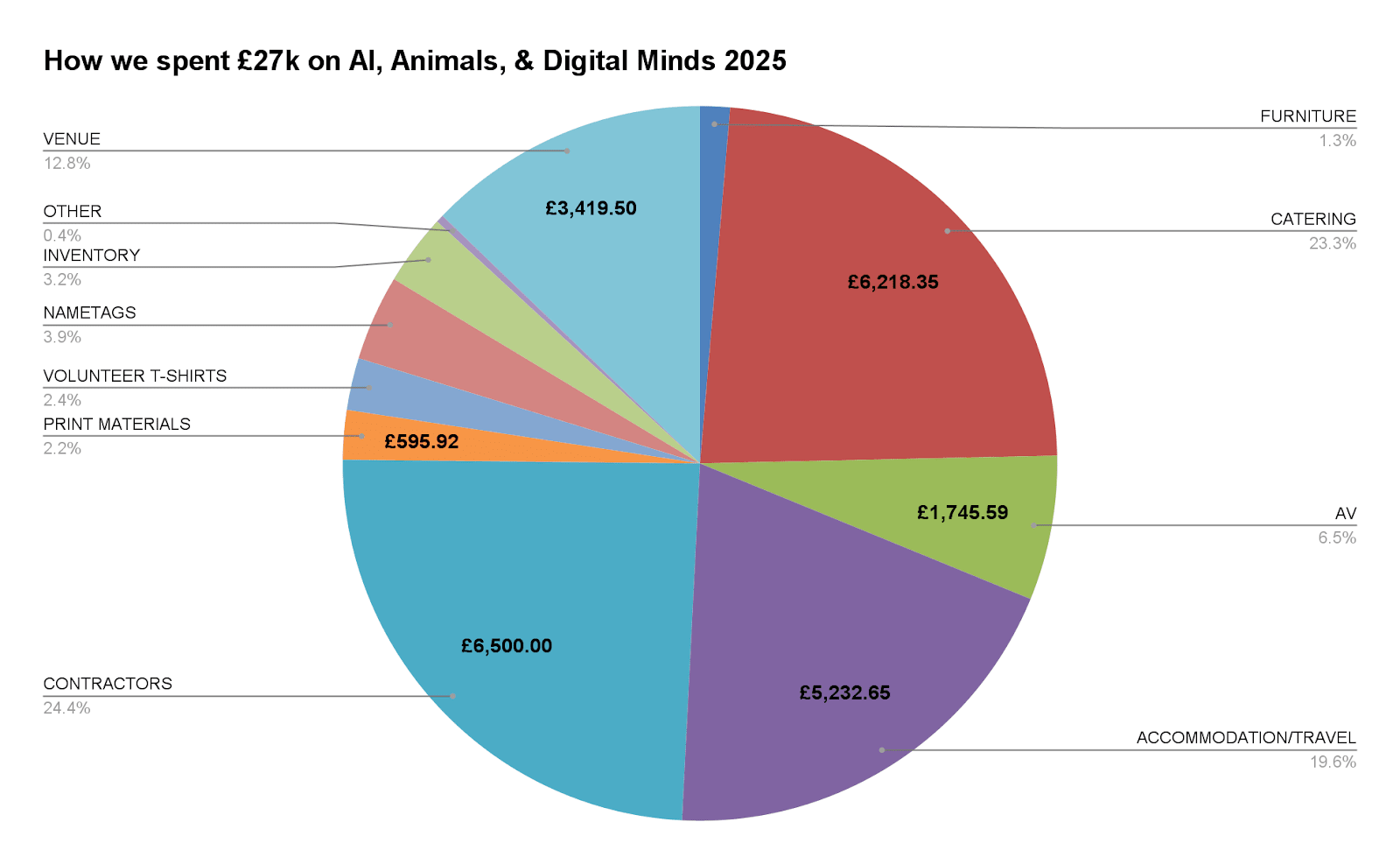
More information is in the budget spreadsheet here.
Acknowledgements
First, we would like to thank all of our speakers and featured guests – during the conference, in-person unconference and virtual unconference.
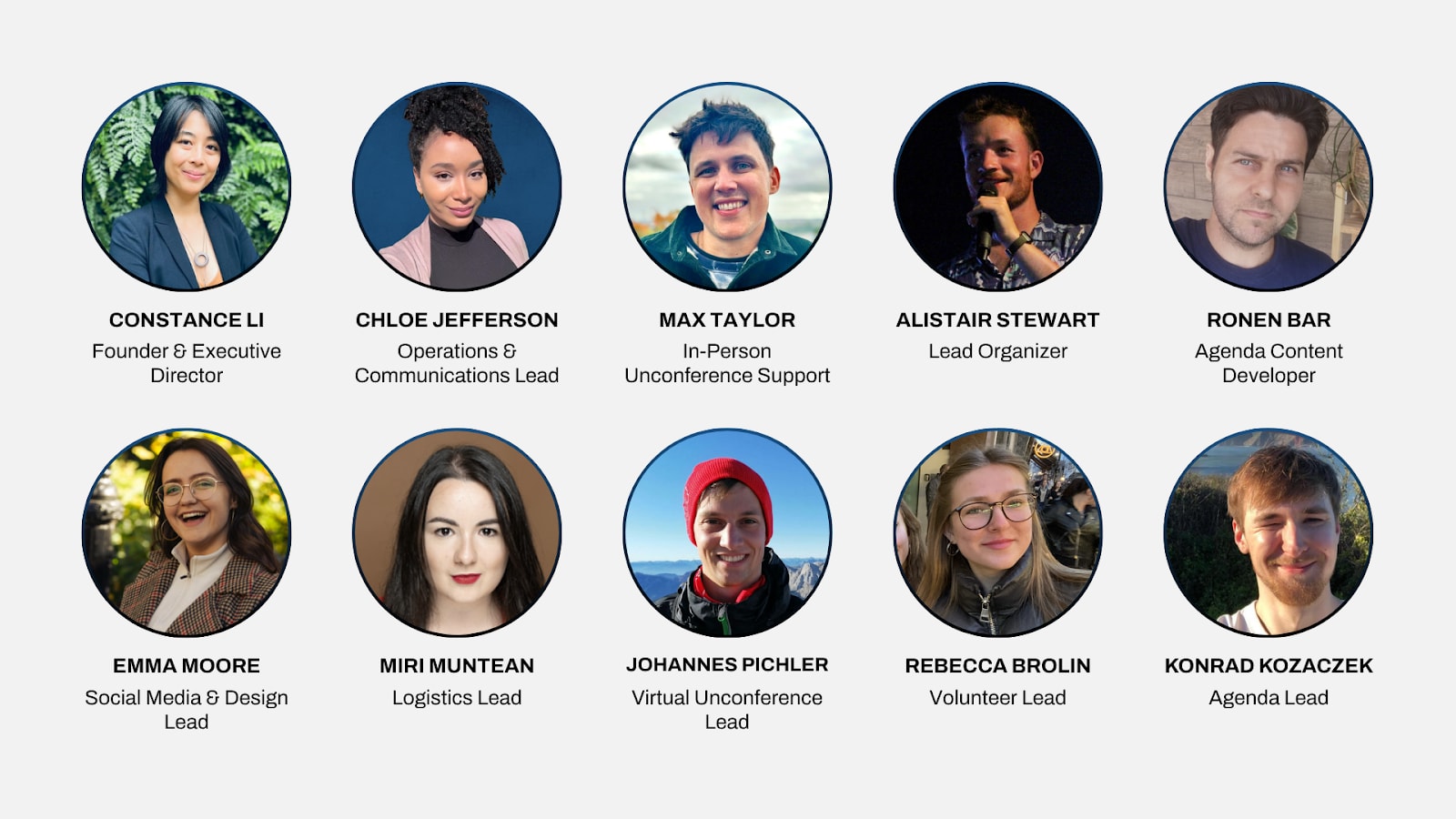
Second, we would like to thank the planning team, who did a wonderful job planning and running the event, mostly on a voluntary basis:
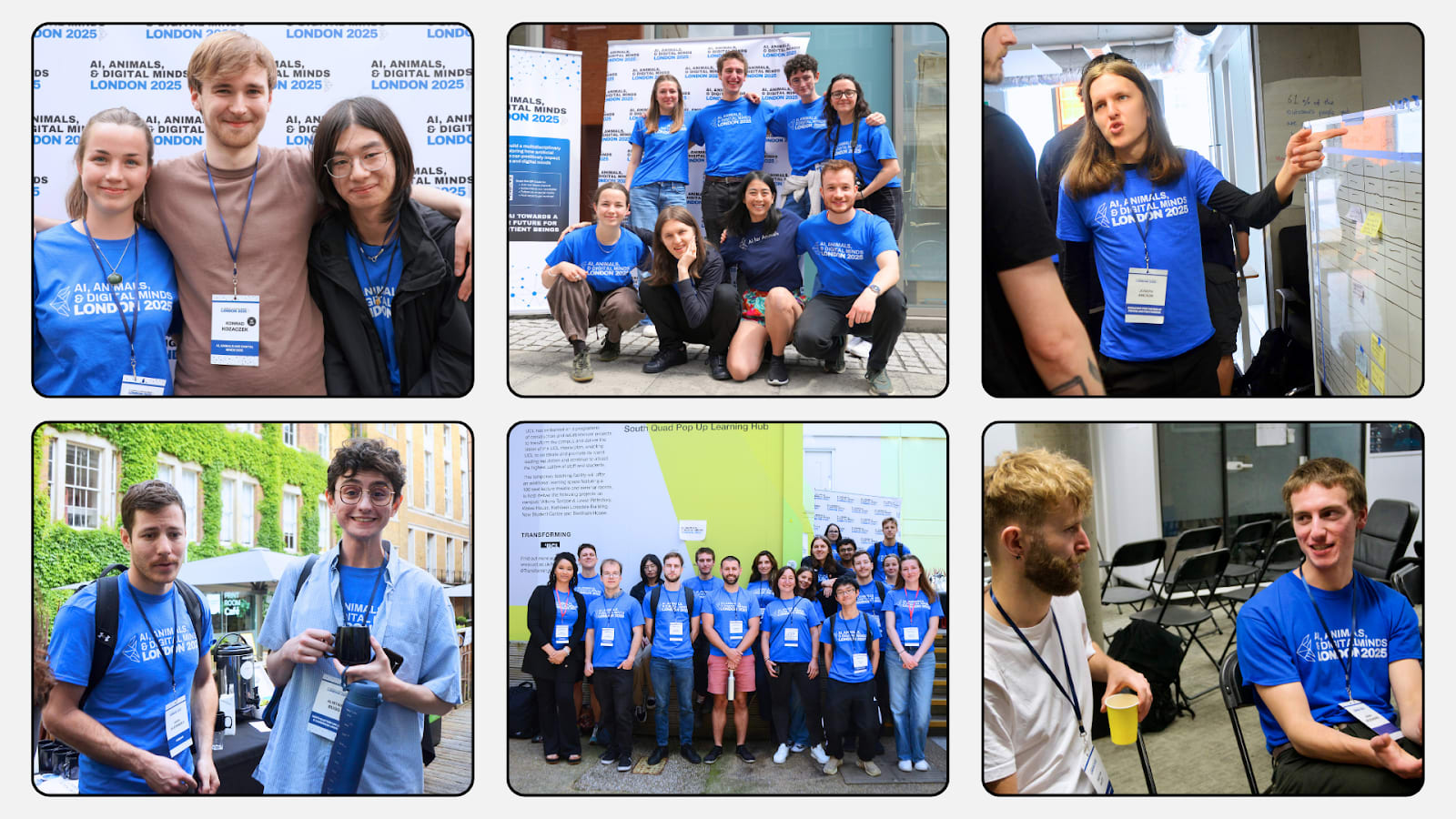
Third, we would like to thank our blue-shirted volunteers, without whom the event could not have run! (We recommend t-shirts for volunteers.)
Finally, special thanks have to go to the team at Ambitious Impact – including Brechtje van den Bosch and Izzy Mencattelli in operations and Joey Savoie as CEO – for letting us take over your beautiful office, for free, for the in-person unconference!
Get involved
- Next conference: likely the first week of October 2025 in New York City (before Effective Altruism Global starts on Friday 10th October) – put it in your calendar now, and we’ll communicate when applications are open on our newsletter and social media.
- Subscribe to the Sentient Futures newsletter here for updates on research, tools and opportunities.
- Join the Sentient Futures Slack community here for ongoing discussions and collaboration.
- Follow us on social media here to stay engaged.
Contact
Email: hello at sentientfutures dot ai
Website: https://sentientfutures.ai
Edit: updated links and contact info that have changed since our rebrand
JoA🔸 @ 2025-07-12T08:23 (+5)
Some of the densest and most action-focused conversations I've ever had were in the two days of the Unconference, I was quite impressed with how well-organized and successful this was. And I admire how the budget was handled! I definitely encourage joining the Slack community if you are eager to understand the issues better and take action.
Alistair Stewart @ 2025-07-12T09:19 (+3)
Thank you! And thanks for all your contributions over the weekend 🤝
ChrisPercy @ 2025-07-20T11:08 (+2)
Great retrospective and a great event! It was a joy to speak there and to learn so much from fellow attendees. I hope to get involved again (although can't get to NY for October, so it would be a later one).