Nonprofits Deserve Better Operations
By Deena Englander @ 2026-02-02T21:08 (+20)
Ops is important
Effective operations are an important part of any impact-focused organization, and even more so for resource-constrained nonprofits. I don’t think anyone will argue that point, and I’ve seen a trend in increased realization of the importance of having a strong internal infrastructure.
Beyond just a “feeling,” or common sense, there’s a lot of data supporting the fact that a well-run organization has increased impact. This study randomly selected organizations from a set of 454 nonprofits. The orgs that received capacity-building support experienced significantly higher levels of growth than the orgs that didn’t receive that level of support. The big consultant groups (McKinsey, BCG, Bain) all have dedicated programs to strengthen nonprofit infrastructure, recognizing that organizational health drives mission success. Specifically, McKinsey's research found that healthy organizations deliver 3x the returns of unhealthy ones. In nonprofits, 91% of staff at healthy organizations say they're achieving their mission, versus just 60% at struggling ones.
But implementing good operations isn’t as simple as it sounds - it requires:
- The ability to think in operational systems
- Knowledge of how others can help
- Experience dealing with similar challenges
- Understand available resources
- Being aware of best practices
- Having the talents and abilities to implement all of them.
But there are too many barriers to success
And that means that there are too many barriers to effective operations. Primarily:
- People don’t know what effective operations actually means
- People think they can do it on their own, start from first principles, and be as successful as those with robust experience
- Organizations lack the funds to bring in specialists.
It’s a challenge - and one I believe that’s worth fighting for. Every step that each organization takes to improve internal operations is a leap for that organization’s impact.
Currently, nonprofit ops isn’t doing so well
In my work, I get to interact with many nonprofits and operations professionals. And what I’ve seen isn’t so encouraging - only a quarter of our nonprofits are operating with excellence. We need to do better. We owe it to our causes. Of 41 organizations that I work with and am familiar enough with the operations to grade, only 25% are operating with excellence, and 51% are below an acceptable level (C and below).
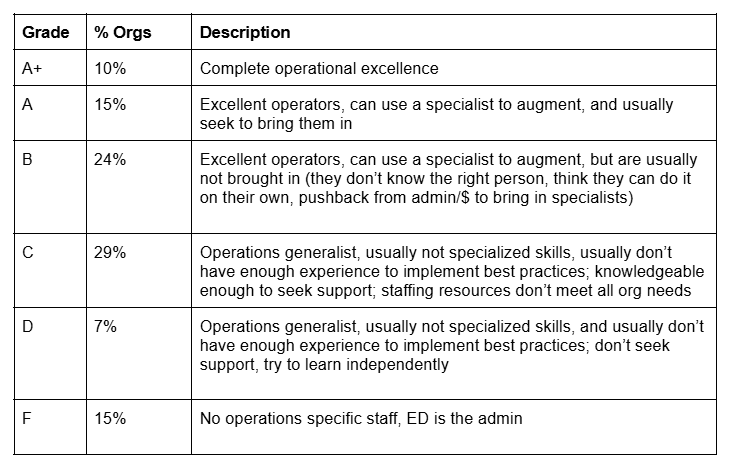
My numbers aren’t outliers. They’re actually pretty similar to Bridgespan’s analysis of 274 highly funded nonprofits. The Stanford Survey on Leadership and Management found that only about 1 in 10 nonprofits have all the foundational elements in place to maximize their impact. The operational gap is real, and it's widespread.
So let’s fix the problem
My perspective on life in general is that there is no such thing as an unfixable problem. We can, and are morally bound, to take the steps necessary to ensure operational excellence.
1. Get better at staffing
The problem: I think people are generally aware that they need operations staff. That, at least, has been a pretty positive trend in the industry. The biggest problem is that they don’t know who to hire, so they often hire inadequate candidates.
The most common cause: There are many different types of operations. Most EDs aren’t aware of what nonprofit operational needs are, and that’s especially true with first-time founders and EDs. So while they might hire an “operations professional”, they might be hiring the wrong type, which means that they’re not getting the support they need. See my prior post about the different types of operators. Nonprofits are also 4x less likely to spend on staff training.
Some Solutions (different ones will work for different situations - choose 1 or more):
- Identify your operational needs - when you know what you need your new hire to do, you’re more likely to screen effectively and hire right. Most wrong hires start off with skipping this step.
- Don’t start off with a full-time hire - get a specialist for the specific type of support you need. It’ll be more cost efficient and you’ll get better results.
- Make work tests and work trials a part of your hiring process. They should mirror what your new hire will be expected to do.
- Invest in training or coaching - there’s not enough time to waste in figuring things out on your own. Training is a shortcut to being an expert faster. Take a look at our operations accelerator training program.
2. Turn everything into a process
The problem: Lack of defined processes creates a feeling of chaos and overwhelm, uncertainties about performance, and undefined success.
Making processes is just like making lists. You’re taking a lot of details that your mind is trying to keep track of, and putting them into an order that makes sense. Just like putting your to-do list on paper calms your brain and makes you more productive, creating processes around your workstreams makes you and your team more productive, efficient, and calm. It provides an element of control, which means that chaos disappears. We humans thrive on structure, and so do our organizations (see this article about the effect of lean six sigma in a food bank). The problem is that it takes time to step back and map out a process. Many will argue that there’s no process, it’s just something different that needs to happen every time. I’ll argue back that there’s a general pattern to how work flows, so even though the details are different, the process is documentable.
Common Causes:
- Most of the visionaries I work with tend to trust their employees to do a fantastic job. The employees, on the other hand, are anxious to please, but are lacking direction from their leader. It might feel like a good culture to trust your employees implicitly, but that trust is misplaced. They need a leader to hold them accountable. (Note: please do trust your employees, just hold them accountable and maintain a degree of skepticism in order to maintain quality)
- A lot of thought goes into what needs to happen, but not how. That creates inefficiencies, little to no transparency in work and work quality, and definitely doesn’t focus on maximizing throughput.
Some Solutions:
- Document the workflow. I like making visual maps of how work flows from conception to completion. That will create a lot more clarity.
- Partner with someone organized. The visionary brain is by nature not ordered. Every visionary needs to partner with someone who can complement them with operations and process. Even though I specialize in process, when I have my nonprofit visionary hat on, I need someone to help me turn it into a process (thanks, team!).
- Focus on what “output” you can check and look for every step of the way - that will give you something more tangible to focus on in the process.
- Take small steps for creating standard operating procedures (SOP) and yes, it’s ok to keep them high level. It might be easier to make it as you’re actually working on something. People often catch inefficiencies or opportunities for improvement just by doing that.
- When you’re finished with a project, do a post-mortem. While it’s still fresh, write down how you did things and why, what went well and what went wrong, and ideas and suggestions for next time. Your future self will thank you.
3. Make software your friend.
The problem: Most organizations aren’t using technology to help them work more efficiently. That creates more opportunity for things to fall through the cracks and limits your impact to the amount of hours you have. From a lean six sigma perspective, we want to maximize throughput while decreasing opportunity for errors - and technology is great at helping us do that, although it’s sadly underutilized.
Common Causes:
- Licensing costs. While cheaper than hiring a human, people try to go with the lowest cost or free software.
- Going back to the process problem: without a clearly defined process, it’s unclear how to utilize technology to make it helpful.
- New systems are overwhelming. No one (at least that I know of) likes change. Finding new tools requires you to research options, analyze them, and implement them - which all take time and effort.
Some Solutions:
- Sign up for TechSoup to get discounts on many software programs.
- Try to translate estimated time savings into reduced staff time. Then you can turn that into numbers based on salary, and now you have a budget of how much you can spend on software. You’ll usually spend only a fraction of the salary amount.
- Start small; you don’t need to implement a huge tech project to start with. Pick one thing to optimize at a time. What would make that process easier? Is there some kind of software that can help you manage that? Most likely, something already exists. You don’t need to overcomplicate it.
- Don’t pick the best software, pick the one that you and your team are most likely to use. That makes it the best. When you do implement it, make sure it’s adopted across the team. A tool that only some people use (especially if it’s a project or contact management tool) is almost useless.
- Just like with hiring, document the processes you’re trying to support. How can technology help you automate? Eliminate errors? Save time? You only know the right answers once you’ve defined the problem you’re trying to solve for.
It’s also worth noting that the lack of technology is especially pronounced in regard to nonprofit marketing and branding, having a social media footprint is very important for any organization trying to create social impact and/or attract donors. It’s easy enough to do with the right talent and technology, but is sorely neglected.
Bottom line:
If you’re a visionary with a mission to change the future, your best chance of bringing your vision to fruition is to pair with a strong operator. Don’t skimp on quality here, the right operations partner will give you the foundation and structure you need to thrive.
Even if you don’t have the resources to put your ideal infrastructure into place, start with one small change at a time, and you’ll see your organization strengthen one step at a time.
Although many orgs are cash-constrained, the scarcity mindset is counterproductive. It’s more efficient and effective to invest your time in constant operational improvements. You’re not the first one to walk this path; use the supportive community around you, lean into the hive mind, and keep taking one step at a time on the road to constant improvement.
Have any thoughts you'd like to share, or questions? Please PM, send me an email, or book a time to chat here. I welcome all questions, comments and feedback about effective ops - keep the bar to reaching out low!
Rushikesh Gaikwad @ 2026-02-06T11:51 (+7)
I really appreciate how this piece treats Operations, not as a nice-to-have, but as a bottleneck that can quietly cap an organization's impact. It reminded me of Goldratt’s The Goal: if you don’t explicitly identify and elevate your constraint, the whole system stalls. The rubric feels like a practical diagnostic tool which we can use, reflect and equip ops capacity, A+ orgs are the ones that treat ops capacity, specialist support, and process design as the constraint to manage!
Omar Z @ 2026-02-09T13:14 (+6)
Great post, Deena. The section on staffing really resonates—especially the advice not to start with a full-time hire.
I think the "all-or-nothing" mindset is a huge blocker in this sector. Many non-profits assume they cannot afford a Head of Operations or Chief of Staff, so they hire a junior admin and hope they can build strategy.
I have recently transitioned from the corporate world (ex-EY) to offer exactly this kind of fractional support to mission-driven organisations. It has been eye-opening to see that most groups don't need a 40-hour/week executive; they just need that level of rigour for 5-10 hours to build the "engine room" you mentioned.
Thanks for championing the fractional model—it is definitely the most efficient way to fix the infrastructure gap without blowing the overhead budget.
Tony Senanayake @ 2026-02-05T03:04 (+1)
This is a fantastic list and I strongly resonate as the leader of a rapidly growing organisation with some of the challenges as fixes that you have shared.
One half-baked thought that I have is that often the skills that make individuals great at entrepreneurship are orthogonal to the skills that may make someone good at building the operational backbone of an organisation. For examples - entrepreneurs need to be comfortable with rapid and often ad hoc decision making, failing fast, comfort with risk and uncertainties, and generally a cowboy / cowgirl mindset. However, in order to build long-term, sustainable operational structures for growing organisations one needs systematic thinking, SOPs and organised policies, risk aversion or at least a risk mitigation mindset, certaintiy and more of a 'city-planner' mindset.
Therefore, one thing that I have observed is that it can often be helpful for organisations to explicitly recognise when they are shifting from R&D / pilot mode to growth / scaling mode and to invest early in operational capacity.
Deena Englander @ 2026-02-09T22:04 (+1)
I think you're totally on target with your thought - being an effective operator is very different than being an effective entrepreneur. They need each other. I personally always think operations and efficiency should be a part of the conversation (not just in growth mode), but by design needs to involve someone other than the entrepreneur to implement it.