Why and How Your University Group Can Run General Meetings
By AgentMa🔸, Mario Fontes, Alex Dial, Sveld @ 2025-03-28T00:34 (+24)
This post is about why and how university group organizers can easily institute weekly, all-invited general meetings into their organizing repertoire. Purdue has hosted meetings on a variety of EA topics, such as a global health vs animal welfare debate, an EAG Boston application workshop, and a guest speaker (or faculty advisor) presenting on meta-ethics. This is in addition to the fellowship.
Why Have General Meetings?
We consider ourselves not just organizers, but community builders. As community builders, it is integral that we build a university-wide community of EAs. This highlights a weakness of the intro fellowship. For groups that only run intro fellowships, members can go months without seeing the other EAs at their university and struggle to keep in touch after the fellowship. This can create some bad attrition: attrition of people who truly care about EA ideas, and could potentially be great examples to others in their club. This problem is easily solved with all-invited “general meetings”. Put another way, general meetings are a highly neglected form of programming.
General meetings also provide a great, low-effort entry point for new members. Attendees are not asked to commit to an 8-week program, and there are no required readings beforehand. This will easily allow your university group to invite new members mid-semester. All that has to be done is communicating a time and place to your new member.
General Meetings fill another important organizing need: post-intro fellowship programming. We acknowledge general meetings may not inspire as deep of engagement with EA ideas as an in-depth fellowship might. However, general meetings are a great way to keep fellowship graduates engaged with your university groups EA community, and they might be able to pass on some of their knowledge through conversation.
The last two paragraphs made the case that general meetings were good for both new and experienced EAs. It then follows that they can foster a mixed EA community which gets together once per week to get to know each other better. This additional engagement with EA will create many more relationships in your club, and will increase the odds of your members taking significant action.
Example #1: EA Purdue’s General Meeting Model
At EA Purdue, we have adopted a presentation-discussion hybrid general meeting. Our presentation is focused on a single topic, and broken up 3-5 times by discussion (see image). By time, we aim to have significantly less than 50% of the meeting be filled with the presentation.
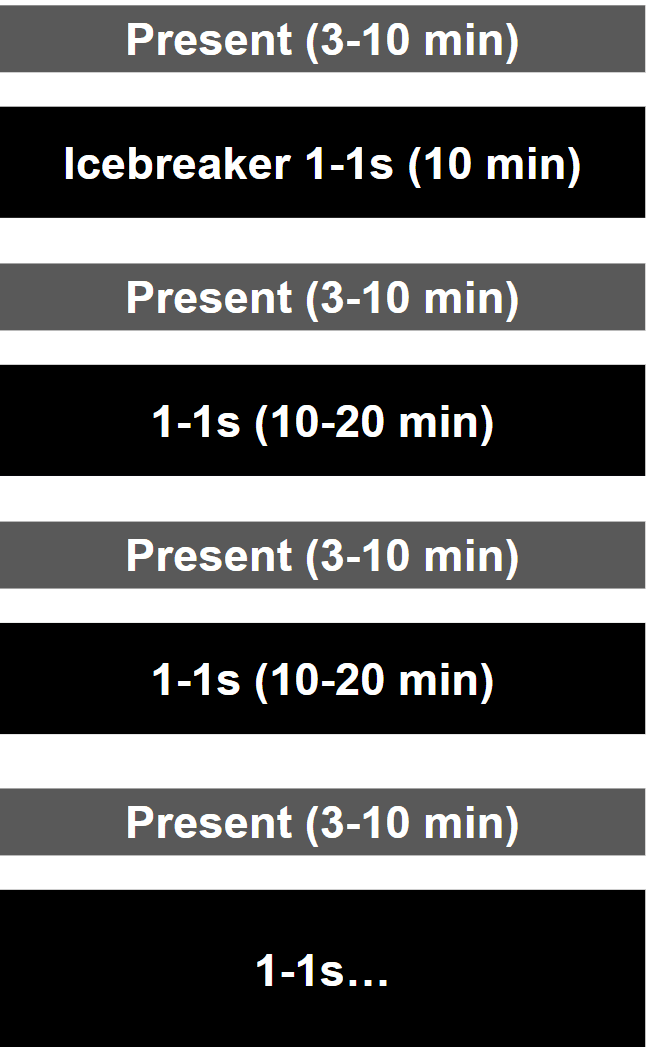
Presentation: Typically, we’ll end up preparing a ~15 minute, ~15 slide presentation, and practice it a few times to ensure that it’s polished and ready to present. We try to present on a variety of EA topics, and in the last semester we have had a global health vs animal welfare debate, an EAG Boston application workshop, and a guest speaker (or faculty advisor) presenting on meta-ethics.
Discussion: During the presentation, we’ll have around 4 sets of discussion questions, during which we ask attendees to pair off in 1-1 conversations. Importantly, we also ask attendees to rotate between 1-1s to talk to someone they haven’t talked to before. This allows all our club members to meet each other and form a stronger community. In our experience, these may have an initial 2-5 seconds of awkward silence, but quickly become engaging— it’s often difficult to focus back on the presentation afterwards, and both of us tend to get sidetracked in conversations too!
We’ve noticed that people often talk more often in general meetings than in fellowships, especially at the beginning of the semester. We think this is because of the more casual environment - since there isn’t as much pressure to have “good” comments or any readings, people feel more comfortable addressing their confusions and applying the ideas of the presentation in novel ways.
Finally, we highly recommend having 2-5 very open-ended discussion questions. We noticed many members glancing back up at the screen to refocus their conversation on another discussion question during instances that might have become awkward pauses. We have even had success with animating additional questions to pop up mid-discussion to softly guide conversations.
The importance of consistency: One of my friends who organized D&D groups once said to me: “the difference between a weekly event and a biweekly [every other week] event is that a weekly event happens, and a biweekly event doesn’t”. His reasoning for this was twofold. First, if your event doesn’t happen every week, people may fail to block out the time in their calendars and attrition is more likely. Second, if a member misses a biweekly event, they may end up going 4 weeks without attending another program of yours, and will be even more likely to attrit from the club in the future. These two reasons combined mean that the groups that run biweekly general meetings should strongly consider having a club dinner or something else at the same time during the “off weeks” from the general meetings. Similar reasoning applies to location and time. Logistics should take up as little time as possible in the minds of members, and consistency helps a lot with this. Try to hold meetings at the same location and time each week.
Dinners: To save on organizer time, we alternated the general meetings with dinners every other week. These were fairly simple to organize - we found a table in a dining court, sent our location in our group chat, and had a good conversation with whoever showed up. Usually, this would achieve a similar number of attendees to the general meetings, and it helped group members get to know each other better in a less focused setting. We think people enjoyed these nearly as much as the general meetings, so we’re planning to continue next semester alongside more frequent general meetings.
Food: The simplest way to bring college students to your meetings is to offer them something to eat. In Fall 2023, when Nathan announced he would bring chips to meetings, attendance increased from 1 to 3; in Fall 2024, consistently ensuring we had chips and fruit snacks helped with attendance. It was somewhat amusing to watch how often at the start of every discussion section, there would be a rush to the chips table to grab a snack.
Make your group something you look forward to: Often, it’s easy to get stuck trying to think of how to make your events better. For this, we recommend a simple heuristic: what would make your event something you would look forward to? This isn’t a perfect proxy for what other people will enjoy, but it is pretty good - if you, an EA, would find having a longer discussion more interesting, or want to try a particular meeting format, or found some particular EA forum post interesting and want to share, this is good evidence that other members of your group would like it too. Finally, even if you don’t get great attendance, this increases the odds that the meeting will still be worth your time.
On the other hand, push yourself: Giving presentations (even to a small EA group) can be scary. Even though this may be true, your presentation skills & confidence will massively improve after a couple meetings. The types of communication skills developed by giving presentations are highly valuable on the job market as well. We think you can do it. If you don’t agree, we suggest giving a 2 minute presentation at the start of meetings and building up from there.
Onboarding new organizers: Sometimes, it can be difficult to find little things engaged members can do to test their fit for organizing. We think that co-preparing a general meeting presentation can be great practice for this. You might be able to get to the point where you can delegate the responsibility for the general meetings entirely to one member of the club, who will in turn reach out to others to present with. EA Purdue is currently doing this, and finds it a great way to split up the organizing workload.
This is way easier than you think: Let's say you have one other person who is willing to help prepare general meetings with you. This cuts your 12-minute presentation in half, down to 6 minutes each per week. Additionally, let's assume you alternate presentations with “club dinners”, which require zero preparation. This cuts your presentation preparation time down to 3 minutes per week. Further, let’s assume you copy another club’s presentation from the General Meetings Google Drive Folder. This means you don’t even have to make those 3 minutes worth or presentation per week, you just have to practice them.Finally, it’s worth mentioning that your time commitment could reasonably be reduced further (potentially down to zero) if you find others interested in helping run the general meetings. In its first semester of general meetings, EA Purdue found three members who were interested in contributing.
Example #2: WashU’s “Impact Lab” Model
WashU Impact Society’s programming for people who have completed our intro fellowship includes weekly “impact lab” meetings as a way to keep people engaged with EA and the club. We try to include an activity for every meeting and alternate weeks discussing topics within EA and career planning. You can read about specific general meetings and how to execute them here, and this is also included in the General Meetings Sharing Folder.
Example #3: EA UC Berkeley’s Model
- EAB’s semester programming consists of Weekly Meetings, the Projects Program (cool name + acronym pending), and our Intro Fellowship.
- Weekly Meetings consist mostly of deep dives, discussion groups about recent news concerning EA (such as the collapse of USAID), group activities/workshops like EA Jeopardy and rationality exercises, and guest speakers from EA orgs, research groups, and professors (examples include AIM, the Good Food Institute, university-specific GH&D researchers and professors, and the Center for Space Governance.)
- The Projects Program pairs university students with effective altruism-aligned companies, non-profits, research projects, and other organizations for a three month-long project. During the program, students learn valuable skills, test their fit, explore their interests, and see what it’s like to put EA principles into practice — all while helping organizations research, develop, and implement high-impact solutions.
- We’re now beginning to test out if we can make this intercollegiate to expand the number of organizations we can assist + interested students who want to see what high impact work looks like!
- Our Intro Fellowship is based on several other published intro fellowships, and gives participants a good understanding about EA’s principles, cause areas, and what “doing EA” looks like.
Example #4: UCLA’s Meeting Model
EA at UCLA has “weekly dinners” with ~10-15 people, where we order in Falafel Inc. and casually discuss a relevant EA reading. The structure of each meeting is as follows:
- People arrive 6:00-6:10, either chat or start doing the reading (printed and handed out to all attendees). An organizer places the Falafel Inc. order on Doordash.
- Any relevant announcements are made around 6:10. (Our meeting room is a classroom, and as such we make use of the projector.)
- Members read silently (pencils provided for annotation) until around 6:20.
- We naturally break into groups to discuss the reading. While formal discussion questions are typically not prepared, board members are typically spread between groups to keep the discussion focused.
- Food typically arrives around 6:45. From here onward, the meeting tends to be less focused on the reading and more social. People typically hang around until 7:30.
Strengths of the model
- Good vibes: the meetings are very casual and natural, generally fostering a sense of community. This was our primary objective this quarter, as we were seeking to grow the club.
- Exposure to ideas: we focus on picking readings that we think no one has read before, and that go significantly beyond the content one would find in our intro fellowships.
- Flexibility: one downside of more formalized models (e.g., presentations) is that the content may be too advanced for some members and too simple for others. With the reading-based model, people will naturally discuss the parts they find interesting, and the higher-context members will typically fill in newer members on any context they may be missing.
Weaknesses of the model
- Lack of seriousness: while we were intentional in our creation of a casual atmosphere, this tends to be in tension with a “goal-oriented” atmosphere. Thus, if our goal is to get members to take significant, impactful actions they wouldn’t have taken otherwise, the weekly dinners will likely not be the thing that pushes them to do so.
- Scalability: while our current approach has been very effective for bringing our attendance from low to medium, it seems unlikely to scale well to large meetings (20+ people) where a) 1-1 outreach for meetings becomes more difficult and b) noise may become an issue with many different discussions taking place at once. Thus, if we do succeed in our goal of continuing to grow the club, we may need to pivot to a more formalized model.
Beyond readings, some of our meetings also feature other content, often in the form of a presentation. Below is the list of our winter quarter meetings.
Winter quarter content
- Week 1: Intro to EA presentation
- Week 2: N/A (LA fires)
- Week 3: N/A (MLK day)
- Week 4: EAG Bay Area application session
- Week 5: Prediction Markets: When do they Work?
- Week 6: Is RP’s Moral Weights Project Too Animal Friendly?
- This week, we had Professor Hayley Clatterbuck join us for discussion; Professor Clatterbuck, while not being on the team that conducted the Moral Weights Project, is a researcher at Rethink Priorities and knew a lot about the project.
- Week 7: N/A (President’s Day)
- Week 8: My Current Impressions on Career Choice for Longtermists
- Week 9: Presentations from two PhD students in the Rational Altruism Lab
- Week 10: End-of-quarter social
Example #5: EA at UT Austin’s Model
- This summary is written by former organizer Alex Dial -- things may have under the new leadership
- EA at UT Austin’s semester programming consists of Weekly Meetings, our Intro Fellowship, and typically an end of semester retreat.
- Our weekly meetings typically consistent of four parts:
- 7-7:10pm Warm up thought experiment:
- Some people will arrive late. Rather than making everyone wait to get started until everyone arrives, we start right at 7 with a warm up bite-sized thought experiment that everyone discusses with those around them.
- 7:15-7:45 Content:
- Each meeting we try to pick and then convey some important EA ideas that don’t get covered in the introductory fellowship but which are still interesting to both intro fellowship graduates and new people trying out the group.
- Sometimes this content is reading an article, or watching a video, but most frequently it is one of our organizers giving a presentation they spent 1-3 hours making (similar in vibe to Marketing Monday)
- We try to have snacks (oreos, grapes, chips and guac) that people can eat during this time
- 7:45-8:30 Activity or Discussion:
- After the content, we either a) have some activity (like “pick a charity to research and prep a short group presentation on” or “apply to EAGxAustin”) or b) 3-5 rounds of 7 minutes in 3 people groups doing “speed updating”, which we think facilitates interesting conversations better than generic discussion prompts.
- 8:30-End (~9:30 or 10) Games:
- Promptly at 8:30 we’ll end the official meeting and let people leave if they have to, and for those who want to stick around will play games. For us, games like Spyfall and Mafia worked really well.
- 7-7:10pm Warm up thought experiment:
- Our weekly meetings typically consistent of four parts:
- Some example meetings:
- Our google drive folder has a bunch of our past meetings for reference (though note that since we haven’t yet added speaker notes they may be hard to use). Here are some of the meetings that I think have gone best:
- Donation Decision: People get in groups of 4, and work together to figure out how to donate $50 of our money. They start with a list of 8 charities, and by the end each has to pick just one.
- Phase 1: Research and spend 20 minutes narrowing to 4 options.
- Phase 2: We present on ITN, DALYs, Hits-based, and groups spend 15 minutes discussing to narrow down to 2 options.
- Phase 3: We present on some quantitative impact models, specific research approaches, and aggregation platforms, and groups spend 10 minutes making their final choice. Then they pass up their decisions and we donated the money.
- We did this with Give Directly, Hellen Keller, Good Food Institute, Patient Philanthropy Fund, Charity Entrepreneurship, Rethink Priorities, Center for AI Safety, Giving Green.
- Ethical Theories & Util: 20 minute presentation based on utilitarianism.net explaining ethical theories, utilitarianism, bullet biting objections and responses, and the “Tower of Assumptions” defense. Then we did speed updating on related ideas.
- AI Executive Order: 20 minute presentation on Biden’s AI Executive Order followed by speed updating.
- Various others (EA Criticisms, What is Forecasting + Estimation Game, Animal Welfare Sentience Estimates, Longtermism deepdive, more)
- Strengths of this setup:
- Keeps people engaging with and learning more about EA ideas after the intro fellowship
- Creates interaction between new members and more involved members
- Meeting quality is high enough that people feel like it’s worth their time and they’re more likely to show up
- Discussions are more focused and interesting because of speed updating setup
- Organizers spend time working together to prep this content, which can be enjoyable and deepen your knowledge and connections as an team
- Weaknesses of this setup:
- Can take a considerable amount of time to prep meetings (1-4 hours total, sometimes longer)
- This can be offset if you a) rotate who presents and b) choose to present on things you’re actually interested in
- Bad turnout can be discouraging (especially if you’ve put in considerable work)
- If overly social (and lacking action-guiding discussions), members could feel that the group isn’t impact-oriented or ambitious enough at actually doing things.
- Can take a considerable amount of time to prep meetings (1-4 hours total, sometimes longer)
- We ran these weekly meetings pretty regularly for the 2 years that I helped organize, and regularly had doubts like: “is this just a glorified friend group with interests in philosophy? We’re doing great at being a place to talk about interesting stuff, but if we want to be achieving impact, maybe we should [drop the weekly meetings and do e.g. projects]” (this is pulled directly from 1/28/2024 leadership notes)
- We were just pretty unsure that this programming was leading to people actually taking better actions, but looking back now the group has had impressive enough outcomes that I think these meetings played a part. As the group matures, it seems possible to me that the level of knowledge of the average member is high enough that just switching towards socials (which are more appealing to the more involved members) might be better -- UChicago has a post on this coming out soon that I’m interested to see engage with this one!
jordanve🔸 @ 2025-03-28T03:14 (+7)
For university group organisers like myself with more limited personal capacity and a limited executive team, I'll also encourage people to consider a minimalist version of this. I've been running weekly social lunches at a cafe every week that are open to everyone interested in the club. The only ongoing effort it requires of me is to turn up, and I always enjoy the discussions. I have plans to scale up to a maximalist version of this once the capacity of the executive team increases.
SummaryBot @ 2025-03-28T16:54 (+1)
Executive summary: Regular, all-invited general meetings are an easy, underutilized way for university EA groups to build stronger communities, retain members, and deepen engagement post-fellowship, with multiple successful formats already in use across campuses.
Key points:
- General meetings help solve a key weakness of intro fellowships: lack of continued engagement and community-building among EA members across cohorts.
- They provide a low-barrier entry point for newcomers and a way for fellowship graduates to stay involved, fostering a vibrant, mixed-experience community.
- EA Purdue’s model emphasizes short, interactive presentations with rotating 1-1 discussions to build connections and maintain engagement; weekly consistency and snacks significantly improve attendance.
- Other models include WashU’s activity-driven “Impact Lab,” Berkeley’s mix of deep dives and guest speakers, UCLA’s casual dinner + reading discussions, and UT Austin’s structured meetings with thought experiments, presentations, and social games.
- General meetings are relatively easy to prepare—especially if organizers collaborate, rotate roles, or reuse content—and can also serve as a training ground for onboarding new organizers.
- While some models trade off between casual atmosphere and goal-oriented impact, many organizers believe these meetings meaningfully contribute to group cohesion and member development, even if not all impact is directly measurable.
This comment was auto-generated by the EA Forum Team. Feel free to point out issues with this summary by replying to the comment, and contact us if you have feedback.