Announcing Spring: a Venture Studio and Fund for Animal Welfare Tech
By EitanF @ 2026-06-30T20:09 (+56)
Why building and backing Welfare Tech companies may be one of the most promising things we can do for billions of animals.
I used AI to assist in writing this post, but I’ve rewritten it extensively and endorse it.
- Announcing the launch of Spring Innovation Fund, a not-for-profit venture philanthropy studio and fund built specifically for Welfare Tech: technology that improves animal welfare in ways that make commercial sense for producers to adopt.
- We think Welfare Tech is unusually promising: neglected, cost-effective, fast-acting, and scalable, with a large amount of low-hanging fruit; and we address some of the leading objections below.
- Three ways to get involved: Spring Works (engineers & builders), Spring Studio (ideators & entrepreneurs), and Spring Ventures (companies & investors).
1. Why we built Spring
I’m Eitan, a long-time EA who spent most of a decade working on turning cultivated meat from an idea into a real field, including founding Mission Barns. Now, I’ve teamed up with Milo Runkle — co-founder of the Good Food Institute, New Crop Capital, Joyful Ventures, among other groups — to found Spring Innovation Fund, together with Nate Crosser, who spent years as an agtech and biotech VC.
Welfare Tech is technology that improves the lives of animals in ways that make commercial sense for producers. The category spans preventing harm (e.g. in-ovo sexing, better genetics, vaccines against painful diseases); detecting and improving welfare (e.g. AI-enabled monitoring paired with treatment); enabling accountability (e.g. welfare traceability, analytics, & compliance infrastructure); and accelerating adoption (e.g. tools that make higher-welfare systems the productive default).
In conversations with over a dozen groups in the space, we’ve collated 100 “white spaces” where a welfare intervention is scientifically plausible and commercially unaddressed.1 That number only scratches the surface: for nearly every farmed species there are many different welfare areas waiting for someone to address. Our vision is an entire ecosystem: a field as serious and well-staffed as alt-protein, with top-caliber researchers, engineers, and entrepreneurs choosing to build Welfare Tech.
This isn’t a new idea so much as a newly growing one. Pioneering nonprofits like Shrimp Welfare Project and Innovate Animal Ag2 have realized the potential of Welfare Tech to transform their industries. In his recent posts, Aaron Boddy argues that the animal welfare movement is too passive, waiting to see what industry builds and then campaigning for its adoption, rather than building the tech it wants itself.3 Spring is, in part, an attempt to put capital and company-building experience behind that thesis. Beyond building and backing companies, we see a coordinating role to play here: centralizing and fostering cooperation between actors with deep on-the-ground knowledge, to drive innovation.
Consider in-ovo sexing as an example of what a healthy Welfare Tech ecosystem looks like. Around 7 billion male chicks are culled every year, ground up soon after hatching because they cannot lay eggs. In-ovo sexing identifies an embryo’s sex before it hatches, so male eggs are never incubated to term. What began as an idea is now a competitive landscape of companies pursuing different technical approaches, from hyperspectral imaging to PCR screening, and that competition keeps pushing costs down. Adoption has gone from pilot to mainstream across much of Europe, and it is now gaining ground in the U.S., Brazil, and Australia, with Walmart and other major buyers signaling a shift. Across dozens of welfare problems, we would love to see a cluster of companies racing to build the best solution, buyers and regulators creating the pull, and the standard of care ratcheting upward year over year.
2. Why Welfare Tech is high-impact
Several things make us think Welfare Tech is unusually high-leverage:
- Building the tech instead of waiting for it. The animal welfare movement’s default posture toward technology has been reactive: industry invents something, and it campaigns for (or against) adoption. Consider cage-free — the single largest effort in animal welfare. The barn and aviary systems that make it possible were invented by the egg industry; advocates did the difficult work of winning the commitments to adopt them. That works, but it leaves progress downstream of whatever industry happens to build. Additionally, building new technologies allows new standards to take root much more easily, once an affordable alternative already exists. Germany and France could ban male-chick culling because in-ovo sexing gave hatcheries a way to comply. The most reliable way to make the next humane standard adoptable is to build the thing that makes compliance cheap.
- Its impact is more direct — same animals, better lives. Many animal-welfare interventions can be contested based on their indirect or secondary effects, such as how a diet shift ripples through wild-animal populations, say, or whether a reform just moves production elsewhere. Welfare Tech is comparatively straightforward: it improves the lives of animals already being farmed anyway.
- Lower-hanging fruit — it doesn't require remaking the industry. Incremental changes producers adopt voluntarily are a far lower-resistance path than replacing animal agriculture or changing how people eat, yet the welfare gains can be large: shrimp are killed by the hundreds of billions in ice slurry or by asphyxiation; an electrical stunner can render them insensible in under a second. Often the change is win-win — for example, when it reduces mortality: a chicken that doesn't die of painful disease is a welfare gain for that chicken, prevents a counterfactual chicken from being raised in its place, and is a yield gain for the farmer. Healthier animals are often more productive animals — and when welfare and economics point the same way, adoption depends on a good product, not on goodwill. (This isn't true for every intervention — addressed below.)
- It’s fast — and so is the feedback. Much EA animal work has long time horizons. Welfare Tech can land impact in just a few years, sometimes sooner: a fish stunner installed this quarter helps animals this quarter. This is especially important for those who have short timelines.4 The feedback loop is just as quick — a company either wins adoption or it doesn’t, and you find out in quarters, not years, so we can tell early what’s working, put more behind it, and stop what isn’t.
- It’s cost-effective, and the economics compound. Take shrimp stunners, estimated to help on the order of 1,400–1,500 shrimp per dollar per year.5 On a welfare-adjusted basis, some analyses (admittedly controversial) found it arguably ~100× more cost-effective than cage-free corporate campaigns, which are estimated at 9–120 chicken-years per dollar. Those multiples lean on moral-weight assumptions for shrimp and pain during death; but even discounted, they’re remarkable. And unlike an annually recurring grant, a company can become self-sustaining: modest upfront capital can seed a revenue model that keeps delivering welfare returns long after our dollar is spent.
- It’s extraordinarily neglected. Historically, in sector after sector, the biggest improvements often came from better technology. Welfare Tech applies the same logic to animal agriculture: make the more humane practice the more viable one, and adoption follows. And almost no one is building here, especially for aquatic animals — the largest farmed populations on Earth and among the least served. Many of the early companies and researchers we have spoken to in the space have been surprised to discover that there is funding for this type of work, and in meaningful amounts. Even modest capital infusions into some of these early-stage companies can counterfactually make-or-break the development entire new product lines. We’re following in a path that Innovate Animal Ag, Shrimp Welfare Project, Aquatic Life Institute, Rethink Priorities, and others have begun; but there is room for far more of us, and we hope to see more actors entering this space soon.
- It’s a diversified, uncorrelated bet. A portfolio approach across many companies, interventions, and species spreads risk, and it’s also uncorrelated with the rest of the movement: even if SOB passes, corporate campaigns stall, or consumption habits change, Welfare Tech keeps progressing. For a movement that is increasingly well-funded, adding uncorrelated, high-absorbency vehicles is valuable in itself. Spring complements advocacy, policy, and corporate campaigns rather than substituting for them, and the relationship runs both ways. Campaigns, education, and regulation create demand for welfare technology; technology makes the next campaign winnable. A live-boiling ban is far easier to pass, and to comply with, once a cheap, humane stunner for crabs and lobsters exists.
- It pulls in new people, talent, and norms. Animal welfare may soon see an influx of philanthropic capital, and some worry whether the field has enough scalable, shovel-ready opportunities to absorb it.6 Companies are one of the best answers: a company can turn capital into deployed impact at scale; once you’ve built a machine that works, you can build the next ten, or hundred. It also broadens who takes part — attracting tech-forward funders and technical builders, and drawing the next generation of students, researchers, and producers into the field, people who might support or work at a welfare company even if they never would at a conventional advocacy nonprofit. Putting welfare-improving products into producers’ hands helps make welfare something the industry continuously measures and improves. When we build the supply chains, engineering talent, producer relationships, measurement tools, and habits of taking animal welfare seriously, we lower the cost of considering their welfare and implementing solutions. We envision a world where every animal health researcher advancing a new vaccine knows that there is funding eager to see it through; where a fisherman with an idea for less painful netting is incentivized to make it a reality; and where hardware inventors facing a largely-for-profit VC funding environment can get their bootstrapped startup off the ground.
3. Why for-profit companies?
Spring is a nonprofit, but what we build and back are primarily for-profit companies. Philanthropy’s real job here is to catalyze markets that can then run on their own legs. Technological innovation in legacy industries often happens slowly or not at all, especially around challenging issues like animal welfare. But once someone gets them started they can pay for themselves and scale without a permanent subsidy.
- Producers actually use the technology. A product that pays for itself gets adopted at commercial scale, on the producer’s own initiative, without a donation behind every unit. The price paid then covers the sales teams, manufacturing, and further scale-up.
- The impact sustains itself. Revenue keeps the intervention going after the grant ends, so a foundation can fund a pilot in Year 1, while a company and its commercial lenders can fund the next decade. Catalytic capital takes the early risk that commercial investors won’t, and where we can we help companies graduate to non-philanthropic funding, freeing our capital for the next white space. Creating an evergreen, permanent capital vehicle lets us recycle exits into the next companies, so impact compounds instead of resetting each grant cycle.
- It draws in operators and capital who otherwise wouldn’t come. A company with equity grants to staff, and upside for investors, motivates engineers, operators, and non-philanthropic capital, from strategic acquirers to mission-aligned investors, to back welfare outcomes that a nonprofit alone would have more difficulty attracting.
4. Objections
Here are the strongest objections we hear, and how we think about them.
- “If it were a good idea, industry would already be doing it.” There is a large space of possible innovations, and industry usually chooses to develop what is most profitable, which is often not what helps animals most. Finding the welfare-improving products that can also make money is a different approach. Even when industry builds something adjacent, it isn’t always backed by as strong a welfare evidence base as we would like to see, which is another reason it's important that welfare-minded people be the ones directing this work. And in some cases, pairing innovations with certifications and legislation is what can create the market pull that makes the better product the profitable one.
- “Do we need new companies?” Sometimes not — where an existing company can and will deliver a welfare improvement, we’d rather back or partner with them than reinvent it. But many of the white spaces we see won’t be filled by incumbents: too small for them, too risky, or simply orthogonal to their incentives. Those need new companies built, which is what Spring is for.
- “Why companies rather than nonprofits?” Nonprofits are superb at advocacy, research, and coordination, but they usually aren’t built to manufacture hardware, optimize a product over many iterations, run a sales motion, and sustain production at scale. A company is the right tool for that work. We stay a nonprofit at the fund level so the mission — not a financial return — stays the point.
- “Markets reward efficiency, not welfare.” True, and a welfare feature that doesn’t also have benefits risks being competed out by a cheaper, lower-welfare alternative. Our answers: prioritize interventions where welfare and economics align (e.g. mortality, disease, quality, worker safety); use mission-locked governance so welfare can’t simply be optimized away; and deploy patient, catalytic capital to carry a welfare-improving product through the valley of death a purely commercial investor wouldn’t fund.
- “This is high-risk — most startups fail.” True, and some of ours likely will. That’s why Spring is a portfolio rather than a single bet: a few successes can outweigh many misses, and even the misses generate evidence, talent, and lessons the whole field reuses. This is how venture and field-building are supposed to work. Animal welfare is reaching a point where it can afford, and very much needs, more innovative, high-risk-high-return bets.
- “Won’t making production more efficient just mean more animals?” Lower costs can mean lower prices, more demand, and more animals farmed — a rebound that can offset part of the gain. We take it seriously and model it explicitly rather than waving it away, and several things blunt it. Many flagship interventions will barely move unit cost (in either direction) — e.g. an electrical stunner adds a tiny fraction of a cent per animal, so its supply effect is effectively nil while the per-animal gain is large. The per-animal improvement applies across the entire installed base, which dominates any marginal increase in numbers. And any cost decreases are often further diluted by retailer margin by the time it affects consumer behavior, so the supply response to a small cost change is itself small. Some efficiency gains reduce animal numbers directly — cutting pre-slaughter mortality means fewer animals born only to die before reaching market. Where a deliberate welfare premium could induce supply, that is the channel we model most carefully, and we prioritize interventions where the welfare gain clearly dominates.
- “AI will soon make factory farming obsolete.” Maybe — and we’re excited to drive innovations accelerated by the new AI age. However, while AI may make alternatives more viable, it can also lower the cost of conventional animal agriculture practices, keeping them price-competitive, and others have made this case carefully.7 Either way, billions of animals are alive now and will be impacted for years to come.
- “Timelines are very short.” If you think transformative AI is very near, capacity-building looks less attractive. But that can also be an argument for Welfare Tech: equipment-level interventions are among the fastest-acting things the movement can do,4 landing impact in quarters, not decades. And unless you are highly confident timelines are short, work that also pays off if they turn out to be long is a robust bet. Improving animals’ lives in the near term is more clearly good across various scenarios than interventions whose payoff depends on a particular post-AGI future.
- “Alternative proteins are about to replace factory farming.” I spent a decade advancing alternative proteins, and I’m still a believer in them. But even in optimistic scenarios this transition takes many years. Driving higher welfare in incumbent production on one side while alternatives gain momentum on the other is a strong “and,” not an “or.”
- “Welfare improvements entrench a system that should be abolished.” We respect this view. But Spring’s approach is one that finds bridges with existing industry – an approach that has rarely been tried to date. Improvements reaching billions of animals now are worth building even as others work to address systemic issues for future animals. In the meantime, entire classes of farmed animals, such as male chicks, feeder rodents, feeder fish, and cleaner fish, could potentially be largely eliminated altogether through these approaches.
5. Who Spring is for
Spring will resonate with you if you think welfare improvements at scale genuinely matter; if you give real weight to aquatic and other small, numerous animals; if you’re temperamentally techno-optimist; and if you think the movement should build scalable vehicles ahead of the money rather than waiting for it. It probably won’t resonate if you think only efforts to end or replace animal agriculture count as progress, if you’re confident AI or alt-proteins will solve this (or render it irrelevant) within a few years, or if you object to directing philanthropic funding toward for-profit vehicles in this space.
Spring runs three programs:
- Spring Works — for builders. Spring Works will be a physical innovation hub in San Francisco building Welfare Tech where the technology doesn’t exist yet. We especially want technical people in hardware, mechanical, and electrical engineering, as well as welfare biology.
- Spring Studio — for ideas and founders. If you have a Welfare Tech idea, or you want to co-found one of the companies we’re incubating, come start it with us as an entrepreneur-in-residence (EIR), co-founder, or early hire. Our EIR program is fully paid: we cover a competitive salary while you work alongside us to validate, build, and launch a company backed by ~$500,000 in initial funding. You bring the technical or industry expertise and the drive, and we bring the capital, the opportunity, and hands-on company-building support. Express interest at: SpringFund.com/for-EIRs/.
- Spring Ventures — for companies and co-investors. We are looking for early-stage investment opportunities and mezzanine finance for Welfare Tech startups. If you’re running (or you know) a Welfare Tech company that should be funded and isn’t yet, talk to us.
Reach out at contact@SpringFund.com, read more at SpringFund.com.
Thanks to the many people across the Welfare Tech landscape who have spoken with us and whose work is pioneering the space, including Shrimp Welfare Project, Aquatic Life Institute, Myrias, Rethink Priorities; as well as other EA Forum posters whose feedback helped shape this.
Notes
1. We plan to publish our list of these opportunities in the coming months, after further prioritization.
2. Robert Yaman (Innovate Animal Ag), “How to Be a Techno-Optimist for Animals,” EA Forum, 15 Nov 2024: forum.effectivealtruism.org/posts/Zrzokpn7cxKsDCtbC.
3. Aaron Boddy (Shrimp Welfare Project), “Welfare tech should be developed by welfare people,” EA Forum, 29 June 2025: forum.effectivealtruism.org/posts/JDDAiMoaeTK6WRNpT; see also his more recent “Turning Farms into Welfare Labs,” EA Forum, 12 Feb 2026: forum.effectivealtruism.org/posts/yRQgZN7aiM6mAKgzq.
4. Hazo, “What Animal Interventions Are Fast Enough for Short AI Timelines?,” EA Forum, 22 July 2025: forum.effectivealtruism.org/posts/NDtvRqGic3v6zLz2n.
5. Vasco Grilo, “Cost-effectiveness of Shrimp Welfare Project’s Humane Slaughter Initiative,” EA Forum, 6 Oct 2024: forum.effectivealtruism.org/posts/EbQysXxofbSqkbAiT; and the 2025 ACE review of SWP. The ≈100× multiple relies on Rethink Priorities’ median shrimp welfare range (~3% of a human’s).
6. JamesÖz & Neil Dullaghan, “Megaprojects for animals,” EA Forum, 13 June 2022: forum.effectivealtruism.org/posts/gGSQrbNJJCxiMNog3.
7. Bentham’s Bulldog, “Intergalactic Torture Chambers” (2026), benthams.substack.com; and Hazo, “AI probably won’t make factory farms obsolete,” EA Forum, 23 June 2026: forum.effectivealtruism.org/posts/YZoBtzuPy8qzJK6z5.
abrahamrowe @ 2026-07-01T02:52 (+41)
I'm excited to see this happen! Some welfare tech ideas seem really promising, and I think this is clearly a promising project — it's great that it's happening.
My biggest areas of uncertainty about welfare tech (which overlap with some you flagged and some of which apply to only some technologies):
- I think that these kinds of projects risk distracting donors because of the double appeal of impact + returns on investment.
- I think cultivated meat and alternative proteins did this for the last decade, and a lot of money that might otherwise have been more effectively deployed was invested in unpromising companies and on an unpromising theory of change (and I think I am on record saying this at the time so am not just trying to claim retrospective credit!).
- I think this was doubly true because if these companies were especially promising, they would (and did, at first) attract non-counterfactually valuable funding (e.g. non-EA venture capital, etc). I'd be very excited about welfare tech funded by non-EA money, and am moderately less excited about it when funded by EAs (though given that there is plausibly more funding coming online than can be spent effectively, this is less of an issue).
- Jevons paradox just does seem challenging for this work — I think there are probably many technologies where it will be less relevant, but it seems plausible that most things impacting pre-slaughter mortality on farms will face it enough that it could be a significant concern for many interventions. Unfortunately, these might often be the best targets for welfare tech on fisheries and farms. I'm much more excited about slaughter-focused welfare tech for this reason, and am excited projects in this space are on your radar. But, slaughter tech seems less ripe for for-profits because there is less reason for producers to pay for it.
- Animal welfare science is advancing at a pace far behind what we might need to make lots of welfare improvements. E.g. shrimp stunning evidence is incredibly thin, and the best, most recent evidence suggests that correct implementation really matters for whether or not we're stunning or just electrocuting shrimp. I worry that accelerating tech before the science is settled in many cases risks just cementing further bad practices, and we'll realize it too late. The companies being for-profits, because they can't be reined in by funders if they are making a mistake, could make this worse (and I'm not sure of ways to design for-profits with strong mission-lock, outside of having their ownership run through a non-profit (which sometimes fails), and benefit corporations don't really seem to work).
- The best examples we have of welfare tech so far (shrimp stunning and in-ovo sexing) seem like they were driven by advocacy (or direct delivery), not for-profits. E.g. shrimp stunner deployment seems mostly driven via SWP just buying them for farms and then ICAW, etc. getting corporate commitments, not farms buying them themselves (even if later advocacy pressure started shifting that). Similarly, it seems like retailer commitments and policy were the initial major drivers in getting in-ovo sexing off the ground. I could imagine much of this work will be most effective when paired with appropriate advocacy to advance it.
Thanks so much for doing this! Seems like a great thing to try, and exciting to see the technology that will come out of it!
Nate Crosser 🔸 @ 2026-06-30T18:49 (+6)
Thanks for the write up, Eitan. A venture philanthropy fund as an animal welfare megaproject has been top of mind for me for years. Your strategic thinking (and Milo's) refined the concept into something uniquely catalytic. Grateful to work on Welfare Tech alongside you and the other great orgs in this field.
Vasco Grilo🔸 @ 2026-07-01T19:22 (+3)
Hi Eitan. Thanks for sharing. I am enthusiastic about this initiative.
Its impact is more direct — same animals, better lives. Many animal-welfare interventions can be contested based on their indirect or secondary effects, such as how a diet shift ripples through wild-animal populations, say, or whether a reform just moves production elsewhere. Welfare Tech is comparatively straightforward: it improves the lives of animals already being farmed anyway.
I think interventions improving the lives of farmed animals may increase or decrease the welfare of soil invertebrates much more than they increase the welfare of farmed animals.
I see no escape from the uncertainty about the effects on soil invertebrates if one wants to increase welfare while accounting for all animals. I am not aware of any intervention supported by impact-focussed funders with effects on soil invertebrates robustly smaller than those on the target beneficiaries. Not saving human lives, not decreasing the consumption of animal foods or ingredients, not replacing fast with slower growth chicken, not replacing layers in battery cages with ones in cage-free aviaries or barns, not replacing standard with bird-safe glass, not replacing rodenticide with fertility control bait, and not even electrically stunning farmed shrimps.
It’s cost-effective, and the economics compound. Take shrimp stunners, estimated to help on the order of 1,400–1,500 shrimp per dollar per year.5 On a welfare-adjusted basis, some analyses (admittedly controversial) found it arguably ~100× more cost-effective than cage-free corporate campaigns, which are estimated at 9–120 chicken-years per dollar. Those multiples lean on moral-weight assumptions for shrimp and pain during death; but even discounted, they’re remarkable.
5. Vasco Grilo, “Cost-effectiveness of Shrimp Welfare Project’s Humane Slaughter Initiative,” EA Forum, 6 Oct 2024: forum.effectivealtruism.org/posts/EbQysXxofbSqkbAiT; and the 2025 ACE review of SWP. The ≈100× multiple relies on Rethink Priorities’ median shrimp welfare range (~3% of a human’s).
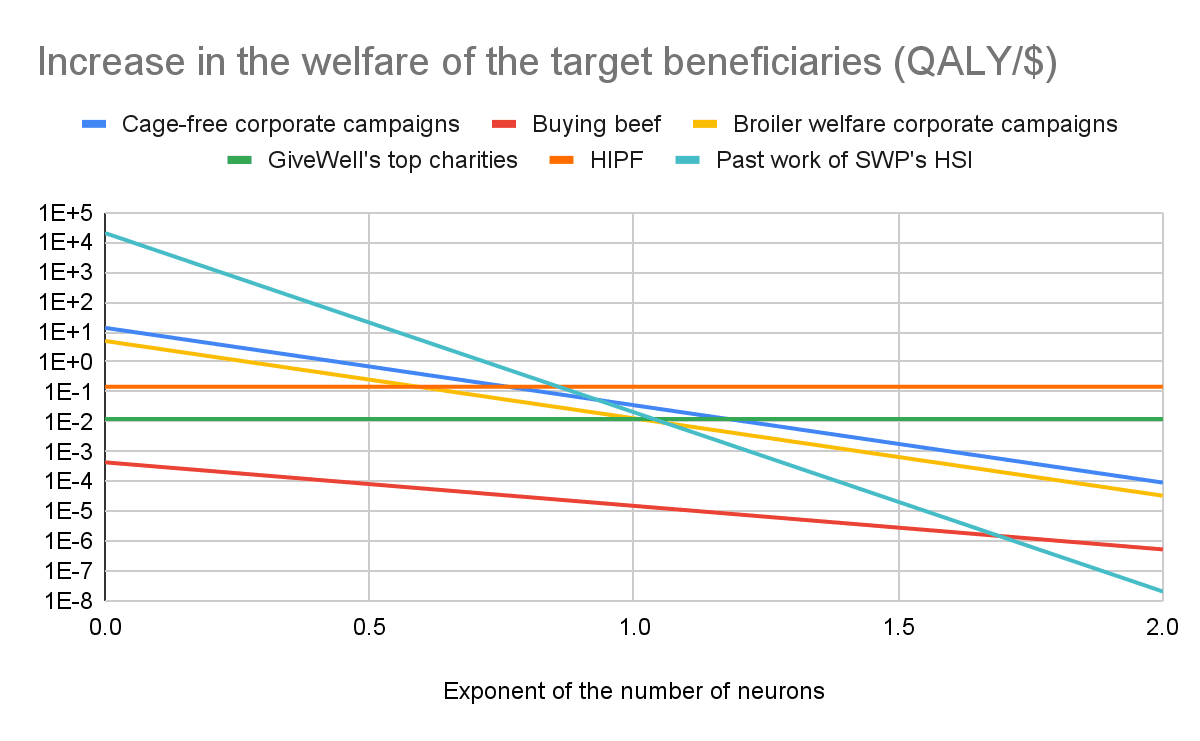
It would be better to argue for high cost-effectiveness comparing interventions targeting similar species (with one intervention involving welfare tech)? Otherwise, the results of the comparisons will be influenced a lot by the uncertainty in welfare comparisons across species. I have practically no idea about whether the Shrimp Welfare Project’s (SWP’s) Humane Slaughter Initiative (HSI) has increased the welfare of shrimps more or less cost-effectively than cage-free egg corporate campaigns increase the welfare of chickens. I estimated HSI has increased the welfare of shrimps 139 times as cost-effectively as cage-free egg corporate campaigns increase the welfare of chickens. However, for sentience-adjusted welfare ranges proportional to "individual number of neurons"^"exponent", and "exponent" from 0 to 2, which covers the best guesses that I consider reasonable, I calculate that HSI has increased the welfare of shrimps 2.26*10^-4 to 1.49 k times as cost-effectively as cage-free egg corporate campaigns. interventions increases the welfare of their target beneficiries more cost-effectively. Below is a graph with the results for "exponent" from 0 to 2.
Fai @ 2026-07-01T15:43 (+3)
I am excited to hear this! I worked at Mercy for Animals when Milo was still there. I want to say that he is a true visionary and doer!