Poll: Wild animal vs Farm Animal welfare
By Toby Tremlett🔹 @ 2025-12-02T13:41 (+47)
The (new) Center for Wild Animal Welfare, the Wild Animal Initiative, the EA Animal Welfare Fund and Animal Charity Evaluators have all been in the Donation Election's top 3 candidates this week. How should we compare between interventions focused on wild animals, and those focused on farmed animals?
I don't have a settled take on this question, and I won't be giving an argument (at least initially). I'm looking forward to reading your takes.
Some considerations:
- There are many more wild animals than farmed animals, especially if we count invertebrates.
- It's likely less than $10M is spent on wild animal welfare annually, whereas around $200M is spent on farm animal welfare. (These are both extremely low compared to the size of the problem).
- It's often argued that we shouldn't get involved in wild animal welfare because we don't know what kind of complex ecological effects we might cause. Unfortunately, this is true of most things, including farm animal welfare.
I've framed the debate around a 'marginal $5K' because, at time of writing, that's roughly what is at stake if an organisation is in/ not in the top three Donation Election candidates by the end of the week.
If the comments below change your mind, you can vote (again) until December 7th.
abrahamrowe @ 2025-12-02T13:58 (+37)
I think that the good opportunities in the farmed (vertebrate) animal welfare space are:
- Smaller in scale than Coefficient's budget (I think that EAs have been overestimating the cost-effectiveness of corporate campaigns for at least a few years, and the good opportunities are actually pretty limited).
- Pretty likely to be funded by non-EAs / people who will give to farmed animal welfare no matter what.
I think that there are likely a couple exceptions to this (shrimp welfare, insect farming, and some other things that Coefficient cannot fund currently), but they are fairly small in scale, and have decent routes to funding.
I think the opportunity for impact for wild animal welfare is way bigger, and it's much more "normal" (e.g. it seems like there are more viable interventions that are acceptable in the mainstream, don't require significant lifestyle changes of people, etc, WAI has gotten some traction within conservation), and generally is more neglected.
NickLaing @ 2025-12-02T20:19 (+6)
I'm yet to be convinced on the it's more "normal" front. If it was really that normal i think some non EA people would be doing it already. I suspected the "don't fiddle with ecological systems" backlash might be greater than some here expect.
But like i said in my comment i think we should be testing whether that's true by doing more already. Then we won't need to talk about whether it might be true or not...
David_Moss @ 2025-12-03T18:27 (+24)
We have some data on public support for WAW interventions of different kinds from our recent Attitudes Towards Wild Animal Welfare Scale paper. The academic paper itself does not highlight the results that would be most interesting to EAs in this context, so I'll reproduce them below, and also link to this more accessible summary on the Faunalytics website. (credit to @Willem Sleegers who was the first author of both).
We asked respondents about their level of support for different specific interventions. All the interventions tested had a plurality of support except for genetically modifying wild animals.[2] Helping wild animals in natural disasters, vaccinating and healing sick wild animals, and supplying food, water and shelter, all had large majorities in support. Note that the survey sample was not weighted to be representative (as the goal of the studies was to validate the measures not to assess public opinion), but I would not expect this to change the basic pattern of the results.
| Oppose | Neither | Support | |
| Helping wild animals in fires and natural disasters | 0.8% | 3.7% | 95.5% |
| Vaccinating and healing sick wild animals | 6.7% | 10.5% | 82.7% |
| Providing for the basic needs of wild animals (e.g., supplying food and water, creating shelters) | 9.5% | 11.5% | 79.1% |
| Conducting research into how to alter nature to improve the lives of wild animals | 26.5% | 19.1% | 54.3% |
| Controlling the fertility of wild animals to manage their population size | 33.9% | 23.8% | 42.3% |
| Genetically modifying wild animals to improve their welfare or the welfare of other wild animals | 70.3% | 16.2% | 13.5% |
Of course, some might claim that the popular interventions are not characteristic of WAW or are too small scale (though I do not think this is true of vaccinations). But I think it is notable than even research into "how to alter nature" has majority support, and fertility control has plurality support.
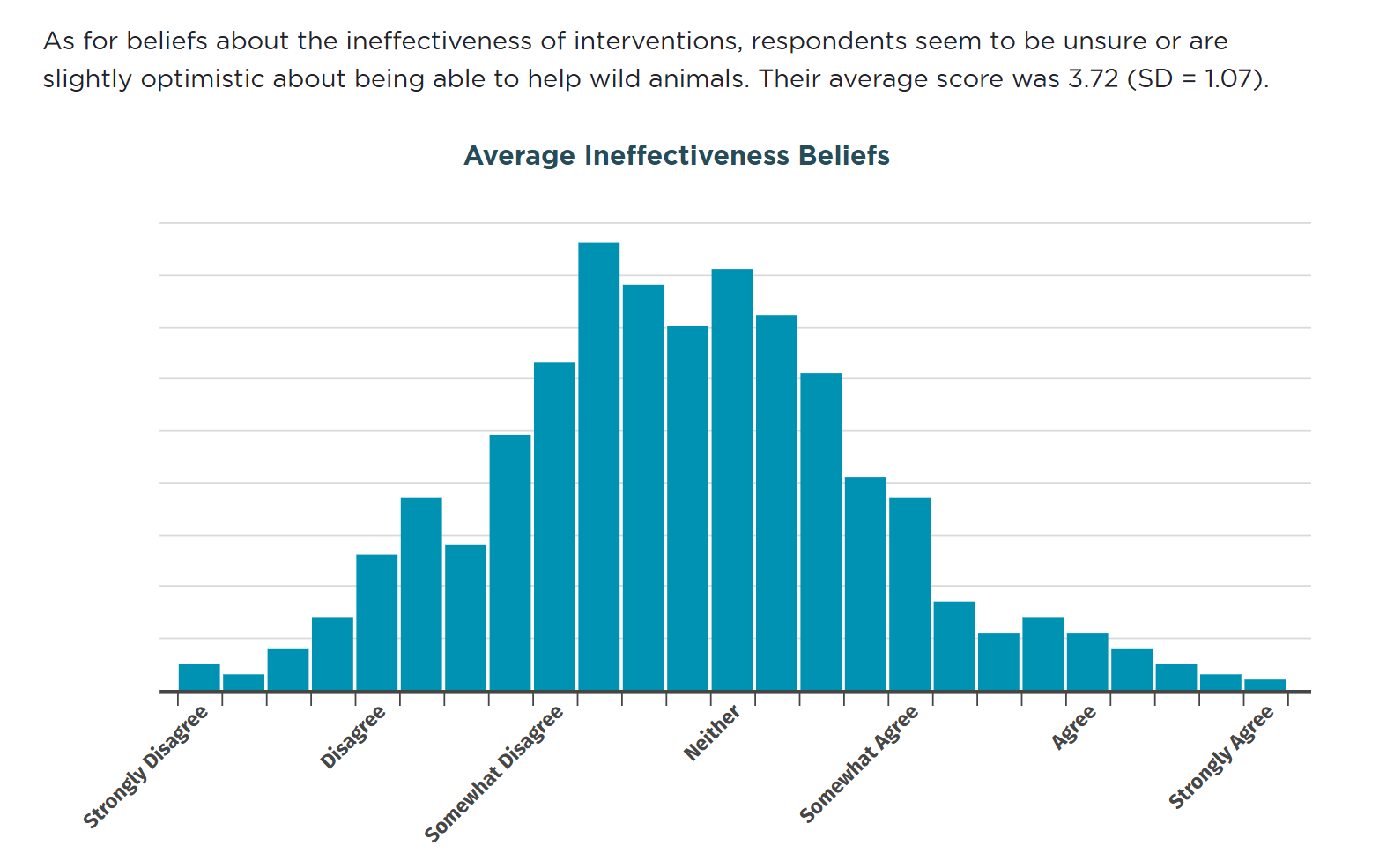
We also asked, more abstractly, about whether people endorse the attitudes that intervening to help wild animals is infeasible (what we call 'intervention ineffectiveness), with these items:
- Ecosystems are too complex to predict the outcomes of efforts aimed at improving the lives of wild animals.
- Nothing much can be done to reduce the hardships that affect animals living in the wild.
- It is not possible to reliably improve the lives of wild animals.
- It is not possible to solve the problems that wild animals face in nature.
With the caveat that this measure was not designed for polling absolute levels of public support, but rather than reliably capturing a specific underlying attitude, on average respondents did not strongly endorse this attitudes, and slightly leaned towards disagreement.
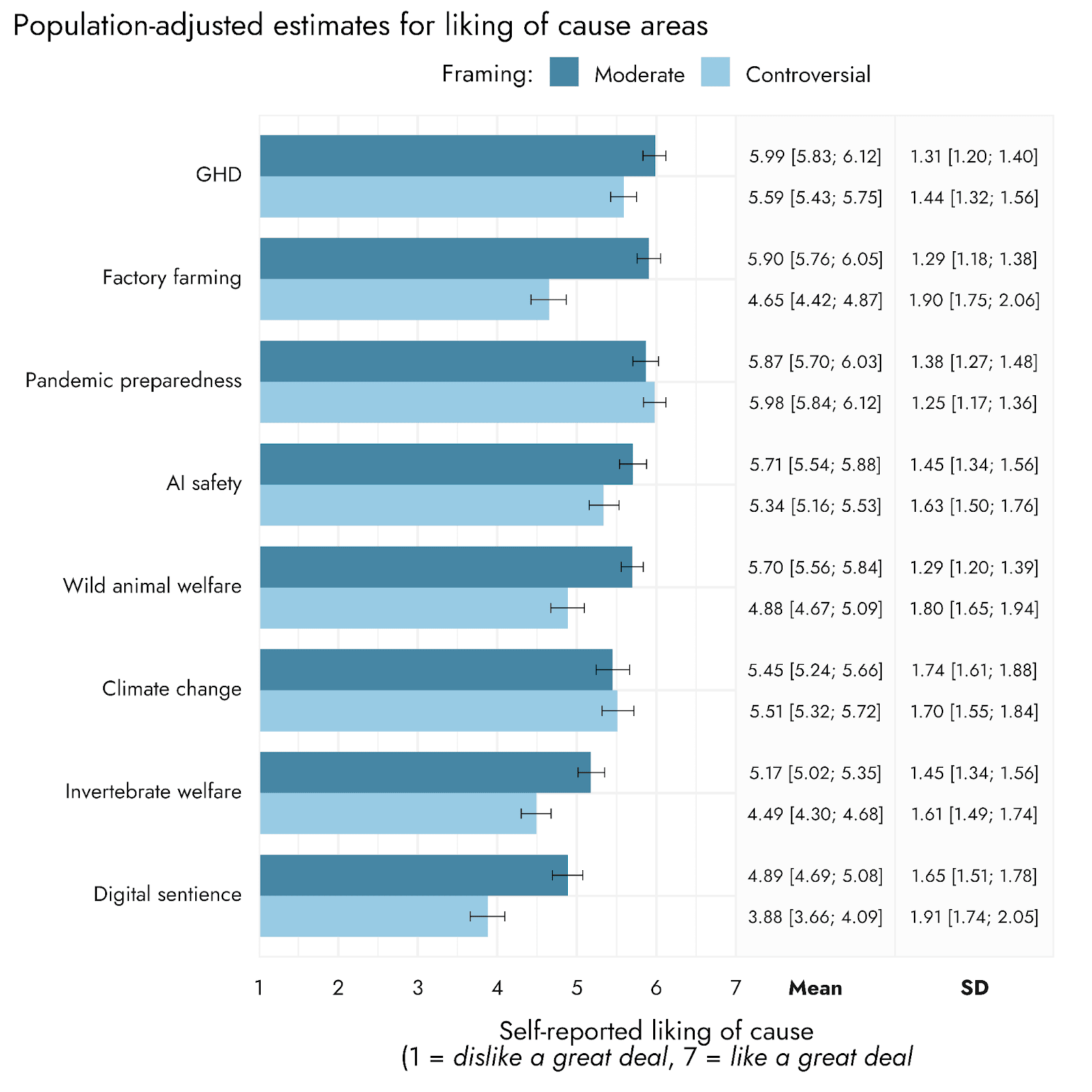
Stepping back, I would not take a very strong stance on the FAW vs WAW normality/popularity question. I think this is very likely to vary at the level of individual intervention, or depend on framing when presented abstractly. As an example of the latter point, when we presented FAW and WAW as abstract cause areas, each with a 'moderate' and 'controversial' framing, WAW was competitive with a moderate framing (non-significantly ahead of Climate Change as well), while it lagged when presented with a framing that mentioned genetic engineering. We'd be happy to gather further evidence to examine a wider variety of framings or interventions.
- ^
Though this was a secondary aspect of the paper. The core aim of the paper was to develop and validate a new set of measures towards wild animal welfare, and these questions about support for different interventions were intended only to validate those measures.
- ^
Which is, perhaps, not surprising, many people oppose GM tout court.
NickLaing @ 2025-12-06T04:41 (+6)
i think this kind of data is important and interesting, but my point was something a bit different. Only by trying to enact some of this stuff will we really find out the extent of resistance and backlash.
Vasco Grilo🔸 @ 2025-12-02T20:35 (+4)
Hi Abraham.
I think the opportunity for impact for wild animal welfare is way bigger, and it's much more "normal"
I agree the absolute value of the total welfare of wild animals is much larger than that of farmed animals. On the other hand, the most popular opportunities to help wild animals focus on ones which only account for a small fraction of the total welfare of wild animals (although I think they change the welfare of soil animals much more). In extreme cases, such opportunitites would only improve the welfare of a few wild mammals to avoid the extinction of species. Of course, this is not the target of the Center for Wild Animal Welfare (CWAW), or Wild Animal Initiative (WAI). However, I still wonder about whether CWAW and WAI are focussing too much on what is popular, and underfunding research informing how to increase the welfare of (wild) soil animals. I currently think funding the Arthropoda Foundation is the best option for this. Mal Graham, who together with Bob Fischer "make[s] most of the strategic and granting decisions for Arthropoda", mentioned "We collaborate with Wild Animal Initiative (I’m the strategy director at WAI) to reduce duplication of effort, and have a slightly better public profile for running soil invertebrate studies, so we expect it will generally be Arthropoda rather than WAI who would be more likely to run this kind of program".
JoA🔸 @ 2025-12-02T19:14 (+12)
(20% Wild Animal Welfare)
Nice poll, but tough call! With the little we know, the effects of interventions on wild animals seem likely to outweigh those on farmed animals. However, we do not have a clear notion of how current wild animal interventions (even field-building and research) will affect wild animals in the long run (though this is also true of interventions that don't aim to help wild animals).
I do not think a "robust" and "safe" pick in animal welfare exists yet (that we're aware of): under the current state of my uncertainties, I'm voting with my dollars on invertebrate welfare interventions (though those are still probably outweighed by effects on wild invertebrates). Though I'm gradually seeing the appeal of funding more research (especially on small wild animals).
Slightly in favor of wild animal welfare here, because it seems likely that if we gain enough knowledge to find a robust intervention in animal welfare, it will target wild animals directly or indirectly (since they're probably the dominant group of moral patients).
NickLaing @ 2025-12-02T20:11 (+8)
Note: I don't know so much about this, so this is a real hot take/shot fired without huge confidence ;).
I'm a super practical person who likes to move 1 step at a time, and I want to see a couple of clear practical wins caused by the WAW movement before more funding goes to WAW.
In my opinion the initial WAW research phase has been long enough to start doing, and at least half of that 10 million dollars a year should be going into getting 1 or 2 wins based on the great research that has been done already. Pick a decently tractable, big welfare gain, least ecological harm intervention and get it done in the easiest place to do it. Then measure then the effects carefully and consider scale up from there. if it doesn't work try something else.
Then when there's a practical scalable playbook like we have seen with corporate campaigns for battery hens and impressively fast for shrimp stunning, then the big bucks can flow in.
Impatient_Longtermist 🔸🌱 @ 2025-12-02T21:57 (+7)
A marginal $ 5000 should go to:
Farmed animal welfare should be addressed first. I think this is an important step in our moral circle expansion (e.g. caring enough about animals to stop actively harming them.) I’m not an deep environmentalist, but there’s also more moral uncertainty about messing with nature (what if wild animals have good lives? What if nature has inherent value?)
K.F. Martin @ 2025-12-04T00:54 (+1)
Thank you for this, both points are great food for thought! Oscar Horta convinced me that care for farmed animals—closer to us, without the public worry of messing with nature—is well condusive to advancing care for wild animals. Bruce Friedrich, also, brought up a point I think a lot about; that people more easily care about animals when they aren't eating meat, having to justify it, which I infer also leads into concern for wild animals.
I heard this in their respective Morality is Hard and 80,000 Hours interviews.
Nicholas Kees Dupuis @ 2025-12-03T21:20 (+6)
Wild animal welfare is just a lot more neglected.
Furthermore, while factory farms may go away by default (with the AI transition), the same can not be said about wild animal suffering (unless all wild animals go extinct, which isn't impossible, but... bad vibes).
Jason @ 2025-12-02T22:23 (+6)
It's not yet sufficiently clear to me that WAW has the readily accessible levers to magnify impact that FAW has. Animals are farmed by humans, who are employed by a manageable number of corporations and answer to a manageable number of governments. That means that changing a single corporation or government's stance can have a massive effect. Moreover, public support to secure a change may be easier to obtain for the average farmed animal.
My view is lightly held, but for now I think I need more evidence that highly-leveraged wins are practically achievable before moving to the WAW side of the ledger.
Caroline Mills @ 2025-12-04T14:36 (+3)
A marginal $ 5000 should go to:
FAW offers a clearer path to tangible impact than WAW from what I can see. While WAW is massive in scale, the field is still largely in a the research phase, lacking the proven interventions needed to absorb large amounts of funding effectively. FAW has established interventions that are already delivering measurable results. I think my personal bias is more toward tractability, given that both FAW and WAW are neglected IMO.
Rick Baker @ 2025-12-05T04:15 (+1)
In my opinion wild animal welfare work has a high probability of achieving nothing (we have very little idea what to do) a moderate chance of doing a large amount of harm (many options risk disrupting ecosystems) and a small chance of doing some net good, likely many hundreds or thousands of years in the future. In addition, the ethics of humans intervening to reduce suffering associated with natural processes, like predation is contested. By contrast, there are cost effective options for farm animal welfare and it is definitely our business.
Adrian Satja Kurdija @ 2025-12-04T12:31 (+1)
neglected, but much more important numberwise
Patrick Wilson @ 2025-12-03T15:56 (+1)
A marginal $ 5000 should go to:
habitat conservation
Jens Aslaug 🔸 @ 2025-12-03T15:53 (+1)
A marginal $ 5000 should go to: .