The vegan trap: are we making animal advocacy harder than it needs to be?
By tobiasleenaert @ 2026-09-24T07:48 (+38)
note: crosspost from my substack
As a vegan for almost thirty years, I’ve long had second thoughts about how effective veganism is for helping animals. I am not alone in this. Recently others have expressed doubts about veganism (see for instance here, here, here, here, or here)

To be sure, veganism has its uses. In essence, veganism is about boycotting animal products - which are almost invariably the products of suffering and exploitation. The hope is that with enough people participating in this boycott, we’ll have an impact on demand, and fewer - ultimately no - animals would be used for food (or other purposes). Veganism also has a signalling function: we show that we don’t participate in animal cruelty because we think it’s wrong. And veganism provides our movement with an identity, which can help with internal cohesion. When a vegan meets another vegan, they know that they “get it”. No conversation is necessary. They have arrived at the same place as we have. They’re one of us. We understand each other. And we’ll feel betrayed and take it personally when others give up on veganism.
Vegans, no doubt, deserve respect. It’s not easy to be vegan in this world and it requires commitment. I have the utmost respect for vegans and still generally consider them “my people”. And no worries, I’m continuing to be vegan, and so should you.
The number of vegans is hardly growing.
But veganism also has quite a few disadvantages and challenges. Before I get into these, let me add that in the thirty years I’ve been into animal activism, I’ve gotten a lot of criticism from vegans, because I’ve always criticized vegan policing and purity politics. I think those are not useful (see below). To say this is to invite scapegoating, bullying and gatekeeping upon oneself - and sometimes all of this can get quite nasty (here’s an example of a person who’s been disingenuously attacking me for many years). It doesn’t bode well for our movement that people who have worked for the animals for decades still have to explain their intentions.
Over the years, I’ve often heard this elegant-sounding theory of change: if every vegan made one other person vegan in one year and those new vegans would do the same, then in five or six years a country could be vegan, starting from a very small base of 1%. It sounds feasible. It’s actually hard to think of why it would not work. But of course it doesn’t. The number of vegans is not increasing. And it’s not just being vegan that’s hard. Staying vegan is also hard. Surveys show that at any given moment there are more ex-vegans than vegans.
Many organizations have therefore moved on from personal vegan outreach to institutional change, welfare reforms, reduction asks, and climate and health messaging. Still, veganism is very much a part of our DNA as a movement. Which is why I’m addressing it.
Veganism has many challenges and downsides
- It can become a very strong in-group identity, which, like I said, is an advantage to a point, but it means that it becomes harder for other people to join us.
- Veganism may become the price of entry to our “club”. If somebody’s not vegan, some animal activists may wonder if they belong among us. This dynamic makes us quite unique as a movement, and I can’t think of similar dynamics in other movements. Imagine the environmental movement: you won’t be shown the door if you show up at a protest with a petrol car. Few other movements have strict requirements and black-and-white rules like the animal rights movement often has.
- Veganism may imply an over-focus on individual change and personal responsibility at the cost of activism or political engagement. Maybe you heard that the concept of the personal carbon footprint was developed by an advertising agency, Ogilvy, for British Petroleum. The idea was to show people what they were personally responsible for in terms of climate impact, and thus take some of the focus and blame away from the fossil fuel companies.
- Veganism can also be a hindrance to collaboration. I remember, in my time when I was working in an organization, how now and then we said no to certain opportunities where we could amplify our message. Some party with a broad reach would want to create and spread a recipe booklet with us, but they wanted some non-vegan recipes in it. So we said no - a missed opportunity based on principles.
- Veganism can become an end in itself, the only thing that matters. And being vegan may give one a moral licence not to do more. One may think: I’m vegan, I’m doing my part.
- Veganism may push us to communicate ineffectively: a representative of an animal organization, speaking in public, may know that pragmatically it’s better to be more moderate, but may fear the backlash from vegans - and thus say things that are not optimal for the public at large.
- Finally, veganism is a very demanding and unattractive concept, and if we’re asking people to go vegan, we’re putting the bar very high. Veganism seems daunting and difficult, and people doubt that it’s healthy. People dislike vegans. And once you’re vegan it may be hard to keep up because of health, social and other challenges, compassion fatigue, and so on.
Creating barriers
One of the main problems I see is that if someone is vegan, this makes that person automatically seem quite different from non-vegans, as if we’re talking about different kinds of people, with different identities. Veganism, in this sense, draws up a wall and makes it harder to speak with others.
The basic dynamic at work is what we call do-gooder derogation. When somebody does something good, it often makes another person feel bad about themselves because the other is not doing that good thing. I’ve written in another post about Anthony Robbins saying that our universal fear is to not be enough, to not be good or smart enough. Vegans, by being vegan, unintentionally tell other people who are not vegan that they’re not good enough. That, at least, is how it’s often perceived, and that is what creates a wall and stops conversation and relationships. Do-gooder derogation means that the non-vegan is going to derogate the vegan (the do-gooder). They’re going to attack and ridicule them out of self-defense, and the chances that the non-vegan will change their behaviour get smaller.
What if we had never invented veganism?
This is a question I’ve started to ask myself over the last few years. What if Donald Watson had never come up with the concept in 1944? It seems absurd to want to help animals, farmed animals in particular, and all the while not completely avoiding their consumption.
It’s not a perfect comparison but the anti-slavery abolitionists had a concept very similar to veganism: the so-called Free Produce Movement. Its adherents were people who boycotted any products from slavery (such as sugar, tobacco or cotton). They even had their own stores, similar to vegan stores. This concept, however, was discussed and criticized a lot and, after some time, was let go of. It was never a major thing in the abolitionist movement. Abolitionists thought the bar was too high and instead focused on political, societal, and institutional change rather than individual purity and individual ethical behaviour.
Then what do we do?
First: let go of the insistence on purity - at least by other people. Be as pure as you want, but don’t put the bar too high for others. The requirement to be vegan always, everywhere, in every situation is ineffective because it turns people off. It’s also impossible, because there are all kinds of animal ingredients in our food, in our life, in our practices. It can be unnecessary - for instance, if now and then one eats animal products from a dumpster, one has no impact on demand. Finally, it’s insufficient, because vegan products might still be detrimental for animals, the planet or other people.
I’d say we’d be more successful if we saw veganism as a 98% thing rather than a 100% thing. Melanie Joy talks about being “as vegan as possible.” Veganish is another term we could use. Again, do what you want, just don’t expect purity from others, and certainly don’t exclude them if their definition of veganism is not sufficiently close to yours. You’ll only make the vegan club smaller.
Secondly, we can use other asks. We can talk about reduction, about vegetarianism. We can launch concepts like “home veganism” (eating vegan at home, not so strict outside) or “weekday veganism”. There are different ways to make it easier to get people to take the first step.
Thirdly, rather than focus on personal diet change, we should go more institutional, structural, political. Rather than asking lifestyle changes from people, we can ask them to help us campaign, vote, donate and thus contribute to systemic change. Chris Bryant from Bryant Research talks about Vegan 2.0, where veganism is about avoiding the most horrible forms of animal suffering and being active against them.
This is actually reflected in the original rules of the Vegan Society. Back in 1944 they set up an associate, so a member, who “makes no promise as to behaviour, but declares himself in agreement with the object”.
The vegan trap
Suppose I was able to prove to you (obviously I am not), without a shadow of a doubt, that our use of the concept of veganism is detrimental for animals. Would we change?
I don’t think so - because vegans are in what I call the vegan trap. We are, I think, to some extent the hostages of our ideals and of our movement. They make us do or avoid things out of principle, out of good intentions - and this is not always the best thing for animals.
The way we are trapped is that we cannot easily change ourselves. We cannot choose not to be vegan, even for a moment, even if it would be pragmatic to do so. We can’t stop believing that moral persuasion works - even if we see that veganism still hasn’t made a dent in animal products consumption. Veganism is also part of who we are, part of our identity. We can’t shake it. And we are very uncomfortable with inconsistencies: it doesn’t feel good to make exceptions. We want to do the 100%.
Many of us also have a hard time stopping trying to influence others from going vegan. Imagine a non-vegan turns up at a vegan potluck. What do vegans do? They zoom in on their new “target” and will try to convert them, for better or for worse. Because it’s what we believe in.
Lastly, part of the vegan trap is also the group pressure. Even if we think it might be wiser to do or say this or that, the rest of the group might push us back in line.
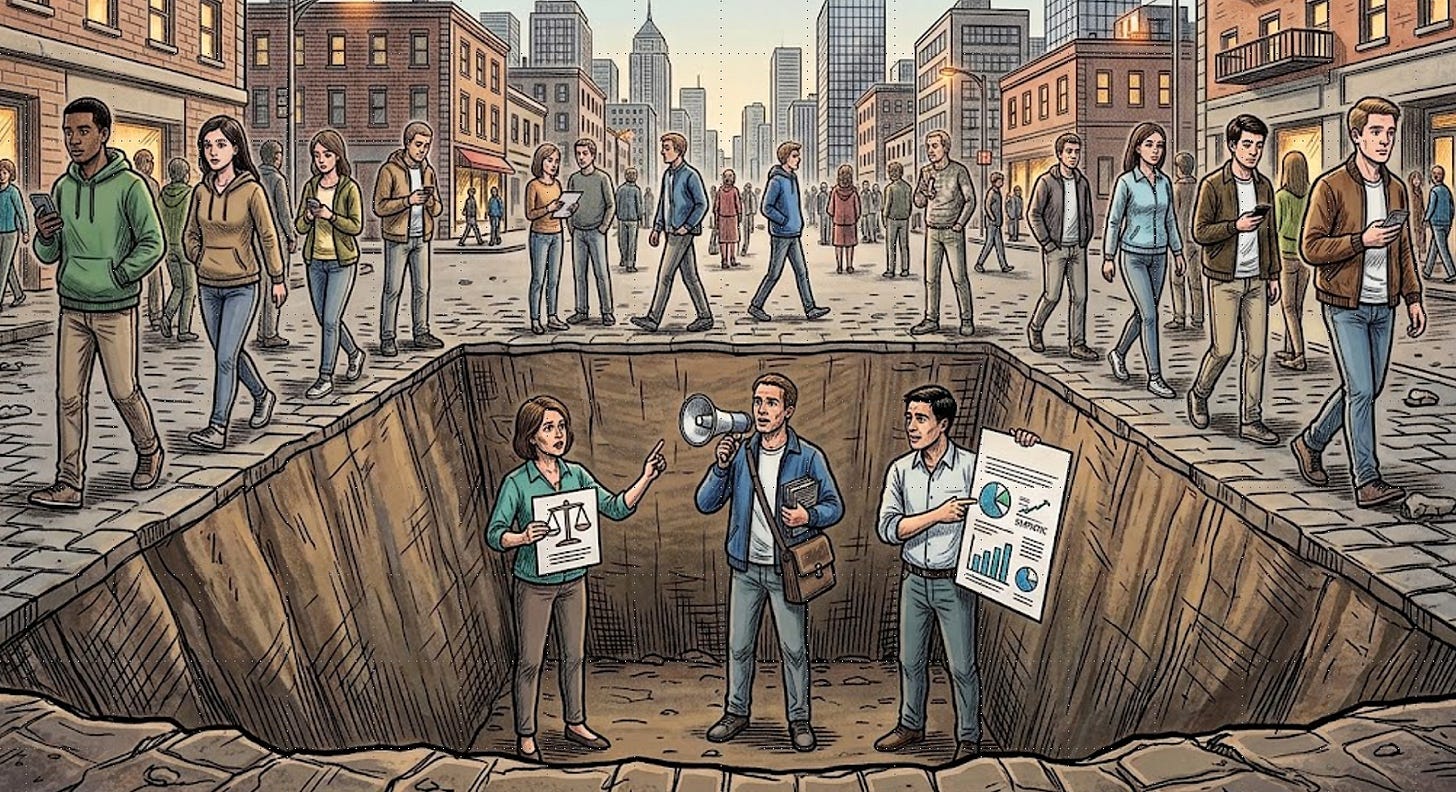
The vegan trap - created by Gemini AI
We need more non-vegans
Often, vegans’ attitudes toward vegans and non-vegans come down to something like this: a vegan can do nothing wrong; a non-vegan can do nothing right. We don’t criticize the vegan who never leaves his house and doesn’t do any influencing. We do criticize a non-vegan advocate for animals.
Vegans are one percent of the population. It will be difficult, if not impossible, to change things for animals with this small group alone. Fortunately, there are many more people who can theoretically help animals - including farmed animals - than there are vegans. There are many more people who are in favour of the closing of slaughterhouses than there are vegans. There are many people who are not vegan but have money to help animals. Take Dustin Moskovitz, a co-founder of Facebook. With his fund, Coefficient Giving, he’s the biggest funder of animal welfare in the world. But he’s not vegan.
This is not all. Non-vegans may be better advocates sometimes. They’re less limited by our rules - they’re not in the vegan trap. They can speak more freely. We are often beholden to our orthodoxy and cannot always bring the best and most suitable message. They are often less threatening and more relatable, so they might be better messengers for animals.
A simple point about communication: it consists of what is said, how it is said, and who says it. Who is the messenger? Who is talking to whom? We know from research, at least from this one study, that messages by non-vegans about the same thing are perceived as less threatening than messages by vegans. Non-vegans can be better spokespeople for our cause, sometimes.
Here’s an example. Days Without Meat (Dagen Zonder Vlees) was an extremely successful vegetarian campaign in Belgium, asking people to go vegetarian or reduce meat consumption during the period of Lent (the 40 days before Easter). At some point over 100,000 people actively participated, in a small country like Belgium, and everyone knew about it. This campaign was organized by a female student who was not vegan or even vegetarian. But I think the effect was that the people who participated didn’t have the impression that there was some vegan from on high telling others what to do. Instead, the audience was in the same boat as the campaigners, meaning they felt a lot less judged. (Note: in a newspaper interview, this young woman said she never said no to a good chicken curry. The fact that I cursed inwardly when I read that, shows that I, too, am in the vegan trap).
Enlisting non-vegans’ help for animals
How do we reach these non-vegans and get them to help animals? We need to do at least three things.
- We need to attract them. Show them that they are capable of helping, even if they’re not vegan. One example comes from Aaron Boddy, from Ambitious Impact. He is very committed to animals, but posted this on his LinkedIn: “I ran an animal charity and I eat dairy.” Some people objected, but I think it’s definitely worth trying to avoid people thinking that they can’t participate because they’re not vegan.
- We need to allow them to be among us. Here is a little thought experiment. Imagine a vegan pride parade. Who is welcome to be there? Are non-vegans welcome? I don’t think that at the moment they are as welcome as straight people are at a Pride parade, but they definitely should be.
- We need to keep them, and with this, I think I mean: “keep them non-vegan”. Often when some vegans will make the case for including non-vegans, they’ll say that these people will turn vegan anyway by being among us. That may be true in many cases, but I’m not sure if it’s actually the best outcome. Maybe some non-vegans should STAY non-vegan - at least for quite some time - to help increase the heterogeneity of our group, so that we can attract more people still. If every non-vegan joining goes vegan tomorrow, we won’t have increased our recruiting power.
All of the above are things for your consideration, and I’m 100% sure of exactly none of it. These are ideas that go against the vegan grain, but I believe as people who take up the plight of beings who can’t fight for themselves, that we keep asking hard questions - and still trust each other to have the best of intentions.
Hazo @ 2026-09-24T23:34 (+13)
"We cannot choose not to be vegan, even for a moment, even if it would be pragmatic to do so."
I genuinely don't mean to be glib, but have you tried? One can just choose to become non-vegan, so if one truly believed that non-vegans were better advocates and we need more of them, surely it should be something to consider.
tobiasleenaert @ 2026-09-25T05:44 (+3)
Of course in theory you're right, but i'm mostly talking about the vegan/animal rights community, and even aside from peer group pressure and the prospect of being ousted, this seems quite hard for many people among them, from what I can tell.
Hazo @ 2026-09-25T14:17 (+13)
Insofar as people are making decisions based on peer group pressure and the fear of being ousted, sounds like some leadership / courage is needed!